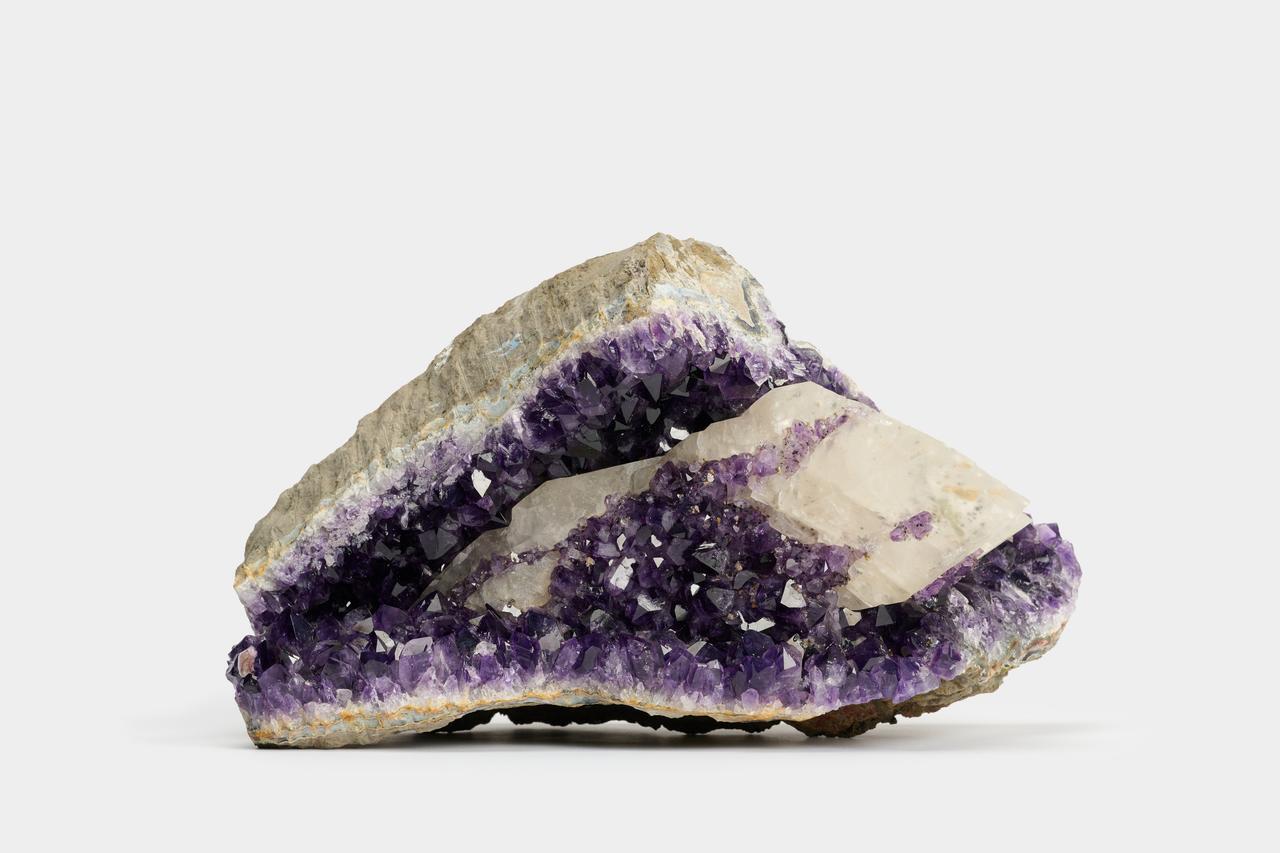
Important collection of minerals from the 90s pt2 Mineral Collection- 5600 g - (25)


04
days
20
hours
16
minutes
38
seconds

 | €120 | |
|---|---|---|
 | €110 | |
| €100 | |
Catawiki Buyer Protection
Your payment’s safe with us until you receive your object.View details
Trustpilot 4.4 | 143856 reviews
Rated Excellent on Trustpilot.
Important mineral collection of 25 samples totaling 5.6 kg, featuring Italian and international specimens with notable pieces such as a fluorescent datolite–calcite association from Sasso di Castro and a green fluorite from Mandrosonoro.
AI-assisted summary
Description from the seller
Important mineral collection – 25 selected samples, 5.6 kg between great Italian classics and international rarities
This important mineral collection brings together 25 selected samples, for a total weight of 5.6 kg, equal to 5,600 grams.
The collection includes a significant variety of Italian and foreign minerals, with specimens from some of the most important localities in Italian mineralogy, alongside interesting international samples from South Africa, Namibia, Madagascar, Russia, Switzerland, Australia, Portugal, Spain, India and Peru.
Among the most significant pieces stand out a splendid association of datolite and large, strongly fluorescent calcite crystals from Sasso di Castro, a beautiful green fluorite from Mandrosonoro, a rare Peruvian tetrahedrite, and numerous samples from historic Italian localities.
A collection that blends aesthetics, mineral variety, fluorescence phenomena, pseudomorphism and important provenance.
The lot includes:
• Fluorescent datolite and calcite – Sasso di Castro, Firenzuola, Tuscany
One of the most important pieces of the entire selection. A splendid association of datolite and large calcite crystals, characterized by particularly intense fluorescence under ultraviolet light. A sample of notable aesthetic impact.
• Hematite and quartz – Cantiere di Valle Giove, Rio Marina, Elba Island, Tuscany
Classic Elba mineralogical association, from one of the island’s best-known mining sites. Interesting for the contrast between metallic hematite and quartz.
• Beta quartz – Castelluccio di Moscheda, Modena, Emilia-Romagna
Appennine specimen with the characteristic skeletal crystal habit commonly defined as beta. A Modenese mineralogy classic, linked to the ophiolitic contexts of the Apennines.
• Pyrite – San Clemente, Monterenzio, Bologna, Emilia-Romagna
Specimen from a historic Bologna locality, appreciated for pyrite crystallizations and strong collecting interest.
• Calcite and barite on septarian nodule – Gaiano, Collecchio, Parma, Emilia-Romagna
Interesting association of calcite and barite developed inside a septarian. A representative sample of the sedimentary mineralizations of the Parma area.
• Mammillated hematite – South Africa
Hematite specimen characterized by the typical mammillated morphology, with rounded and botryoidal surfaces. A growth form highly appreciated for its particular aesthetic appearance.
• Quartz – Ponte della Venturina, Bologna, Emilia-Romagna
Specimen from a Apennine locality known for its quartz, especially valued in Italian collecting.
• Gypsum – Gabicce Mare, Pesaro and Urbino, Marche
Classic gypsum specimen from the Adriatic area, interesting for crystallization and connection with evaporitic formations of the Apennines.
• Fluorite – Namibia
Fluorite specimen from Namibia, a country known for its numerous mineral localities. An interesting international presence to complete the collection’s variety.
• Quartz hopper-style – Porretta Terme, Bologna, Emilia-Romagna
Specimen characterized by a particular skeletal crystal growth, commonly defined as hopper. Interesting for morphology and Apennine provenance.
• Fluorite and hematite – Rio Marina, Elba Island, Tuscany
Interesting association of fluorite and hematite from the famous Elba iron district. A specimen of notable interest for the mineralogical combination and locality.
• Sulfur – Le Cetine di Cotorniano, Chiusdino, Siena, Tuscany
Classic native sulfur specimen from the historic Tuscan locality of Cetine, known for antimony-bearing mineralizations.
• Gypsum – Secchiano, Emilia-Romagna
Specimen from an Apennine locality known for gypsum mineralizations. Interesting for provenance and collecting value.
• Quartz with goethite pseudomorph on pyrite – Bruzolo, Turin, Piedmont
Interesting association where iron oxide products preserve the original pyrite crystal morphology. A representative example of pseudomorphism.
• Green fluorite – Mandrosonoro, Madagascar
One of the most interesting pieces in the entire collection. Stunning green fluorite from Mandrosonoro, known for its cube crystallizations and intense green tones, sometimes with bluish optical effects.
A provenance highly appreciated by international collectors.
• Rhodochrosite – Russia
Rhodochrosite specimen, manganese carbonate known for its pink to reddish hues. A species particularly appreciated for color and mineralogical interest.
• Ciniane – Ticino, Switzerland
Alpine ciniane specimen, aluminum silicate typical of metamorphic environments. Interesting for Swiss provenance and systematic value.
• Arsenic – Australia
Australian specimen labeled as arsenic, interesting for the presence of this relatively uncommon species in mineral collections. Requires careful preservation, avoiding abrasion, breakage, and dispersion of powders.
• Staurolite – Portugal
Staurolite specimen from Portugal, silicate typical of metamorphic rocks. A mineral particularly interesting for its crystallographic characteristics and systematic value.
• Quartz – Selvino, Bergamo, Lombardy
Quartz specimen from a Lombardy locality known in Italian mineral collecting. Interesting for provenance and crystallization.
• Pyrite – Livorno, Tuscany
Pyrite specimen from the Livorno area. A representative example of one of the most well-known and valued metallic sulfides in the mineral world.
• Calcite – Tuscany
Tuscan calcite specimen, interesting for crystallization and provenance. A classic presence that enriches the carbonate diversity within the selection.
• Fluorite – Berbes, Asturias, Spain
Classic specimen from one of Europe’s most famous fluorite localities. Berbes is particularly valued for crystal quality and the collecting value of its specimens.
• Stilbite – Pune District, Maharashtra, India
Indian stilbite specimen, a zeolite mineral. The Pune district is internationally known for its important mineralizations in basalt rock cavities.
• Tetrahedrite – Lima, Peru
One of the collection’s mineral rarities. Tetrahedrite specimen from Peru, belonging to the sulfarsenide group. A species of notable systematic interest, particularly appreciated by specialists in metalliferous mineralizations.
⸻
This important mineral collection comprises 25 samples for a total weight of 5,600 grams, from numerous Italian and foreign localities.
The selection stands out for the variety of species and for the presence of particularly interesting specimens, including the datolite with large, strongly fluorescent calcite crystals, Mandrosonoro green fluorite, Peruvian tetrahedrite, and the Elba Island mineral associations.
An ensemble that allows appreciation of different mineralogical phenomena, from pseudomorphs to hopper crystallizations, up to fluorescence under ultraviolet light.
The presence of numerous samples from classic Apennine and Alpine localities and from major Italian mining districts makes this collection particularly interesting for Italian mineral enthusiasts, without compromising the charm of major international localities.
Kire Minerals is proud to offer this important mineral selection, personally curated by Erik Lombini with the usual passion and expertise. Each specimen has been evaluated for aesthetic, scientific, or collecting interest, with the aim of offering an authentic, varied collection representative of the extraordinary diversity of the mineral world.
Kire Minerals – your collection, with passion.
Details
Number of objects
25
Main mineral
Important collection of minerals from the 90s pt2
Mineral form
Mineral Collection
Weight
5600 g
Country of origin
Italy
Sold by