Ngil - Fang - Gabon


03
days
07
hours
03
minutes
32
seconds
Current bid
€ 50
Reserve price not met

Expert
Selected by Dimitri André
Holds a postgraduate degree in African studies and 15 years experience in African art.
Estimate € 150 - € 200
 | €50 |
|---|
Catawiki Buyer Protection
Your payment’s safe with us until you receive your object.View details
Trustpilot 4.4 | 143806 reviews
Rated Excellent on Trustpilot.
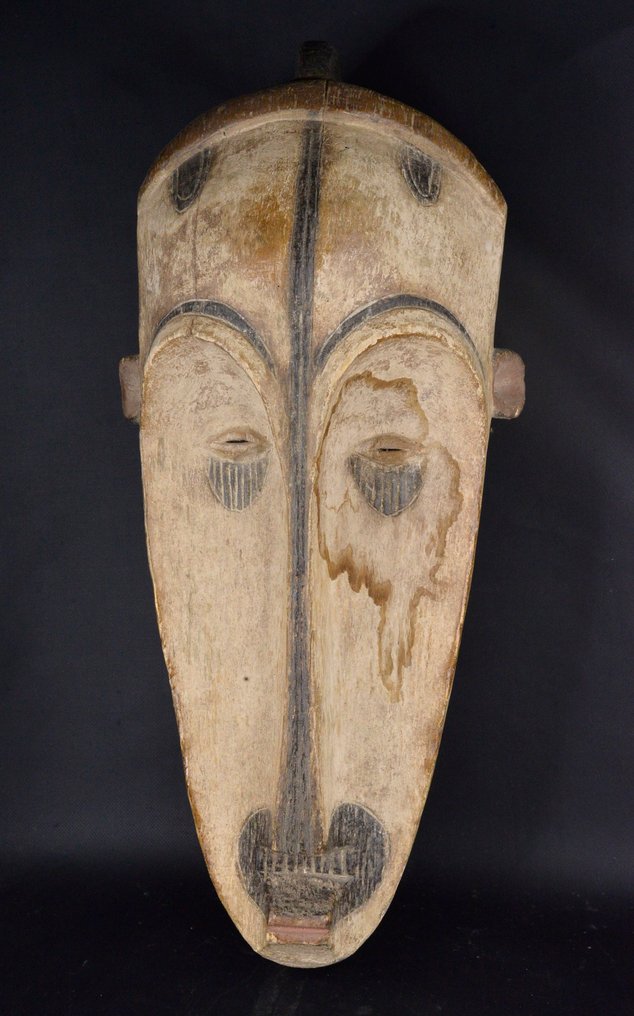
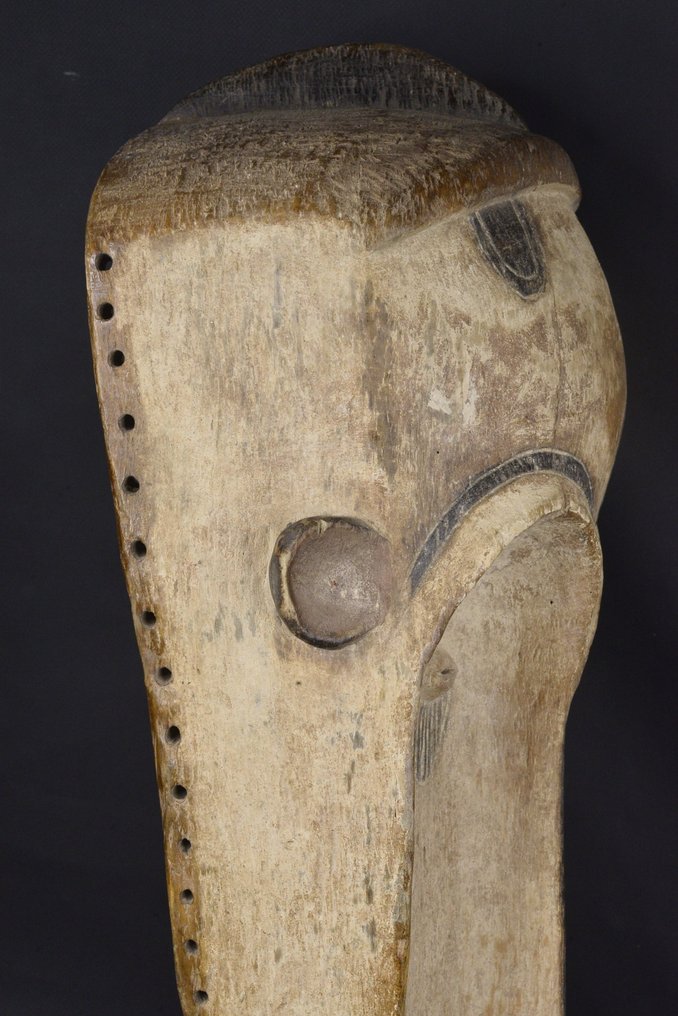
Fang Ngil wooden mask from Gabon, made of Bois, with a heart-shaped face, white kaolin patina, minimalist features, dimensions 620 mm high by 290 mm wide by 200 mm deep, authentic original.
AI-assisted summary
Description from the seller
Gabon
Fang
Wood
Height 620mm
Width: 290mm
Depth: 200mm
This superb carved wooden mask corresponds to the emblematic Fang mask style, an important ethnicity mainly present in Gabon, Equatorial Guinea and southern Cameroon.
1. Characteristics and Origin: The Ngil style
This mask presents the minimalist and refined aesthetics typical of the masks of the Ngil secret society (the Gorilla):
• The heart-shaped elongated face: The face stretches concavely into an elongated heart shape, a feature particular to Fang statuary that strongly influenced early 20th-century Western modern artists (such as Modigliani or Picasso).
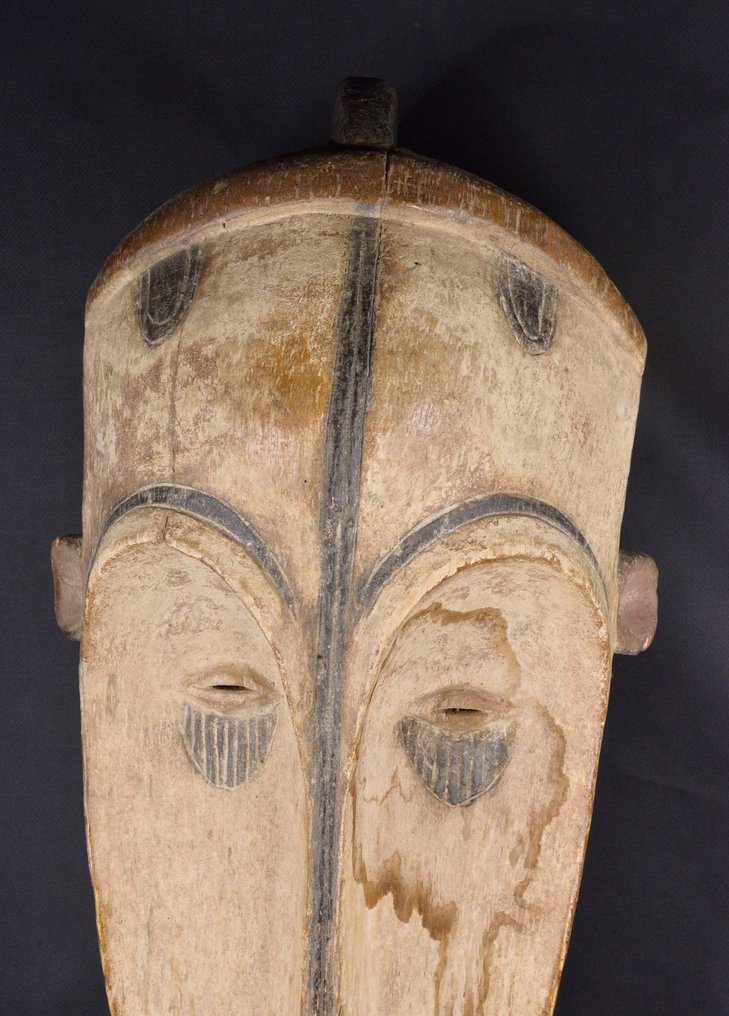
• The kaolin whiteness: The face is covered with a white patina based on kaolin. In Fang cosmogony, the color white is not chosen at random: it symbolizes light, purity, justice, but it also directly references the realm of ancestors and spirits (the dead having a white or pale appearance).
• The minimalist features: The eyes are reduced to fine slits (horizontal incisions), the nose is extremely long and straight, dividing the face symmetrically with a dark line, and the mouth is placed very low, reduced to its simplest expression. Dark scarification patterns (often in the form of lines or chevrons) emphasize the forehead, eyes and cheeks.
2. Usage and social function
Historically, this mask played a crucial judicial and social-regulatory role within Fang communities, before the Ngil society was banned by French colonial authorities in the early 20th century (around 1910) due to its power being deemed too great.
• The pursuit of sorcerers and criminals: The Ngil secret society watched over public order. The mask bearer usually appeared at nightfall, escorted by initiates. Its main function was to unmask sorcerers (beyem), poisoners, thieves, or individuals who had committed serious crimes within the village.
• A supreme judicial authority: Because of its spectral, imposing, and mystical appearance, the mask embodied an indisputable sentence. The whiteness recalling the deceased conferred upon the bearer the absolute authority of the ancestors. Guilt-ridden individuals faced severe penalties, ranging from heavy fines to death.
• Purifying effect: Beyond repression, the visit of the Ngil mask allowed spiritual cleansing of the village from negative forces and the restoration of social and religious harmony.
Fast and protected shipping. Packages are sent with insurance and a tracking number.
Delivery by Chronopost within 1 to 3 days in France, 2 to 5 days in the European Union. Delivery in the rest of Europe, worldwide and in the islands with Colissimo International.
We speak english.
mask african art Afrikanische Maskenkunst arte de máscaras africanas arte delle maschere africane
statue african art Arte de estatuas africanas arte delle statue africane Afrikanische Maskenkunst
Seller's Story
Passionate about World Arts and more specifically about African Art, we buy from collectors, former officials, military, health workers, public works staff who have worked in Africa and also in Côte d'Ivoire, from antique dealers and traders who roam across West Africa to find quality objects.
It is with pride that we present works that, beyond their power to beautify spaces, invite our collectors to resonate with the richness and depth of human expression through the most authentic art.
At Arts Ethniques Gallery, we have the privilege of offering our visitors an exclusive selection of artworks, all unique and original. Each piece presented is the outcome of a demanding artistic approach, driven by a singular vision and mastered craftsmanship, all elements that guarantee authenticity and value.
The works we offer are not industrial reproductions. They are individual creations, crafted with sensitivity and precision, each bearing its own story, identity and presence. Originality is the very foundation of our commitment to excellence. Thus, every mask and every statue in our collection is the subject of a rigorous selection, in order to preserve their rarity and singularity.
Acquiring a work from Arts Ethniques Gallery means owning a truly unique piece: a creation that embodies both talent, cultural memory and the expressive force of African art. It is also a lasting investment in a work whose artistic and emotional value transcends time.
We guarantee that every work leaving our gallery is an authentic piece, without replicas, bearing witness to the creativity, heritage and passion of the African artists who shaped them.
We invite you to participate in our gallery’s auctions with confidence. Each presented work is an original, unique and irreplaceable creation, selected with the greatest rigor to guarantee its authenticity and artistic value.
Whether you wish to enrich a personal collection or introduce an exceptional artwork into your space, Arts Ethniques Gallery offers a safe, transparent and professional setting to acquire remarkable pieces.
Art auctions are a privileged moment to discover rare works, capable of becoming the heart of a collection. Acquiring a work at our sales is not just buying an object: it is investing in a creation whose aesthetic value and cultural reach reinforce over time.
The pieces presented by Arts Ethniques Gallery testify not only to the talent and vision of the artists but also possess the ability to transform spaces and enrich the gaze of those who behold them.
Participating in our auctions is taking part in a singular experience, where the passion for art meets the rigors of collecting. Bidding on a work from Arts Ethniques Gallery goes beyond a simple transaction: it is a gesture of commitment and appreciation for art in its most authentic form.
We invite you to bid with passion and to join us in this adventure dedicated to discovery, transmission and celebration of art.
Perhaps your next heart piece is already waiting for you."
Translated by Google TranslateGabon
Fang
Wood
Height 620mm
Width: 290mm
Depth: 200mm
This superb carved wooden mask corresponds to the emblematic Fang mask style, an important ethnicity mainly present in Gabon, Equatorial Guinea and southern Cameroon.
1. Characteristics and Origin: The Ngil style
This mask presents the minimalist and refined aesthetics typical of the masks of the Ngil secret society (the Gorilla):
• The heart-shaped elongated face: The face stretches concavely into an elongated heart shape, a feature particular to Fang statuary that strongly influenced early 20th-century Western modern artists (such as Modigliani or Picasso).
• The kaolin whiteness: The face is covered with a white patina based on kaolin. In Fang cosmogony, the color white is not chosen at random: it symbolizes light, purity, justice, but it also directly references the realm of ancestors and spirits (the dead having a white or pale appearance).
• The minimalist features: The eyes are reduced to fine slits (horizontal incisions), the nose is extremely long and straight, dividing the face symmetrically with a dark line, and the mouth is placed very low, reduced to its simplest expression. Dark scarification patterns (often in the form of lines or chevrons) emphasize the forehead, eyes and cheeks.
2. Usage and social function
Historically, this mask played a crucial judicial and social-regulatory role within Fang communities, before the Ngil society was banned by French colonial authorities in the early 20th century (around 1910) due to its power being deemed too great.
• The pursuit of sorcerers and criminals: The Ngil secret society watched over public order. The mask bearer usually appeared at nightfall, escorted by initiates. Its main function was to unmask sorcerers (beyem), poisoners, thieves, or individuals who had committed serious crimes within the village.
• A supreme judicial authority: Because of its spectral, imposing, and mystical appearance, the mask embodied an indisputable sentence. The whiteness recalling the deceased conferred upon the bearer the absolute authority of the ancestors. Guilt-ridden individuals faced severe penalties, ranging from heavy fines to death.
• Purifying effect: Beyond repression, the visit of the Ngil mask allowed spiritual cleansing of the village from negative forces and the restoration of social and religious harmony.
Fast and protected shipping. Packages are sent with insurance and a tracking number.
Delivery by Chronopost within 1 to 3 days in France, 2 to 5 days in the European Union. Delivery in the rest of Europe, worldwide and in the islands with Colissimo International.
We speak english.
mask african art Afrikanische Maskenkunst arte de máscaras africanas arte delle maschere africane
statue african art Arte de estatuas africanas arte delle statue africane Afrikanische Maskenkunst
Seller's Story
Passionate about World Arts and more specifically about African Art, we buy from collectors, former officials, military, health workers, public works staff who have worked in Africa and also in Côte d'Ivoire, from antique dealers and traders who roam across West Africa to find quality objects.
It is with pride that we present works that, beyond their power to beautify spaces, invite our collectors to resonate with the richness and depth of human expression through the most authentic art.
At Arts Ethniques Gallery, we have the privilege of offering our visitors an exclusive selection of artworks, all unique and original. Each piece presented is the outcome of a demanding artistic approach, driven by a singular vision and mastered craftsmanship, all elements that guarantee authenticity and value.
The works we offer are not industrial reproductions. They are individual creations, crafted with sensitivity and precision, each bearing its own story, identity and presence. Originality is the very foundation of our commitment to excellence. Thus, every mask and every statue in our collection is the subject of a rigorous selection, in order to preserve their rarity and singularity.
Acquiring a work from Arts Ethniques Gallery means owning a truly unique piece: a creation that embodies both talent, cultural memory and the expressive force of African art. It is also a lasting investment in a work whose artistic and emotional value transcends time.
We guarantee that every work leaving our gallery is an authentic piece, without replicas, bearing witness to the creativity, heritage and passion of the African artists who shaped them.
We invite you to participate in our gallery’s auctions with confidence. Each presented work is an original, unique and irreplaceable creation, selected with the greatest rigor to guarantee its authenticity and artistic value.
Whether you wish to enrich a personal collection or introduce an exceptional artwork into your space, Arts Ethniques Gallery offers a safe, transparent and professional setting to acquire remarkable pieces.
Art auctions are a privileged moment to discover rare works, capable of becoming the heart of a collection. Acquiring a work at our sales is not just buying an object: it is investing in a creation whose aesthetic value and cultural reach reinforce over time.
The pieces presented by Arts Ethniques Gallery testify not only to the talent and vision of the artists but also possess the ability to transform spaces and enrich the gaze of those who behold them.
Participating in our auctions is taking part in a singular experience, where the passion for art meets the rigors of collecting. Bidding on a work from Arts Ethniques Gallery goes beyond a simple transaction: it is a gesture of commitment and appreciation for art in its most authentic form.
We invite you to bid with passion and to join us in this adventure dedicated to discovery, transmission and celebration of art.
Perhaps your next heart piece is already waiting for you."
Translated by Google TranslateDetails
Indigenous object name
Ngil
Ethnic group/ culture
Fang
Country of Origin
Gabon
Material
Wood
Sold with stand
No
Condition
Fair condition
Authenticity
Original/official
Sold by
