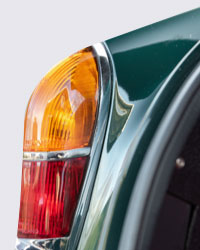
Renault - 5 L - 1973


Starting bid
€ 1
Add to your favourites to get an alert when the auction starts.

Catawiki Buyer Protection
Your payment’s safe with us until you receive your object.View details
Trustpilot 4.4 | 143634 reviews
Rated Excellent on Trustpilot.
Description from the seller
Renault 5 L 1973
• Restored in the past
• Beautiful bright color "Rouge"
• Interior in neat condition
• Revised 845 cc four-cylinder "Billancourt" engine and a manual five-speed gearbox
• Vehicle tax and APK exemption in the Netherlands
HISTORY
The now iconic Renault 5, world-famous as the successor to the Renault 5 and recently even put back into production! This points to the popularity of the retro look of this car. This example was brought to us from Italy in 2026. In 1973 this Renault 5 L was newly delivered by the Renault dealer in Pezze di Greco, Italy. The original dealer sticker is still present on the rear window!
Production of the 5 began in 1972, so this is an early-produced specimen. There are many reasons to choose an antique car, but seldom does a car involve its gear lever. Yet that is exactly what the last owner from Milan was looking for: an R5 L, because as a enthusiast of the R4 (he owns a TL from 1971 and a Safari from 1977) he specifically wanted the version with the characteristic “umbrella” gear stick. In 2014 he bought this example and had it transported by transporter from Brindisi to Milan, and then restored it.
The restoration was difficult due to the lack of parts: in Italy R5s have almost disappeared. The odometer stood at 34,800 km three years ago, and almost 10,000 km have since been added. In 2017 this specimen was extensively described in an Italian classic car magazine. Because of its age over 50 years, the Renault is exempt from road tax and the APK in the Netherlands.
EXTERIOR
The red paint with color code F733 has a nice shine, but also some imperfections. It concerns an older restoration. Looking at the car, one notices more and more distinctive and beautiful details. Think of the sporty grilles next to the rear window, the door handlesless doors, the air intake on the hood, and the side indicator lights in the Renault logo shaped like a window. The chrome work has patina and the rubber seals are in good, renewed condition.
The 13" wheels are equipped with neat chrome hubcaps. The lighting and glass are also in good condition without cracks. The gray plastic bumpers are likewise in good condition. The tires still have sufficient tread.
INTERIOR
It was the R5 that caused a turning point in automotive history. In comparison with the Fiat 127, in its early years it already had an extra asset: it was a three-door, while many competitors still had no tailgate. Together with the R4, the R5 initially also shared the position of the gear lever high on the dashboard. The only side opening is very long and makes entry relatively easy.
What stands out especially is the exceptional comfort for such a small car: the suspension has an almost spectacularly large travel, the engine is unobtrusive, and the seats are soft. People used to call it “French suspension.” The interior is in neat, restored condition. The upholstery was re-woven based on an original sample, while the door panels were simply thoroughly cleaned.
The side panels are also upholstered with synthetic leather. The headliner is a work of art in itself. Floor mats are present throughout the interior. The interior is in good condition with normal signs of use. The side panels and the dashboard are also in good condition without damage or worn spots. The trunk space is tidy.
TECHNICAL
The R5 is equipped with a small Billancourt 782 cc four-cylinder gasoline engine, delivering about 34 hp and driving the front wheels via a manual five-speed gearbox, which was quite modern for a small car at the time. This engine comes from the older Renault engine family, named after the factory in Billancourt (near Paris) where it was developed. The engine is transversely placed at the front, with the gearbox next to it, keeping the car compact while offering relatively generous interior space.
The suspension consists of independent front axle with torsion bars and a trailing torsion bar rear axle, which provides surprisingly comfortable handling despite the simple technology. Brakes are drum brakes, and the steering is fully mechanical without power assistance, making the car light but direct at low speeds. Due to the simple mechanics, the low weight and robust construction, the R5 L is known for being easy to maintain and relatively easy to repair, which at the time made it a popular city car and today a beloved classic among enthusiasts of pure, analog technology.
The car was used without problems on a long trip in June 2026 and runs, brakes, and shifts well. The engine bay looks clean and well-kept and provides space for the spare wheel. The engine was fully rebuilt around 2015 by a specialist in R4 engines, and radiators, exhaust, brakes, suspension, and steering gear were also renewed. The clutch and gearbox are pleasant to use, with very smooth operation, while the steering is light.
GENERAL
The 1973 Renault 5 L is an early version of the first generation Renault 5, a compact hatchback that was introduced in 1972 as a modern and economical alternative to Renault’s older small models. It followed the Renault 4 indirectly as a more contemporary city car, but the Renault 4 remained for many years alongside the R5 as a tougher and simpler utilitarian model.
The R5 L itself was the base version with the small 782 cc engine, intended for affordable transport in a period when efficiency became increasingly important due to the oil crisis. As the successor to the first generation R5, in 1984 the second generation Renault 5 (often called “Supercinq”) appeared, which became more modern in design, comfort and safety and eventually was succeeded by the Renault Clio in 1990. Interestingly, the R5 also became popular for its practical third or fifth door and clever use of space in a very compact exterior, and the simple L version today is exactly loved by classic car enthusiasts for its pure, minimalist character without superfluous luxury.
Seller's Story
For several years we have been active in the sale of vintage, classic and modern sports cars throughout the Netherlands, Europe and the rest of the world. We offer a wonderful variety of collector and driver cars that you can enjoy for years to come. You can find this online at Carrosso. com or by visiting our showroom in Oldemarkt, an hour's drive from Amsterdam.
We have a wide variety of classic sports cars, if you are interested in the specific details of a particular car, feel free to give us a call. We are open to negotiating transactions, we can store cars, and we have an effective and reliable way to sell your cars through our purchase or consignment sales program. So, if you have a (classic) sports car for sale, contact us and we can give you the price your car deserves!
Details
Brand
Renault
Model type
5 L
Year
1973
Located in
Netherlands
Mileage reading
44535 km
Registration papers
with Italian registration
Transmission
Manual
Fuel
Petrol
Colour
Red
Horse power
37
Cubic capacity
845
Matching numbers
Unknown
Matching colours
Unknown
Service book/history
No
Valid MOT
No
CoC (Certificate of Conformity) present
No
Condition (Exterior)
Good: may require conventional body and paintwork. May require replacement of parts
Condition (Interior)
Very Good: clean, showing minimal wear. May require replacement of minor missing or broken parts
Condition (Frame and Underbody)
Good: frame/structure shows minor signs of surface rust, signs of usage/wear, may require some attention
Condition (Mechanical)
Very Good: mechanically sound, may require minor service
Condition (Overall)
Good condition: visible signs of wear and general ageing
Vehicle registration
We can help buyers register their vehicle through our trusted external partner. The process is straightforward and can be completed after purchase. Vehicle registration remains the buyer's responsibility.
Sold by
Disclaimer
Catawiki always aims to offer you the best possible buying experience. Our experts virtually review and select every vehicle in line with our submission guidelines and we require our sellers to provide the most accurate description of the vehicle. However, providing a fully detailed analysis of the vehicle is extremely difficult, and close to impossible. To guide you, we ask our sellers to provide information about the vehicle’s condition. Please consider that most vehicles for sale are classic vehicles and they often already have a whole life behind them, meaning that even a condition 1 or 2 vehicle might need maintenance to be ready for the road. It is advised to carefully read our submission guidelines that further describe details about the condition grades and types to manage your expectations. Cars are sold “as is”, meaning as described and in the condition they are in at the time of the sale and without any representation, warranty or assumption of liability of any kind as to the condition by Catawiki or by the seller. The condition of this item is the opinion of the seller and may differ from yours, your local garage, or the dealer’s opinion. This does not automatically mean the car does not conform to its description. Before bidding, please check your local legislation regarding vehicle registration. Neither the seller nor Catawiki is responsible for the registration of the vehicle in your country and will not accept a cancellation for your failure to register the vehicle. We also recommend that, if possible, you arrange a viewing with the seller before placing a bid.
Catawiki always aims to offer you the best possible buying experience. Our experts virtually review and select every vehicle in line with our submission guidelines and we require our sellers to provide the most accurate description of the vehicle. However, providing a fully detailed analysis of the vehicle is extremely difficult, and close to impossible. To guide you, we ask our sellers to provide information about the vehicle’s condition. Please consider that most vehicles for sale are classic vehicles and they often already have a whole life behind them, meaning that even a condition 1 or 2 vehicle might need maintenance to be ready for the road. It is advised to carefully read our submission guidelines that further describe details about the condition grades and types to manage your expectations. Cars are sold “as is”, meaning as described and in the condition they are in at the time of the sale and without any representation, warranty or assumption of liability of any kind as to the condition by Catawiki or by the seller. The condition of this item is the opinion of the seller and may differ from yours, your local garage, or the dealer’s opinion. This does not automatically mean the car does not conform to its description. Before bidding, please check your local legislation regarding vehicle registration. Neither the seller nor Catawiki is responsible for the registration of the vehicle in your country and will not accept a cancellation for your failure to register the vehicle. We also recommend that, if possible, you arrange a viewing with the seller before placing a bid.