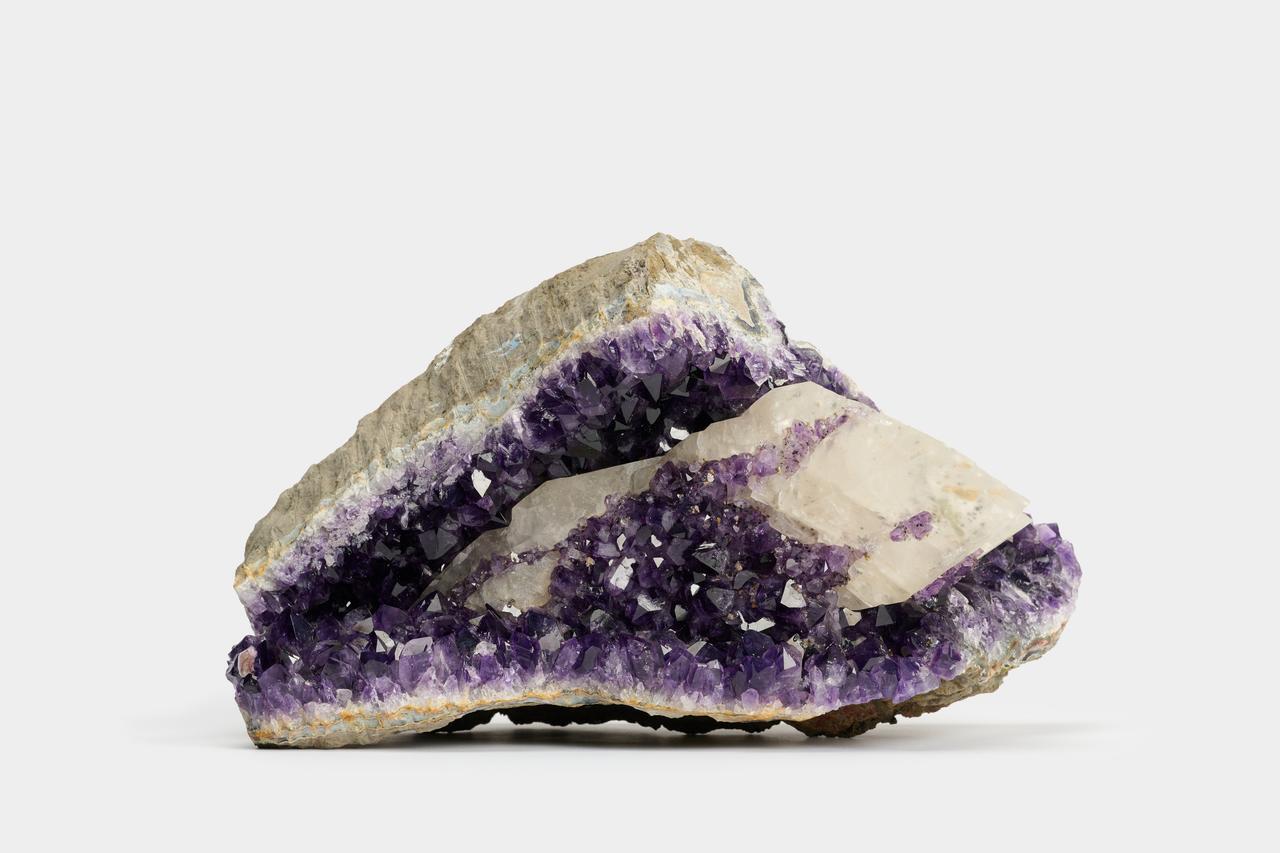
Black Agate Geode – Natural Quartz Crystal Druzy Sparkling Crystal Cavity on Display - Height: 190 mm - Width: 60 mm- 424 g


05
days
03
hours
27
minutes
29
seconds

 | €2 |
|---|
Catawiki Buyer Protection
Your payment’s safe with us until you receive your object.View details
Trustpilot 4.4 | 143856 reviews
Rated Excellent on Trustpilot.
This object will sell during a livestream so make sure you’re watching!
Brazilian black agate geode with quartz crystal druze, an elongated irregular specimen mounted on a black metal stand, with a hollow cavity lined by quartz crystals; weight 424 g, dimensions 190 × 60 × 60 mm.
AI-assisted summary
Description from the seller
Black Agate Geode and Quartz Druse – Brazil
Natural geode from Brazil, longitudinally cut to reveal an internal cavity lined with a dense crystallization of quartz. The specimen has an elongated, irregular shape, with an external profile that preserves part of the rock’s original surface and an internal structure characterized by a marked contrast between the black agate and the brightness of the crystals.
The section allows observation of a succession of thin concentric bands of chalcedony, predominantly dark gray to black, faithfully following the contour of the cavity. Some bands are almost imperceptible, others more defined, with silvery-gray lines standing out against the dark background. This stratification is one of agate’s most interesting features: the progressive deposition of silica inside a previously empty space.
The central cavity, narrow at the top and progressively wider toward the bottom, is lined with numerous small quartz crystals arranged in tight aggregates. The crystal terminations reflect light with different intensities, creating a sparkling surface that contrasts with the dense, opaque bands of the surrounding agate.
The crystallization shows hues from transparent white to smoky gray, with darker zones in the upper part, where the cavity depth and the color of the underlying material enhance the shadow effect. In the lower part, instead, the crystals appear lighter and more luminous, forming a particularly dense druse.
On the right side one observes a chalcedony formation protruding inward, surrounded by curved and concentric bands. This detail interrupts the cavity’s regularity and shows how silica deposition did not occur uniformly. The geode’s geometry is the result of the interaction between the original space’s shape, the flow of mineralizing solutions, and the subsequent growth phases of the minerals.
Brazilian agate geodes are frequently associated with the ancient basaltic volcanic rocks of southern Brazil, where cavities formed during lava cooling later hosted silica deposition. In these environments chalcedony can form concentric coatings along the walls, while quartz develops crystals facing the remaining central space.
In this specimen the difference between the two forms of silica is particularly evident: on the outside one observes the compact, finely stratified bands of agate, while inside the material takes on a three-dimensional crystalline structure, with numerous clearly distinguishable terminations.
The section is mounted vertically on a black metal support, which enhances its slender profile and allows frontal viewing of the entire cavity. The irregular outer edge preserves the geode’s natural character, while the cut surface allows appreciation of the band arrangement and the depth of crystallization.
An interesting sample both mineralogically, for the succession between chalcedony and crystallized quartz, and as a display object, thanks to the combination of an elongated form, dark tones, and a luminous druse.
Details
Main mineral
Black Agate Geode – Natural Quartz Crystal Druzy
Mineral form
Sparkling Crystal Cavity on Display
Weight
424 g
Country of origin
Brazil
Height
190 mm
Width
60 mm
Depth
60 mm
Sold by
Giveaway Disclaimer
Giveaways may be organised as part of Catawiki Live. Participation in a giveaway is subject to the Giveaway Policy. By bidding on an object, you acknowledge that you may automatically be entered into a giveaway, where applicable.
Each giveaway may have different entry requirements and rules. The seller will announce these during the livestream. Make sure you understand the rules before taking part.