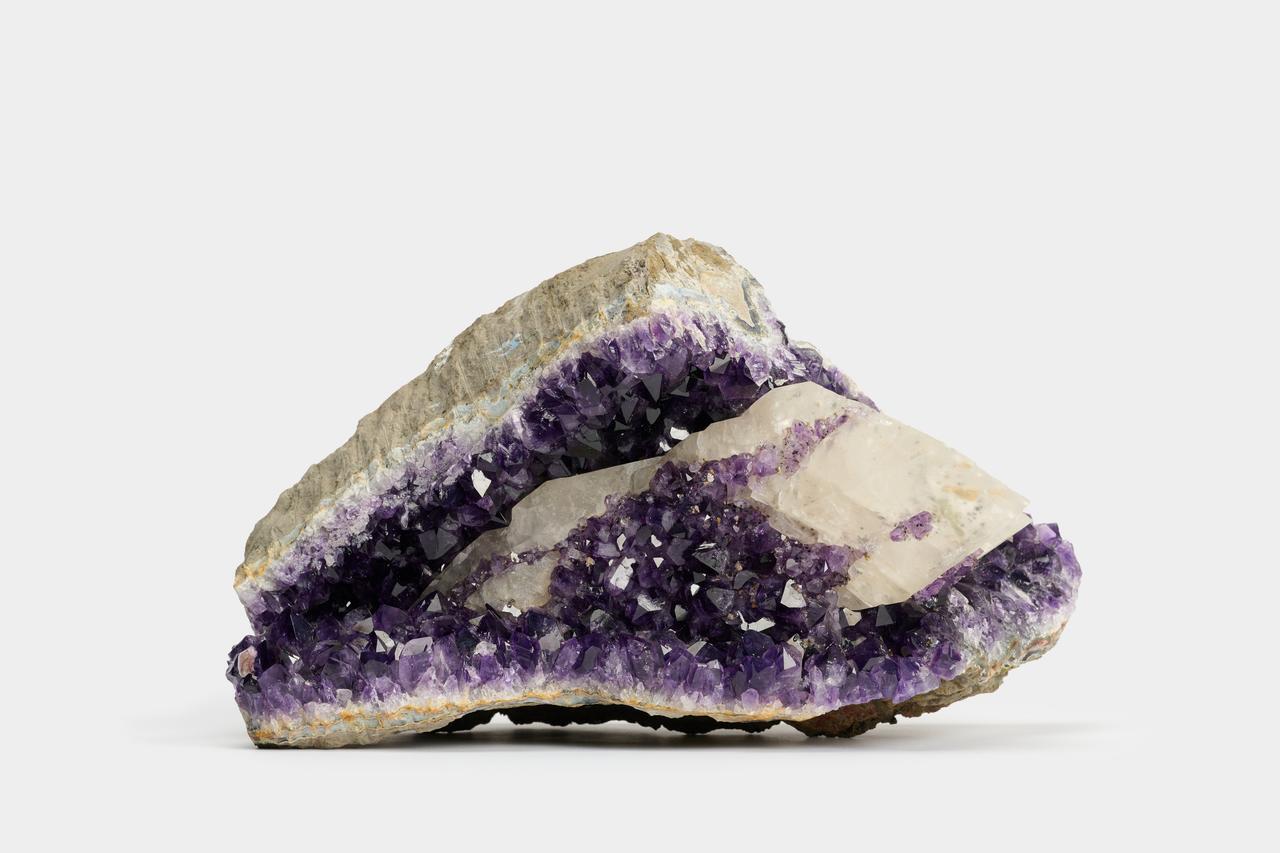
Aragonite – Natural Hexagonal Crystal Aggregates - Height: 81 mm - Width: 70 mm- 374 g


01
day
00
hours
35
minutes
46
seconds

 | €1 |
|---|
Catawiki Buyer Protection
Your payment’s safe with us until you receive your object.View details
Trustpilot 4.4 | 144154 reviews
Rated Excellent on Trustpilot.
This object will sell during a livestream so make sure you’re watching!
Aragonite meteorite from Morocco, in the form of natural hexagonal crystal aggregates, weight 374 g, dimensions 81 × 70 × 62 mm.
AI-assisted summary
Description from the seller
Aragonite – Hexagonal Crystals from Morocco
Natural aragonite sample from Morocco, characterized by a particular association of crystalline aggregates coated with hundreds of small well-formed crystals, with a clear color distinction between ivory-white areas and reddish-brown zones.
The specimen presents an articulated structure, composed of rounded and irregular reliefs on which dense crystallization develops. The surfaces are entirely covered by small prismatic individuals, many of which show well-defined geometric terminations, with apparently hexagonal contours and shiny faces. The close arrangement of the crystals creates a compact, mosaic-like texture, particularly evident in close-up photographs.
Coloration is one of the most interesting aspects of the sample. Part of the surface is dominated by white, cream, and slightly translucent crystals, while a sector shows a concentration of crystals in shades of orange, brick red, and amber-brown. The transition between the two zones is not uniform and allows observation of different intensities of pigmentation even among adjacent crystals.
Aragonite is a mineral composed of calcium carbonate (CaCO₃), with the same chemical composition as calcite but a different crystal structure. While calcite crystallizes in the trigonal system, aragonite belongs to the orthorhombic system.
One of its most well-known crystallographic features is the ability to develop cyclic twinning, in which multiple crystallites associate to simulate hexagonal symmetry. This phenomenon, defined as pseudohexagonality, explains why many aragonite crystals show sections and terminations reminiscent of minerals in the hexagonal system, yet possess a different internal structure.
The reddish and orange hues present in Moroccan aragonites are frequently associated with pigmentation due to iron compounds, particularly oxides and oxyhydroxides. The presence and distribution of these substances can significantly modify the appearance of the crystals, producing different colorations within the same aggregate. In the case of this specimen, the exact nature of the pigment has not been analytically determined.
Genetically speaking, aragonite can form by precipitation from aqueous solutions rich in calcium carbonate, in sedimentary, hydrothermal, and rock-cavity environments. Its crystallization depends on several physico-chemical factors, including temperature, solution composition, and the presence of other dissolved ions.
The specimen allows observation of two distinctive aspects of this mineral species: the pseudo-hexagonal geometry of the small crystals and the contrast between almost colorless areas and zones intensely pigmented. Macro photographs also highlight individual terminations, variations in transparency, and the three-dimensional arrangement of crystallization.
Seller's Story
The Mineral Art Gallery offers minerals, fossils, shells and natural elements.
Born in Italy in 2017, today she collaborates with international galleries and collectors, she is a direct importer of large minerals and naturalistic collectible elements; deals with the processing to insert them inside the living space. A section of the gallery was dedicated to the Wunderkammer, "chamber of wonders or cabinet of curiosities" in which Mirabilia elements are presented: naturalia and italiania, a union between "the present is the past".
All lots are shipped via DHL Express and Fercam couriers, with insured parcel and tracking.
Translated by Google TranslateAragonite – Hexagonal Crystals from Morocco
Natural aragonite sample from Morocco, characterized by a particular association of crystalline aggregates coated with hundreds of small well-formed crystals, with a clear color distinction between ivory-white areas and reddish-brown zones.
The specimen presents an articulated structure, composed of rounded and irregular reliefs on which dense crystallization develops. The surfaces are entirely covered by small prismatic individuals, many of which show well-defined geometric terminations, with apparently hexagonal contours and shiny faces. The close arrangement of the crystals creates a compact, mosaic-like texture, particularly evident in close-up photographs.
Coloration is one of the most interesting aspects of the sample. Part of the surface is dominated by white, cream, and slightly translucent crystals, while a sector shows a concentration of crystals in shades of orange, brick red, and amber-brown. The transition between the two zones is not uniform and allows observation of different intensities of pigmentation even among adjacent crystals.
Aragonite is a mineral composed of calcium carbonate (CaCO₃), with the same chemical composition as calcite but a different crystal structure. While calcite crystallizes in the trigonal system, aragonite belongs to the orthorhombic system.
One of its most well-known crystallographic features is the ability to develop cyclic twinning, in which multiple crystallites associate to simulate hexagonal symmetry. This phenomenon, defined as pseudohexagonality, explains why many aragonite crystals show sections and terminations reminiscent of minerals in the hexagonal system, yet possess a different internal structure.
The reddish and orange hues present in Moroccan aragonites are frequently associated with pigmentation due to iron compounds, particularly oxides and oxyhydroxides. The presence and distribution of these substances can significantly modify the appearance of the crystals, producing different colorations within the same aggregate. In the case of this specimen, the exact nature of the pigment has not been analytically determined.
Genetically speaking, aragonite can form by precipitation from aqueous solutions rich in calcium carbonate, in sedimentary, hydrothermal, and rock-cavity environments. Its crystallization depends on several physico-chemical factors, including temperature, solution composition, and the presence of other dissolved ions.
The specimen allows observation of two distinctive aspects of this mineral species: the pseudo-hexagonal geometry of the small crystals and the contrast between almost colorless areas and zones intensely pigmented. Macro photographs also highlight individual terminations, variations in transparency, and the three-dimensional arrangement of crystallization.
Seller's Story
The Mineral Art Gallery offers minerals, fossils, shells and natural elements.
Born in Italy in 2017, today she collaborates with international galleries and collectors, she is a direct importer of large minerals and naturalistic collectible elements; deals with the processing to insert them inside the living space. A section of the gallery was dedicated to the Wunderkammer, "chamber of wonders or cabinet of curiosities" in which Mirabilia elements are presented: naturalia and italiania, a union between "the present is the past".
All lots are shipped via DHL Express and Fercam couriers, with insured parcel and tracking.
Translated by Google TranslateDetails
Mineral form
Aragonite – Natural Hexagonal Crystal Aggregates
Weight
374 g
Country of origin
Morocco
Height
81 mm
Width
70 mm
Depth
62 mm
Sold by
Giveaway Disclaimer
Giveaways may be organised as part of Catawiki Live. Participation in a giveaway is subject to the Giveaway Policy. By bidding on an object, you acknowledge that you may automatically be entered into a giveaway, where applicable.
Each giveaway may have different entry requirements and rules. The seller will announce these during the livestream. Make sure you understand the rules before taking part.