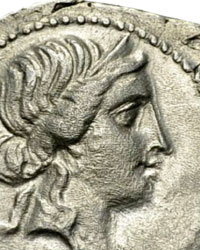
Greece (ancient) Lot van 4 Æ stuks (No reserve price)


00
days
05
hours
20
minutes
35
seconds

 | €16 | |
|---|---|---|
| €11 | |
| €7 | |
Catawiki Buyer Protection
Your payment’s safe with us until you receive your object.View details
Trustpilot 4.4 | 145304 reviews
Rated Excellent on Trustpilot.
This lot contains four uncertified ancient Greek coins, each bearing a countermark and showing patina.
AI-assisted summary
Description from the seller
4 ancient Greek coins with beautiful patina, each with its own history thanks to the countermark on it.
As accurately described and depicted as possible, but interesting enough to invite further research.
COIN OVERVIEW – ANCIENT GREEK COINS
COIN 1
• Civilization: Seleucid Empire (Syria/Asia Minor)
• Ruler: Antiochus I Soter (281–261 BC)
• Mint: Often Antioch or a mobile military mint in the region.
• Reference: This specific type, with the Nike reverse and anchor countermark, is listed in numismatic catalogs under references such as SNG Spaer 245 or variants in Houghton & Lorber (Seleucid Coins). The 4 mm thickness is characteristic of the thick bronze flans, cast and then struck, from this particular Hellenistic period.
COIN 2
• Object type: Classical Greek / Macedonian royal bronze coin (Æ Unit)
• Date: 4th century BC (ca. 323–297 BC, Hellenistic period)
• Region of origin: Kingdom of Macedon (mints such as Pella or Amphipolis)
• Attributed to: Cassander (317–297 BC) or Philip III Arrhidaeus (323–317 BC)
• Dimensions: Diameter of 20 mm and thickness of approx. 3 mm
• Material: Bronze with dark green to brown copper-corrosion patina
• Obverse countermark: A deep, round impression struck precisely on Heracles’ cheek.
• Reverse countermark: A clear, round stamp on the left (behind the horse), containing a geometric symbol or monogram.
COIN 3
• Object type: Greek royal bronze coin (Æ Unit / Chalkous)
• Issuer: Philip II of Macedon
• Date: Approx. 359–310 BC
• Size: Diameter of approx. 18 mm and thickness of 3 mm
• Mint: Various Macedonian mints (such as Pella or Amphipolis)
• Catalog reference: Comparable to SNG ANS 850–851 or HGC 3.1, 882
COIN 4
This is a classical Greek / Seleucid bronze Æ20 coin (Unit) from the Seleucid Empire, struck in the late 3rd or early 2nd century BC. It is a type struck under King Antiochus III the Great (reigned 222–187 BC) or shortly afterward.
Full Identification & Characteristics
• Object type: Greek royal bronze coin (Æ Unit)
• Issuer: Seleucid Empire (Syria / Mesopotamia)
• Date: Approx. 222–187 BC
• Size: Diameter of approx. 20 mm and a notable thickness of 4 mm
• Material: Bronze with a thick, characteristic reddish-brown and green copper-corrosion patina.
The Symbol: This type of coin is known for having been countermarked with an anchor (the dynastic symbol of the Seleucids). The countermark was struck directly on Heracles’ cheek/face. In the second photo, the central vertical axis and a slight curvature can be discerned in the recessed area.
TOTAL NUMBER OF COINS: 4
Details
Era
Before 1400
Culture/region
Greece (ancient)
Number of items
4
Denomination
Lot van 4 Æ stuks
Metal
AR
Condition
Ungraded