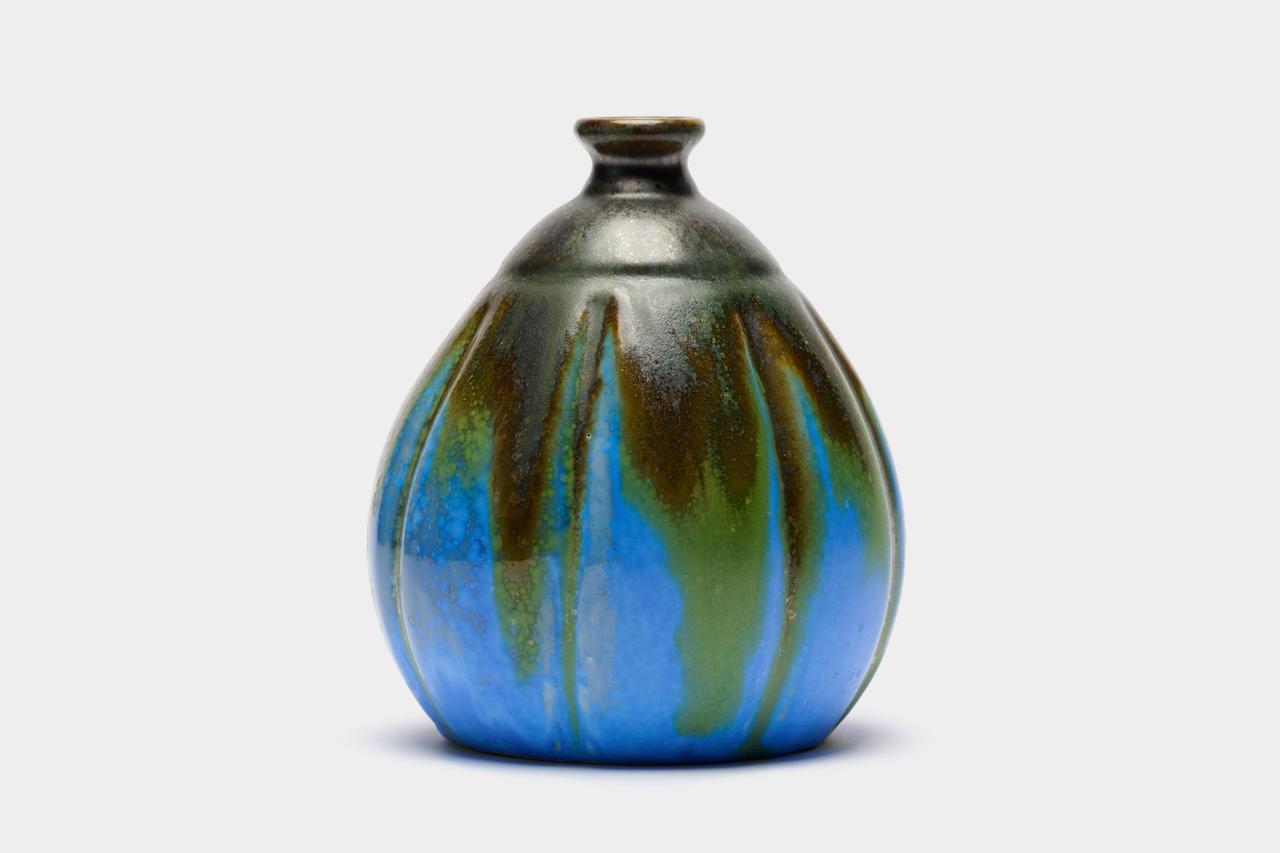
Vase - 40. 399 - Porcelain


04
days
05
hours
53
minutes
27
seconds

 | €1 |
|---|
Catawiki Buyer Protection
Your payment’s safe with us until you receive your object.View details
Trustpilot 4.4 | 144490 reviews
Rated Excellent on Trustpilot.
This Belgian Villeroy & Boch porcelain cabinet vase, model 399 and marked 40, has a fitted lid, multicoloured floral decoration and gilt details, and measures 41 cm high by 20 cm wide.
AI-assisted summary
Description from the seller
VILLEROY & BOCH – IMPOSING DESK-WARE VASE WITH LID, MODEL 399, BELGIUM
Manufacturer: Villeroy & Boch, according to the factory mark reading
Origin: Belgium, in accordance with the country of production designation
Dating: First half of the 20th century, probably around 1910–1930
Object type: Decorative desk vase with a matching lid
Model number: 399
Size indication: 40
Material: Glazed ceramic with multicolored decoration and gilded details
Decoration technique: Multicolored botanical decoration with gilding
Dimensions: Height about 40–41 cm; maximum belly diameter about 20 cm
Construction: Two parts: body and matching lid
Auction estimate: 350–550 EUR
1. Characteristics and typology of the object
A representative decorative vase with an imposing amphora-like silhouette, intended for display in an interior. The object consists of a body and a matching lid, topped with a decorative knurled finial. The elaborate form, multicolored floral composition, and gilded details give the vessel a distinctly decorative character.
The body features a broad, full belly, its profile gently narrowing toward the neck and the lower part of the vessel. The upper part transitions into a narrower opening, and symmetrically arranged handles emphasize the architecture of the form. The combination of the rounded belly with a narrower neck and lid creates a harmonious, vertically organized silhouette.
The vase is not merely a simple ceramic container. Its proportions, handles, lid, and surface decoration have been subordinated to a representational function. It is the type of object intended to be a standalone element of a drawing-room, study, or elegant living space.
The preservation of the lid is important for the visual completeness of the whole piece. The lid is an integral part of the composition, capping the form from above and completing the silhouette. In an auction assessment, however, one should distinguish the visual fitting of the two elements from documentary evidence of their original factory belonging to the same set.
2. Form, proportions and plastic treatment
The most important structural element is the spacious, rounded belly. Its smooth profile provides a wide surface for floral decoration, while also giving the vase a stable, full look. The transition from belly to neck is distinct but without sharp bends, ensuring the silhouette remains cohesive.
The neck is relatively narrow in relation to the widest part of the body. Two symmetrical, contoured handles are placed in this area. These elements enrich the volume, creating a visual bridge between the body and the lid. Their finish is in harmony with the gilded accents on other parts of the vase.
The lid has a convex, domed profile and is crowned with a decorative finial. Its shape naturally continues the upper part of the vase, and the gilded detail at the apex draws attention and completes the vertical composition. The fit between lid and body is important for aesthetics as well as for cataloguing the completeness of the set.
With a height of about 40–41 cm and a maximum belly diameter of about 20 cm, the vessel has the character of a large decorative object. It has a pronounced spatial presence, and its ornament remains legible even from some distance.
3. Ceramic material and glazed surface
The body is made of ceramic covered with a glaze of a creamy, bone-white shade. The light background provides a backdrop for the multicolored ornament and gilded details, allowing a strong contrast between the surface and decoration.
In the provided description the material is identified as terre de fer, also known in English as ironstone. These terms refer to certain hard ceramic types, but the creamy color of the body or the surface appearance alone are not sufficient to confirm the composition. Without technical documentation or specialized testing, it is safer to describe the material as glazed decorative ceramic.
The glaze forms a smooth, light ground on which plant motifs are arranged. The color variation and gilded accents ensure the surface is read as a decorative composition subordinate to the vessel’s shape.
A network of hairline glaze cracks, known as craquelure, is visible on the surface. This phenomenon may result from stresses between the glaze and ceramic body. Its presence should be noted in the condition description but cannot by itself prove age, producer, or authenticity.
4. Multicolored floral decoration
The most striking artistic feature of the vase is the floral and botanical decoration spread over the pale body. The composition includes large, stylized flowers and foliage, rendered in contrasting colors. The motifs are adapted to the rounded belly, ensuring the ornament emphasizes the vessel’s spatial character.
The color palette includes shades of red, carmine, purple, pink, ochre, turquoise, and green. Warm flower tones contrast with cooler botanical tones, creating a decoration with strong visual impact. The creamy background moderates the color contrasts and preserves legibility of the individual motifs.
Stylized flowers are the main focal point, while leaves and botanical elements complement the composition and guide the eye along the body. The ornament is not merely filler; it is an integral part of the design, working with the belly’s profile to emphasize its volume.
The decoration refers to European decorative-ceramics tradition, where botanical motifs were used in both utilitarian wares and items intended for representative interiors. In this case, the vase’s scale, rich color palette, and gilded finishes reinforce its cabinet-like character.
However, without workshop documentation, one should not attribute the decoration to a specific technique with complete certainty. It cannot be decided solely on appearance whether the pattern was transferred and then hand-painted, or if another combination of decorative techniques was used. Therefore, the proper catalog designation remains multicolored floral decoration on a glazed surface.
5. Gilding and finishing details
The gilded accents play an important role in the overall plastic treatment of the vase. They highlight selected edges and structural elements, including the areas of the handles, rims, and lid finial. The metallic sheen contrasts with the creamy ground and the vivid colors of the floral decoration.
The gilding visually organizes the form, emphasizing its most important points. On the lid it accentuates the finial; on the body it strengthens the division between different parts of the mass. Thus, the floral ornament and the metallic finish do not compete with each other but form a unified composition.
The appearance of gilding may depend on the preparation used, the method of application, the firing temperature, and later usage. Without material analysis, it is not possible to credibly determine its exact composition or confirm that 24-carat gold was used. In the auction description it is appropriate to use the terms “gilded details” or “gilding.”
When assessing the condition, consider the continuity of the gilding, possible wear, losses, and variations in sheen. This information can influence the final valuation because the decorative finish affects the visual impression of the entire object.
6. Factory marks and identification
On the bottom of the vessel there is a circular stamp, the numbers 399 and 40, and a manually incised mark resembling the letter T or F. According to the provided reading of the stamp, the visible fragment of the name includes the ending letters “EROY,” and the lower part of the designation contains a reference to Belgium, read as “BELGIQUE” or “MADE IN BELGIUM.”
The reading of the mark has been presented as the basis for attributing the vase to Villeroy & Boch. In the auction documentation, the reading of the visible fragments of the stamp should be distinguished from a full confirmation of the particular variant of the mark and the production facility. A fragment of the inscription can be a useful identifying clue, but full attribution requires the layout of the entire stamp to correspond to the documented producer’s mark.
The number 399 is the marking on the bottom of the vessel. It may serve as a model, form, or pattern number, but without a factory catalogue its original meaning cannot be definitively determined.
The marking 40 is a second numerical datum. It may refer to a form or size variant, but interpreting it as an official size designation requires manufacturer documentation. Therefore, dimensions should be provided independently, based on actual measurement.
The manually incised mark resembling a T or F may be a workshop mark. However, there are not enough grounds to assign it to a particular thrower, painter, or quality-control inspector without additional sources.
The combination of the stamp and numerical marks is an important part of the object’s documentation. The catalog entry should note them precisely, avoiding ascribing meanings to individual signs that are not confirmed by surviving source materials.
7. Historical context of the producer
The history of Villeroy & Boch is one of the most important chapters in European ceramic production. The Boch family’s activity began in 1748 when François Boch and his sons started producing ceramics in Lorraine. Nicolas Villeroy expanded ceramic activity from the late 18th century. In 1836, the two families’ firms merged to form Villeroy & Boch.
The company developed industrial production, refined ceramic technologies, and expanded its range with products for international markets. In the 19th century, innovations in materials and the development of methods reproducing decorations were important, enabling large-series production while maintaining a high level of surface finishing.
It should be noted that the history of Villeroy & Boch must be distinguished from the history of the Belgian Boch Frères Keramis manufactory in La Louvière. The Keramis plant was established in 1841 by Jean-François Boch and developed as a Belgian ceramics factory historically connected to the Boch family. This is a separate plant’s history and should not be automatically equated with the production site of every item bearing the Villeroy & Boch name.
In the 1920s and 1930s European ceramic design moved within several parallel currents, from decorative forms derived from Art Nouveau to more orderly Art Deco approaches. The manufacturer’s history confirms that in the 1920s and 1930s Art Deco and modernist attitudes toward form played a significant role in European production. This does not, by itself, prove an exact dating for this piece.
8. Stylistic analysis
The vase combines a classic amphora shape with rich plant decoration and gilded details. The form itself references the tradition of representative decorative vessels where symmetry, clearly defined belly, and a closed form with a lid were important.
The plant decoration recalls the aesthetics of the late 19th and early 20th centuries, when floral motifs occupied a prominent place in applied art. The organic shapes of flowers and leaves contrast with the vase’s orderly construction. In this way the ceramic surface gains dynamism while the form remains stable and symmetrical.
The intense color palette, with warm reds and purples contrasted with cool turquoise and the prominent gilding, gives the decoration a strong visual character. It is not a subtle ornament but a bold surface treatment intended to be clearly visible in a room.
With regard to the exact stylistic direction, caution is advised. Without confirmed dating, model catalogue, or decoration documentation, one cannot categorically label the vase as an exemplary instance of Art Nouveau or Art Deco. The most accurate description is European decorative ceramic with an amphora form, multicolored floral decoration, and gilded accents.
9. Condition and completeness
The vase retains the body and the matching lid, forming a complete closed composition. The lid with the finial is important for the item’s aesthetics because it completes the silhouette and crowns the project.
A glaze craquelure is visible on the surface. It should be noted in the documentation as a surface feature. It should not be automatically considered proof of centennial age or guaranteed authenticity.
Before listing the auction, it is advisable to check and describe any cracks in the body, chipped edges, losses of decoration, repairs, glue marks, and the degree of gilding preservation. If no such flaws are found, the description can be updated after direct inspection of the object. Without such an inspection one should not claim an absolutely perfect or completely original condition.
Due to the glazed surface and gilded details, handle the item with care. Do not use abrasive cleaners or aggressive chemicals that could damage the decoration. Do not assume the vessel is watertight, especially if the glaze is cracked.
10. Collectible and display value
The most important qualities of the object are its large scale, elaborate silhouette, multicolored floral decoration, gilded details, and preserved lid. The combination of these features allows the vase to function as a standalone decorative element without needing to be paired with other items.
The creamy background and the saturated colors of the ornament provide a striking visual impact. The gilding adds light-reflecting accents, particularly on the handle and lid profiles. For display, even lighting is important to read both the form and color of the decoration without excessive gloss on the glaze.
For a potential buyer, legibility of the bottom marks, alignment of the lid with the body, and detailed condition documentation will be relevant. Photos should show the full vase from the front and back, details of the decoration, the lid, handles, gilded areas, and a clear shot of the bottom with the stamp and numbers visible.
11. Auction estimate
Proposed estimate: 350–550 EUR.
This range accounts for the decorative character of the vase, its substantial size, multicolored floral decoration, gilded details, and the preserved lid. The producer confirmation and dating, glaze condition, decoration preservation, and any damage or repairs will also influence market appeal.
Attribution to Villeroy & Boch should be presented according to the stamp reading, with caution regarding the exact workshop and production date. Do not justify the valuation with unconfirmed claims about a limited edition, 24-carat gold, or rarity of the model.
Catalog summary
Large decorative ceramic vase with a matching lid, amphora form, creamy background, multicolored floral-plant decoration, and gilded details. On the bottom there is a circular stamp read as an indication of Villeroy & Boch with a Belgian reference, as well as the numbers 399 and 40 and a manually incised mark. The object represents European decorative ceramics from the first half of the 20th century and is distinguished by its imposing proportions, rich color, and preserved lid.
Auction estimate: 350–550 EUR.
Details
Era
1900-2000
Specific region of origin
VILLEROY & BOCH – OKAZAŁA WAZA GABINETOWA Z POKRYWĄ, MODEL 399, BELGIA
Country of origin
Belgium
Model
40. 399
Material
Porcelain
Condition
Excellent condition: barely used with minimal signs of wear
Height
41 cm
Width
20 cm
Depth
20 cm
Diameter
20 cm
Estimated period
1920-1930
Sold by