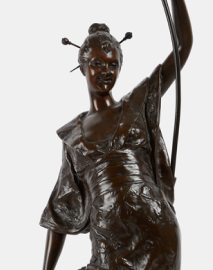
Statue, Icarus - 50 cm - Patinated bronze


05
days
06
hours
40
minutes
38
seconds
Starting bid
€ 1
Reserve price not met

No bids placed
Catawiki Buyer Protection
Your payment’s safe with us until you receive your object.View details
Trustpilot 4.4 | 144879 reviews
Rated Excellent on Trustpilot.
Description from the seller
Icarus, a stylish Art Deco sculpture of a winged athlete in the style of Otto Schmidt-Hofer, Germany.
The figure is mounted on a spherical marble base.
Bronze, made using the lost-wax process.
Lost-Wax Casting Process
The most detailed pieces are cast using the “lost-wax” process. This is the most precise metal-casting technique in existence, ensuring accurate reproductions of the original sculpture and exquisite detail. All bronze pieces are cast from a wax model, regardless of the material in which the original model was sculpted, usually clay or wax. The lost-wax casting method was discovered thousands of years ago.
In Greek mythology, Icarus (/ˈɪkərəs/; Ancient Greek: Ἴκαρος, romanized: Íkaros, pronounced [ǐːkaros]) was the son of the master craftsman Daedalus, the architect of the labyrinth of Crete. After Theseus, king of Athens and enemy of Minos, escaped from the labyrinth, King Minos suspected that Icarus and Daedalus had revealed the labyrinth's secrets and imprisoned them—either in a large tower overlooking the ocean or in the labyrinth itself, depending on the account.[1][2] Icarus and Daedalus escaped using wings that Daedalus constructed from feathers, threads from blankets and clothes, and beeswax.[3] Daedalus first warned Icarus against complacency and then against hubris, instructing him to fly neither too low nor too high, lest the sea's dampness clog his wings or the sun's heat melt them.[3] Icarus ignored Daedalus’s instructions not to fly too close to the sun, causing the beeswax in his wings to melt. Icarus fell from the sky, plunged into the sea, and drowned. The myth gave rise to the idiom “fly too close to the sun.”
We ship via UPS or DHL with tracking.
Details
Era
1900-2000
Bronze type
Patinated bronze
Country of origin
Europe
Material
Bronze
Title of artwork
Icarus
Signature
Not signed
Edition
Open
Condition
Excellent condition
Height
50 cm
Width
40 cm
Depth
30 cm
Sold by