Greece (ancient) Lot of 12 Æ coins 3rd - 1rd century BC (No reserve price)


05
days
10
hours
15
minutes
47
seconds

 | €5 | |
|---|---|---|
| €3 |
Catawiki Buyer Protection
Your payment’s safe with us until you receive your object.View details
Trustpilot 4.4 | 145414 reviews
Rated Excellent on Trustpilot.
A lot of 12 ancient Greek and Roman coins featuring varied designs.
AI-assisted summary
Description from the seller
12 Roman and Greek coins. As far as I can assess:
Coin 1:
weighs 4.7 grams.
Roman provincial bronze coin (AE) from the Koinon of Macedon (Koinon Makedonon), struck in the 3rd century AD (likely during the reign of Emperor Severus Alexander or Gordian III).
Reverse: It bears a multi-line Greek inscription with the words ΜΑΚΕΔΟΝΩΝ ΝΕΩΚΟΡΩΝ (Makedonōn Neōkorōn). The title Neokoros (temple guardian) was a prestigious status granted by the Roman emperor to important cities or provincial federations for their imperial temples.
• Obverse: Shows a standing figure (perhaps Alexander the Great in military attire or the goddess Athena) facing left, with one arm outstretched (often with a patera or small Nike) and the other hand resting on a spear or shield.
Coin 2
The city of Kyme (Cyme) in Aeolis (in present-day Turkey), struck in the period ca. 350–250 BCE. Weight 3.8 grams.
• Mint: Kyme (Aeolis).
• Dating: Circa 350–250 BCE.
• Metal: Bronze (AE).
• Obverse: The forepart of a rearing or galloping horse (forepart of a prancing horse) looking to the right.
• Reverse: A one-horned vase or cup (often identified as an oinochoe, kotyle or skyphos).
Coin 3
This type concerns an ancient coin of the Thessalian League (Koinon of Thessaly), struck between 196 and 146 BCE in the city of Larissa.
Period: 196–146 BCE (the period after the Thessalian cities were liberated by the Roman general Flamininus, before Rome annexed the area).
• Obverse: Laureate head of the god Apollo to the right.
• Reverse: Athena Itonia (the patron goddess of the Thessalian League, named after the sanctuary at Iton), who advances to the right or walks, or stands while throwing a spear/javelin and holding a shield on her arm. Weight 7.3 grams.
Coin 4:
Quadrans (a quarter of an As).
• Obverse: The bust of Hercules (Heracles) to the right, recognizable by the lion skin he wears on his head and around his neck. Above his head are three dots (pellets/globules). These dots are the denomination indicator and stand for 3 unciae (since 1 quadrans = 3 unciae).
• Reverse: The iconic prow of a Roman warship (ship’s prow) to the right. The inscription ROMA is often above or below, and there are also three denomination dots.
• Weight: 4.6 grams/
Coin 5:
Weight 1.1 grams.
A Classical Greek silver coin (a diobol or obol) from the city of Cyzicus (located in present-day Turkey, then the Mysia region), circa 450–400 BCE.
Obverse: The forepart of a wild boar looking to the left. To its right a small vertical tuna (the symbol of Cyzicus).
Reverse: The head of a roaring lion with an open mouth to the left, set in a recessed square (incuse square).
The silver coin is probably a trihemiobol. A standard silver obol from Cyzicus (Mysia) from this period typically weighs between 0.60 and 0.85 g. With a weight of 1.1 g (often varying between 0.87 and 1.18 g), this type falls into the larger denomination of the trihemiobol (i.e., 1.5 obol).
Region: Mysia, Cyzicus.
Dating: Circa 480–400 BCE.
Material: Silver (AR).
Coin 6:
Weight 6.3 grams
Seleucid Kingdom. Alexander I, Balas. 152-145 BCE.
Type: Alexander with helm / Nike crowned
Obverse: The portrait of king Alexander I Balas to the right. He wears a Boeotian royal helmet here.
• Reverse: The winged goddess of victory, Nike, who stands or strides to the left. She holds a palm branch in one hand and elevates a victory wreath with the other, symbolically crowning the letters of the royal title.
Coin 7:
Weight 4 grams.
SELEucid EMPIRE. This is a bronze coin from the Seleucid Empire, very likely struck under Antiochus II Theos (ruled 261–246 BCE).
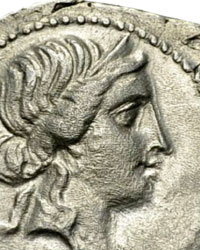
• Obverse: The crowned head of the god Apollo to the right, with finely detailed locks of hair and a pearl necklace along the edge.
• Reverse: A tripod—the sacred symbol of Apollo—in place of a quiver. On the right side the Greek inscription BAΣΙΛΕΩΣ (king) is read and on the left ANTIOXOY (Antiochus). The letters NTI and PA appear as monograms or loose letters in the field.
This type of coin (often referred to as a Chalkon) was minted in many places such as Antiochia ad Orontem or Sardes.
Coin 8:
Weight 3 grams.
Obverse: Laureate head of Zeus to the right.
Reverse: ΣΕΛΕΥΚΕΩΝ. Lightning bolts.
Apparently rare variant. Greek, 147–146 BCE, SELEUCIA PIERIA AE22. Alexander I Balas. Zeus-Thunderbolt. RARE! VF / EF.
Coin 9:
Weight 3.8 grams
This concerns a Greek bronze coin (AE Dichalkon) from the Kingdom of Macedon, struck during the Interregnum period (288–277 BCE). This was a turbulent transition phase in which several rulers (such as Lysimachus, Pyrrhus and Seleucus) fought for power after the fall of Demetrius I Poliorketes.
Below are the main specifications of this coin:
Characteristics & Design
Dating: 288–277 BCE (Interregnum)
Material: Bronze (AE)
Weight: 3.8 grams
Nominal: Dichalkon / Quarter unit
Obverse: Macedonian shield with in the central medallion the image of a Gorgoneion (the head of Medusa as a deterrent symbol).
Reverse: Macedonian helmet.
References: Catalog number: Sear 6782 ( Greek Coins and their Values / Greek Coins and their Values, vol. II). Note: In some databases it is also closely related registered under number Sear 6781 or 6783, depending on the specific monograms on the reverse.
Coin 10:
Weight 4.9 grams
Æ22 - Gordian III ΕΦΕϹΙΩΝ ΑΛΕΞΑΝΔΡΕΩΝ
Æ22 - Gordian III (ΕΦΕϹΙΩΝ ΑΛΕΞΑΝΔΡΕΩΝ) - obverse Æ22 - Gordian III (ΕΦΕϹΙΩΝ ΑΛΕΞΑΝΔΡΕΩΝ) - reverse
Features
Issuing authority: Ephesus (conventus Efeze)
Emperor: Gordianus III (Marcus Antonius Gordianus) (238-244)
Type: Standard circulating coin
Years: 238-244
Composition: Bronze
Weight: 4.9 g
Obverse: Laureate, draped and crowned bust of Gordian III, right, as seen face-on.
Inscription: ΑΥΤ Κ Μ ΑΝΤ ΓΟΡΔΙΑΝΟϹ
Expanded text: Αὐτοκράτωρ Καῖσαρ Μᾶρκος Ἀντώνιος Γορδιανός
Reverse: Bull Apis standing, right.
Ephesus, Ionia, modern Selçuk, Turkey
Emperor: Gordianus III
Coin 1:
1
Weight 5.8 grams.
Coin features
Metal & Size: Bronze with a weight of 5.8 grams.
• Mint: The inscription ΑΚΜΟΝΕΩΝ (Akmoneon) refers to the inhabitants of Akmoneia, the city that issued the coin.
• Obverse: Probably the bust of Emperor Trebonianus Gallus.
• Reverse: Displays the likeness of the Greek-Roman demigod Hercules (Herakles), his head facing right, or a scene in which Hercules is central (such as completing his legendary labors).
Coin 12:
Weight 7.4 grams.
Coin type: Bronze (Æ Litra / Unit)
Obverse: Bust of Artemis Soteira (Artemis the Deliverer) to the right. She wears an earring and her hair is up, with flowing tresses at the back. Behind her shoulder one can just glimpse the tip of her quiver. Originally the Greek text ΣΩΤΕΙΡΑ (Soteira) appeared here.
• Reverse: A horizontal winged lightning bolt (the attribute of Zeus). The Greek inscription partially ΑΓΑΘ... and ΣΙΕΡΑ... reads in practice: Above the lightning bolt: ΑΓΑΘΟΚΛΕΟΣ (Agathokleos — “Of Agathokles”). Below the lightning bolt: ΒΑΣΙΛΕΩΣ (Basileos — “Of the king”). The letters that look like ΣΙΕΡΑ are the Greek letters ΣΙΛΕ from the word ΒΑΣΙΛΕΩΣ. This type of coin is historically very important, as it marks the transition where Agathokles proclaimed himself king (Basileus) in the manner of Hellenistic rulers like Alexander the Great.
Coins are well packed and insured when shipped.
Details
Era
Before 1400
Culture/region
Greece (ancient)
Year/period and variation
3rd - 1rd century BC
Denomination
Lot of 12 Æ coins
Condition
Ungraded
Number of objects
12
Sold by