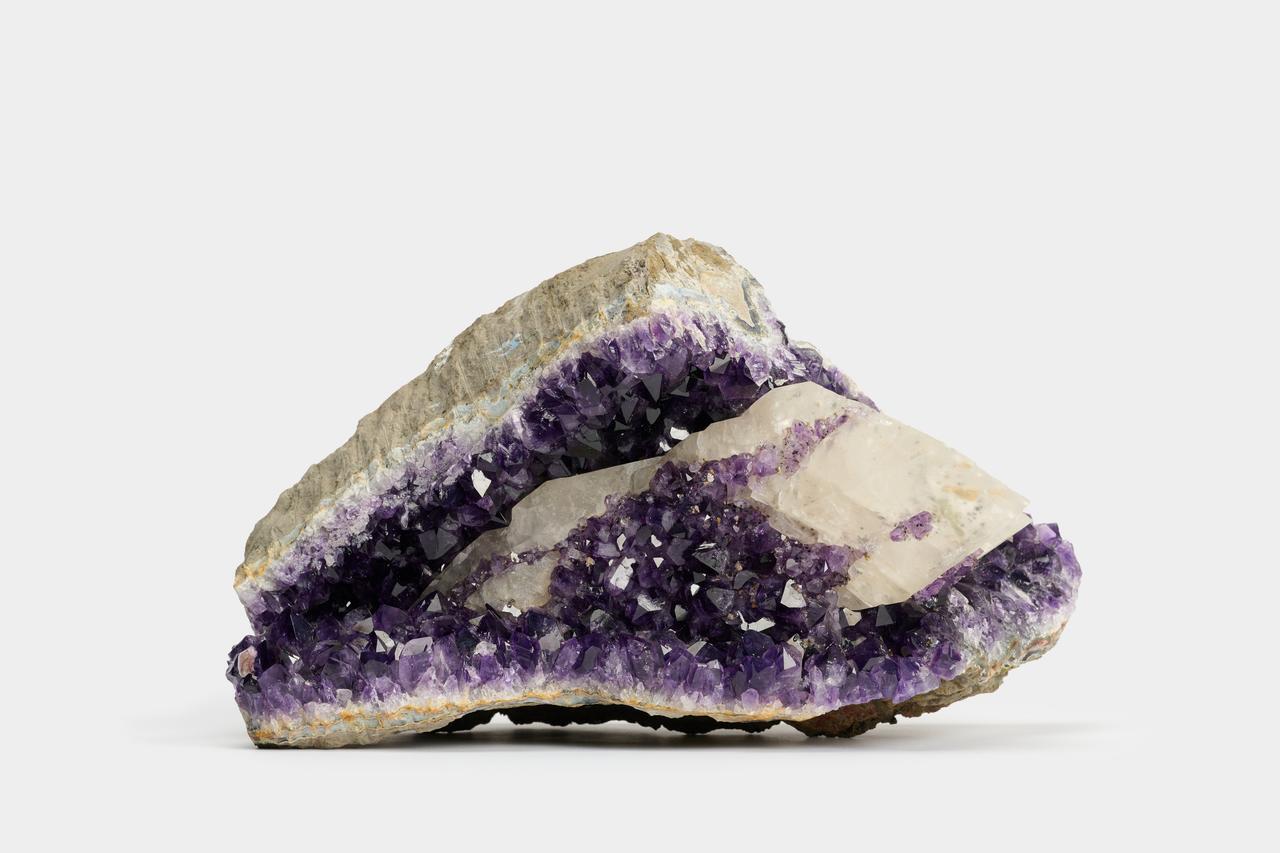
Large Brazilian Smoky Quartz with a Striking Intergrown Crystal Formation Fantastic Sculptural Form with Deeply Striated Prismatic Crystal Faces - Height: 340 mm - Width: 190 mm- 4375 g - (1)


05
days
06
hours
09
minutes
02
seconds

No bids placed
Catawiki Buyer Protection
Your payment’s safe with us until you receive your object.View details
Trustpilot 4.4 | 145414 reviews
Rated Excellent on Trustpilot.
A 4,375 g Brazilian black smoky quartz (morion) specimen features two large, deeply striated prismatic crystals intersecting in a sculptural form.
AI-assisted summary
Description from the seller
Crossed Black Smoky Quartz from Brazil — This lot features an imposing specimen of black Smoky Quartz, known in its darkest variety as Morion, from Brazil. The specimen stands out for its rare and spectacular pairing of two large prismatic crystals, which grew intersecting one another to form a composition of exceptional sculptural impact. Mounted on a custom-made metal base, the specimen takes on the appearance of a natural work of art, a mineral monument that captures the essence of geological forces. The piece’s architecture is defined by a massive, vertically oriented main crystal, which serves as a pillar for a second, almost equally large crystal that joins it crosswise. This crossed growth, or “penetration,” creates a dynamic and powerful visual balance. The crystal surfaces offer an open book on their history: broad prismatic faces display a vitreous luster and are marked by dense horizontal striations, evidence of their growth process. Growth patterns and contact points with the parent rock can also be observed, attesting to its completely natural origin. The color is this quartz’s defining feature. It ranges from an intense smoky brown to a deep anthracite gray, culminating in sections that are almost entirely black, which justifies its classification as Morion. Although the crystal mass appears opaque, when illuminated by a powerful light source, the specimen reveals a surprising internal translucency, with warm tobacco tones emerging from its depths. This interplay between external darkness and inner light gives the piece a mysterious, magnetic appeal. Smoky Quartz, chemically silicon dioxide (SiO₂), owes its characteristic color to the natural irradiation of trace amounts of aluminum present in its crystal lattice. This process, which took place over millions of years within pegmatite veins, “colored” the crystal without altering its structure. The distinctive formation of crossed crystals is the result of specific conditions during crystallization, when the crystals had the space and time to develop freely until they met and interpenetrated in this unique configuration. Beyond its undeniable mineralogical interest, this specimen is an object of great aesthetic value. Its bold, almost architectural form, enhanced by the minimalist metal stand that elevates it and presents it as a sculpture, makes it a standout display piece. It is an ideal specimen for enhancing a high-end mineral collection, becoming the centerpiece of a modern Wunderkammer, or bringing a touch of primordial elegance to a study or contemporary interior design. It is important to note that the slight chips along the edges, internal fractures (the so-called “veils”), inclusions, and irregularities on the faces should not be considered defects, but rather the scars and imprints of its natural formation. These details tell the story of a mineral extracted from the heart of the Earth and give the specimen authenticity and uniqueness.
Seller's Story
The Mineral Art Gallery offers minerals, fossils, shells and natural elements.
Born in Italy in 2017, today she collaborates with international galleries and collectors, she is a direct importer of large minerals and naturalistic collectible elements; deals with the processing to insert them inside the living space. A section of the gallery was dedicated to the Wunderkammer, "chamber of wonders or cabinet of curiosities" in which Mirabilia elements are presented: naturalia and italiania, a union between "the present is the past".
All lots are shipped via DHL Express and Fercam couriers, with insured parcel and tracking.
Translated by Google TranslateCrossed Black Smoky Quartz from Brazil — This lot features an imposing specimen of black Smoky Quartz, known in its darkest variety as Morion, from Brazil. The specimen stands out for its rare and spectacular pairing of two large prismatic crystals, which grew intersecting one another to form a composition of exceptional sculptural impact. Mounted on a custom-made metal base, the specimen takes on the appearance of a natural work of art, a mineral monument that captures the essence of geological forces. The piece’s architecture is defined by a massive, vertically oriented main crystal, which serves as a pillar for a second, almost equally large crystal that joins it crosswise. This crossed growth, or “penetration,” creates a dynamic and powerful visual balance. The crystal surfaces offer an open book on their history: broad prismatic faces display a vitreous luster and are marked by dense horizontal striations, evidence of their growth process. Growth patterns and contact points with the parent rock can also be observed, attesting to its completely natural origin. The color is this quartz’s defining feature. It ranges from an intense smoky brown to a deep anthracite gray, culminating in sections that are almost entirely black, which justifies its classification as Morion. Although the crystal mass appears opaque, when illuminated by a powerful light source, the specimen reveals a surprising internal translucency, with warm tobacco tones emerging from its depths. This interplay between external darkness and inner light gives the piece a mysterious, magnetic appeal. Smoky Quartz, chemically silicon dioxide (SiO₂), owes its characteristic color to the natural irradiation of trace amounts of aluminum present in its crystal lattice. This process, which took place over millions of years within pegmatite veins, “colored” the crystal without altering its structure. The distinctive formation of crossed crystals is the result of specific conditions during crystallization, when the crystals had the space and time to develop freely until they met and interpenetrated in this unique configuration. Beyond its undeniable mineralogical interest, this specimen is an object of great aesthetic value. Its bold, almost architectural form, enhanced by the minimalist metal stand that elevates it and presents it as a sculpture, makes it a standout display piece. It is an ideal specimen for enhancing a high-end mineral collection, becoming the centerpiece of a modern Wunderkammer, or bringing a touch of primordial elegance to a study or contemporary interior design. It is important to note that the slight chips along the edges, internal fractures (the so-called “veils”), inclusions, and irregularities on the faces should not be considered defects, but rather the scars and imprints of its natural formation. These details tell the story of a mineral extracted from the heart of the Earth and give the specimen authenticity and uniqueness.
Seller's Story
The Mineral Art Gallery offers minerals, fossils, shells and natural elements.
Born in Italy in 2017, today she collaborates with international galleries and collectors, she is a direct importer of large minerals and naturalistic collectible elements; deals with the processing to insert them inside the living space. A section of the gallery was dedicated to the Wunderkammer, "chamber of wonders or cabinet of curiosities" in which Mirabilia elements are presented: naturalia and italiania, a union between "the present is the past".
All lots are shipped via DHL Express and Fercam couriers, with insured parcel and tracking.
Translated by Google TranslateDetails
Number of objects
1
Main mineral
Large Brazilian Smoky Quartz with a Striking Intergrown Crystal Formation
Mineral form
Fantastic Sculptural Form with Deeply Striated Prismatic Crystal Faces
Supplement
Large Sculptural Brazilian Morion Quartz
Weight
4375 g
Country of origin
Brazil
Height
340 mm
Width
190 mm
Depth
140 mm
Sold by