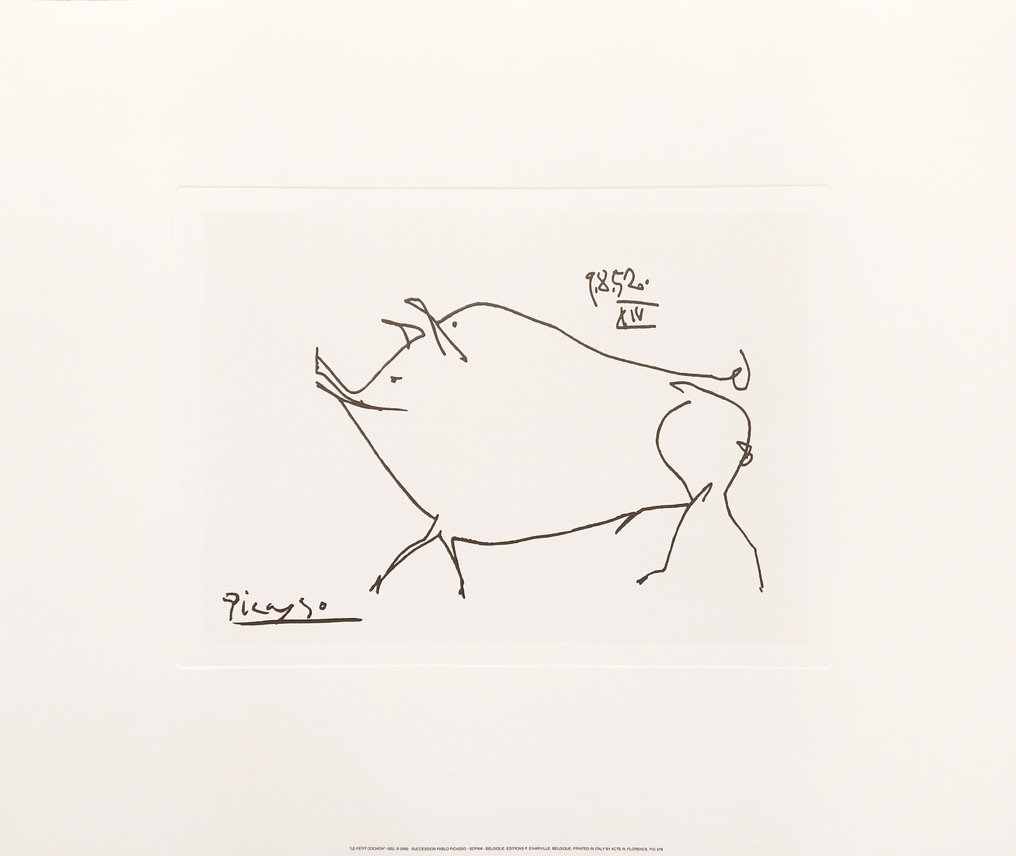
Pablo Picasso (1881-1973) (after) - "Le Petit Cochon, 1952" - (50x60cm)




03
days
18
hours
38
minutes
37
seconds

 | €28 | |
|---|---|---|
 | €23 | |
 | €18 | |
Catawiki Buyer Protection
Your payment’s safe with us until you receive your object.View details
Trustpilot 4.4 | 145414 reviews
Rated Excellent on Trustpilot.
This 50 × 60 cm serigraph on handmade paper, made in Italy between 2000 and 2010 after Pablo Picasso, depicts an animal in a minimalist style and is titled “Le Petit Cochon, 1952”; it is signed in the plate.
AI-assisted summary
Description from the seller
- Pablo Picasso (after), serigraphic print on handmade paper (approx. 250 gsm; refers to the paper’s thickness/density).
- Copyright Succession Pablo Picasso.
- Signed in the plate.
- Stamp on verso.
- Ready to frame. The picture in which the item appears framed is a simulated recreation for illustrative purposes only; the frame and other decorative elements shown are not included in the lot you are bidding on.
- Size: 50 x 60 cm.
- Condition: excellent. Never framed, never displayed.
- More lots currently at auction: https://www.catawiki.com/es/u/7684787-yuke
- Pablo Picasso’s Le Petit Cochon (1952) reveals the extraordinary economy of line that characterized the artist’s mature draughtsmanship. With only a handful of spontaneous, fluid strokes, Picasso transforms the familiar silhouette of a small pig into an image full of personality and movement: the arched back, pointed ears, sturdy legs and tightly curled tail are instantly recognizable despite the radical simplicity of the drawing. The work belongs to Picasso’s lifelong fascination with animals—from bulls, horses and goats to doves and owls—and demonstrates his ability to reduce a subject to its essential visual signs without sacrificing humour or vitality. Dated 1952, it reflects the freedom of his post-war years on the Mediterranean, when drawing, ceramics and playful animal imagery became important vehicles for experimentation.
The restrained brown-black line against an expansive ivory ground gives Le Petit Cochon an unusually contemporary decorative quality. Its minimalist appearance works beautifully in modern, Scandinavian, Japandi, Mid-Century, rustic-chic and eclectic interiors, where the generous negative space can provide a quiet counterpoint to more colourful artworks. It is particularly effective with natural oak, walnut, black or antique-gold framing and against cream, warm grey, sage, dusty blue, terracotta or muted burgundy walls. Displayed in a kitchen, dining room, study, hallway or informal living space, its combination of Picasso’s unmistakable hand and gentle humour also makes it an original gift for admirers of modern art, drawing and animal imagery.
As one of the defining figures of twentieth-century art, Picasso continues to connect naturally with collections spanning Matisse, Miró, Dalí, Chagall, Modigliani, Léger, Klimt, Warhol, Basquiat, Haring, Hockney, Banksy, Shepard Fairey, Kaws and Karl Lagasse. The graphic immediacy of Le Petit Cochon also allows it to sit comfortably within contemporary collections combining fine art with design and cultural icons such as Cartier, Rolex, Patek Philippe, Chanel, Dior, Hermès, Gucci, Lego, Star Wars and Pokémon. Playful, economical and immediately recognizable, it demonstrates how Picasso could turn the simplest line drawing into an image of enduring character and sophistication.
Seller's Story
Seller on Catawiki for more than eight years.
I invite you to visit my profile; there you'll find a complete list of the different lots that are currently up for bid. Click on "Yuke".
Good luck with the auctions!
Translated by Google Translate- Pablo Picasso (after), serigraphic print on handmade paper (approx. 250 gsm; refers to the paper’s thickness/density).
- Copyright Succession Pablo Picasso.
- Signed in the plate.
- Stamp on verso.
- Ready to frame. The picture in which the item appears framed is a simulated recreation for illustrative purposes only; the frame and other decorative elements shown are not included in the lot you are bidding on.
- Size: 50 x 60 cm.
- Condition: excellent. Never framed, never displayed.
- More lots currently at auction: https://www.catawiki.com/es/u/7684787-yuke
- Pablo Picasso’s Le Petit Cochon (1952) reveals the extraordinary economy of line that characterized the artist’s mature draughtsmanship. With only a handful of spontaneous, fluid strokes, Picasso transforms the familiar silhouette of a small pig into an image full of personality and movement: the arched back, pointed ears, sturdy legs and tightly curled tail are instantly recognizable despite the radical simplicity of the drawing. The work belongs to Picasso’s lifelong fascination with animals—from bulls, horses and goats to doves and owls—and demonstrates his ability to reduce a subject to its essential visual signs without sacrificing humour or vitality. Dated 1952, it reflects the freedom of his post-war years on the Mediterranean, when drawing, ceramics and playful animal imagery became important vehicles for experimentation.
The restrained brown-black line against an expansive ivory ground gives Le Petit Cochon an unusually contemporary decorative quality. Its minimalist appearance works beautifully in modern, Scandinavian, Japandi, Mid-Century, rustic-chic and eclectic interiors, where the generous negative space can provide a quiet counterpoint to more colourful artworks. It is particularly effective with natural oak, walnut, black or antique-gold framing and against cream, warm grey, sage, dusty blue, terracotta or muted burgundy walls. Displayed in a kitchen, dining room, study, hallway or informal living space, its combination of Picasso’s unmistakable hand and gentle humour also makes it an original gift for admirers of modern art, drawing and animal imagery.
As one of the defining figures of twentieth-century art, Picasso continues to connect naturally with collections spanning Matisse, Miró, Dalí, Chagall, Modigliani, Léger, Klimt, Warhol, Basquiat, Haring, Hockney, Banksy, Shepard Fairey, Kaws and Karl Lagasse. The graphic immediacy of Le Petit Cochon also allows it to sit comfortably within contemporary collections combining fine art with design and cultural icons such as Cartier, Rolex, Patek Philippe, Chanel, Dior, Hermès, Gucci, Lego, Star Wars and Pokémon. Playful, economical and immediately recognizable, it demonstrates how Picasso could turn the simplest line drawing into an image of enduring character and sophistication.
Seller's Story
Seller on Catawiki for more than eight years.
I invite you to visit my profile; there you'll find a complete list of the different lots that are currently up for bid. Click on "Yuke".
Good luck with the auctions!
Translated by Google TranslateDetails
Sold by
Owner or reseller
Edition
Original
Artist
Pablo Picasso (1881-1973) (after)
Title of artwork
"Le Petit Cochon, 1952" - (50x60cm)
Technique
Silkscreen
Signature
Plate signed
Country of origin
Italy
Condition
Excellent condition
Height
50 cm
Width
60 cm
Depiction/theme
Animals
Style
Minimalism
Sold with frame
No
Period
2000-2010