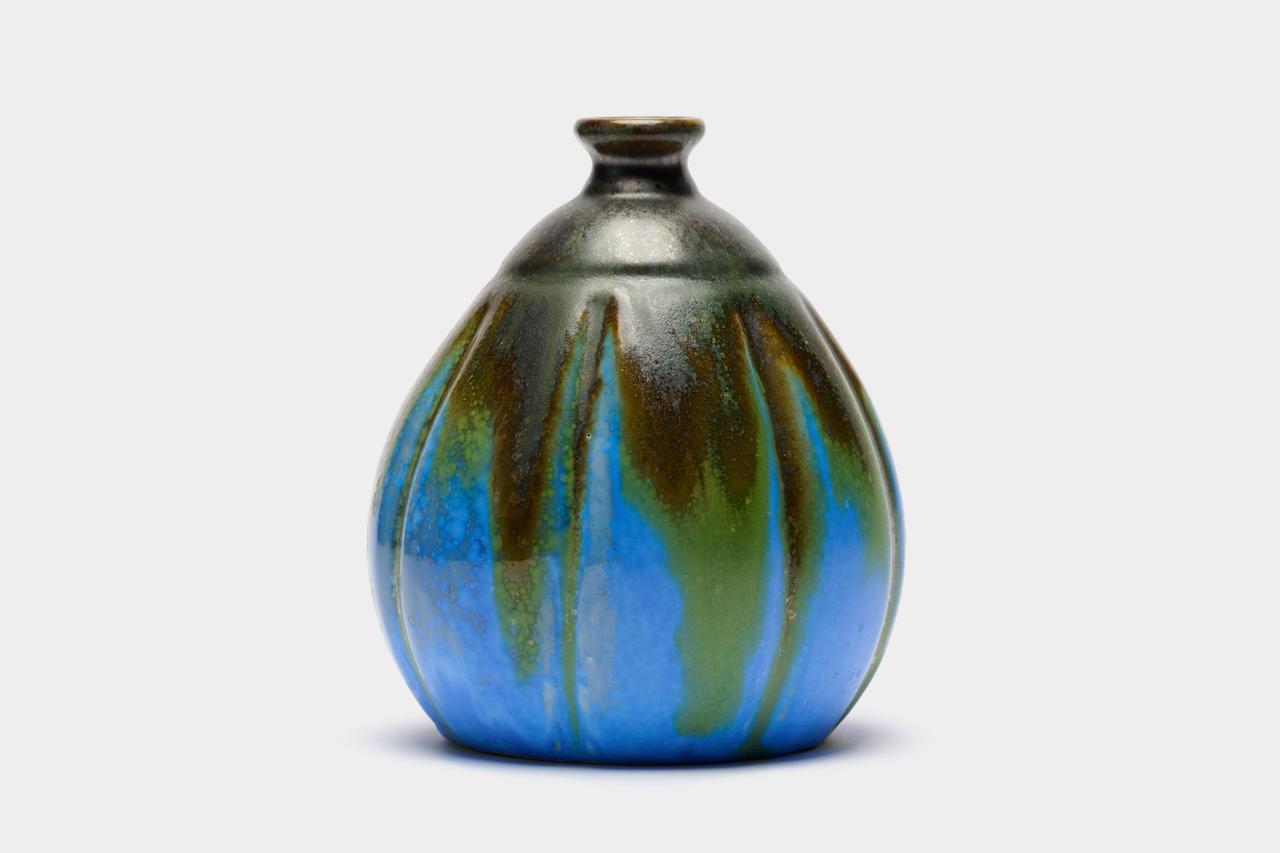
Verreries Schneider - Charles Schneider ( 1881-1953) - Très rare - Vase - Art Deco Masterpiece: Imposing vase 'Boule Aplatie' on a pedestal - Signed 'Schneider France' - Multilayer marbled art glass. - Height 20 cm - Circumference 91 cm - 4.3 kg


06
days
19
hours
31
minutes
35
seconds
Current bid
€ 270
Reserve price met

Expert
Selected by Michel Karis
Art historian with extensive experience working at various auction houses in antiques.
Estimate € 500 - € 550
 | €270 | |
|---|---|---|
 | €250 | |
 | €245 | |
Catawiki Buyer Protection
Your payment’s safe with us until you receive your object.View details
Trustpilot 4.4 | 145414 reviews
Rated Excellent on Trustpilot.
Description from the seller
Rare and spectacular prestige piece created by Charles Schneider (1881-1953), a master glassmaker indispensable to the Art Deco era. This piece was executed between 1918 and 1925. It sits at the pinnacle of the Marmoreal period for the brand, a time of crazy creativity where Schneider challenged the codes of art glass with the boldness of his colors. Pieces from this decade represented French luxury in the world’s leading international exhibitions of the time and are today highly sought after by international collectors.
Description of the vase:
Exceptional in its dimensions and physical presence, this majestic vase standing 20 cm high immediately commands attention with its spectacular circumference of 91 cm and its remarkable weight of 4.3 kg, testifying to the richness and density of the material worked by Schneider.
This model adopts a silhouette of the “flattened ball” type (or obloid form), a geometry particularly bold and sought-after. Its profile features a very low, perfectly stable base, which widens dramatically at a generous shoulder before narrowing toward a short neck with a delicately flared lip. This minimalist aesthetics offers a monumentally visual presence.
Regarding the decoration, this vase features a superb marbled effect. The body of the vase is a true fire tableau. On a translucent yellow-orange background that is bright and luminous, an abstract motif of clouds of white powders and powder-pink pigments unfolds. This evanescent pattern is enhanced in depth by broad intercalated blotches of bright scarlet red and dense amber orange. The contrast between the opaque powdered zones and the translucency of the base creates a striking play of light, varying with the room’s lighting.
It is truly a stunning decorative piece full of character, typical of Schneider glasswork and the Art Deco period. This vase immediately stands out for its monumental proportions, extraordinary physical presence, and flamboyant color palette.
An ideal work for connoisseurs of art glass or for a refined, luxurious, and colorful interior decoration. The 6th photo will help you envision a contemporary and luxurious interior decoration.
Detailed description:
- Work: Imposing “Flattened Ball” Vase on a marmoreal pedestal finished with a full fire polish giving it a superb shine.
- Artist: Charles Schneider (1881-1953). A leading artist and master glassmaker, Charles Schneider began his artistic career as a model-maker with the prestigious Daum house in Nancy. Building on this excellence, he co-founded with his brother Ernest (1877-1937) their own company in 1913, the Schneider manufacture in 1913.
- Manufacture: Schneider (1913-1939)
- Epoch: 1918-1925
- Artistic movement: Art Deco
- Dimensions:
* 20 cm tall
* 30 cm wide
* Circumference: 91 cm
* Neck: 13 cm diameter
- Weight: 4.3 kg
- Material: Marmoreal glass
- Technique: Fully hand-shaped and hot-worked at the pontil by Schneider’s master glassmakers, the piece is made in multi-layer marmoreal glass. This highly complex physical technique relies on interleaving powders and vitrified metal oxides applied between several thick layers of molten glass during blowing. The piece was finally given a full fire polish on exiting the oven, giving it its superb smooth, glossy, and vitreous finish across its surface.
- Signature: The vase is signed “Schneider France” engraved with a fine italic point above the base. This signature certifies a creation between 1920-1925, and this work thus belongs to Schneider’s early prestige line. Indeed, the “Schneider” line is the prestige line featuring more than 32 different colors, unlike the “Le Verre Français” line which is the public line.
- Condition: Excellent condition for this magnificent high-end Schneider vase, no chips, no cracks. A few trace signs of use on the edge of the neck are truly minimal. The glass retains all its original brilliance and freshness. There is a delicate local wear line near the signature at the base. It is not a crack, a hairline, or a chip but a manufacturing mark inherent to hot-since hand-blown glasswork or a sign of use that is not perceptible to the touch and does not affect the object’s solidity or beauty. It is barely visible (in the last two photos) and not noticeable at all when the piece is placed, as it is above the pedestal and thus below the shoulder. This is a very rare collector’s piece magnificently preserved. (Please see the many photos)
- Shipping:
Careful and secure shipping with signature-required delivery and tracking number via Colissimo/La Poste.
* New double box
* New thick bubble wrap
Our shipping prices include insurance, packing, pickup, and signature-required delivery, and are determined based on the package weight, item value, and destination.
- WITHIN the EU: Shipping via Colissimo-La Poste within the European Union. Other carriers available on request (any additional fees, if any, are the buyer’s responsibility).
- OUTSIDE THE EU: Shipping only by Colissimo/La Poste outside the European Union; however, if you wish to use another carrier outside the EU, this is possible but will require a new calculation and thus an additional cost which can be significant depending on the package characteristics, the object, and the country, and will be the buyer’s responsibility.
Please let us know if you have a carrier preference.
Biography of Charles Schneider:
Charles Schneider, born February 23, 1881 in Château-Thierry and died January 7, 1953 in Épinay-sur-Seine (Seine), was a French Art Deco master-glassmaker, a pupil of Jean Daum in Nancy, and creator of the Le Verre Français art glass signature with his brother Ernest Schneider (1877-1937).
Ernest and Charles Schneider grew up in Nancy. In 1903, Ernest Schneider was hired by the commercial direction of the Daum Frères manufacture. He obtained that his younger brother Charles, trained in sculpture at the École des Beaux-Arts de Nancy and then Paris, proposed vase and glass-paste projects. This collaboration continued until 1911.
They founded their own company, Verreries Schneider, in Épinay-sur-Seine in 1913. The company’s success was confirmed after the end of hostilities in 1918. It employed up to five hundred workers in 1925 and sold its creations worldwide.
After 1918, the first pieces with enamel floral and landscape decorations revisited pre-war studies as well as those of his friend Gaston Hoffmann. However, Charles Schneider quickly became the sole creator of the pieces. Moving away from Art Nouveau, he developed a very personal style, characterized by vivid, powerful, contrasted colors and naturalistic and stylized motifs, perfectly symbolizing the Art Deco style of the interwar period.
The company produced under two brands, “Le Verre Français” and the “Schneider” line. The former aimed to be more accessible with 17 color variations versus 32 for Schneider. It made a splash with its “butterflies” pattern created around 1925 featuring insects in red and blue on a sunlit azure cloudy background. It used complex techniques such as bubble glass. Some productions are signed “Charder,” an abbreviation of Charles Schneider.
The glassworks remained active until 1938.
Schneider, Charles Schneider, Ernest Schneider, Le Verre Français, art vase, luxury vase, French vase, vase, luxury art, glass art, Art Deco, art deco vase, marmoreal vase, fire-polished, blown glass, master glassmakers, Daum Nancy, Épinay-sur-Seine, ball vase, imposing vase, large vase, antique vase, antiques, 1920 glass, 1920s, French glass, Schneider collection, collectible vase, high glassware, orange vase, Art Deco decoration, art object, vase, luxury decoration, design luxury, glass art, French vase, French glass, Art Nouveau
Details
Glass type
Multilayer marbled art glass.
Weight
4.3 kg
Era
1900-2000
Title additional information
Height 20 cm - Circumference 91 cm - 4.3 kg
Number of objects
1
Country of origin
France
Model
Art Deco Masterpiece: Imposing vase 'Boule Aplatie' on a pedestal - Signed 'Schneider France'
Designer/artist/maker
Charles Schneider ( 1881-1953) - Très rare
Material
Glass
Style
Art Deco
Manufacturer/brand
Verreries Schneider
Colour
Brown, Orange, White, Yellow
Condition
Excellent condition: barely used with minimal signs of wear
Height
20 cm
Width
30 cm
Depth
20 cm
Estimated period
1918-1925
Sold by