Reliquary head - Fang - Gabon


01
day
02
hours
57
minutes
09
seconds
Starting bid
€ 1
Reserve price not met

Expert
Selected by Julien Gauthier
A decade of experience in historical arms, armour, and African art.
Estimate € 150 - € 200
No bids placed
Catawiki Buyer Protection
Your payment’s safe with us until you receive your object.View details
Trustpilot 4.4 | 145304 reviews
Rated Excellent on Trustpilot.
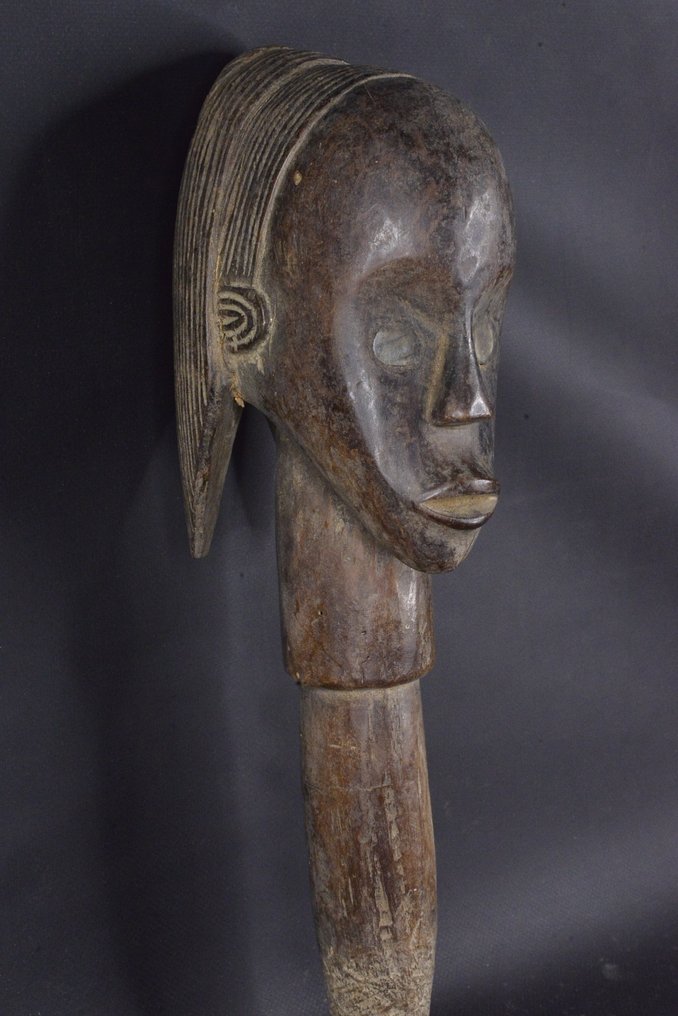
This Fang reliquary head from Gabon, named Tête reliquaire, is made of wood with glass eyes and measures 43 cm high.
AI-assisted summary
Description from the seller
Gabon
Fang
Wood and glass
Height 430mm
Width: 90mm
Depth: 120mm
This reliquary head is a major ritual art object originating from the Fang people. This large ethnic group of Central Africa is spread across a territory encompassing Gabon, Equatorial Guinea, southern Cameroon, and western Republic of the Congo.
Fang sculpture, highly conceptual and marked by great formal rigor, had a profound impact on the history of Western art when it was rediscovered in the early 20th century.
1. Stylistic Characteristics and Composition
This isolated head displays the classic expressive features of the Fang aesthetic canon, blending solemnity and introspection:
The crest-shaped or helmet-like hairstyle: The head is adorned with an elaborate traditional hairstyle marked with fine parallel incisions imitating braids. It extends backward and falls along the sides of the nape, faithfully representing the hairstyles worn by Fang warriors and dignitaries in the 19th century.
The bulging forehead and heart-shaped face: The forehead is particularly prominent, large, and concave, overhanging a slightly elongated heart-shaped face. The nose is fine and straight, and the mouth is carved in a schematic style, closed, with full lips projecting forward.
The inlaid eyes: The eyes are made from inlaid plates of light-colored metal (brass or tin) secured with nails. This striking metallic contrast catches the light and gives the sculpture a fixed, hypnotic gaze, symbolizing the vision of the invisible world.
The attachment peg: The head extends downward into a long cylindrical neck that flares into a sturdy tenon (or peg) of untreated wood. The base of this shaft shows signs of natural erosion and prolonged insertion.
The seeping patina: The wood has a dark brown, satin-like patina, characteristic of Fang rituals in which sculptures were regularly anointed with palm oil mixed with redwood powder, sometimes giving the wood this dark, “seeping” appearance.
2. Ritual Use and Function: The Byeri Cult
In Fang society, these reliquary heads or figures (called Eyema Byeri) are not idols to be worshipped, but spiritual guardians associated with the ancestor cult, the Byeri:
Guardians of reliquary boxes: The Fang were a migrant people. To transport and honor their dead, they kept the sacred bones of the most illustrious ancestors (skulls, skeletal fragments of lineage founders, great warriors, or fertile women) in cylindrical bark boxes called nsek-byeri. The wooden tenon beneath the head was specifically used to fix the sculpture through the lid of this box.
Protection and consultation: The reliquary head served as a sentinel. Its function was to watch over the bones and repel the uninitiated or malevolent sorcerous forces. Before making crucial decisions for the clan (war, migration, choice of alliances), family leaders consulted the relics and made offerings to the Byeri.
Initiation ceremonies: During the rites of passage for young boys (the Melan), the sculptures were detached from their boxes. They were presented to the initiates in a theatrical manner, to tell them the clan's genealogy and transmit the life force of the ancestors, thus ensuring the continuity and spiritual survival of the lineage.
Parcels are sent Monday through Saturday with a tracking number.
Delivery by Chronopost takes 1 to 3 days in France and 2 to 5 days throughout the European Union. Delivery to the rest of Europe and worldwide is by Colissimo International.
We speak English.
African mask art Afrikanische Maskenkunst arte de máscaras africanas arte delle maschere africane
African statue art Arte de estatuas africanas arte delle statue africane Afrikanische Maskenkunst
Seller's Story
Passionate about World Arts and more specifically about African Art, we buy from collectors, former officials, military, health workers, public works staff who have worked in Africa and also in Côte d'Ivoire, from antique dealers and traders who roam across West Africa to find quality objects.
It is with pride that we present works that, beyond their power to beautify spaces, invite our collectors to resonate with the richness and depth of human expression through the most authentic art.
At Arts Ethniques Gallery, we have the privilege of offering our visitors an exclusive selection of artworks, all unique and original. Each piece presented is the outcome of a demanding artistic approach, driven by a singular vision and mastered craftsmanship, all elements that guarantee authenticity and value.
The works we offer are not industrial reproductions. They are individual creations, crafted with sensitivity and precision, each bearing its own story, identity and presence. Originality is the very foundation of our commitment to excellence. Thus, every mask and every statue in our collection is the subject of a rigorous selection, in order to preserve their rarity and singularity.
Acquiring a work from Arts Ethniques Gallery means owning a truly unique piece: a creation that embodies both talent, cultural memory and the expressive force of African art. It is also a lasting investment in a work whose artistic and emotional value transcends time.
We guarantee that every work leaving our gallery is an authentic piece, without replicas, bearing witness to the creativity, heritage and passion of the African artists who shaped them.
We invite you to participate in our gallery’s auctions with confidence. Each presented work is an original, unique and irreplaceable creation, selected with the greatest rigor to guarantee its authenticity and artistic value.
Whether you wish to enrich a personal collection or introduce an exceptional artwork into your space, Arts Ethniques Gallery offers a safe, transparent and professional setting to acquire remarkable pieces.
Art auctions are a privileged moment to discover rare works, capable of becoming the heart of a collection. Acquiring a work at our sales is not just buying an object: it is investing in a creation whose aesthetic value and cultural reach reinforce over time.
The pieces presented by Arts Ethniques Gallery testify not only to the talent and vision of the artists but also possess the ability to transform spaces and enrich the gaze of those who behold them.
Participating in our auctions is taking part in a singular experience, where the passion for art meets the rigors of collecting. Bidding on a work from Arts Ethniques Gallery goes beyond a simple transaction: it is a gesture of commitment and appreciation for art in its most authentic form.
We invite you to bid with passion and to join us in this adventure dedicated to discovery, transmission and celebration of art.
Perhaps your next heart piece is already waiting for you."
Translated by Google TranslateGabon
Fang
Wood and glass
Height 430mm
Width: 90mm
Depth: 120mm
This reliquary head is a major ritual art object originating from the Fang people. This large ethnic group of Central Africa is spread across a territory encompassing Gabon, Equatorial Guinea, southern Cameroon, and western Republic of the Congo.
Fang sculpture, highly conceptual and marked by great formal rigor, had a profound impact on the history of Western art when it was rediscovered in the early 20th century.
1. Stylistic Characteristics and Composition
This isolated head displays the classic expressive features of the Fang aesthetic canon, blending solemnity and introspection:
The crest-shaped or helmet-like hairstyle: The head is adorned with an elaborate traditional hairstyle marked with fine parallel incisions imitating braids. It extends backward and falls along the sides of the nape, faithfully representing the hairstyles worn by Fang warriors and dignitaries in the 19th century.
The bulging forehead and heart-shaped face: The forehead is particularly prominent, large, and concave, overhanging a slightly elongated heart-shaped face. The nose is fine and straight, and the mouth is carved in a schematic style, closed, with full lips projecting forward.
The inlaid eyes: The eyes are made from inlaid plates of light-colored metal (brass or tin) secured with nails. This striking metallic contrast catches the light and gives the sculpture a fixed, hypnotic gaze, symbolizing the vision of the invisible world.
The attachment peg: The head extends downward into a long cylindrical neck that flares into a sturdy tenon (or peg) of untreated wood. The base of this shaft shows signs of natural erosion and prolonged insertion.
The seeping patina: The wood has a dark brown, satin-like patina, characteristic of Fang rituals in which sculptures were regularly anointed with palm oil mixed with redwood powder, sometimes giving the wood this dark, “seeping” appearance.
2. Ritual Use and Function: The Byeri Cult
In Fang society, these reliquary heads or figures (called Eyema Byeri) are not idols to be worshipped, but spiritual guardians associated with the ancestor cult, the Byeri:
Guardians of reliquary boxes: The Fang were a migrant people. To transport and honor their dead, they kept the sacred bones of the most illustrious ancestors (skulls, skeletal fragments of lineage founders, great warriors, or fertile women) in cylindrical bark boxes called nsek-byeri. The wooden tenon beneath the head was specifically used to fix the sculpture through the lid of this box.
Protection and consultation: The reliquary head served as a sentinel. Its function was to watch over the bones and repel the uninitiated or malevolent sorcerous forces. Before making crucial decisions for the clan (war, migration, choice of alliances), family leaders consulted the relics and made offerings to the Byeri.
Initiation ceremonies: During the rites of passage for young boys (the Melan), the sculptures were detached from their boxes. They were presented to the initiates in a theatrical manner, to tell them the clan's genealogy and transmit the life force of the ancestors, thus ensuring the continuity and spiritual survival of the lineage.
Parcels are sent Monday through Saturday with a tracking number.
Delivery by Chronopost takes 1 to 3 days in France and 2 to 5 days throughout the European Union. Delivery to the rest of Europe and worldwide is by Colissimo International.
We speak English.
African mask art Afrikanische Maskenkunst arte de máscaras africanas arte delle maschere africane
African statue art Arte de estatuas africanas arte delle statue africane Afrikanische Maskenkunst
Seller's Story
Passionate about World Arts and more specifically about African Art, we buy from collectors, former officials, military, health workers, public works staff who have worked in Africa and also in Côte d'Ivoire, from antique dealers and traders who roam across West Africa to find quality objects.
It is with pride that we present works that, beyond their power to beautify spaces, invite our collectors to resonate with the richness and depth of human expression through the most authentic art.
At Arts Ethniques Gallery, we have the privilege of offering our visitors an exclusive selection of artworks, all unique and original. Each piece presented is the outcome of a demanding artistic approach, driven by a singular vision and mastered craftsmanship, all elements that guarantee authenticity and value.
The works we offer are not industrial reproductions. They are individual creations, crafted with sensitivity and precision, each bearing its own story, identity and presence. Originality is the very foundation of our commitment to excellence. Thus, every mask and every statue in our collection is the subject of a rigorous selection, in order to preserve their rarity and singularity.
Acquiring a work from Arts Ethniques Gallery means owning a truly unique piece: a creation that embodies both talent, cultural memory and the expressive force of African art. It is also a lasting investment in a work whose artistic and emotional value transcends time.
We guarantee that every work leaving our gallery is an authentic piece, without replicas, bearing witness to the creativity, heritage and passion of the African artists who shaped them.
We invite you to participate in our gallery’s auctions with confidence. Each presented work is an original, unique and irreplaceable creation, selected with the greatest rigor to guarantee its authenticity and artistic value.
Whether you wish to enrich a personal collection or introduce an exceptional artwork into your space, Arts Ethniques Gallery offers a safe, transparent and professional setting to acquire remarkable pieces.
Art auctions are a privileged moment to discover rare works, capable of becoming the heart of a collection. Acquiring a work at our sales is not just buying an object: it is investing in a creation whose aesthetic value and cultural reach reinforce over time.
The pieces presented by Arts Ethniques Gallery testify not only to the talent and vision of the artists but also possess the ability to transform spaces and enrich the gaze of those who behold them.
Participating in our auctions is taking part in a singular experience, where the passion for art meets the rigors of collecting. Bidding on a work from Arts Ethniques Gallery goes beyond a simple transaction: it is a gesture of commitment and appreciation for art in its most authentic form.
We invite you to bid with passion and to join us in this adventure dedicated to discovery, transmission and celebration of art.
Perhaps your next heart piece is already waiting for you."
Translated by Google TranslateDetails
Indigenous object name
Reliquary head
Ethnic group/ culture
Fang
Country of Origin
Gabon
Material
Wood / glass eyes
Sold with stand
No
Condition
Excellent condition
Sold by
