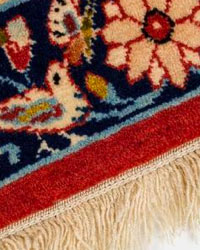
Qom Omar Khayyam - Rug - 193 cm - 122 cm


02
days
06
hours
40
minutes
51
seconds
Current bid
€ 300
Reserve price not met

Expert
Selected by Richard Ebbers
Certified appraiser at Federation TMV with 30 years' professional antiques experience.
Estimate € 1,700 - € 1,900
 | €300 | |
|---|---|---|
 | €1 |
Catawiki Buyer Protection
Your payment’s safe with us until you receive your object.View details
Trustpilot 4.4 | 145414 reviews
Rated Excellent on Trustpilot.
The Ghoum Omar Khayyam carpet is made of silk on silk and was hand-knotted in India in the mid-20th century.
AI-assisted summary
Description from the seller
Ghom Omar Khayyam Rug – 100% silk on silk – Knotted by hand – India – 1960/1970
We present an extraordinary Ghom oriental rug, Omar Khayyam model, Persian-style, attributed to India and handmade in silk on silk.
Its design draws inspiration from Persian artistic and poetic tradition and bears the name of Omar Khayyam (1048–1131), renowned Persian poet, mathematician, astronomer and philosopher, world-famous for his Rubaiyat poems, dedicated to reflections on life, love and the passage of time.
This magnificent piece stands out for the extraordinary fineness of its weave, the delicacy of its details, and its excellent craftsmanship, with a declared density of approximately 730,000 knots per square meter, equivalent to about 73 knots per cm².
Characteristics
* Model: Ghom – Omar Khayyam
* Origin attributed: India
* Estimated period: 1960–1970
* Material: 100% silk on silk
* Craftsmanship: 100% hand-knotted
* Measurements without fringe: 183 × 122 cm
* Total measurements with fringe: 193 × 122 cm
* Declared density: Approximately 730,000 knots/m²
* Condition: Perfect condition
Condition and conservation
The rug is in perfect condition given its age. It has been used exclusively as a decorative wall piece, never walked on or subjected to the wear typical of a floor rug.
Only light professional cleaning is recommended to remove dust accumulated over the years, preserving the delicate softness and natural shine of the silk.
Certificate of authenticity
All of our rugs come with our authenticity certificate, detailing their main characteristics, including model, attributed origin, measurements, estimated period and materials used.
A piece of great elegance and artisanal finesse, ideal for collectors and lovers of Oriental rugs.
A true textile artwork, inspired by the Persian tradition and the legacy of the great Omar Khayyam.
Details
Era
1900-2000
Model
Qom Omar Khayyam
Length
193 cm
Width
122 cm
Material
Silk on silk
Country of origin
India
Condition
In very good condition
Professionally cleaned
No
Manufacturing period
Mid 20th century
Weight
5 kg
Sold by