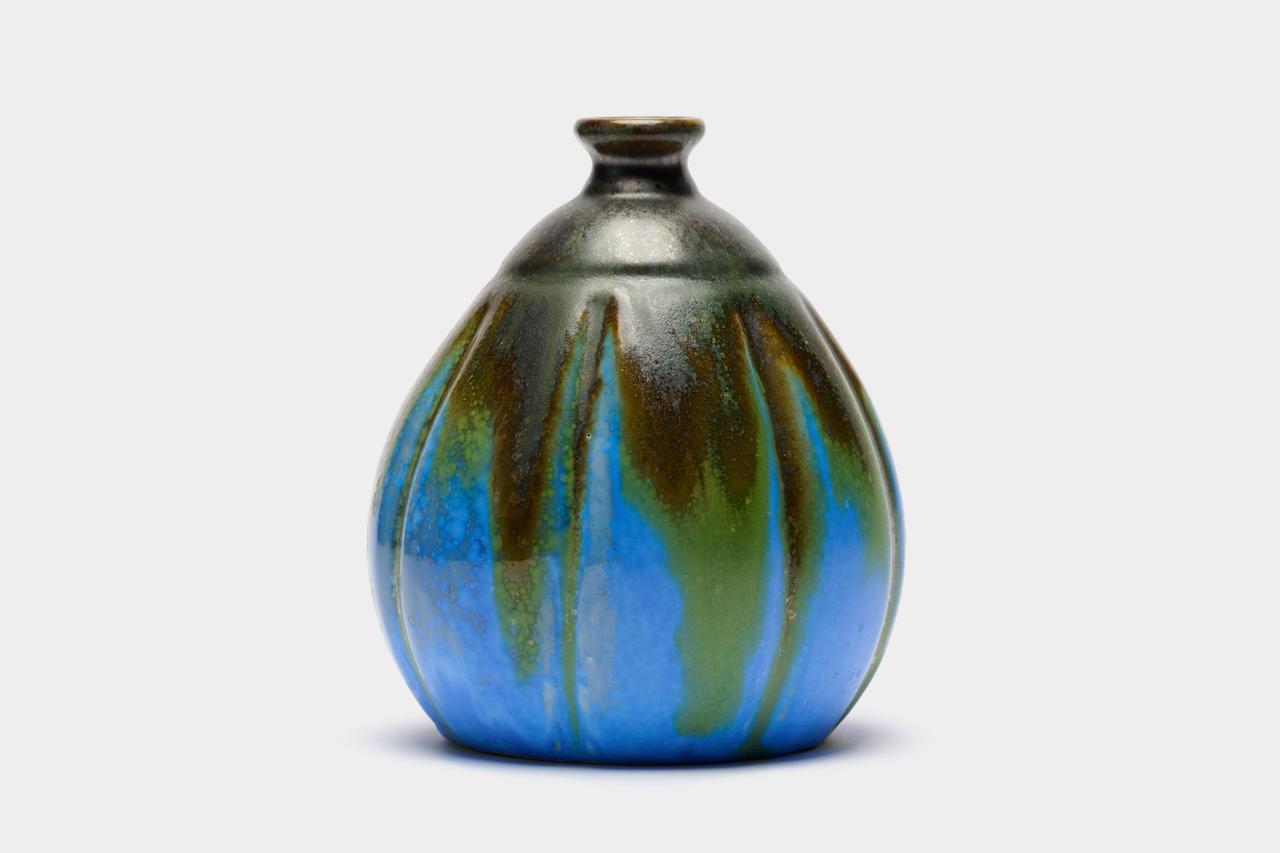
Val Saint Lambert, Luxval - Charles Graffart & René Delvenne - Vase - Baden rosaline - Manganese - Art Deco


03
days
10
hours
39
minutes
43
seconds
Current bid
€ 2
No reserve price

Expert
Selected by Michel Karis
Art historian with extensive experience working at various auction houses in antiques.
Estimate € 150 - € 200
 | €2 | |
|---|---|---|
 | €1 |
Catawiki Buyer Protection
Your payment’s safe with us until you receive your object.View details
Trustpilot 4.4 | 145414 reviews
Rated Excellent on Trustpilot.
A 1930s Art Deco Baden rosaline moulded-glass vase by Val Saint Lambert, made in Belgium, measuring 20.6 cm high and 15.3 cm in diameter, in near-new unused condition and unsigned.
AI-assisted summary
Description from the seller
Spectacular Art Deco vase “Baden” in rosaline molded glass, produced by Cristalleries du Val Saint Lambert. This piece is distinguished by its flared silhouette and its particularly expressive geometric composition, where the interplay of reliefs and the delicate rosy tint of the glass create an ensemble that is both elegant and sculptural.
The upper part, largely open, features a succession of vertical flutes that flare gradually toward the neck and terminate in a milled edge. The center of the vase is marked by a wide decorative belt in relief, composed of an alternating pattern of triangular and pyramidal motifs that give the piece a remarkable architectural dimension. The lower part repeats the geometric vocabulary in a more restrained composition, with a faceted base ensuring the overall stability. The rosaline glass reveals subtle rosé and amber hues depending on the glass thickness and the incidence of light. The vase measures 20.6 cm in height, has an upper diameter of 15.3 cm and a base diameter of 8.8 cm, and weighs 1,400 g. This specimen is unsigned.
The condition is remarkable, nearly mint. The vase shows no apparent deterioration and preserves the sharpness of its reliefs as well as the transparency and the brilliance of its glass. It constitutes a very fine example of this model.
Cristalleries du Val Saint Lambert, a workshop founded in 1826 near Liège, enjoyed particularly international acclaim during the Art Deco period. Their interwar production is characterized notably by advanced studies in molded glass, enabling the development of architectural forms, complex geometric reliefs, and a wide variety of colorations. The “Baden” model perfectly illustrates this mastery of glassworking and the characteristic aesthetics of Belgian glassmaking from that era.
Details
Specific region of origin
Wallonie
Glass type
Manganese
Weight
1400 g
Era
1900-2000
Title additional information
Art Deco
Number of objects
1
Country of origin
Belgium
Model
Baden rosaline
Designer/artist/maker
Charles Graffart & René Delvenne
Material
Glass
Style
Art Deco
Manufacturer/brand
Luxval, Val Saint Lambert
Colour
Orange, Pink
Condition
As new - unused
Height
20.6 cm
Width
15.3 cm
Depth
20.6 cm
Diameter
15.3 cm
Estimated period
1930-1940
Sold by