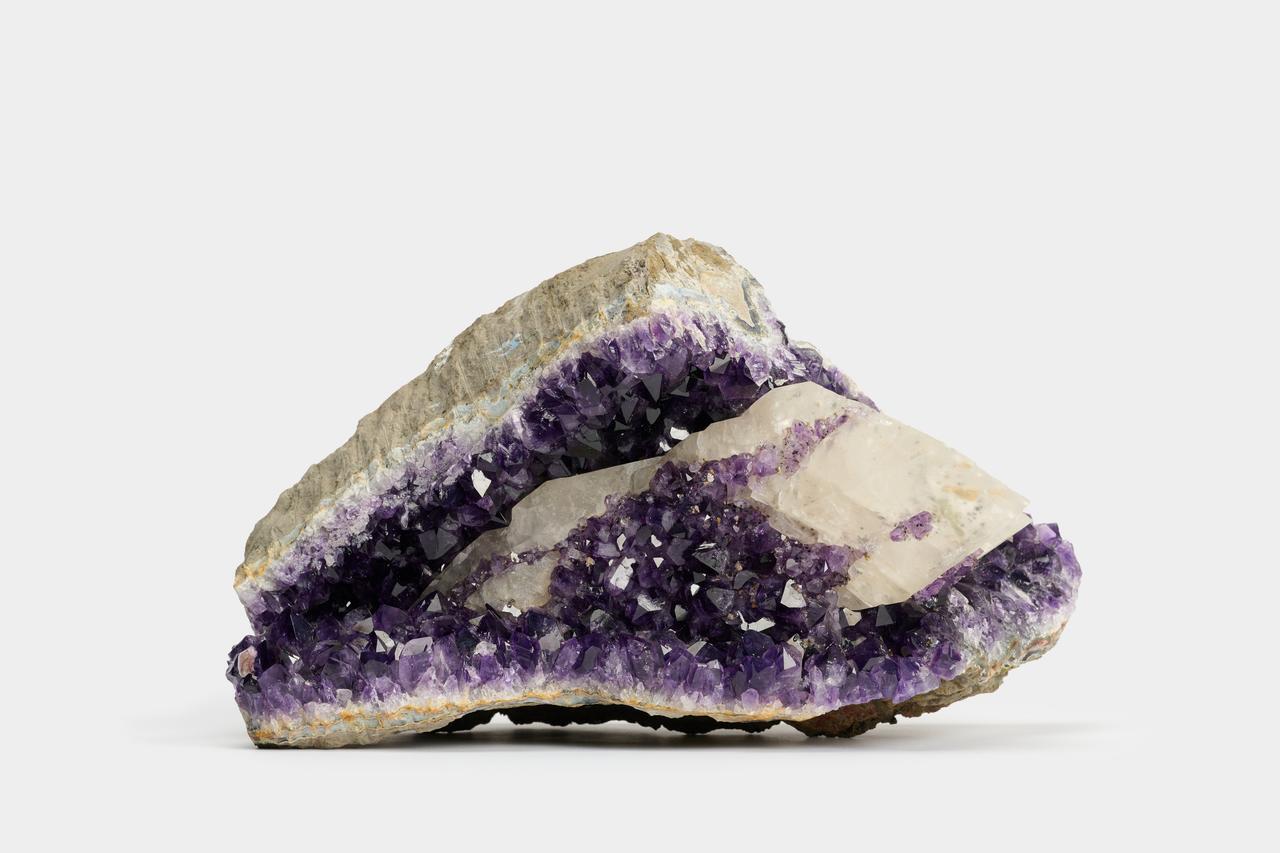
VERY RARE Herkimer Diamond — 4.01 carats Exceptional clarity - NO RESERVE PRICE - Height: 11.5 cm - Width: 10.5 cm- 0.8 g - (1)


05
days
21
hours
35
minutes
58
seconds

No bids placed
Catawiki Buyer Protection
Your payment’s safe with us until you receive your object.View details
Trustpilot 4.4 | 145472 reviews
Rated Excellent on Trustpilot.
A natural, double-terminated Herkimer-type quartz crystal weighing 4.01 carats, with two prominent points, internal inclusions and fractures, from Pakistan.
AI-assisted summary
Description from the seller
Discover this exceptional natural Herkimer diamond specimen weighing 4.01 carats, a fascinating mineral formation distinguished by its atypical silhouette, pronounced crystal terminations, and the richness of its internal structures.
This remarkable crystal presents an architecture that is particularly original, characterized by two visible tips oriented in different directions. This arrangement gives it an almost sculptural silhouette, quite different from crystals with classic, perfectly symmetric shapes.
Its upper termination, slender and distinctly drawn, dominates a second, shorter tip, creating a geometrically striking contrast. The natural faces cross and meet at precise angles, revealing the full complexity of its crystal growth.
One of the great aesthetic qualities of this specimen lies in its transparency, which allows a fascinating network of internal structures to be observed. Fine natural fractures, dark inclusions, and multiple crystal veils compose a true mineral landscape. Under suitable lighting, these features generate a multitude of silvery reflections and bright flashes.
The formation of crystals with such expressive geometry depends on particular geological conditions. The available space during growth, the circulation of mineralizing fluids, and variations in their composition can influence the organization of the faces and the development of terminations. Each crystal thus has its own unique morphology.
Herkimer diamonds have been famous for centuries for their natural luster and their appearance reminiscent of faceted gemstones. Their history dates back to discoveries in Herkimer County, New York, where these formations gained international renown among collectors.
With its 4.01 carats and dimensions of 11.5 × 10.5 × 6 mm, this specimen has a harmonious format that particularly showcases its two visible tips, its crystal faces, and its fascinating internal details.
This piece constitutes a remarkable natural quartz biterminated specimen of the Herkimer type, whose complex morphology and expressive terminations give it particular interest for the collection. The name “Herkimer diamond” is a traditional designation for these naturally faceted crystals, not a true diamond.
Technical specifications
- Trade name: Herkimer Diamond (Herkimer type)
- Mineral nature: Natural biterminated quartz
- Provenance: Pakistan
- Weight: 4.01 carats (0.802 gram)
- Dimensions: 11.5 × 10.5 × 6 mm
- Color: Colorless, with slight internal nuances
- Transparency: Transparent to translucent depending on the area
- Crystallization: Natural, with pyramidal terminations
- Morphology: Asymmetric formation with two particularly visible tips
- Luster: Vitreous, with numerous silvery reflections
- Inclusions: Natural inclusions, crystal veils, and fine internal fractures
- Condition: Raw natural specimen
- Hardness: 7 on the Mohs scale
- Destination: Mineralogical collection, crystallography, and display
The fascinating history of Herkimer diamonds
Herkimer diamonds are among the most iconic natural crystals in the history of American mineralogy.
Their name comes from Herkimer County, New York, where these formations have been known for centuries.
Even before their popularity among modern collectors, the indigenous peoples of the region knew these remarkably brilliant crystals.
Their transparency and naturally geometric faces earned them their famous nickname, due to their visual resemblance to cut diamonds.
Unlike gems whose facets are cut by a lapidary, these crystals develop their own geometric surfaces naturally during growth.
This feature is one of the main attractions of these formations.
The famous historical Herkimer deposits are associated with Cambrian dolomitic rocks, dating back roughly 500 million years.
Over their geological history, cavities in these rocks allowed the circulation of mineralizing fluids.
Under certain conditions, these fluids favored the progressive formation of crystals within the available spaces.
When growth could proceed freely, crystals developed terminations at both ends.
This phenomenon gave rise to their characteristic morphology, now particularly prized in the world of mineral collecting.
Collectors especially seek specimens with good transparency, expressive terminations, and an interesting natural geometry.
Asymmetric formations or those with morphological peculiarities can also generate great interest, particularly when they allow observation of unusual growth phenomena.
Today, Herkimer diamonds occupy an important place in natural crystal collections, both for their beauty and for their crystallographic interest.
A remarkable two-point formation
The most spectacular feature of this specimen lies in its particularly expressive morphology.
Unlike a perfectly regular formation, this crystal presents two distinct tips visible on its upper and lateral parts.
The first, taller and more slender, has a well-defined geometric termination.
The second, shorter and oriented differently, creates a visually striking break in the silhouette of the specimen.
This arrangement gives the whole an almost architectural appearance.
The natural faces meet along angular lines, forming a succession of reliefs and lit surfaces.
Observing these structures allows appreciation of the complexity of crystallization phenomena.
Crystal growth is directly influenced by the physical and chemical conditions of its environment.
Variations in temperature, dissolved element concentration, and available space can modify the development rate of certain faces.
These differences can lead to the formation of asymmetric crystals with unevenly developed terminations.
In some cases, several generations of growth can also contribute to the final morphology’s complexity.
The presented specimen precisely illustrates this fascinating architecture, with its two visible tips and its numerous natural faces.
This singular geometry is a true aesthetic asset and gives the piece an instantly recognizable identity.
An interior universe to explore
The transparency of this Herkimer diamond reveals a remarkable diversity of internal details.
Many natural inclusions are visible through the different crystal faces.
Some take the form of small dark dots, while others appear as fine lines or crystal veils.
These structures create a visual depth that is particularly interesting.
Light enters the most transparent zones before being reflected by the various internal surfaces.
This phenomenon produces a succession of silvery flashes, bright reflections, and subtle contrasts.
Natural fractures can also create small optical effects, especially visible when the crystal is viewed from different angles.
Each change in orientation reveals new details.
Some areas appear almost clear, while others show a higher concentration of inclusions.
This alternation contributes to the specimen’s aesthetic richness.
The inclusions and internal structures also bear witness to its geological history.
They can result from phenomena occurring during crystal growth or during later evolution.
All together, they form a complex mineral landscape, with details gradually revealed to the observer.
The complexity of crystallization processes
The formation of a natural crystal with developed terminations requires a favorable geological environment.
In many deposits, crystals grow directly on a host rock matrix.
Part of their structure remains attached to the substrate, preventing complete development of certain faces.
When conditions allow freer growth, terminations can form at multiple ends.
This freedom of development contributes to the appearance of crystals with particularly expressive geometries.
Growth proceeds gradually, according to the atomic organization of the mineral and the conditions of its environment.
Mineralizing fluids bring the elements necessary for building the crystal network.
Over time, these elements organize along precise directions, giving rise to the characteristic faces of the crystal.
Environmental variations can influence the final shape.
Some faces may develop more quickly than others.
Growth interruptions or local changes in conditions can also leave traces in the internal structure.
These phenomena help explain the wide morphological diversity observed among natural crystals.
The presented specimen illustrates this complexity through its asymmetric terminations and its numerous internal structures.
A splendid demonstration of geological processes capable of naturally producing highly sophisticated crystal architectures.
A natural 4.01-carat specimen
With a weight of 4.01 carats, this Herkimer diamond presents a compact and particularly elegant format.
Its dimensions of 11.5 × 10.5 × 6 mm allow the geometry to be appreciated from different angles.
Its asymmetric silhouette is its main distinctive element.
The two visible tips create a dynamic whole, while the lateral faces add balance and depth to the composition.
The transparency of certain zones highlights internal structures.
Natural inclusions provide an interesting contrast with the brighter surfaces.
Under directional lighting, the many faces produce reflections that emphasize the crystal’s reliefs.
This combination of external geometry and internal complexity gives the piece a particularly engaging presence.
It constitutes a beautiful example of a natural formation intended for the collection.
A collection piece with unique character
Each natural crystal has its own morphology and internal structure.
This specimen stands out in particular for the originality of its two visible tips and the richness of its crystal details.
Its asymmetrical architecture gives it an immediately recognizable silhouette.
The natural faces create numerous plays of light.
Its internal inclusions add depth to the observation.
Presented under appropriate lighting, the crystal progressively reveals its reliefs and geometric characteristics.
It can be a very beautiful piece for a collection dedicated to biterminated formations, natural crystals, or atypical crystal morphologies.
Its format also allows for elegant display on an individual stand.
A particularly alluring piece for collectors who appreciate natural crystals with original shapes and fascinating mineralogical details.
Conclusion – A Herkimer diamond with remarkable geometry
This exceptional natural Herkimer diamond of 4.01 carats, measuring 11.5 × 10.5 × 6 mm, stands out for its fascinating two-point silhouette, its numerous crystal faces, and its complex internal structures.
Its asymmetrical architecture gives it a unique identity, while its transparency and natural inclusions offer remarkable observation richness.
Each face and each detail testifies to the complexity of crystallization growth phenomena.
A magnificent collection piece, combining natural geometry, luminous brilliance, and mineralogical character, ideal for lovers of remarkable crystals.
(General Terms of Sale – MineralsOpals)
At MineralsOpals, your satisfaction is a top priority.
All orders are processed with the utmost care, from stone selection to final shipment.
- Shipping & timelines:
Shipments within a maximum of 1 to 3 business days, generally the day after the order.
Shipped Monday to Friday (excluding weekends and holidays).
Each package is sent via La Poste with a tracking number provided.
Careful packaging: each stone is individually protected, then placed in a secure rigid box.
- Warranty & customer service:
100% of shipments are guaranteed: if there is an issue, we always find a solution.
You buy with complete confidence: full refund, replacement, or courtesy gesture in case of loss or proven problem.
If you have questions, doubts, or a specific request, you can contact me at any time; I will gladly respond as soon as possible.
Trust & commitment
Each stone is photographed with care to reflect its natural beauty.
You benefit from personalized tracking.
My goal: to offer you a reliable, human, and transparent purchasing experience.
Thank you for your support.
Do not hesitate to check our no-reserve auctions to discover other exceptional products and follow us to stay informed about our new offers.
Seller's Story
MineralsOpals is a boutique specializing in the sale of authentic minerals and gemstones. We carefully select exceptional stones, ethically sourced and renowned for their quality and benefits.
Our commitment:
Offering top quality minerals, with total transparency on their origin and properties. Each stone is chosen to enrich your collection or to accompany your well-being.
Why MineralsOpals?
Detailed descriptions, high-quality photos and attentive customer service ensure you can buy with confidence.
Discover our selection and contact us for any questions.
Translated by Google TranslateDiscover this exceptional natural Herkimer diamond specimen weighing 4.01 carats, a fascinating mineral formation distinguished by its atypical silhouette, pronounced crystal terminations, and the richness of its internal structures.
This remarkable crystal presents an architecture that is particularly original, characterized by two visible tips oriented in different directions. This arrangement gives it an almost sculptural silhouette, quite different from crystals with classic, perfectly symmetric shapes.
Its upper termination, slender and distinctly drawn, dominates a second, shorter tip, creating a geometrically striking contrast. The natural faces cross and meet at precise angles, revealing the full complexity of its crystal growth.
One of the great aesthetic qualities of this specimen lies in its transparency, which allows a fascinating network of internal structures to be observed. Fine natural fractures, dark inclusions, and multiple crystal veils compose a true mineral landscape. Under suitable lighting, these features generate a multitude of silvery reflections and bright flashes.
The formation of crystals with such expressive geometry depends on particular geological conditions. The available space during growth, the circulation of mineralizing fluids, and variations in their composition can influence the organization of the faces and the development of terminations. Each crystal thus has its own unique morphology.
Herkimer diamonds have been famous for centuries for their natural luster and their appearance reminiscent of faceted gemstones. Their history dates back to discoveries in Herkimer County, New York, where these formations gained international renown among collectors.
With its 4.01 carats and dimensions of 11.5 × 10.5 × 6 mm, this specimen has a harmonious format that particularly showcases its two visible tips, its crystal faces, and its fascinating internal details.
This piece constitutes a remarkable natural quartz biterminated specimen of the Herkimer type, whose complex morphology and expressive terminations give it particular interest for the collection. The name “Herkimer diamond” is a traditional designation for these naturally faceted crystals, not a true diamond.
Technical specifications
- Trade name: Herkimer Diamond (Herkimer type)
- Mineral nature: Natural biterminated quartz
- Provenance: Pakistan
- Weight: 4.01 carats (0.802 gram)
- Dimensions: 11.5 × 10.5 × 6 mm
- Color: Colorless, with slight internal nuances
- Transparency: Transparent to translucent depending on the area
- Crystallization: Natural, with pyramidal terminations
- Morphology: Asymmetric formation with two particularly visible tips
- Luster: Vitreous, with numerous silvery reflections
- Inclusions: Natural inclusions, crystal veils, and fine internal fractures
- Condition: Raw natural specimen
- Hardness: 7 on the Mohs scale
- Destination: Mineralogical collection, crystallography, and display
The fascinating history of Herkimer diamonds
Herkimer diamonds are among the most iconic natural crystals in the history of American mineralogy.
Their name comes from Herkimer County, New York, where these formations have been known for centuries.
Even before their popularity among modern collectors, the indigenous peoples of the region knew these remarkably brilliant crystals.
Their transparency and naturally geometric faces earned them their famous nickname, due to their visual resemblance to cut diamonds.
Unlike gems whose facets are cut by a lapidary, these crystals develop their own geometric surfaces naturally during growth.
This feature is one of the main attractions of these formations.
The famous historical Herkimer deposits are associated with Cambrian dolomitic rocks, dating back roughly 500 million years.
Over their geological history, cavities in these rocks allowed the circulation of mineralizing fluids.
Under certain conditions, these fluids favored the progressive formation of crystals within the available spaces.
When growth could proceed freely, crystals developed terminations at both ends.
This phenomenon gave rise to their characteristic morphology, now particularly prized in the world of mineral collecting.
Collectors especially seek specimens with good transparency, expressive terminations, and an interesting natural geometry.
Asymmetric formations or those with morphological peculiarities can also generate great interest, particularly when they allow observation of unusual growth phenomena.
Today, Herkimer diamonds occupy an important place in natural crystal collections, both for their beauty and for their crystallographic interest.
A remarkable two-point formation
The most spectacular feature of this specimen lies in its particularly expressive morphology.
Unlike a perfectly regular formation, this crystal presents two distinct tips visible on its upper and lateral parts.
The first, taller and more slender, has a well-defined geometric termination.
The second, shorter and oriented differently, creates a visually striking break in the silhouette of the specimen.
This arrangement gives the whole an almost architectural appearance.
The natural faces meet along angular lines, forming a succession of reliefs and lit surfaces.
Observing these structures allows appreciation of the complexity of crystallization phenomena.
Crystal growth is directly influenced by the physical and chemical conditions of its environment.
Variations in temperature, dissolved element concentration, and available space can modify the development rate of certain faces.
These differences can lead to the formation of asymmetric crystals with unevenly developed terminations.
In some cases, several generations of growth can also contribute to the final morphology’s complexity.
The presented specimen precisely illustrates this fascinating architecture, with its two visible tips and its numerous natural faces.
This singular geometry is a true aesthetic asset and gives the piece an instantly recognizable identity.
An interior universe to explore
The transparency of this Herkimer diamond reveals a remarkable diversity of internal details.
Many natural inclusions are visible through the different crystal faces.
Some take the form of small dark dots, while others appear as fine lines or crystal veils.
These structures create a visual depth that is particularly interesting.
Light enters the most transparent zones before being reflected by the various internal surfaces.
This phenomenon produces a succession of silvery flashes, bright reflections, and subtle contrasts.
Natural fractures can also create small optical effects, especially visible when the crystal is viewed from different angles.
Each change in orientation reveals new details.
Some areas appear almost clear, while others show a higher concentration of inclusions.
This alternation contributes to the specimen’s aesthetic richness.
The inclusions and internal structures also bear witness to its geological history.
They can result from phenomena occurring during crystal growth or during later evolution.
All together, they form a complex mineral landscape, with details gradually revealed to the observer.
The complexity of crystallization processes
The formation of a natural crystal with developed terminations requires a favorable geological environment.
In many deposits, crystals grow directly on a host rock matrix.
Part of their structure remains attached to the substrate, preventing complete development of certain faces.
When conditions allow freer growth, terminations can form at multiple ends.
This freedom of development contributes to the appearance of crystals with particularly expressive geometries.
Growth proceeds gradually, according to the atomic organization of the mineral and the conditions of its environment.
Mineralizing fluids bring the elements necessary for building the crystal network.
Over time, these elements organize along precise directions, giving rise to the characteristic faces of the crystal.
Environmental variations can influence the final shape.
Some faces may develop more quickly than others.
Growth interruptions or local changes in conditions can also leave traces in the internal structure.
These phenomena help explain the wide morphological diversity observed among natural crystals.
The presented specimen illustrates this complexity through its asymmetric terminations and its numerous internal structures.
A splendid demonstration of geological processes capable of naturally producing highly sophisticated crystal architectures.
A natural 4.01-carat specimen
With a weight of 4.01 carats, this Herkimer diamond presents a compact and particularly elegant format.
Its dimensions of 11.5 × 10.5 × 6 mm allow the geometry to be appreciated from different angles.
Its asymmetric silhouette is its main distinctive element.
The two visible tips create a dynamic whole, while the lateral faces add balance and depth to the composition.
The transparency of certain zones highlights internal structures.
Natural inclusions provide an interesting contrast with the brighter surfaces.
Under directional lighting, the many faces produce reflections that emphasize the crystal’s reliefs.
This combination of external geometry and internal complexity gives the piece a particularly engaging presence.
It constitutes a beautiful example of a natural formation intended for the collection.
A collection piece with unique character
Each natural crystal has its own morphology and internal structure.
This specimen stands out in particular for the originality of its two visible tips and the richness of its crystal details.
Its asymmetrical architecture gives it an immediately recognizable silhouette.
The natural faces create numerous plays of light.
Its internal inclusions add depth to the observation.
Presented under appropriate lighting, the crystal progressively reveals its reliefs and geometric characteristics.
It can be a very beautiful piece for a collection dedicated to biterminated formations, natural crystals, or atypical crystal morphologies.
Its format also allows for elegant display on an individual stand.
A particularly alluring piece for collectors who appreciate natural crystals with original shapes and fascinating mineralogical details.
Conclusion – A Herkimer diamond with remarkable geometry
This exceptional natural Herkimer diamond of 4.01 carats, measuring 11.5 × 10.5 × 6 mm, stands out for its fascinating two-point silhouette, its numerous crystal faces, and its complex internal structures.
Its asymmetrical architecture gives it a unique identity, while its transparency and natural inclusions offer remarkable observation richness.
Each face and each detail testifies to the complexity of crystallization growth phenomena.
A magnificent collection piece, combining natural geometry, luminous brilliance, and mineralogical character, ideal for lovers of remarkable crystals.
(General Terms of Sale – MineralsOpals)
At MineralsOpals, your satisfaction is a top priority.
All orders are processed with the utmost care, from stone selection to final shipment.
- Shipping & timelines:
Shipments within a maximum of 1 to 3 business days, generally the day after the order.
Shipped Monday to Friday (excluding weekends and holidays).
Each package is sent via La Poste with a tracking number provided.
Careful packaging: each stone is individually protected, then placed in a secure rigid box.
- Warranty & customer service:
100% of shipments are guaranteed: if there is an issue, we always find a solution.
You buy with complete confidence: full refund, replacement, or courtesy gesture in case of loss or proven problem.
If you have questions, doubts, or a specific request, you can contact me at any time; I will gladly respond as soon as possible.
Trust & commitment
Each stone is photographed with care to reflect its natural beauty.
You benefit from personalized tracking.
My goal: to offer you a reliable, human, and transparent purchasing experience.
Thank you for your support.
Do not hesitate to check our no-reserve auctions to discover other exceptional products and follow us to stay informed about our new offers.
Seller's Story
MineralsOpals is a boutique specializing in the sale of authentic minerals and gemstones. We carefully select exceptional stones, ethically sourced and renowned for their quality and benefits.
Our commitment:
Offering top quality minerals, with total transparency on their origin and properties. Each stone is chosen to enrich your collection or to accompany your well-being.
Why MineralsOpals?
Detailed descriptions, high-quality photos and attentive customer service ensure you can buy with confidence.
Discover our selection and contact us for any questions.
Translated by Google TranslateDetails
Number of objects
1
Main mineral
VERY RARE Herkimer Diamond — 4.01 carats
Mineral form
Exceptional clarity - NO RESERVE PRICE
Weight
0.8 g
Country of origin
Pakistan
Height
11.5 cm
Width
10.5 cm
Depth
6 cm
Sold by
Disclaimer
It is believed that certain gemstones and minerals have beneficial health and spiritual properties. However, using or wearing gemstones or minerals does not mean that you can treat, cure or prevent any disease. Please consult your health care professional for information on health care issues and do not stop any medications or courses of treatment, without first consulting your health care professional. The use of gemstones or minerals as a wellness therapy is one of personal choice. While stones or crystals have been used historically to relieve or prevent symptoms, the objects sold on our website offer no guarantee of results. Therefore, Catawiki cannot guarantee or be held liable for the effectiveness of these objects sold herein.
It is believed that certain gemstones and minerals have beneficial health and spiritual properties. However, using or wearing gemstones or minerals does not mean that you can treat, cure or prevent any disease. Please consult your health care professional for information on health care issues and do not stop any medications or courses of treatment, without first consulting your health care professional. The use of gemstones or minerals as a wellness therapy is one of personal choice. While stones or crystals have been used historically to relieve or prevent symptoms, the objects sold on our website offer no guarantee of results. Therefore, Catawiki cannot guarantee or be held liable for the effectiveness of these objects sold herein.