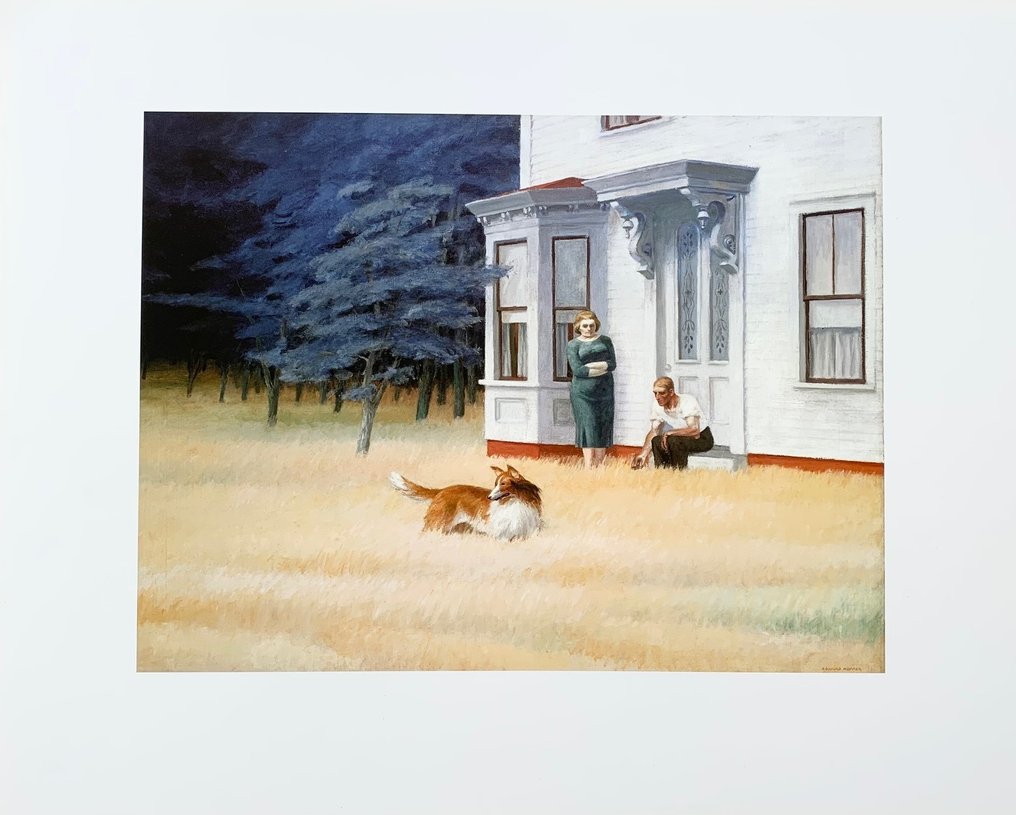
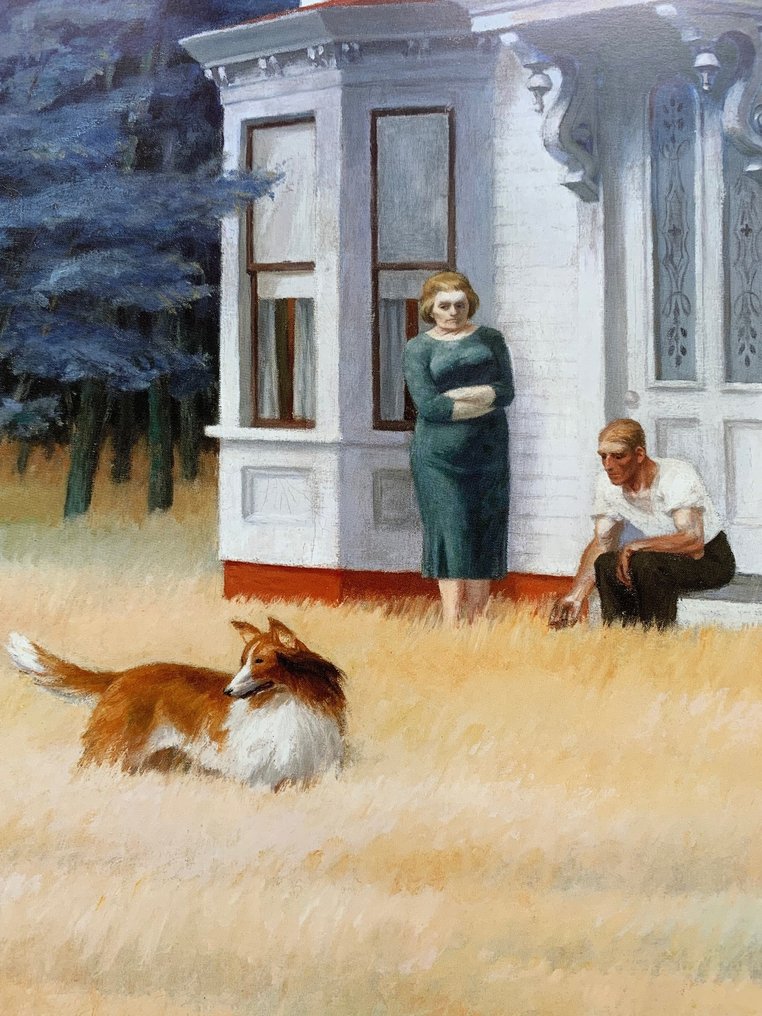
After Edward Hopper - Cape Cod Evening - Artprint - 50 x 40 cm



03
days
05
hours
47
minutes
24
seconds

 | €2 | |
|---|---|---|
| €1 |
Catawiki Buyer Protection
Your payment’s safe with us until you receive your object.View details
Trustpilot 4.4 | 145217 reviews
Rated Excellent on Trustpilot.
A 50 × 40 cm offset-print reproduction after Edward Hopper’s *Cape Cod Evening*, on high-quality paper and in excellent condition.
AI-assisted summary
Description from the seller
Beautiful, colorful art print by Edward Hopper, measuring 40.0 x 50.0 cm, titled Cape Cod Evening. Printed on high-quality paper using offset printing, the work is in perfect, flawless condition.
Artist: Edward Hopper
Title: Cape Cod Evening
Type: Poster art print, reproduction
Technique: Offset print on high-quality paper
Originality: Reproduction
Overall size: 40.0 x 50.0 cm
Condition: flawless condition, like new
Source: Art publisher
Edward Hopper:
Edward Hopper (1882–1967) was an important American painter and printmaker whose realistic depictions of urban and rural life in the United States made him a major 20th-century realist. His works, known for their atmosphere of loneliness and isolation, are deeply rooted in American culture and influenced numerous artists of his time and after.
Hopper’s art shows clear influences from European painters such as Édouard Manet and Edgar Degas. From Manet, he adopted an interest in everyday scenes, and from Degas, the use of unusual viewpoints and a focus on urban life. The influence of Henri Toulouse-Lautrec is also evident in Hopper’s work, particularly in his depictions of figures in interiors.
In the United States, Hopper was strongly influenced by the Ashcan School, a group of artists such as Robert Henri and John Sloan who depicted the everyday lives of the American urban population. This movement, which also included artists such as George Bellows and Edward Weston, laid the groundwork for Hopper’s later works, which often show people in anonymous urban settings.
Hopper’s depictions of architecture and urban scenes have parallels with the work of Charles Sheeler, a co-founder of Precisionism, who emphasized the clear, geometric representation of buildings and industrial landscapes. There is also an affinity with the work of Reginald Marsh, who likewise captured America’s urban landscape and everyday life, though with a stronger focus on the city’s dynamism and movement.
The emotional isolation and melancholy that run through Hopper’s works can also be found in the work of Andrew Wyeth, another American realist who often painted lonely rural scenes. Hopper’s interest in light and shadow, particularly in his depictions of interiors, connects his work with that of Vilhelm Hammershøi, a Danish painter known for his quiet, introspective interiors.
The visual language and narrative quality of Hopper’s art, which often hints at a story, also bring to mind the work of Edward Gorey, an illustrator and author known for his melancholy and often eerie scenes. The cinematic quality of Hopper’s paintings also inspired filmmakers such as Alfred Hitchcock, particularly in their use of light and composition to create a specific mood.
Hopper later influenced contemporary artists such as David Hockney and Gerhard Richter, both of whom further developed aspects of realistic representation and the treatment of light and space in their work. Hockney, particularly in his depictions of California, and Richter in his photorealistic paintings, incorporated elements of Hopper’s analytical view of the world and placed them in new contexts.
Edward Hopper’s works remain a central source of inspiration in art history because they uniquely capture the tension and unease of modern existence. His ability to imbue everyday scenes with profound emotional and psychological layers makes him a timeless and relevant artist.
Artists thematically related to Edward Hopper:
Andrew Wyeth, Grant Wood, Norman Rockwell, Charles Sheeler, John Sloan, George Bellows, Reginald Marsh, Thomas Hart Benton, Robert Henri, Winslow Homer, Childe Hassam, Everett Shinn, Edward Weston, Georgia O'Keeffe
Shipping information:
We roll art prints onto hardboard tubes, pack them in corrugated cardboard, and ship them in specially designed, very sturdy boxes. Shipments are insured and include a tracking number.
About us:
We have been active in the art trade for over 20 years and have extensive experience in the professional handling and shipping of artworks.
- No shipping to the Canary Islands or Taiwan -
Seller's Story
We have been operating several online shops in the art trade for over 20 years. On the one hand, we specialize in rare art prints, exhibition posters and collectible reproductions, and on the other hand, we trade in art editions and originals by well-known contemporary artists.
The works we offer all come from the respective publishers, art galleries and institutions such as museums that published them in close cooperation with the artists. The works you find with us are often several decades old, in perfect or good condition and without a previous private owner.
We place particular emphasis on professional packaging. Nothing is more annoying than purchasing a rare print that arrives damaged due to poor or inadequate packaging.
If you have any questions about the works on offer, we are always happy to help you!
Translated by Google TranslateBeautiful, colorful art print by Edward Hopper, measuring 40.0 x 50.0 cm, titled Cape Cod Evening. Printed on high-quality paper using offset printing, the work is in perfect, flawless condition.
Artist: Edward Hopper
Title: Cape Cod Evening
Type: Poster art print, reproduction
Technique: Offset print on high-quality paper
Originality: Reproduction
Overall size: 40.0 x 50.0 cm
Condition: flawless condition, like new
Source: Art publisher
Edward Hopper:
Edward Hopper (1882–1967) was an important American painter and printmaker whose realistic depictions of urban and rural life in the United States made him a major 20th-century realist. His works, known for their atmosphere of loneliness and isolation, are deeply rooted in American culture and influenced numerous artists of his time and after.
Hopper’s art shows clear influences from European painters such as Édouard Manet and Edgar Degas. From Manet, he adopted an interest in everyday scenes, and from Degas, the use of unusual viewpoints and a focus on urban life. The influence of Henri Toulouse-Lautrec is also evident in Hopper’s work, particularly in his depictions of figures in interiors.
In the United States, Hopper was strongly influenced by the Ashcan School, a group of artists such as Robert Henri and John Sloan who depicted the everyday lives of the American urban population. This movement, which also included artists such as George Bellows and Edward Weston, laid the groundwork for Hopper’s later works, which often show people in anonymous urban settings.
Hopper’s depictions of architecture and urban scenes have parallels with the work of Charles Sheeler, a co-founder of Precisionism, who emphasized the clear, geometric representation of buildings and industrial landscapes. There is also an affinity with the work of Reginald Marsh, who likewise captured America’s urban landscape and everyday life, though with a stronger focus on the city’s dynamism and movement.
The emotional isolation and melancholy that run through Hopper’s works can also be found in the work of Andrew Wyeth, another American realist who often painted lonely rural scenes. Hopper’s interest in light and shadow, particularly in his depictions of interiors, connects his work with that of Vilhelm Hammershøi, a Danish painter known for his quiet, introspective interiors.
The visual language and narrative quality of Hopper’s art, which often hints at a story, also bring to mind the work of Edward Gorey, an illustrator and author known for his melancholy and often eerie scenes. The cinematic quality of Hopper’s paintings also inspired filmmakers such as Alfred Hitchcock, particularly in their use of light and composition to create a specific mood.
Hopper later influenced contemporary artists such as David Hockney and Gerhard Richter, both of whom further developed aspects of realistic representation and the treatment of light and space in their work. Hockney, particularly in his depictions of California, and Richter in his photorealistic paintings, incorporated elements of Hopper’s analytical view of the world and placed them in new contexts.
Edward Hopper’s works remain a central source of inspiration in art history because they uniquely capture the tension and unease of modern existence. His ability to imbue everyday scenes with profound emotional and psychological layers makes him a timeless and relevant artist.
Artists thematically related to Edward Hopper:
Andrew Wyeth, Grant Wood, Norman Rockwell, Charles Sheeler, John Sloan, George Bellows, Reginald Marsh, Thomas Hart Benton, Robert Henri, Winslow Homer, Childe Hassam, Everett Shinn, Edward Weston, Georgia O'Keeffe
Shipping information:
We roll art prints onto hardboard tubes, pack them in corrugated cardboard, and ship them in specially designed, very sturdy boxes. Shipments are insured and include a tracking number.
About us:
We have been active in the art trade for over 20 years and have extensive experience in the professional handling and shipping of artworks.
- No shipping to the Canary Islands or Taiwan -
Seller's Story
We have been operating several online shops in the art trade for over 20 years. On the one hand, we specialize in rare art prints, exhibition posters and collectible reproductions, and on the other hand, we trade in art editions and originals by well-known contemporary artists.
The works we offer all come from the respective publishers, art galleries and institutions such as museums that published them in close cooperation with the artists. The works you find with us are often several decades old, in perfect or good condition and without a previous private owner.
We place particular emphasis on professional packaging. Nothing is more annoying than purchasing a rare print that arrives damaged due to poor or inadequate packaging.
If you have any questions about the works on offer, we are always happy to help you!
Translated by Google TranslateDetails
Era
1900-2000
Designer/artist
After Edward Hopper
Poster title
Cape Cod Evening - Artprint - 50 x 40 cm
Country of origin
Germany
Condition
A (excellent - mint condition)
Height
40 cm
Width
50 cm
Autographed by a famous person
No