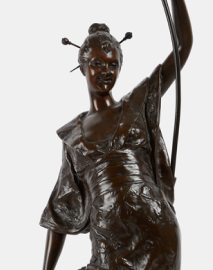
after Pablo Picasso - Sculpture, La Chèvre - 32 cm - Patinated bronze


02
days
03
hours
33
minutes
31
seconds
Current bid
€ 93
Reserve price not met

 | €93 | |
|---|---|---|
 | €90 | |
 | €35 | |
Catawiki Buyer Protection
Your payment’s safe with us until you receive your object.View details
Trustpilot 4.4 | 146014 reviews
Rated Excellent on Trustpilot.
La Chèvre is a posthumous contemporary cast after Pablo Picasso, made from brown-patinated bronze and measuring 32 × 32 × 10 cm.
AI-assisted summary
Description from the seller
(1881 Málaga - 1973 Mougins) after "La Chèvre" (The Goat). Original title Bronze, brown patinated.
Posthumous, contemporary cast after the goat sculpture created by Picasso in 1950 (today in the Musée Picasso in Paris).
Picasso's studio in the pottery town of Vallauris, where he worked from 1948, was located next to a courtyard into which the potters threw their waste – metal pieces and ceramic shards. Picasso — who had a fondness for goats, decided to create a goat in his characteristic experimental manner and searched the courtyard for discarded materials that could point to parts of the animal's body. From these he fashioned a skeleton and filled the sculpture with plaster; a wicker basket forms the thorax; two ceramic jugs were modified as udders; palm fronds determine the tilt of the goat's spine and the length of its snout; metal scraps are consistently used as structural units. First bronze casts of the goat were made in the early 1950s (including at the Museum of Modern Art in New York, cast 1952). H. 88.5 cm; L. approx. 100 cm. After Pablo Picasso (1881 - 1973). Light green patinated bronze. Posthumous, contemporary cast late 20th/early 21st century.
Details
Era
1900-2000
Bronze type
Patinated bronze
Country of origin
France
Style
Contemporary
Material
Bronze
Artist
after Pablo Picasso
Title of artwork
La Chèvre
Signature
Not signed
Edition
open
Colour
Brown
Condition
Excellent condition
Height
32 cm
Width
32 cm
Depth
10 cm
Weight
3 kg
Sold by