Reine - Baule


00
days
22
hours
22
minutes
34
seconds
Starting bid
€ 1
Reserve price not met

Expert
Selected by Julien Gauthier
A decade of experience in historical arms, armour, and African art.
Estimate € 150 - € 200
No bids placed
Catawiki Buyer Protection
Your payment’s safe with us until you receive your object.View details
Trustpilot 4.4 | 145967 reviews
Rated Excellent on Trustpilot.
Description from the seller
Côte d'Ivoire
Baoulé
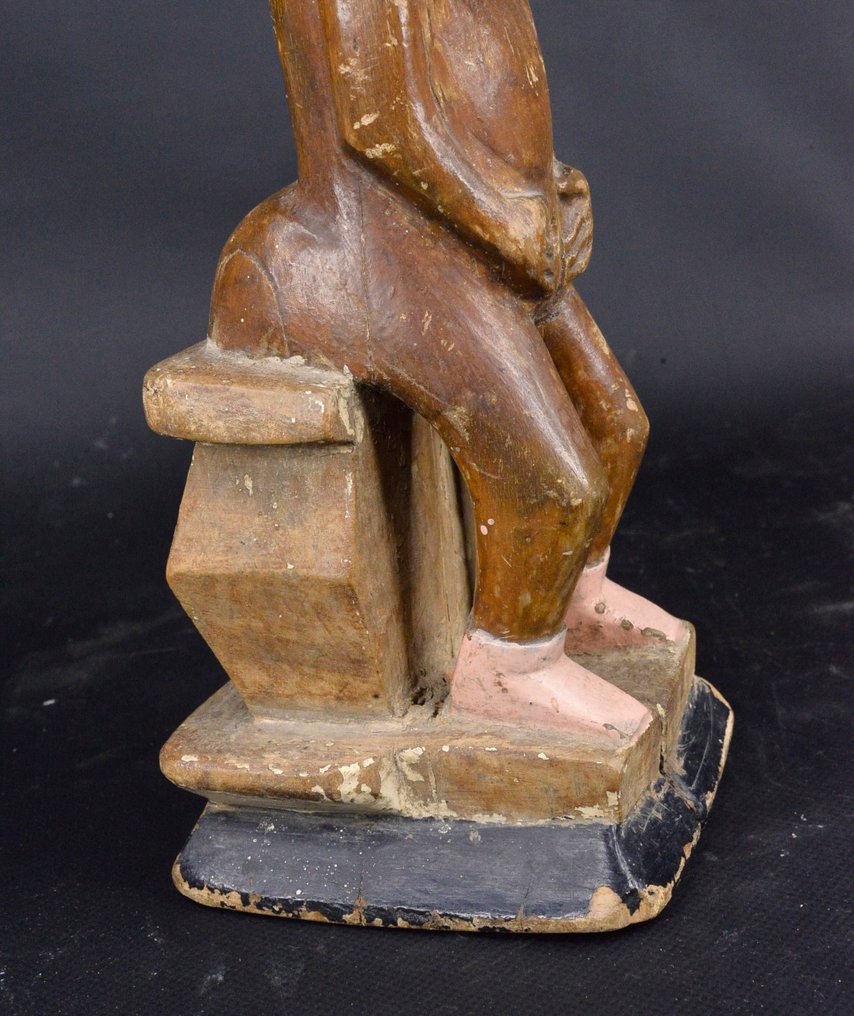
Wood, fine crack at the base in the middle and chips on the left base, small chip at the front of the hairline. see photos.
Height: 310 mm
Width: 6.5+6 cm
Depth: 6+5.5 cm
Baoulé — seated female figure of the Asie Usu type
Côte d’Ivoire — Baoulé culture
Examination of the various views allows attributing to Baoulé, with an identification as a seated female figure of the Asie Usu type, i.e. a representation serving as a receptacle for a nature spirit within the Baoulé divination context.
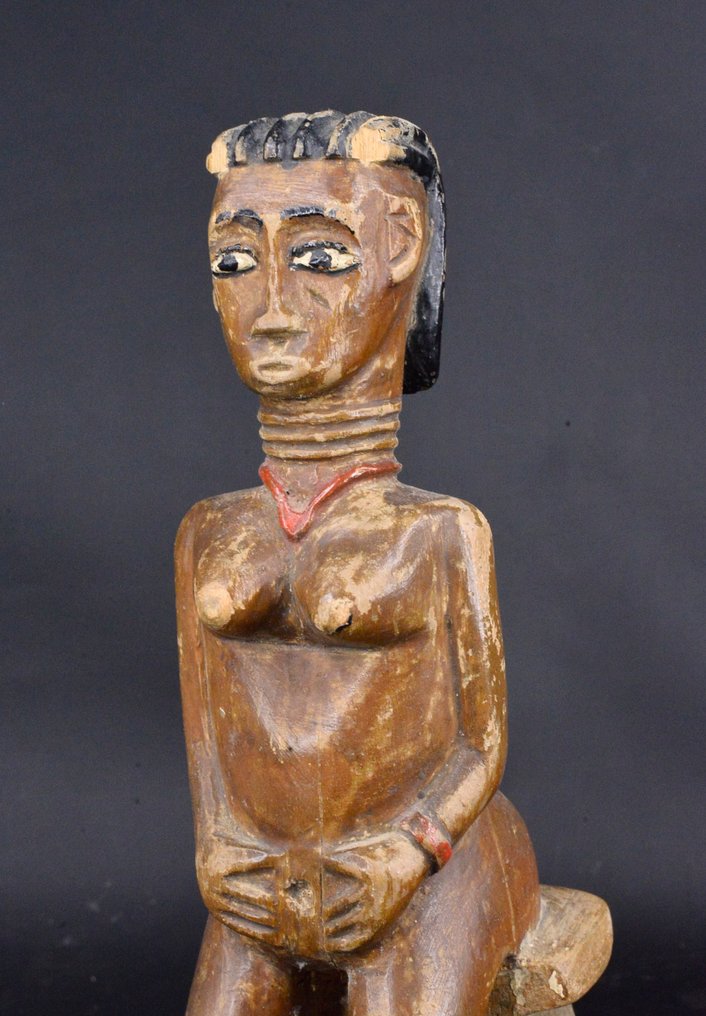
Several elements are particularly significant: the seated position on a chair, the carefully modeled body, the hands joined in front of the abdomen, the long beaded neck, the elaborate coiffure, the intentionally idealized proportions and the naturalistic treatment of the face. The Musée du quai Branly notes that Asie Usu figures can be difficult to distinguish from mystic spouses blolo bla/blolo bian, but documents specifically seated figures on a chair within this corpus.
Geographic origin
Central Côte d’Ivoire — Baoulé cultural area.
The Baoulé mainly occupy the center of Côte d’Ivoire. The Musée du quai Branly describes their statuary as a means of mediation between the human world and the nature spirits usu or busu.
Ethnic group / culture
Baoulé
The sculpture corresponds to the classic Baoulé statuary vocabulary: idealized female body, face with regular features, long neck, worked coiffure, carefully balanced body volumes and a highly individualized representation of the person. The Smithsonian describes this pursuit of beauty and individuality as fundamental to the Baoulé concept of waka sran, literally “person in wood.”
Type of object
Seated female figure — Asie Usu
The seated position is here a key element. The Dapper Museum preserves a Baoulé Asie Usu seated statuette, presented as the representation of a nature spirit, whose seated position refers to a figure vested with authority and capable of intervening in community affairs.
The Musée du quai Branly also preserves a seated Baoulé male figure Asie Usu, where the seat is an important iconographic element and the position is directly associated with the status and authority of the character.
Artistic and stylistic description
The figure is depicted seated, in a particularly upright and composed posture.
The face, slightly elongated, features a high forehead, arched eyebrows, large painted eyes, a fine and straight nose, and a small carefully drawn mouth. The eyes are treated in a very naturalistic manner with a contrast between white and black, giving the face a very present expression.
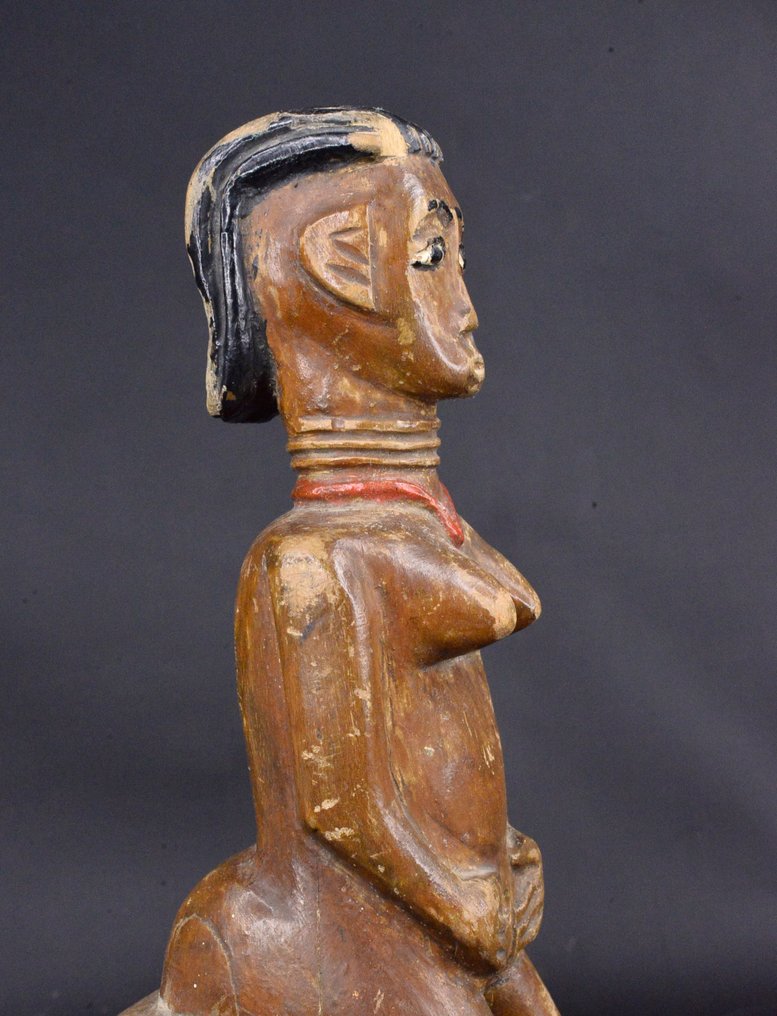
The coiffure is built in parallel bands carefully carved, with a long back part falling behind the head. This treatment aligns with the importance given by the Baoulé to the coiffure as a mark of beauty, status and individuality. The Smithsonian notably notes the role of elaborate coiffure in characterizing Baoulé figures.
The very long neck is organized around several carved rings. Necklaces and neck rings are a motif regularly represented in Baoulé statuary; the Smithsonian describes female figures with ringed necks and the association of these elements with adornment.
The chest is full and carefully modeled. The breasts, belly, hips and thighs are treated with rounded volumes that reflect the Baoulé body canon.
Both arms descend naturally along the body and join in front of the lower abdomen. The hands are carved with clearly individualized fingers.
The lower part shows a figure seated on an architecturally shaped seat, with legs bent and feet resting on the base of the composition.
The back confirms the sculpture’s three-dimensional coherence: the sculptor did not design only a frontal view, but organized the volume of the body, shoulders, back, hips and coiffure across the whole piece.
Materials and technique
Carved wood and polychrome pigments.
The sculpture was entirely carved from wood, then covered with different colors.
Polychromy plays an important role here: brown for the body, black for the coiffure and some details, white for the eyes and pale pink for the feet. A small red area at the neck and a red bracelet complete the coloration.
The Smithsonian preserves a precisely a seated Baoulé female figure, painted wood, with black hair and shoes and neck rings, showing that Baoulé sculpture can incorporate elaborate polychromy in the representation of the figure.
Symbolism
The Baoulé figure is designed as a person, not a mere decorative representation.
In the case of Asie Usu, the sculpture serves as a support for the relationship with a nature spirit. The Quai Branly Museum explains that these spirits, associated with the Earth goddess Asiè, can engage with humans and that their representations must possess the aesthetic qualities sought by these powers.
This pursuit of beauty explains the care given to proportions, coiffure, face, body modeling and ornaments.
The seated position also carries symbolic meaning: Quai Branly explains that it can evoke the position of a character with authority to listen, judge and deal with community affairs.
Function / ritual use
Asie Usu figures are associated with Baoulé divination practices (komien).
They can serve as a receptacle for a nature spirit during divinatory consultations. The Dapper Museum explains that these figures participate in the relationship between the diviner and the invisible forces and can contribute to revealing the origin of difficulties or problems affecting a person.
The Smithsonian also describes Baoulé figures used as intermediaries with the spirits and placed in a cult space where they are honored with offerings.
For this piece, it is appropriate to retain this function of the object type, without asserting a particular ritual use for this exemplar.
Cultural context
Baoulé statuary is closely linked to a worldview in which the living maintain relationships with ancestors, deities and nature spirits.
The term waka sran, “person in wood,” precisely expresses the idea that a successful sculpture should convey the impression of a real person. The Smithsonian stresses the individuality of the character, its beauty, coiffure, ornaments and bearing as constitutive elements of this representation.
The seated position holds a special place in Baoulé sculpture. The Quai Branly links it to Akan material culture influence and the symbolic prestige of the seat.
Comparisons with museum pieces and documented collections
Musée du quai Branly – Jacques Chirac, Paris
Statue masculine seated Asie Usu, Baoulé, Côte d'Ivoire, inv. 70.2017.66.7.
This is a particularly important European reference for the present sculpture. It likewise associates a seated Baoulé figure on a seat, a refined body construction and a representation intended to serve as mediation with the spirits of nature. The museum explicitly notes the special function of the seat and the symbolic importance of this position.
Fondation Dapper, Paris
Statuette Asie Usu, Baoulé, Côte d'Ivoire, inv. 0484, H. 37 cm.
The Foundation Dapper explicitly identifies it as a representation of a nature spirit Asie Usu. It emphasizes the seated position, described as that of a character empowered to manage community affairs.
Centre Pompidou, Paris
Statuette Baoulé, Genie Asie Usu, inv. AM 1984-328, wood, beads, fabric and pigments.
This work provides a direct French institutional reference to the Asie Usu corpus. Centre Pompidou catalogs it explicitly as a Baoulé statuette representing a Genie Asie Usu.
Museum Barbier-Mueller, Geneva
The Barbier-Mueller collections are a major reference for Baoulé art. The museum houses Baoulé works and notes, in its documentation, the works of Susan Vogel, Jean-Paul Barbier and Alain-Michel Boyer devoted to Baoulé statuary and systems of representation.
National Museum of African Art – Smithsonian Institution, Washington
Female Figure, Baoulé, inv. 69-25-1, wood and paint, 47 cm.
This piece is a particularly interesting comparison: it is seated on a stool, has a strongly modeled female body, black coiffure, body polychromy, painted shoes and neck rings. The Smithsonian interprets it as a representation of a blolo bla, wife of the beyond.
The comparison also shows the formal proximity between several categories of Baoulé spiritual figures; the Quai Branly Museum itself notes that Asie Usu can be difficult to distinguish from blolo bla and blolo bian.
Dallas Museum of Art
The Dallas Museum of Art preserves several Baoulé sculptures connected to the world of spirits, notably a seated male figure. The museum explicitly links this statuary to divinatory practices and to Asie Usu spirits.
Nasher Museum of Art at Duke University
The museum also houses a Seated female figure (blolo bla) of the Baoulé, confirming the importance of the seated female type in the corpus of figures related to the Baoulé invisible world.
Bibliography / sources
• Alain-Michel Boyer, Baule, 5 Continents, Milan.
• Susan M. Vogel, Baule: African Art, Western Eyes, Yale University Press. The Quai Branly bibliography refers to this work for the study of Baoulé statuary.
• Susan M. Vogel, L'Art baoulé, du visible et de l'invisible, Adam Biro.
• Eberhard Fischer & Lorenz Homberger, Les Maîtres de la sculpture de Côte d'Ivoire, Musée du quai Branly / Skira.
• Musée du quai Branly – Jacques Chirac, documentation on the Asie Usu Baoulé figures.
• Fondation Dapper, Statuette, Baule, Côte d'Ivoire, inv. 0484.
• Centre Pompidou, Statuette Baoulé, Génie Asie Usu, inv. AM 1984-328.
• National Museum of African Art, Smithsonian Institution, Female Figure, inv. 69-25-1.
• Dallas Museum of Art, Seated male figure, Baule.
Shipping with tracking number.
Fast and secure shipping in France via Chronopost in 1 to 2 days and 3 to 5 days within the European Union and in the rest of Europe and around the world with Colissimo International.
mask african art Afrikanische Maskenkunst arte de máscaras africanas arte delle maschere africane
statue african art Arte de estatuas africanas arte delle statue africane Afrikanische Maskenkunst
Seller's Story
Passionate about World Arts and more specifically about African Art, we buy from collectors, former officials, military, health workers, public works staff who have worked in Africa and also in Côte d'Ivoire, from antique dealers and traders who roam across West Africa to find quality objects.
It is with pride that we present works that, beyond their power to beautify spaces, invite our collectors to resonate with the richness and depth of human expression through the most authentic art.
At Arts Ethniques Gallery, we have the privilege of offering our visitors an exclusive selection of artworks, all unique and original. Each piece presented is the outcome of a demanding artistic approach, driven by a singular vision and mastered craftsmanship, all elements that guarantee authenticity and value.
The works we offer are not industrial reproductions. They are individual creations, crafted with sensitivity and precision, each bearing its own story, identity and presence. Originality is the very foundation of our commitment to excellence. Thus, every mask and every statue in our collection is the subject of a rigorous selection, in order to preserve their rarity and singularity.
Acquiring a work from Arts Ethniques Gallery means owning a truly unique piece: a creation that embodies both talent, cultural memory and the expressive force of African art. It is also a lasting investment in a work whose artistic and emotional value transcends time.
We guarantee that every work leaving our gallery is an authentic piece, without replicas, bearing witness to the creativity, heritage and passion of the African artists who shaped them.
We invite you to participate in our gallery’s auctions with confidence. Each presented work is an original, unique and irreplaceable creation, selected with the greatest rigor to guarantee its authenticity and artistic value.
Whether you wish to enrich a personal collection or introduce an exceptional artwork into your space, Arts Ethniques Gallery offers a safe, transparent and professional setting to acquire remarkable pieces.
Art auctions are a privileged moment to discover rare works, capable of becoming the heart of a collection. Acquiring a work at our sales is not just buying an object: it is investing in a creation whose aesthetic value and cultural reach reinforce over time.
The pieces presented by Arts Ethniques Gallery testify not only to the talent and vision of the artists but also possess the ability to transform spaces and enrich the gaze of those who behold them.
Participating in our auctions is taking part in a singular experience, where the passion for art meets the rigors of collecting. Bidding on a work from Arts Ethniques Gallery goes beyond a simple transaction: it is a gesture of commitment and appreciation for art in its most authentic form.
We invite you to bid with passion and to join us in this adventure dedicated to discovery, transmission and celebration of art.
Perhaps your next heart piece is already waiting for you."
Translated by Google TranslateCôte d'Ivoire
Baoulé
Wood, fine crack at the base in the middle and chips on the left base, small chip at the front of the hairline. see photos.
Height: 310 mm
Width: 6.5+6 cm
Depth: 6+5.5 cm
Baoulé — seated female figure of the Asie Usu type
Côte d’Ivoire — Baoulé culture
Examination of the various views allows attributing to Baoulé, with an identification as a seated female figure of the Asie Usu type, i.e. a representation serving as a receptacle for a nature spirit within the Baoulé divination context.
Several elements are particularly significant: the seated position on a chair, the carefully modeled body, the hands joined in front of the abdomen, the long beaded neck, the elaborate coiffure, the intentionally idealized proportions and the naturalistic treatment of the face. The Musée du quai Branly notes that Asie Usu figures can be difficult to distinguish from mystic spouses blolo bla/blolo bian, but documents specifically seated figures on a chair within this corpus.
Geographic origin
Central Côte d’Ivoire — Baoulé cultural area.
The Baoulé mainly occupy the center of Côte d’Ivoire. The Musée du quai Branly describes their statuary as a means of mediation between the human world and the nature spirits usu or busu.
Ethnic group / culture
Baoulé
The sculpture corresponds to the classic Baoulé statuary vocabulary: idealized female body, face with regular features, long neck, worked coiffure, carefully balanced body volumes and a highly individualized representation of the person. The Smithsonian describes this pursuit of beauty and individuality as fundamental to the Baoulé concept of waka sran, literally “person in wood.”
Type of object
Seated female figure — Asie Usu
The seated position is here a key element. The Dapper Museum preserves a Baoulé Asie Usu seated statuette, presented as the representation of a nature spirit, whose seated position refers to a figure vested with authority and capable of intervening in community affairs.
The Musée du quai Branly also preserves a seated Baoulé male figure Asie Usu, where the seat is an important iconographic element and the position is directly associated with the status and authority of the character.
Artistic and stylistic description
The figure is depicted seated, in a particularly upright and composed posture.
The face, slightly elongated, features a high forehead, arched eyebrows, large painted eyes, a fine and straight nose, and a small carefully drawn mouth. The eyes are treated in a very naturalistic manner with a contrast between white and black, giving the face a very present expression.
The coiffure is built in parallel bands carefully carved, with a long back part falling behind the head. This treatment aligns with the importance given by the Baoulé to the coiffure as a mark of beauty, status and individuality. The Smithsonian notably notes the role of elaborate coiffure in characterizing Baoulé figures.
The very long neck is organized around several carved rings. Necklaces and neck rings are a motif regularly represented in Baoulé statuary; the Smithsonian describes female figures with ringed necks and the association of these elements with adornment.
The chest is full and carefully modeled. The breasts, belly, hips and thighs are treated with rounded volumes that reflect the Baoulé body canon.
Both arms descend naturally along the body and join in front of the lower abdomen. The hands are carved with clearly individualized fingers.
The lower part shows a figure seated on an architecturally shaped seat, with legs bent and feet resting on the base of the composition.
The back confirms the sculpture’s three-dimensional coherence: the sculptor did not design only a frontal view, but organized the volume of the body, shoulders, back, hips and coiffure across the whole piece.
Materials and technique
Carved wood and polychrome pigments.
The sculpture was entirely carved from wood, then covered with different colors.
Polychromy plays an important role here: brown for the body, black for the coiffure and some details, white for the eyes and pale pink for the feet. A small red area at the neck and a red bracelet complete the coloration.
The Smithsonian preserves a precisely a seated Baoulé female figure, painted wood, with black hair and shoes and neck rings, showing that Baoulé sculpture can incorporate elaborate polychromy in the representation of the figure.
Symbolism
The Baoulé figure is designed as a person, not a mere decorative representation.
In the case of Asie Usu, the sculpture serves as a support for the relationship with a nature spirit. The Quai Branly Museum explains that these spirits, associated with the Earth goddess Asiè, can engage with humans and that their representations must possess the aesthetic qualities sought by these powers.
This pursuit of beauty explains the care given to proportions, coiffure, face, body modeling and ornaments.
The seated position also carries symbolic meaning: Quai Branly explains that it can evoke the position of a character with authority to listen, judge and deal with community affairs.
Function / ritual use
Asie Usu figures are associated with Baoulé divination practices (komien).
They can serve as a receptacle for a nature spirit during divinatory consultations. The Dapper Museum explains that these figures participate in the relationship between the diviner and the invisible forces and can contribute to revealing the origin of difficulties or problems affecting a person.
The Smithsonian also describes Baoulé figures used as intermediaries with the spirits and placed in a cult space where they are honored with offerings.
For this piece, it is appropriate to retain this function of the object type, without asserting a particular ritual use for this exemplar.
Cultural context
Baoulé statuary is closely linked to a worldview in which the living maintain relationships with ancestors, deities and nature spirits.
The term waka sran, “person in wood,” precisely expresses the idea that a successful sculpture should convey the impression of a real person. The Smithsonian stresses the individuality of the character, its beauty, coiffure, ornaments and bearing as constitutive elements of this representation.
The seated position holds a special place in Baoulé sculpture. The Quai Branly links it to Akan material culture influence and the symbolic prestige of the seat.
Comparisons with museum pieces and documented collections
Musée du quai Branly – Jacques Chirac, Paris
Statue masculine seated Asie Usu, Baoulé, Côte d'Ivoire, inv. 70.2017.66.7.
This is a particularly important European reference for the present sculpture. It likewise associates a seated Baoulé figure on a seat, a refined body construction and a representation intended to serve as mediation with the spirits of nature. The museum explicitly notes the special function of the seat and the symbolic importance of this position.
Fondation Dapper, Paris
Statuette Asie Usu, Baoulé, Côte d'Ivoire, inv. 0484, H. 37 cm.
The Foundation Dapper explicitly identifies it as a representation of a nature spirit Asie Usu. It emphasizes the seated position, described as that of a character empowered to manage community affairs.
Centre Pompidou, Paris
Statuette Baoulé, Genie Asie Usu, inv. AM 1984-328, wood, beads, fabric and pigments.
This work provides a direct French institutional reference to the Asie Usu corpus. Centre Pompidou catalogs it explicitly as a Baoulé statuette representing a Genie Asie Usu.
Museum Barbier-Mueller, Geneva
The Barbier-Mueller collections are a major reference for Baoulé art. The museum houses Baoulé works and notes, in its documentation, the works of Susan Vogel, Jean-Paul Barbier and Alain-Michel Boyer devoted to Baoulé statuary and systems of representation.
National Museum of African Art – Smithsonian Institution, Washington
Female Figure, Baoulé, inv. 69-25-1, wood and paint, 47 cm.
This piece is a particularly interesting comparison: it is seated on a stool, has a strongly modeled female body, black coiffure, body polychromy, painted shoes and neck rings. The Smithsonian interprets it as a representation of a blolo bla, wife of the beyond.
The comparison also shows the formal proximity between several categories of Baoulé spiritual figures; the Quai Branly Museum itself notes that Asie Usu can be difficult to distinguish from blolo bla and blolo bian.
Dallas Museum of Art
The Dallas Museum of Art preserves several Baoulé sculptures connected to the world of spirits, notably a seated male figure. The museum explicitly links this statuary to divinatory practices and to Asie Usu spirits.
Nasher Museum of Art at Duke University
The museum also houses a Seated female figure (blolo bla) of the Baoulé, confirming the importance of the seated female type in the corpus of figures related to the Baoulé invisible world.
Bibliography / sources
• Alain-Michel Boyer, Baule, 5 Continents, Milan.
• Susan M. Vogel, Baule: African Art, Western Eyes, Yale University Press. The Quai Branly bibliography refers to this work for the study of Baoulé statuary.
• Susan M. Vogel, L'Art baoulé, du visible et de l'invisible, Adam Biro.
• Eberhard Fischer & Lorenz Homberger, Les Maîtres de la sculpture de Côte d'Ivoire, Musée du quai Branly / Skira.
• Musée du quai Branly – Jacques Chirac, documentation on the Asie Usu Baoulé figures.
• Fondation Dapper, Statuette, Baule, Côte d'Ivoire, inv. 0484.
• Centre Pompidou, Statuette Baoulé, Génie Asie Usu, inv. AM 1984-328.
• National Museum of African Art, Smithsonian Institution, Female Figure, inv. 69-25-1.
• Dallas Museum of Art, Seated male figure, Baule.
Shipping with tracking number.
Fast and secure shipping in France via Chronopost in 1 to 2 days and 3 to 5 days within the European Union and in the rest of Europe and around the world with Colissimo International.
mask african art Afrikanische Maskenkunst arte de máscaras africanas arte delle maschere africane
statue african art Arte de estatuas africanas arte delle statue africane Afrikanische Maskenkunst
Seller's Story
Passionate about World Arts and more specifically about African Art, we buy from collectors, former officials, military, health workers, public works staff who have worked in Africa and also in Côte d'Ivoire, from antique dealers and traders who roam across West Africa to find quality objects.
It is with pride that we present works that, beyond their power to beautify spaces, invite our collectors to resonate with the richness and depth of human expression through the most authentic art.
At Arts Ethniques Gallery, we have the privilege of offering our visitors an exclusive selection of artworks, all unique and original. Each piece presented is the outcome of a demanding artistic approach, driven by a singular vision and mastered craftsmanship, all elements that guarantee authenticity and value.
The works we offer are not industrial reproductions. They are individual creations, crafted with sensitivity and precision, each bearing its own story, identity and presence. Originality is the very foundation of our commitment to excellence. Thus, every mask and every statue in our collection is the subject of a rigorous selection, in order to preserve their rarity and singularity.
Acquiring a work from Arts Ethniques Gallery means owning a truly unique piece: a creation that embodies both talent, cultural memory and the expressive force of African art. It is also a lasting investment in a work whose artistic and emotional value transcends time.
We guarantee that every work leaving our gallery is an authentic piece, without replicas, bearing witness to the creativity, heritage and passion of the African artists who shaped them.
We invite you to participate in our gallery’s auctions with confidence. Each presented work is an original, unique and irreplaceable creation, selected with the greatest rigor to guarantee its authenticity and artistic value.
Whether you wish to enrich a personal collection or introduce an exceptional artwork into your space, Arts Ethniques Gallery offers a safe, transparent and professional setting to acquire remarkable pieces.
Art auctions are a privileged moment to discover rare works, capable of becoming the heart of a collection. Acquiring a work at our sales is not just buying an object: it is investing in a creation whose aesthetic value and cultural reach reinforce over time.
The pieces presented by Arts Ethniques Gallery testify not only to the talent and vision of the artists but also possess the ability to transform spaces and enrich the gaze of those who behold them.
Participating in our auctions is taking part in a singular experience, where the passion for art meets the rigors of collecting. Bidding on a work from Arts Ethniques Gallery goes beyond a simple transaction: it is a gesture of commitment and appreciation for art in its most authentic form.
We invite you to bid with passion and to join us in this adventure dedicated to discovery, transmission and celebration of art.
Perhaps your next heart piece is already waiting for you."
Translated by Google TranslateDetails
Ethnic group/ culture
Baule
Material
Wood
Sold with stand
No
Condition
Fair condition
Title of artwork
Reine
Sold by
