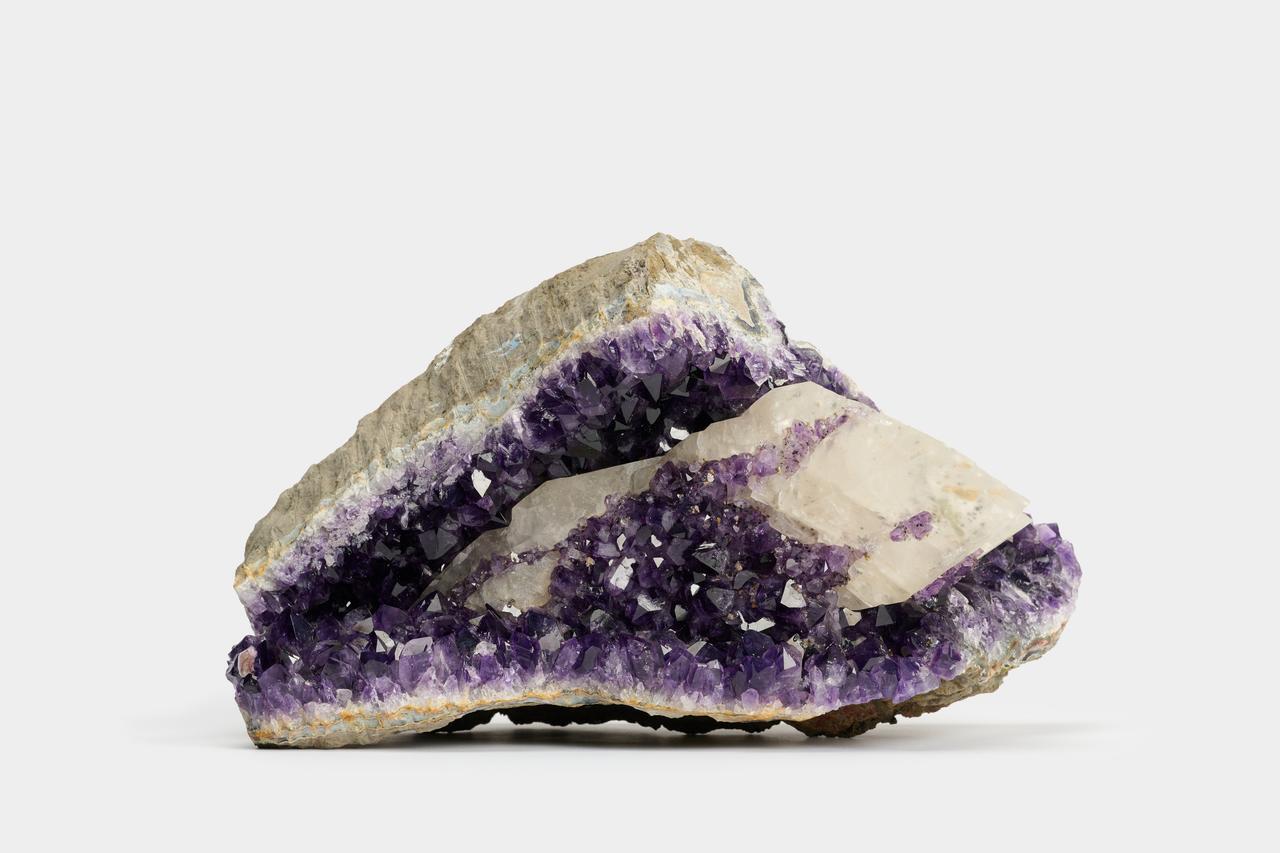
Polished agate egg with a translucent gray-lavender tone. Natural Crystal Drusa - Height: 80 mm - Width: 57 mm- 335 g - (1)


00
days
04
hours
25
minutes
24
seconds
Current bid
€ 3
No reserve price

Expert
Selected by Georgia Foteinou
Holds BSc in geology and post-graduate qualifications in geochemistry.
Estimate € 150 - € 200
 | €3 |
|---|
Catawiki Buyer Protection
Your payment’s safe with us until you receive your object.View details
Trustpilot 4.4 | 146393 reviews
Rated Excellent on Trustpilot.
This polished agate geode egg from Brazil has translucent grey-lavender tones and a natural quartz crystal druse.
AI-assisted summary
Description from the seller
Polished Agate Geode Egg from Brazil — An elegant egg carved from a Brazilian agate geode. This specimen fuses the perfection of a smooth form with the raw beauty of a natural crystal cavity, creating a visual dialogue between human intervention and geological process. Its main feature lies in the evocative contrast between the glossy exterior surface and the sparkling core, which reveals the geode origin of the mineral. The ovate, compact, and well-proportioned shape was achieved through careful polishing that enhances the smooth, tactile surface and its brilliant appearance. The color palette is dominated by delicate shades of lavender-gray and translucent white, blending into concentric bands typical of agate. In some areas, the translucency of chalcedony allows light to penetrate, revealing depth and the intricate internal stratification of the mineral. The heart of the piece is its geode cavity, left intact to show its original structure. The edge of the cavity is defined by a lighter chalcedony layer, framing a druse of microcrystals of quartz. These countless crystal points capture light from every angle, sparkling and creating a clear material contrast with the polished part. Inside one of the translucent sections, small dark pinpoint inclusions can be seen, adding another level of detail and uniqueness. Rotating the egg reveals ever-changing perspectives. One side features more defined, darker bands, creating almost graphic patterns. The other side shows the more uniform mass of gray-blue chalcedony, interrupted only by the small window into the inner druse. These variations attest to the geode's complex growth history, making the object a small mineral world to explore. The genesis of such a piece dates back millions of years. Agates form inside volcanic rocks, where trapped gas bubbles create cavities. Over geological eons, fluids rich in silicon dioxide slowly percolate through the rock, depositing ultra-thin layers of chalcedony on the cavity walls. This slow, repetitive process creates the characteristic colored bands. Sometimes, as in this case, the cavity is not completely filled, leaving a hollow space in which quartz crystals can develop more distinctly. This agate geode egg is a perfect example of how natural beauty can be enhanced by human hands. It is not only a decorative object but a fragment of Earth's history, ideal for enriching a mineral collection, a contemporary Cabinet of Curiosities, or as a sculptural piece on a desk, a bookshelf, or in a display case. Its symbolic form and material duality make it an object of timeless fascination. Technical details Name: Geode Agate Classification: Mineral, quartz variety Origin: Brazil Dimensions: 80 x 56.5 x 56.5 mm Weight: 335 g Conditions: Object worked and polished from natural mineral. The geode cavity, inclusions, and irregularities are intrinsic characteristics of the material. Treatments: None.
Seller's Story
The Mineral Art Gallery offers minerals, fossils, shells and natural elements.
Born in Italy in 2017, today she collaborates with international galleries and collectors, she is a direct importer of large minerals and naturalistic collectible elements; deals with the processing to insert them inside the living space. A section of the gallery was dedicated to the Wunderkammer, "chamber of wonders or cabinet of curiosities" in which Mirabilia elements are presented: naturalia and italiania, a union between "the present is the past".
All lots are shipped via DHL Express and Fercam couriers, with insured parcel and tracking.
Translated by Google TranslatePolished Agate Geode Egg from Brazil — An elegant egg carved from a Brazilian agate geode. This specimen fuses the perfection of a smooth form with the raw beauty of a natural crystal cavity, creating a visual dialogue between human intervention and geological process. Its main feature lies in the evocative contrast between the glossy exterior surface and the sparkling core, which reveals the geode origin of the mineral. The ovate, compact, and well-proportioned shape was achieved through careful polishing that enhances the smooth, tactile surface and its brilliant appearance. The color palette is dominated by delicate shades of lavender-gray and translucent white, blending into concentric bands typical of agate. In some areas, the translucency of chalcedony allows light to penetrate, revealing depth and the intricate internal stratification of the mineral. The heart of the piece is its geode cavity, left intact to show its original structure. The edge of the cavity is defined by a lighter chalcedony layer, framing a druse of microcrystals of quartz. These countless crystal points capture light from every angle, sparkling and creating a clear material contrast with the polished part. Inside one of the translucent sections, small dark pinpoint inclusions can be seen, adding another level of detail and uniqueness. Rotating the egg reveals ever-changing perspectives. One side features more defined, darker bands, creating almost graphic patterns. The other side shows the more uniform mass of gray-blue chalcedony, interrupted only by the small window into the inner druse. These variations attest to the geode's complex growth history, making the object a small mineral world to explore. The genesis of such a piece dates back millions of years. Agates form inside volcanic rocks, where trapped gas bubbles create cavities. Over geological eons, fluids rich in silicon dioxide slowly percolate through the rock, depositing ultra-thin layers of chalcedony on the cavity walls. This slow, repetitive process creates the characteristic colored bands. Sometimes, as in this case, the cavity is not completely filled, leaving a hollow space in which quartz crystals can develop more distinctly. This agate geode egg is a perfect example of how natural beauty can be enhanced by human hands. It is not only a decorative object but a fragment of Earth's history, ideal for enriching a mineral collection, a contemporary Cabinet of Curiosities, or as a sculptural piece on a desk, a bookshelf, or in a display case. Its symbolic form and material duality make it an object of timeless fascination. Technical details Name: Geode Agate Classification: Mineral, quartz variety Origin: Brazil Dimensions: 80 x 56.5 x 56.5 mm Weight: 335 g Conditions: Object worked and polished from natural mineral. The geode cavity, inclusions, and irregularities are intrinsic characteristics of the material. Treatments: None.
Seller's Story
The Mineral Art Gallery offers minerals, fossils, shells and natural elements.
Born in Italy in 2017, today she collaborates with international galleries and collectors, she is a direct importer of large minerals and naturalistic collectible elements; deals with the processing to insert them inside the living space. A section of the gallery was dedicated to the Wunderkammer, "chamber of wonders or cabinet of curiosities" in which Mirabilia elements are presented: naturalia and italiania, a union between "the present is the past".
All lots are shipped via DHL Express and Fercam couriers, with insured parcel and tracking.
Translated by Google TranslateDetails
Number of objects
1
Main mineral
Polished agate egg with a translucent gray-lavender tone.
Mineral form
Natural Crystal Drusa
Supplement
Agata's Egg
Weight
335 g
Country of origin
Brazil
Height
80 mm
Width
57 mm
Depth
57 mm
Sold by