Protective talisman - Songye - DR Congo


06
days
15
hours
43
minutes
36
seconds
Current bid
€ 65
Reserve price not met

Expert
Selected by Dimitri André
Holds a postgraduate degree in African studies and 15 years experience in African art.
Estimate € 280 - € 330
 | €65 |
|---|
Catawiki Buyer Protection
Your payment’s safe with us until you receive your object.View details
Trustpilot 4.4 | 145879 reviews
Rated Excellent on Trustpilot.
Description from the seller
Congo (ex-Zaïre)
Songyé
Wood, bells, beads, cord, horn, metal necklace
Height: 385mm + base 45mm
Width: 105mm
Depth: 105mm
Weight: 1570g
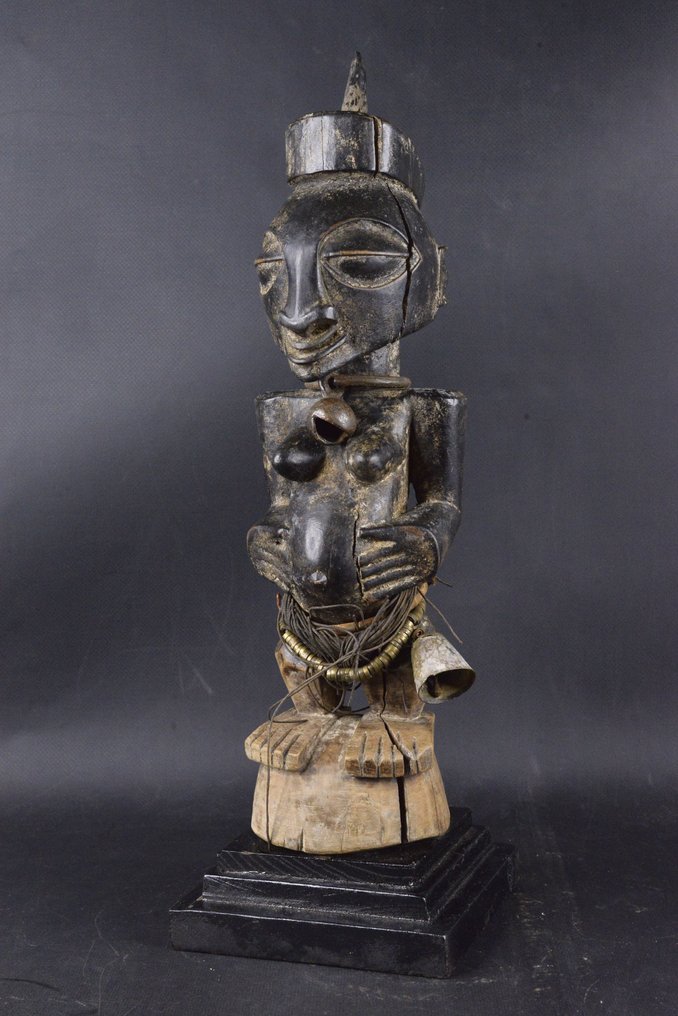
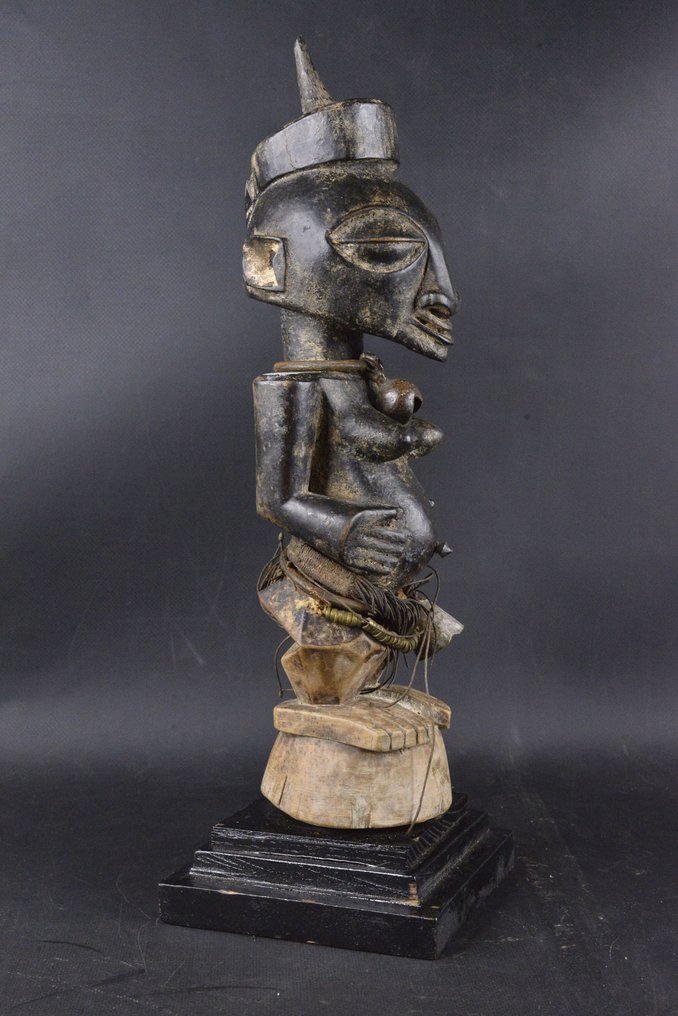
Crack on the left side, see photos.
This 38.5 cm tall wooden sculpture is a protective effigy from the Songye people (or Songe), an ethnic group established in the south-central region of the Democratic Republic of the Congo (DRC), along the Lomami River.
Here are the details concerning its stylistic origin and ritual use:
1. Stylistic Features (The Songye Aesthetics)
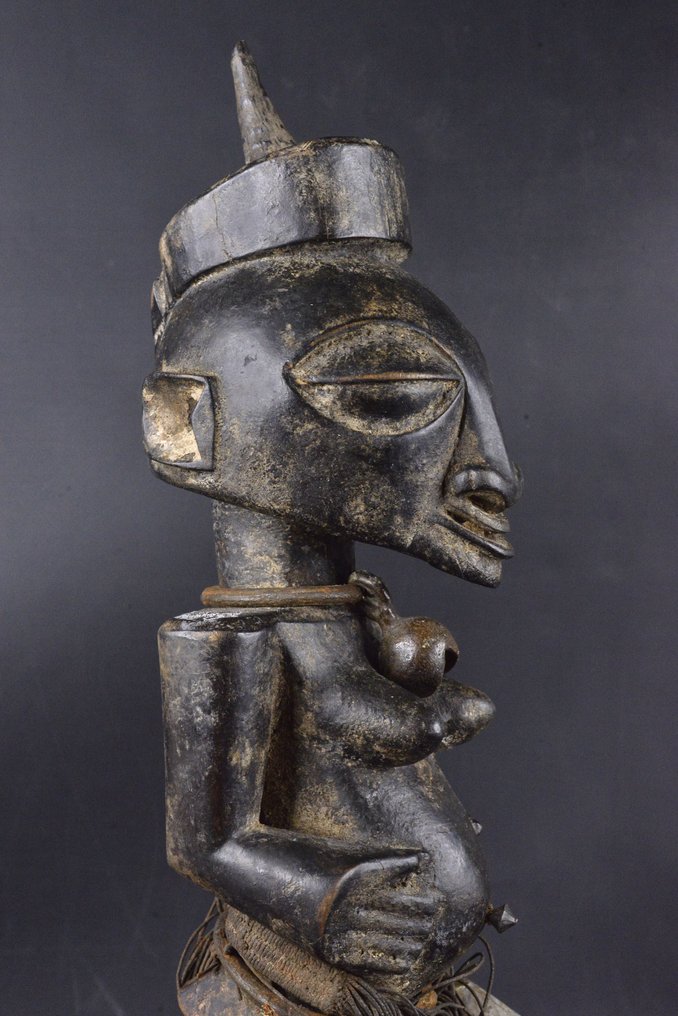
The horned crown: The top of the head is crowned with a real animal horn (often an antelope or goat horn). It is the quintessential marker of spiritual power among the Songye, functioning as an antenna to the invisible world.
Face treatment: The face features large almond-shaped or "coffee bean" eyes, a strong triangular nose, and a relief-sculpted mouth, often slightly open or protruding. The head bears a geometric cap or scalp carved from the mass.
Exogenous and ritual elements: The statue retains its original attributes tied around the neck and waist: a metal bell (jingle bell), leather cords or thongs, and a belt of beads or metal rings. These elements are not decorative; they serve to activate and amplify the object's power.
Posture: The hands are sculpted schematically and grasp a notably rounded abdomen. It is at this point (the navel), or sometimes at the top of the head beneath the horn, that a cavity is traditionally carved to house the magical charge.
2. Use and Meaning: The Nkishi
In Songye culture, this statuette is called a Nkishi (plural Mankishi). It is a major magico-religious object, designed as a dynamic protector:
The receptacle of the magical charge (Bishimba): The wooden statue is only the bodily envelope. It is the nganga (the diviner-healer) who gives it power by inserting the Bishimba, a secret mixture of ritual substances (sacred soils, plants, plant fibers from powerful animals like lions or leopards).
Role of community or family protection: Given its size (38.5 cm), it can be a large family Nkishi or an intermediate community model. It is carved to protect the home or village against witchcraft, epidemics, malevolent spirits, or to ensure hunting success and women's fertility.
Link with justice and authority: The Mankishi act as guardians of social and moral order. They are invoked through offerings and prayers to obtain redress or to repel an imminent invisible threat.
In summary, this work is a classic and complete example of Songye Nkishi statuary, where the cubist expression of the sculpture blends with ritual elements to form a powerful spiritual shield.
The items are shipped with tracking number.
Delivery in France by Chronopost in 1 to 2 days. Delivery in the European Union by Chronopost International in 3 to 5 days. Delivery by Colissimo International for the rest of Europe and for the whole world.
We speak english.
Seller's Story
Passionate about World Arts and more specifically about African Art, we buy from collectors, former officials, military, health workers, public works staff who have worked in Africa and also in Côte d'Ivoire, from antique dealers and traders who roam across West Africa to find quality objects.
It is with pride that we present works that, beyond their power to beautify spaces, invite our collectors to resonate with the richness and depth of human expression through the most authentic art.
At Arts Ethniques Gallery, we have the privilege of offering our visitors an exclusive selection of artworks, all unique and original. Each piece presented is the outcome of a demanding artistic approach, driven by a singular vision and mastered craftsmanship, all elements that guarantee authenticity and value.
The works we offer are not industrial reproductions. They are individual creations, crafted with sensitivity and precision, each bearing its own story, identity and presence. Originality is the very foundation of our commitment to excellence. Thus, every mask and every statue in our collection is the subject of a rigorous selection, in order to preserve their rarity and singularity.
Acquiring a work from Arts Ethniques Gallery means owning a truly unique piece: a creation that embodies both talent, cultural memory and the expressive force of African art. It is also a lasting investment in a work whose artistic and emotional value transcends time.
We guarantee that every work leaving our gallery is an authentic piece, without replicas, bearing witness to the creativity, heritage and passion of the African artists who shaped them.
We invite you to participate in our gallery’s auctions with confidence. Each presented work is an original, unique and irreplaceable creation, selected with the greatest rigor to guarantee its authenticity and artistic value.
Whether you wish to enrich a personal collection or introduce an exceptional artwork into your space, Arts Ethniques Gallery offers a safe, transparent and professional setting to acquire remarkable pieces.
Art auctions are a privileged moment to discover rare works, capable of becoming the heart of a collection. Acquiring a work at our sales is not just buying an object: it is investing in a creation whose aesthetic value and cultural reach reinforce over time.
The pieces presented by Arts Ethniques Gallery testify not only to the talent and vision of the artists but also possess the ability to transform spaces and enrich the gaze of those who behold them.
Participating in our auctions is taking part in a singular experience, where the passion for art meets the rigors of collecting. Bidding on a work from Arts Ethniques Gallery goes beyond a simple transaction: it is a gesture of commitment and appreciation for art in its most authentic form.
We invite you to bid with passion and to join us in this adventure dedicated to discovery, transmission and celebration of art.
Perhaps your next heart piece is already waiting for you."
Translated by Google TranslateCongo (ex-Zaïre)
Songyé
Wood, bells, beads, cord, horn, metal necklace
Height: 385mm + base 45mm
Width: 105mm
Depth: 105mm
Weight: 1570g
Crack on the left side, see photos.
This 38.5 cm tall wooden sculpture is a protective effigy from the Songye people (or Songe), an ethnic group established in the south-central region of the Democratic Republic of the Congo (DRC), along the Lomami River.
Here are the details concerning its stylistic origin and ritual use:
1. Stylistic Features (The Songye Aesthetics)
The horned crown: The top of the head is crowned with a real animal horn (often an antelope or goat horn). It is the quintessential marker of spiritual power among the Songye, functioning as an antenna to the invisible world.
Face treatment: The face features large almond-shaped or "coffee bean" eyes, a strong triangular nose, and a relief-sculpted mouth, often slightly open or protruding. The head bears a geometric cap or scalp carved from the mass.
Exogenous and ritual elements: The statue retains its original attributes tied around the neck and waist: a metal bell (jingle bell), leather cords or thongs, and a belt of beads or metal rings. These elements are not decorative; they serve to activate and amplify the object's power.
Posture: The hands are sculpted schematically and grasp a notably rounded abdomen. It is at this point (the navel), or sometimes at the top of the head beneath the horn, that a cavity is traditionally carved to house the magical charge.
2. Use and Meaning: The Nkishi
In Songye culture, this statuette is called a Nkishi (plural Mankishi). It is a major magico-religious object, designed as a dynamic protector:
The receptacle of the magical charge (Bishimba): The wooden statue is only the bodily envelope. It is the nganga (the diviner-healer) who gives it power by inserting the Bishimba, a secret mixture of ritual substances (sacred soils, plants, plant fibers from powerful animals like lions or leopards).
Role of community or family protection: Given its size (38.5 cm), it can be a large family Nkishi or an intermediate community model. It is carved to protect the home or village against witchcraft, epidemics, malevolent spirits, or to ensure hunting success and women's fertility.
Link with justice and authority: The Mankishi act as guardians of social and moral order. They are invoked through offerings and prayers to obtain redress or to repel an imminent invisible threat.
In summary, this work is a classic and complete example of Songye Nkishi statuary, where the cubist expression of the sculpture blends with ritual elements to form a powerful spiritual shield.
The items are shipped with tracking number.
Delivery in France by Chronopost in 1 to 2 days. Delivery in the European Union by Chronopost International in 3 to 5 days. Delivery by Colissimo International for the rest of Europe and for the whole world.
We speak english.
Seller's Story
Passionate about World Arts and more specifically about African Art, we buy from collectors, former officials, military, health workers, public works staff who have worked in Africa and also in Côte d'Ivoire, from antique dealers and traders who roam across West Africa to find quality objects.
It is with pride that we present works that, beyond their power to beautify spaces, invite our collectors to resonate with the richness and depth of human expression through the most authentic art.
At Arts Ethniques Gallery, we have the privilege of offering our visitors an exclusive selection of artworks, all unique and original. Each piece presented is the outcome of a demanding artistic approach, driven by a singular vision and mastered craftsmanship, all elements that guarantee authenticity and value.
The works we offer are not industrial reproductions. They are individual creations, crafted with sensitivity and precision, each bearing its own story, identity and presence. Originality is the very foundation of our commitment to excellence. Thus, every mask and every statue in our collection is the subject of a rigorous selection, in order to preserve their rarity and singularity.
Acquiring a work from Arts Ethniques Gallery means owning a truly unique piece: a creation that embodies both talent, cultural memory and the expressive force of African art. It is also a lasting investment in a work whose artistic and emotional value transcends time.
We guarantee that every work leaving our gallery is an authentic piece, without replicas, bearing witness to the creativity, heritage and passion of the African artists who shaped them.
We invite you to participate in our gallery’s auctions with confidence. Each presented work is an original, unique and irreplaceable creation, selected with the greatest rigor to guarantee its authenticity and artistic value.
Whether you wish to enrich a personal collection or introduce an exceptional artwork into your space, Arts Ethniques Gallery offers a safe, transparent and professional setting to acquire remarkable pieces.
Art auctions are a privileged moment to discover rare works, capable of becoming the heart of a collection. Acquiring a work at our sales is not just buying an object: it is investing in a creation whose aesthetic value and cultural reach reinforce over time.
The pieces presented by Arts Ethniques Gallery testify not only to the talent and vision of the artists but also possess the ability to transform spaces and enrich the gaze of those who behold them.
Participating in our auctions is taking part in a singular experience, where the passion for art meets the rigors of collecting. Bidding on a work from Arts Ethniques Gallery goes beyond a simple transaction: it is a gesture of commitment and appreciation for art in its most authentic form.
We invite you to bid with passion and to join us in this adventure dedicated to discovery, transmission and celebration of art.
Perhaps your next heart piece is already waiting for you."
Translated by Google TranslateDetails
Indigenous object name
Protective talisman
Ethnic group/ culture
Songye
Country of Origin
DR Congo
Material
Wood
Sold with stand
Yes
Condition
Good condition
Authenticity
Original/official
Sold by
