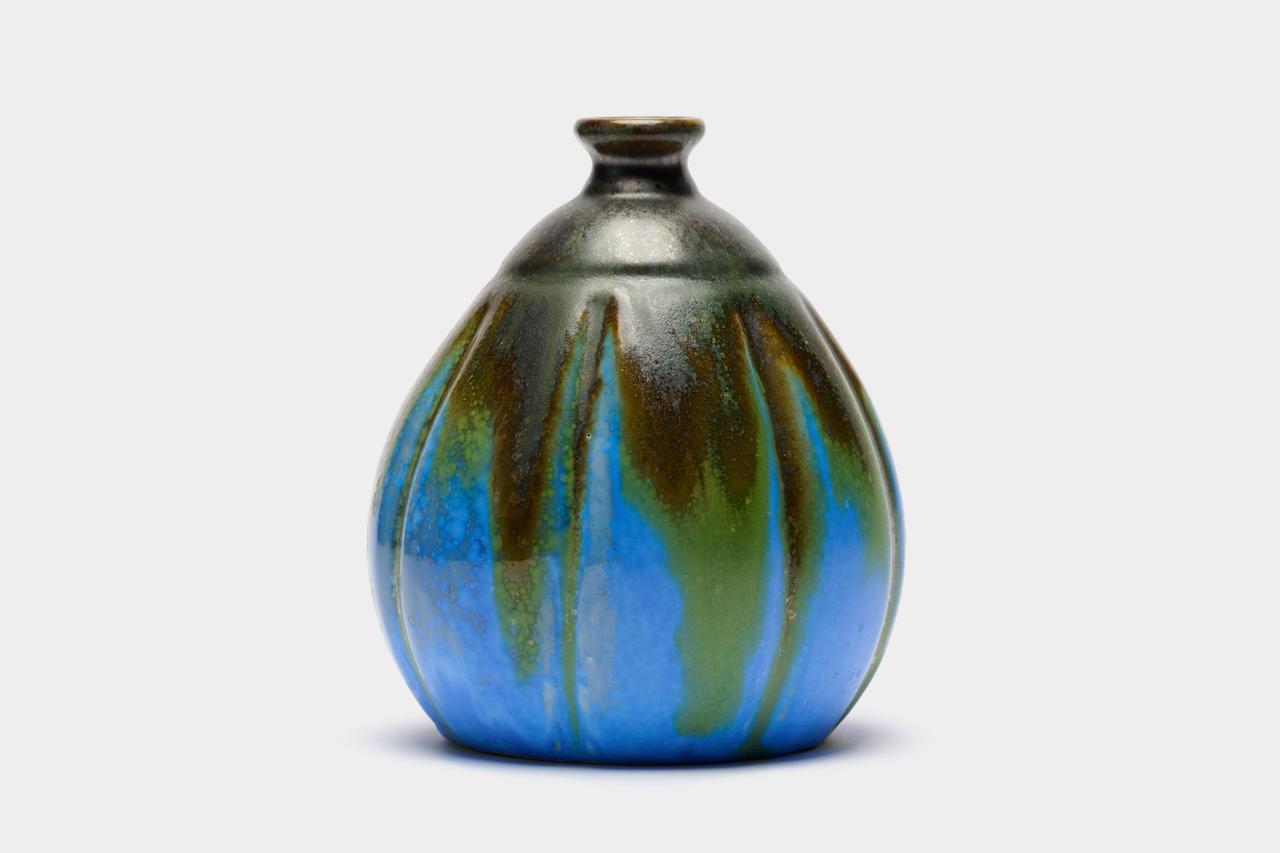
Verreries Doyen - Vase - Floralies - Uranium glass - OURALINE ART DECO


02
days
21
hours
04
minutes
38
seconds

 | €40 | |
|---|---|---|
 | €35 | |
| €30 | |
Catawiki Buyer Protection
Your payment’s safe with us until you receive your object.View details
Trustpilot 4.4 | 146014 reviews
Rated Excellent on Trustpilot.
This 1930s Belgian Art Deco Floralies vase by Verreries Doyen is made of green uranium glass, measures 25.8 cm high and 13.5 cm wide, and is in excellent condition with minimal signs of wear.
AI-assisted summary
Description from the seller
Elegant Deco-era vase in green opal glass, produced by Verreries Doyen in Havré in the 1930s, part of the “Floralies” collection. This piece perfectly illustrates the interwar taste for architectural forms and the play of light characteristic of the decorative arts of the period. Its generous silhouette, punctuated by vertical lines and a flared neck with a softly undulating rim, gives it a remarkable decorative presence. Made of ouraline glass, the vase displays a luminous green coloration that reveals a fluorescent reaction across the entire piece under 395 nm ultraviolet light. Although this fluorescence remains relatively moderate in intensity, its uniform character is especially interesting and testifies to the presence of a small proportion of uranium compounds in the glass composition.
The body of the vase adopts a swollen, balanced shape, extended by a narrowed neck with vertical reliefs that flares open into a wide, flaring mouth. The decor is mainly composed of molded ribs that follow the curves of the piece and enhance the variations in transparency and luminosity of the opaline glass. The whole rests on a slightly overhanging circular base that ensures its stability. The vase measures 25.8 cm in height and 13.5 cm in width, with a weight of 850 grams.
The piece is in very good condition. Some superficial residues remain in certain areas, as well as at the bottom of the vase, and have been deliberately preserved to protect the integrity of the glass surface. There is also a small discreet chip at the level of the rim forming the base. These observations are localized and do not detract from the overall handsome presentation of the piece.
Verreries Doyen, established in Havré near Mons, are among the Belgian glassmakers who contributed to the development of decorative glass in the first half of the 20th century. The “Floralies” collection, characteristic of 1930s Art Deco production, bears witness to this pursuit of balance between geometric forms, generous volumes, and the expressive qualities of colored glass. This piece thus stands as a fine example of Belgian glass production from the interwar period.
Details
Specific region of origin
Wallonie
Glass type
Uranium glass
Weight
850 g
Era
1900-2000
Title additional information
OURALINE ART DECO
Number of objects
1
Country of origin
Belgium
Model
Floralies
Material
Glass
Style
Art Deco
Manufacturer/brand
Verreries Doyen
Colour
Green
Condition
Excellent condition: barely used with minimal signs of wear
Height
25.8 cm
Width
13.5 cm
Depth
25.8 cm
Diameter
13.5 cm
Estimated period
1930-1940
Sold by