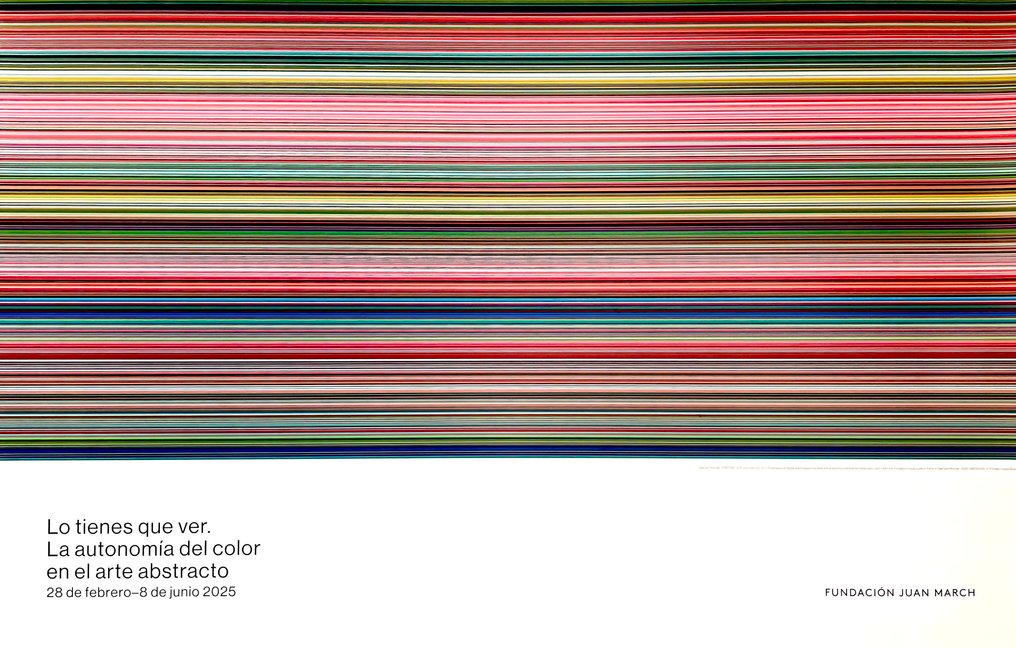
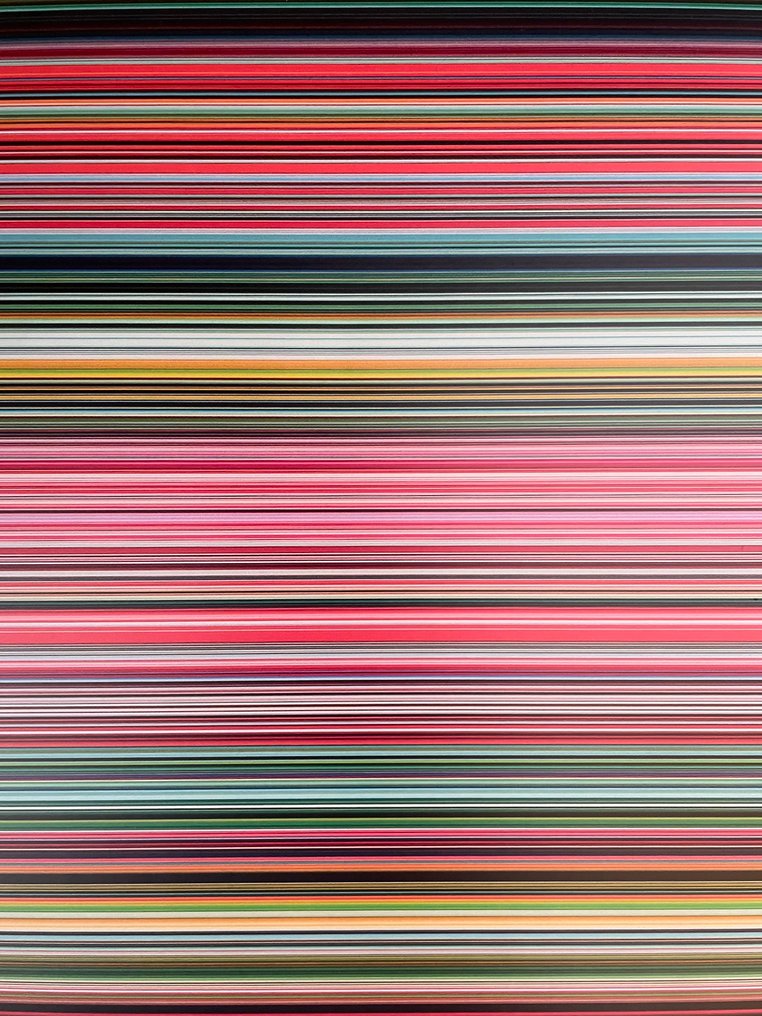
Gerard Richter (after) - STRIP (921-2) / Lo tienes que ver…

01
day
21
hours
56
minutes
27
seconds
Starting bid
€ 1
Reserve price not met

Expert
Selected by Alexander Fahl
Art historian with over 10 years' experience and expertise in Italian design.
Estimate € 150 - € 200
No bids placed
Catawiki Buyer Protection
Your payment’s safe with us until you receive your object.View details
Trustpilot 4.4 | 146130 reviews
Rated Excellent on Trustpilot.
This 2025 large-format offset poster, published by Fundación Juan March, reproduces Gerard Richter’s (after) STRIP (921-2) for the exhibition “Lo tienes que ver…”, and measures 96.7 × 61.5 cm.
AI-assisted summary
Description from the seller
Offset print by Gerard Richter (*)
Published on the occasion of the exhibition “You Have to See It…” at the Juan March Foundation in 2025.
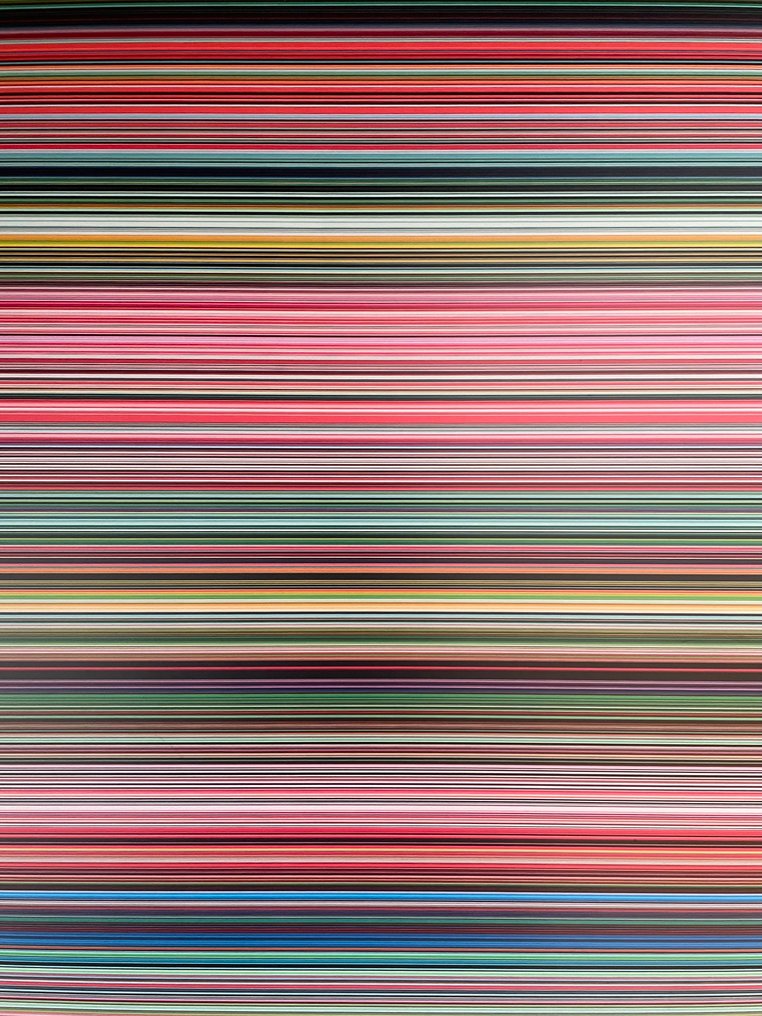
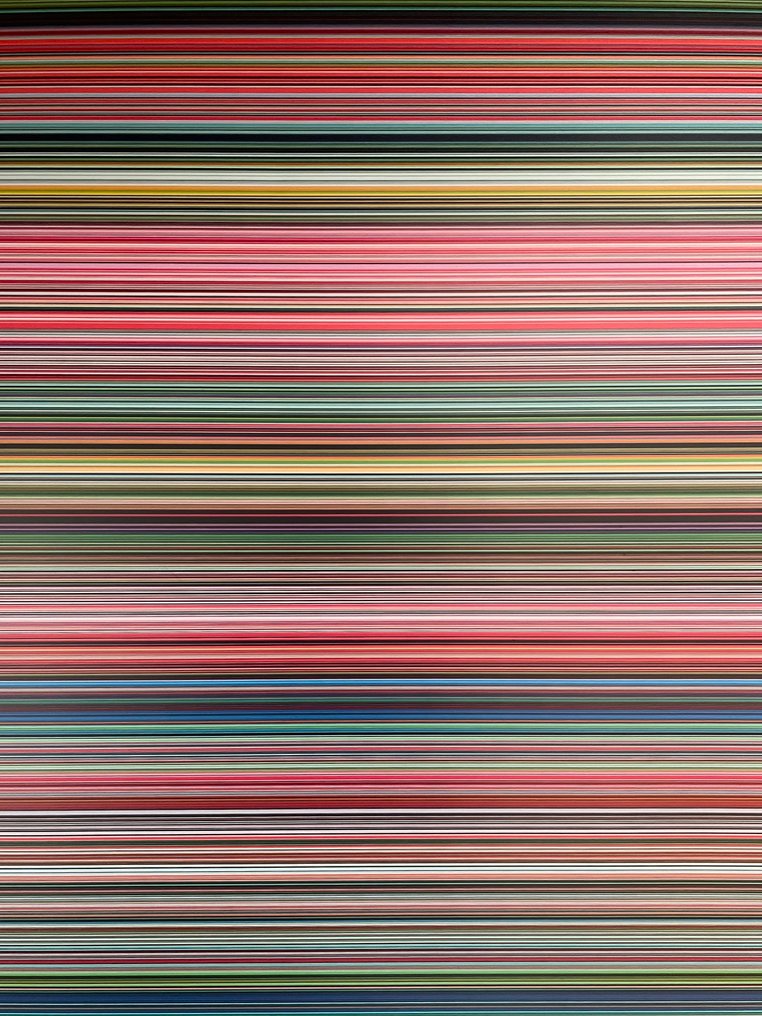
Reproduction of the work STRIP (921-2), created by Richter in 2011 and part of the collection of the Fondation Louis Vuitton in Paris.
Published by the Juan March Foundation.
Authorized print with copyright.
Large format.
*** LAST COPIES ***
- Sheet dimensions: 96.7 x 61.5 cm
- Year: 2025
- Condition: Excellent (this work has never been framed or displayed; it has always been stored in a professional art portfolio and is therefore in perfect condition).
- Provenance: Private collection.
The work will be carefully handled and packed in reinforced cardboard packaging. It will be sent by registered mail with a tracking number.
The shipment will also include transport insurance covering the final value of the work, with a full refund in the event of loss or damage, at no cost to the buyer.
(*) Gerhard Richter, still active in his nineties, dared to contradict Adorno by asserting that poetry is possible even after Auschwitz.
This artist, born in Dresden in 1932, trained at its Academy of Fine Arts and resident in West Germany since 1961, has in essence made reflection on the possibility of creating art after Nazism and the Holocaust the focus of his work. He preferred to destroy some of his early canvases, sometimes titled Execution or Hitler (1962); these were followed, in the mid-1960s, by works that fared better materially, such as Aunt Marianne, Uncle Rudi, and Mr. Heyde, based on photographs and referring both to Germany’s past and to his own family history.
At the same time, he began collecting historical visual records, sometimes private ones, such as photographs, newspaper clippings, and sketches, in what he called his Atlas, from which he has continued to draw sources to this day. That archive also includes images of concentration camps, which he tried for the first time in the 1990s to use as pictorial subjects, but ultimately abandoned the idea.
Richter understands art as a catalyst for problems and as a problem in itself. He has been interested in the other side of painting: in being able to assert the meaning of the act of painting and then deny it, highlighting the distance between painting that depicts subjects and painting that reflects on itself rather than on reality.
He decided to leave East Germany after discovering Fontana’s and Pollock’s work at Documenta in Kassel in 1958. Both were a turning point for him, leading him to conclude that his quest would have to be based on a struggle against painting without abandoning it. Under the influence of other European artists (Giacometti and Dubuffet), he began reproducing photographs in oil and, eager to distance himself from the German tradition, embarked on an artistic path he wanted to be independent, halfway between philosophical skepticism and solemnity.
The photographs that nourished Richter’s work also seemed deeply bitter to him: he felt that they languished and led nomadic, miserable lives; he also believed he could remake and rescue them. For the German artist, painters should not try to express their models’ character, and when working from a photograph, they do not depict an individual but an image that has nothing to do with them. The aim of achieving likeness would be futile.
Following this idea further, when painting from a photograph, conscious thought would disappear: the artist need not make decisions. There is no notion of originality, no temptation to describe, no sentimentality, no thematic or iconographic content… For all these reasons, viewers must also change how they see and think: if the canvas no longer imitates and cannot be interpreted as a document, one must seek in it an unreality that leaves room for irony.
What do his techniques involve? Richter copies anonymous photographs in oil on primed canvas, precisely and without intending to add or remove anything. These photographs have no aesthetic pretensions or, apparently, emotional value. He neither alters nor distorts the source images, and his reasoning precedes his art: “I don’t need to distort things as Bacon does; objects are already frightening enough.”
The dominant grays in many of his works connect with this complete lack of desire to express an opinion. To quote his own words again, gray is better suited than any other color to represent absolutely nothing. The discovery that would become his trademark, however, breaks with this mechanistic approach: the blurring of contours, which contrasts with the sharpness of classical photography and leaves us faced at once with the real image and its dissolution.
I don’t need to distort things as Bacon does; objects are already frightening enough.
As for the selection of images that feed his work, Richter does not choose them at random. One of the most emblematic is the aforementioned Uncle Rudi (1965), depicting his own uncle: apparently a cheerful man wearing a Nazi army uniform. The artist dedicated this work to the victims of the SS during the punitive action against the people of Lidice, Czechoslovakia, in 1984; it can therefore be understood as a reflection on acts of commemoration and mourning in postwar Germany. He was also obsessed with pain and death, as he again demonstrated in Shot 2 (1988), an expression of his despair at the dilemma that our eyes allow us to identify things while also preventing and restricting our understanding of reality.
In 2014, for the Birkenau series, his starting point was four photographs of the Auschwitz-Birkenau concentration camp itself, secretly taken in 1944 by Jewish prisoners who risked their lives to make them. They show both areas of the camp and the interior of Crematorium V, with numerous corpses, and are the only surviving images of these extermination sites that originated with the victims.
They were not published until after World War II, and Richter had already included several of them in his Atlas in 1967. However, it was not until some appeared in Georges Didi-Huberman’s essay Images in Spite of All (2008), in which the philosopher used them to examine how the Holocaust might be represented, that Richter felt compelled to use them in his work. He transferred four scenes in charcoal and oil paint onto individual canvases, then painted over them using abstract methods, so that with each added layer the original subjects disappeared until they were no longer visible.
We have referred to specific works, but to understand Richter’s art we must study it as a whole: his different styles have coexisted, and are therefore ambiguous. In each of them he has sought technical mastery, and taken together they seem to form a grand opera: he has explored monochrome and Expressionism, hyperrealism and abstraction, landscape, portraiture, and still life.
His color charts are well known; they challenged a certain decorative tendency in European abstraction. These industrial catalogs emphasize painting’s nature as a dazzling spectacle and undermine the foundations of styles. The result resembles a fresco of that discipline in the twentieth century.
Like Josef Albers, he also explored color fields using the geometric form of the square from the mid-1960s onward, when he was fascinated, almost obsessed, with mass-produced color sample cards, their smooth perfection, and the precision with which they reproduced tones and their possible variations. For Richter, these squares evoked the opposite of emotional emphasis, expressiveness, or the sublime—that is, the properties considered intrinsic to painting up until the first decades of the previous century.
Seller's Story
EsKobARTE carefully selects artworks from renowned and emerging artists worldwide, offering them here at affordable prices. *** HIGH-QUALITY LICENSED PRINTS *** We only sell authentic artworks and high-quality licensed prints. *** WE ARE PROFESSIONALS *** You can bid on our items with complete confidence. Over 1000 positive reviews on Catawiki attest to our professionalism. *** SECURE, CERTIFIED, AND INSURED SHIPPING *** All our items are carefully packaged in eco-friendly cardboard boxes. We work with the best courier services (UPS, DPD, DHL, FedEx) to guarantee the best service and tracking. Our shipments also include insurance against damage or loss, at no extra cost to the buyer *** COMBINED SHIPPING *** If you purchase multiple items -even from different auctions- you will only pay for shipping once *** ANY QUESTIONS? *** Feel free to contact us via chat, we will gladly assist you as soon as possible *** THANK YOU AND GOOD LUCK WITH YOUR BIDS! ***
Translated by Google TranslateOffset print by Gerard Richter (*)
Published on the occasion of the exhibition “You Have to See It…” at the Juan March Foundation in 2025.
Reproduction of the work STRIP (921-2), created by Richter in 2011 and part of the collection of the Fondation Louis Vuitton in Paris.
Published by the Juan March Foundation.
Authorized print with copyright.
Large format.
*** LAST COPIES ***
- Sheet dimensions: 96.7 x 61.5 cm
- Year: 2025
- Condition: Excellent (this work has never been framed or displayed; it has always been stored in a professional art portfolio and is therefore in perfect condition).
- Provenance: Private collection.
The work will be carefully handled and packed in reinforced cardboard packaging. It will be sent by registered mail with a tracking number.
The shipment will also include transport insurance covering the final value of the work, with a full refund in the event of loss or damage, at no cost to the buyer.
(*) Gerhard Richter, still active in his nineties, dared to contradict Adorno by asserting that poetry is possible even after Auschwitz.
This artist, born in Dresden in 1932, trained at its Academy of Fine Arts and resident in West Germany since 1961, has in essence made reflection on the possibility of creating art after Nazism and the Holocaust the focus of his work. He preferred to destroy some of his early canvases, sometimes titled Execution or Hitler (1962); these were followed, in the mid-1960s, by works that fared better materially, such as Aunt Marianne, Uncle Rudi, and Mr. Heyde, based on photographs and referring both to Germany’s past and to his own family history.
At the same time, he began collecting historical visual records, sometimes private ones, such as photographs, newspaper clippings, and sketches, in what he called his Atlas, from which he has continued to draw sources to this day. That archive also includes images of concentration camps, which he tried for the first time in the 1990s to use as pictorial subjects, but ultimately abandoned the idea.
Richter understands art as a catalyst for problems and as a problem in itself. He has been interested in the other side of painting: in being able to assert the meaning of the act of painting and then deny it, highlighting the distance between painting that depicts subjects and painting that reflects on itself rather than on reality.
He decided to leave East Germany after discovering Fontana’s and Pollock’s work at Documenta in Kassel in 1958. Both were a turning point for him, leading him to conclude that his quest would have to be based on a struggle against painting without abandoning it. Under the influence of other European artists (Giacometti and Dubuffet), he began reproducing photographs in oil and, eager to distance himself from the German tradition, embarked on an artistic path he wanted to be independent, halfway between philosophical skepticism and solemnity.
The photographs that nourished Richter’s work also seemed deeply bitter to him: he felt that they languished and led nomadic, miserable lives; he also believed he could remake and rescue them. For the German artist, painters should not try to express their models’ character, and when working from a photograph, they do not depict an individual but an image that has nothing to do with them. The aim of achieving likeness would be futile.
Following this idea further, when painting from a photograph, conscious thought would disappear: the artist need not make decisions. There is no notion of originality, no temptation to describe, no sentimentality, no thematic or iconographic content… For all these reasons, viewers must also change how they see and think: if the canvas no longer imitates and cannot be interpreted as a document, one must seek in it an unreality that leaves room for irony.
What do his techniques involve? Richter copies anonymous photographs in oil on primed canvas, precisely and without intending to add or remove anything. These photographs have no aesthetic pretensions or, apparently, emotional value. He neither alters nor distorts the source images, and his reasoning precedes his art: “I don’t need to distort things as Bacon does; objects are already frightening enough.”
The dominant grays in many of his works connect with this complete lack of desire to express an opinion. To quote his own words again, gray is better suited than any other color to represent absolutely nothing. The discovery that would become his trademark, however, breaks with this mechanistic approach: the blurring of contours, which contrasts with the sharpness of classical photography and leaves us faced at once with the real image and its dissolution.
I don’t need to distort things as Bacon does; objects are already frightening enough.
As for the selection of images that feed his work, Richter does not choose them at random. One of the most emblematic is the aforementioned Uncle Rudi (1965), depicting his own uncle: apparently a cheerful man wearing a Nazi army uniform. The artist dedicated this work to the victims of the SS during the punitive action against the people of Lidice, Czechoslovakia, in 1984; it can therefore be understood as a reflection on acts of commemoration and mourning in postwar Germany. He was also obsessed with pain and death, as he again demonstrated in Shot 2 (1988), an expression of his despair at the dilemma that our eyes allow us to identify things while also preventing and restricting our understanding of reality.
In 2014, for the Birkenau series, his starting point was four photographs of the Auschwitz-Birkenau concentration camp itself, secretly taken in 1944 by Jewish prisoners who risked their lives to make them. They show both areas of the camp and the interior of Crematorium V, with numerous corpses, and are the only surviving images of these extermination sites that originated with the victims.
They were not published until after World War II, and Richter had already included several of them in his Atlas in 1967. However, it was not until some appeared in Georges Didi-Huberman’s essay Images in Spite of All (2008), in which the philosopher used them to examine how the Holocaust might be represented, that Richter felt compelled to use them in his work. He transferred four scenes in charcoal and oil paint onto individual canvases, then painted over them using abstract methods, so that with each added layer the original subjects disappeared until they were no longer visible.
We have referred to specific works, but to understand Richter’s art we must study it as a whole: his different styles have coexisted, and are therefore ambiguous. In each of them he has sought technical mastery, and taken together they seem to form a grand opera: he has explored monochrome and Expressionism, hyperrealism and abstraction, landscape, portraiture, and still life.
His color charts are well known; they challenged a certain decorative tendency in European abstraction. These industrial catalogs emphasize painting’s nature as a dazzling spectacle and undermine the foundations of styles. The result resembles a fresco of that discipline in the twentieth century.
Like Josef Albers, he also explored color fields using the geometric form of the square from the mid-1960s onward, when he was fascinated, almost obsessed, with mass-produced color sample cards, their smooth perfection, and the precision with which they reproduced tones and their possible variations. For Richter, these squares evoked the opposite of emotional emphasis, expressiveness, or the sublime—that is, the properties considered intrinsic to painting up until the first decades of the previous century.
Seller's Story
EsKobARTE carefully selects artworks from renowned and emerging artists worldwide, offering them here at affordable prices. *** HIGH-QUALITY LICENSED PRINTS *** We only sell authentic artworks and high-quality licensed prints. *** WE ARE PROFESSIONALS *** You can bid on our items with complete confidence. Over 1000 positive reviews on Catawiki attest to our professionalism. *** SECURE, CERTIFIED, AND INSURED SHIPPING *** All our items are carefully packaged in eco-friendly cardboard boxes. We work with the best courier services (UPS, DPD, DHL, FedEx) to guarantee the best service and tracking. Our shipments also include insurance against damage or loss, at no extra cost to the buyer *** COMBINED SHIPPING *** If you purchase multiple items -even from different auctions- you will only pay for shipping once *** ANY QUESTIONS? *** Feel free to contact us via chat, we will gladly assist you as soon as possible *** THANK YOU AND GOOD LUCK WITH YOUR BIDS! ***
Translated by Google TranslateDetails
Era
After 2000
Designer/artist
Gerard Richter (after)
Poster title
STRIP (921-2) / Lo tienes que ver…
Subject
Art
Country of origin
Germany
Condition
A (excellent - mint condition)
Height
96.7 cm
Width
61.5 cm