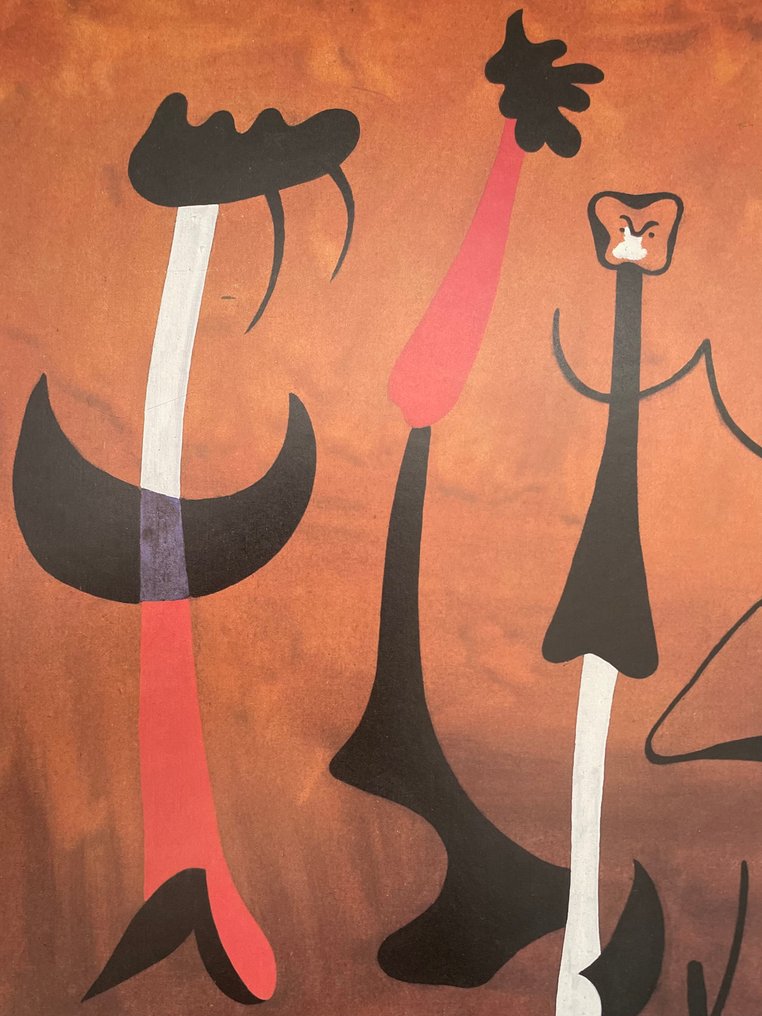
(after), Joan Miró - Personnages Rythmiques - Offset lithograph - 90x70 - Achenbach licensed print



01
day
05
hours
33
minutes
20
seconds

 | €1 |
|---|
Catawiki Buyer Protection
Your payment’s safe with us until you receive your object.View details
Trustpilot 4.4 | 146014 reviews
Rated Excellent on Trustpilot.
This 1986 authorised Achenbach Art Edition offset lithograph after Joan Miró’s 1934 work “Personnages Rythmiques” measures 90 × 70.5 cm and is in excellent condition.
AI-assisted summary
Description from the seller
Offset lithography after Joan Miró (*)
Reproduction of the work “Personnages Rythmiques,” created by Miró in 1934 and part of the Kunstsammlung Nordrhein-Westfalen collection in Düsseldorf.
Printed on high-grade Fine Art cardstock (200 g).
Published by Achenbach Art Edition, Düsseldorf.
Authorized print with copyright and legally registered serial number.
Large Format.
- Sheet dimensions: 90 x 70.5 cm
- Year: 1986
- Condition: Excellent (this work has never been framed or exhibited, always stored in a professional art folder, and is therefore in perfect condition).
- Provenance: Private collection.
The work will be carefully handled and packaged in reinforced cardboard. The shipment will be insured with a tracking number.
The shipment will also include transport insurance for the final value of the work with full reimbursement in case of loss or damage, at no cost to the buyer.
(*) Joan Miró (1893-1983) was born in Barcelona, but his emotional landscapes, which shaped him as a person and as an artist, are essentially Mont-roig, Paris, Mallorca and later New York and Japan. Mont-roig, a small town in the Baix Camp comarca, will counterbalance the intellectual agitation he experienced in Paris in the 1920s with surrealist poets, and the stimulus of abstract expressionism he discovered in New York in the 1940s. Later, in the midst of World War II, Joan Miró would leave his exile in France and settle in Palma de Mallorca, a retreat and workspace, where his friend Josep Lluís Sert would design the studio he had always dreamed of.
Rooted in the Mont-roig landscape first and in Mallorca later, this would prove decisive for his work. The bond with the land and the interest in everyday objects and the surrounding natural environment would underpin some of his technical and formal investigations. Miró runs away from academicism, in search of a constant global and pure artwork, not affiliated with any particular movement. Contained in form and in public manifestations, it is through the plastic act that Joan Miró shows his rebellious spirit and a deep sensitivity to the political and social events around him. This clash of forces led him to create a unique and highly personal language that positions him as one of the most influential artists of the 20th century."
Seller's Story
EsKobARTE carefully selects artworks from renowned and emerging artists worldwide, offering them here at affordable prices. *** HIGH-QUALITY LICENSED PRINTS *** We only sell authentic artworks and high-quality licensed prints. *** WE ARE PROFESSIONALS *** You can bid on our items with complete confidence. Over 1000 positive reviews on Catawiki attest to our professionalism. *** SECURE, CERTIFIED, AND INSURED SHIPPING *** All our items are carefully packaged in eco-friendly cardboard boxes. We work with the best courier services (UPS, DPD, DHL, FedEx) to guarantee the best service and tracking. Our shipments also include insurance against damage or loss, at no extra cost to the buyer *** COMBINED SHIPPING *** If you purchase multiple items -even from different auctions- you will only pay for shipping once *** ANY QUESTIONS? *** Feel free to contact us via chat, we will gladly assist you as soon as possible *** THANK YOU AND GOOD LUCK WITH YOUR BIDS! ***
Translated by Google TranslateOffset lithography after Joan Miró (*)
Reproduction of the work “Personnages Rythmiques,” created by Miró in 1934 and part of the Kunstsammlung Nordrhein-Westfalen collection in Düsseldorf.
Printed on high-grade Fine Art cardstock (200 g).
Published by Achenbach Art Edition, Düsseldorf.
Authorized print with copyright and legally registered serial number.
Large Format.
- Sheet dimensions: 90 x 70.5 cm
- Year: 1986
- Condition: Excellent (this work has never been framed or exhibited, always stored in a professional art folder, and is therefore in perfect condition).
- Provenance: Private collection.
The work will be carefully handled and packaged in reinforced cardboard. The shipment will be insured with a tracking number.
The shipment will also include transport insurance for the final value of the work with full reimbursement in case of loss or damage, at no cost to the buyer.
(*) Joan Miró (1893-1983) was born in Barcelona, but his emotional landscapes, which shaped him as a person and as an artist, are essentially Mont-roig, Paris, Mallorca and later New York and Japan. Mont-roig, a small town in the Baix Camp comarca, will counterbalance the intellectual agitation he experienced in Paris in the 1920s with surrealist poets, and the stimulus of abstract expressionism he discovered in New York in the 1940s. Later, in the midst of World War II, Joan Miró would leave his exile in France and settle in Palma de Mallorca, a retreat and workspace, where his friend Josep Lluís Sert would design the studio he had always dreamed of.
Rooted in the Mont-roig landscape first and in Mallorca later, this would prove decisive for his work. The bond with the land and the interest in everyday objects and the surrounding natural environment would underpin some of his technical and formal investigations. Miró runs away from academicism, in search of a constant global and pure artwork, not affiliated with any particular movement. Contained in form and in public manifestations, it is through the plastic act that Joan Miró shows his rebellious spirit and a deep sensitivity to the political and social events around him. This clash of forces led him to create a unique and highly personal language that positions him as one of the most influential artists of the 20th century."
Seller's Story
EsKobARTE carefully selects artworks from renowned and emerging artists worldwide, offering them here at affordable prices. *** HIGH-QUALITY LICENSED PRINTS *** We only sell authentic artworks and high-quality licensed prints. *** WE ARE PROFESSIONALS *** You can bid on our items with complete confidence. Over 1000 positive reviews on Catawiki attest to our professionalism. *** SECURE, CERTIFIED, AND INSURED SHIPPING *** All our items are carefully packaged in eco-friendly cardboard boxes. We work with the best courier services (UPS, DPD, DHL, FedEx) to guarantee the best service and tracking. Our shipments also include insurance against damage or loss, at no extra cost to the buyer *** COMBINED SHIPPING *** If you purchase multiple items -even from different auctions- you will only pay for shipping once *** ANY QUESTIONS? *** Feel free to contact us via chat, we will gladly assist you as soon as possible *** THANK YOU AND GOOD LUCK WITH YOUR BIDS! ***
Translated by Google TranslateDetails
Era
1900-2000
Designer/artist
(after), Joan Miró
Poster title
Personnages Rythmiques - Offset lithograph - 90x70 - Achenbach licensed print
Subject
Art, Original artwork
Country of origin
Germany
Condition
A (excellent - mint condition)
Height
90 cm
Width
70.5 cm