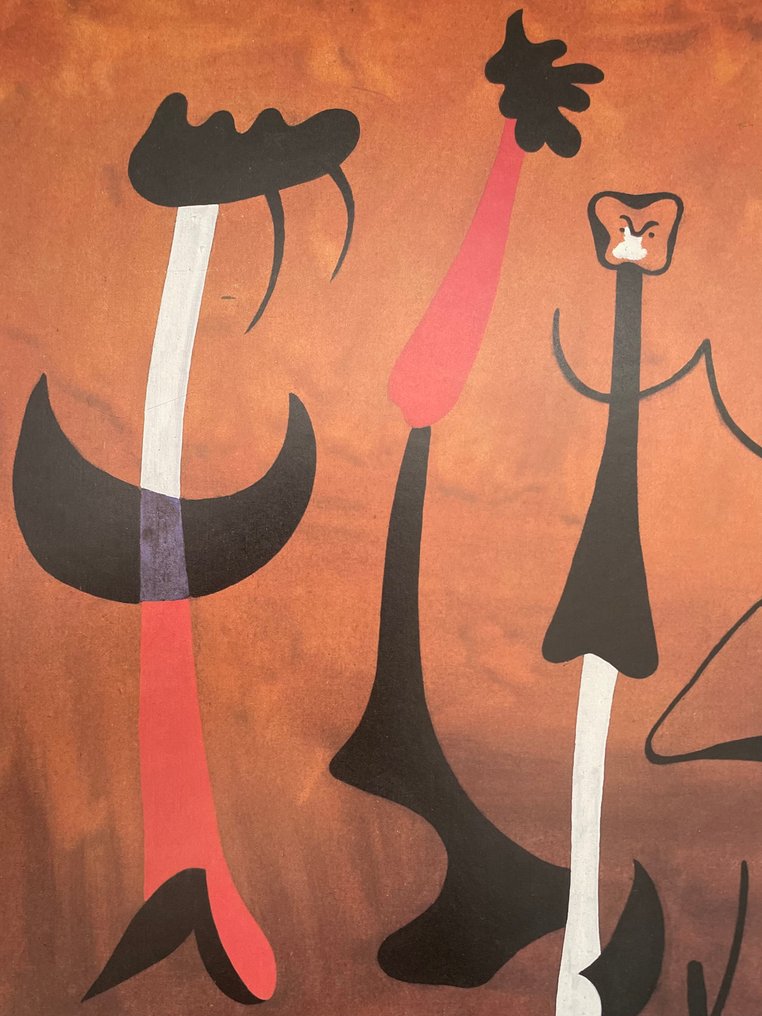
(after), Joan Miró - Personnages Rythmiques - Offset lithograph - 90x70 - Achenbach licensed print



02
days
19
hours
55
minutes
26
seconds
Current bid
€ 3
No reserve price

Expert
Selected by Constance Rousseau
Master marquetry craftswoman with 4 years' expert experience. Trainee auctioneer at Sotheby's Paris.
Estimate € 100 - € 140
 | €3 |
|---|
Catawiki Buyer Protection
Your payment’s safe with us until you receive your object.View details
Trustpilot 4.4 | 146042 reviews
Rated Excellent on Trustpilot.
An authorised 1986 offset lithograph after Joan Miró, Personnages Rythmiques, published by Achenbach Art Edition, measuring 90 × 70.5 cm and in excellent condition.
AI-assisted summary
Description from the seller
Offset lithography after Joan Miró (*)
Reproduction of the work “Personnages Rythmiques” created by Miró in 1934 and part of the Kunstsammlung Nordrhein-Westfalen collection in Düsseldorf.
Printed on high-quality Fine Art card using heavy weight (200g).
Published by Achenbach Art Edition, Düsseldorf.
Authorized print with copyright and legal serial number.
Large format.
- Sheet dimensions: 90 x 70.5 cm
- Year: 1986
- Condition: Excellent (this work has never been framed or exhibited, always kept in a professional art folder, and thus is in perfect condition).
- Provenance: Private collection.
The work will be carefully handled and packaged in reinforced cardboard packaging. The shipment will be tracked with a tracking number.
The shipment will also include transport insurance for the final value of the work with full reimbursement in case of loss or damage, at no cost to the buyer.
(*) Joan Miró (1893-1983) was born in Barcelona, but his emotional landscapes, which shaped him as a person and as an artist, are essentially Mont-roig, Paris, Mallorca, and later New York and Japan. Mont-roig, a small town in the Baix Camp region, will be the counterpoint to the intellectual agitation he experienced in Paris in the twenties alongside the surrealist poets, and to the stimulus of abstract expressionism he discovered in New York in the forties. Later, in the midst of World War II, Joan Miró left his exile in France and settled in Palma de Mallorca, a space of refuge and work, where his friend Josep Lluís Sert designed the workshop he had always dreamed of.
Rooted first in the Mont-roig landscape and later in Mallorca, these ties would prove decisive in his work. The connection with the land and an interest in everyday objects and the natural environment would be the backdrop to some of his technical and formal investigations. Miró fled academicism, pursuing a constant search for a global, pure work not affiliated with any specific movement. Content in forms and public manifestations, it is through the plastic act that Joan Miró reveals his rebellion and a great sensitivity to the political and social events surrounding him. This clash of forces led him to create a unique, highly personal language that places him among the most influential artists of the 20th century."}{
Seller's Story
EsKobARTE carefully selects artworks from renowned and emerging artists worldwide, offering them here at affordable prices. *** HIGH-QUALITY LICENSED PRINTS *** We only sell authentic artworks and high-quality licensed prints. *** WE ARE PROFESSIONALS *** You can bid on our items with complete confidence. Over 1000 positive reviews on Catawiki attest to our professionalism. *** SECURE, CERTIFIED, AND INSURED SHIPPING *** All our items are carefully packaged in eco-friendly cardboard boxes. We work with the best courier services (UPS, DPD, DHL, FedEx) to guarantee the best service and tracking. Our shipments also include insurance against damage or loss, at no extra cost to the buyer *** COMBINED SHIPPING *** If you purchase multiple items -even from different auctions- you will only pay for shipping once *** ANY QUESTIONS? *** Feel free to contact us via chat, we will gladly assist you as soon as possible *** THANK YOU AND GOOD LUCK WITH YOUR BIDS! ***
Translated by Google TranslateOffset lithography after Joan Miró (*)
Reproduction of the work “Personnages Rythmiques” created by Miró in 1934 and part of the Kunstsammlung Nordrhein-Westfalen collection in Düsseldorf.
Printed on high-quality Fine Art card using heavy weight (200g).
Published by Achenbach Art Edition, Düsseldorf.
Authorized print with copyright and legal serial number.
Large format.
- Sheet dimensions: 90 x 70.5 cm
- Year: 1986
- Condition: Excellent (this work has never been framed or exhibited, always kept in a professional art folder, and thus is in perfect condition).
- Provenance: Private collection.
The work will be carefully handled and packaged in reinforced cardboard packaging. The shipment will be tracked with a tracking number.
The shipment will also include transport insurance for the final value of the work with full reimbursement in case of loss or damage, at no cost to the buyer.
(*) Joan Miró (1893-1983) was born in Barcelona, but his emotional landscapes, which shaped him as a person and as an artist, are essentially Mont-roig, Paris, Mallorca, and later New York and Japan. Mont-roig, a small town in the Baix Camp region, will be the counterpoint to the intellectual agitation he experienced in Paris in the twenties alongside the surrealist poets, and to the stimulus of abstract expressionism he discovered in New York in the forties. Later, in the midst of World War II, Joan Miró left his exile in France and settled in Palma de Mallorca, a space of refuge and work, where his friend Josep Lluís Sert designed the workshop he had always dreamed of.
Rooted first in the Mont-roig landscape and later in Mallorca, these ties would prove decisive in his work. The connection with the land and an interest in everyday objects and the natural environment would be the backdrop to some of his technical and formal investigations. Miró fled academicism, pursuing a constant search for a global, pure work not affiliated with any specific movement. Content in forms and public manifestations, it is through the plastic act that Joan Miró reveals his rebellion and a great sensitivity to the political and social events surrounding him. This clash of forces led him to create a unique, highly personal language that places him among the most influential artists of the 20th century."}{
Seller's Story
EsKobARTE carefully selects artworks from renowned and emerging artists worldwide, offering them here at affordable prices. *** HIGH-QUALITY LICENSED PRINTS *** We only sell authentic artworks and high-quality licensed prints. *** WE ARE PROFESSIONALS *** You can bid on our items with complete confidence. Over 1000 positive reviews on Catawiki attest to our professionalism. *** SECURE, CERTIFIED, AND INSURED SHIPPING *** All our items are carefully packaged in eco-friendly cardboard boxes. We work with the best courier services (UPS, DPD, DHL, FedEx) to guarantee the best service and tracking. Our shipments also include insurance against damage or loss, at no extra cost to the buyer *** COMBINED SHIPPING *** If you purchase multiple items -even from different auctions- you will only pay for shipping once *** ANY QUESTIONS? *** Feel free to contact us via chat, we will gladly assist you as soon as possible *** THANK YOU AND GOOD LUCK WITH YOUR BIDS! ***
Translated by Google TranslateDetails
Era
1900-2000
Designer/artist
(after), Joan Miró
Poster title
Personnages Rythmiques - Offset lithograph - 90x70 - Achenbach licensed print
Subject
Art, Original artwork
Country of origin
Germany
Condition
A (excellent - mint condition)
Height
90 cm
Width
70.5 cm