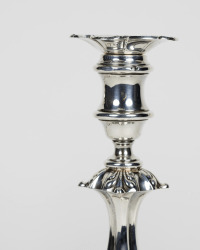
Gebroeders en P.A.A. van Roosmalen - Gebroeders en P.A.A. van Roosmalen - Chalice (3) - .835 silver - Miskelk, pateen kelklepel


05
days
01
hour
21
minutes
43
seconds
Current bid
€ 25
Reserve price not met

Expert
Selected by Inés Fernández
Specialised in Spanish and Portuguese silver with over 10 years in galleries and auctions.
Estimate € 2,000 - € 2,500
 | €25 | |
|---|---|---|
| €1 |
Catawiki Buyer Protection
Your payment’s safe with us until you receive your object.View details
Trustpilot 4.4 | 146042 reviews
Rated Excellent on Trustpilot.
This 1923 Dutch Art Nouveau set by Gebroeders en P.A.A. van Roosmalen comprises a gilt .835 silver chalice, paten and spoon, weighing 709 g.
AI-assisted summary
Description from the seller
Gilt silver chalice, paten and spoon made by the renowned Dutch silversmiths Gebroeders van Roosmalen, on the Oosterkade in Utrecht.
This chalice dates from 1923. The set is made of 2nd-grade .835 silver and is gilded. The stem rises from a round, collar-shaped foot and has a spherical knop, above which is a broad, convex cup. The piece is decorated as follows. The foot has three repoussé medallions featuring curling, interwoven ears of wheat and grapevines. The central medallion depicts Christ on the cross, flanked by John and Mary. The other two medallions depict drinking deer, a reference to Psalm 42: “As a deer longs for flowing water.” The spherical knop, stem and counter-cup are decorated with repoussé rose vines and roses in lobes, set with opals and red stones. The piece can be dismantled into three parts.
The underside of the foot bears the inscription: “Fecerunt Gebr. v. Roosmalen Ultraject.” and “J.W. Oostveen 1923.”
The paten is plain and has a small medallion on the front engraved with a quatrefoil motif containing a portrait of Christ crucified.
Chalice spoon with a vine-shaped handle and a curled leaf motif containing a cross.
The set is kept in a case made by the firm Van Roosmalen, covered in imitation leather and lined with velvet. It bears the inscription: “Gebr. v. Roosmalen Edelsmederij Utrecht Holland.” The case is in poor condition.
• Date: 1923
• Place of manufacture: Utrecht
• Maker: Gebr. en P.A.A. van Roosmalen
• Silver fineness: 2nd grade
• Weight: 709 grams
• Condition: good. The plating is slightly worn in places; small scratches on the cup. (See photos.)
• Dimensions:
- Chalice: 17.8 x 16.4 cm
- Paten: diam. 16.5 cm
- Chalice spoon: 7.8 cm
Silver hallmarks:
On chalice:
- PR3 in a horizontal hexagon (= maker’s mark of P.A.A. and Gebr. van Roosmalen, Utrecht 1913–1953)
- K2, in a square (= assay office mark of KH.F.J. Kaub, Utrecht 1918)
- Sword (= small silver articles, .835 silver fineness)
On paten:
- Sword (= small silver articles, .835 silver fineness)
On chalice spoon:
- PR3 in a horizontal hexagon (= maker’s mark of P.A.A. and Gebr. van Roosmalen, Utrecht 1913–1953)
- Sword (= small silver articles, .835 silver fineness)
The chalice was made in 1923 for Johannes Wilhelmus Oostveen, born in Utrecht in 1894 and died in 1972. This is probably the same Oostveen who authored Velua Catholica, a two-volume standard historical work on the Roman Catholic Church in the Veluwe, written by J.W. Oostveen. The work was privately published in Apeldoorn between 1950 and 1953.
The Mass chalice (calix in Latin) is a cup that belongs to the vasa sacra (sacred vessels) among liturgical vessels in the Catholic Church. A chalice consists of a bowl (cuppa), a foot and a decorated knop (nodus) between them. During the Eucharistic celebration, the chalice is used to hold the wine to be consecrated, which becomes the blood of Jesus Christ after the epiclesis. Since the chalice is thus involved in the part of the Eucharist considered most holy, most chalices are especially richly and lovingly decorated.
Details
Specific region of origin
Utrecht
Silver type
.835 silver
Gross weight
709 g
Style subtype
Jugendstil
Era
1900-2000
Title additional information
Miskelk, pateen kelklepel
Number of objects
3
Manufacturer/brand
Gebroeders en P.A.A. van Roosmalen
Country of origin
Netherlands
Designer/artist/maker
Gebroeders en P.A.A. van Roosmalen
Material
Gold plated, Silver
Style
Art Nouveau
Colour
Gold
Condition
Good condition - used with small signs of ageing
Height
17.8 cm
Width
16.4 cm
Diameter
12.5 cm
Depth
16.4 cm
Estimated period
1920-1930