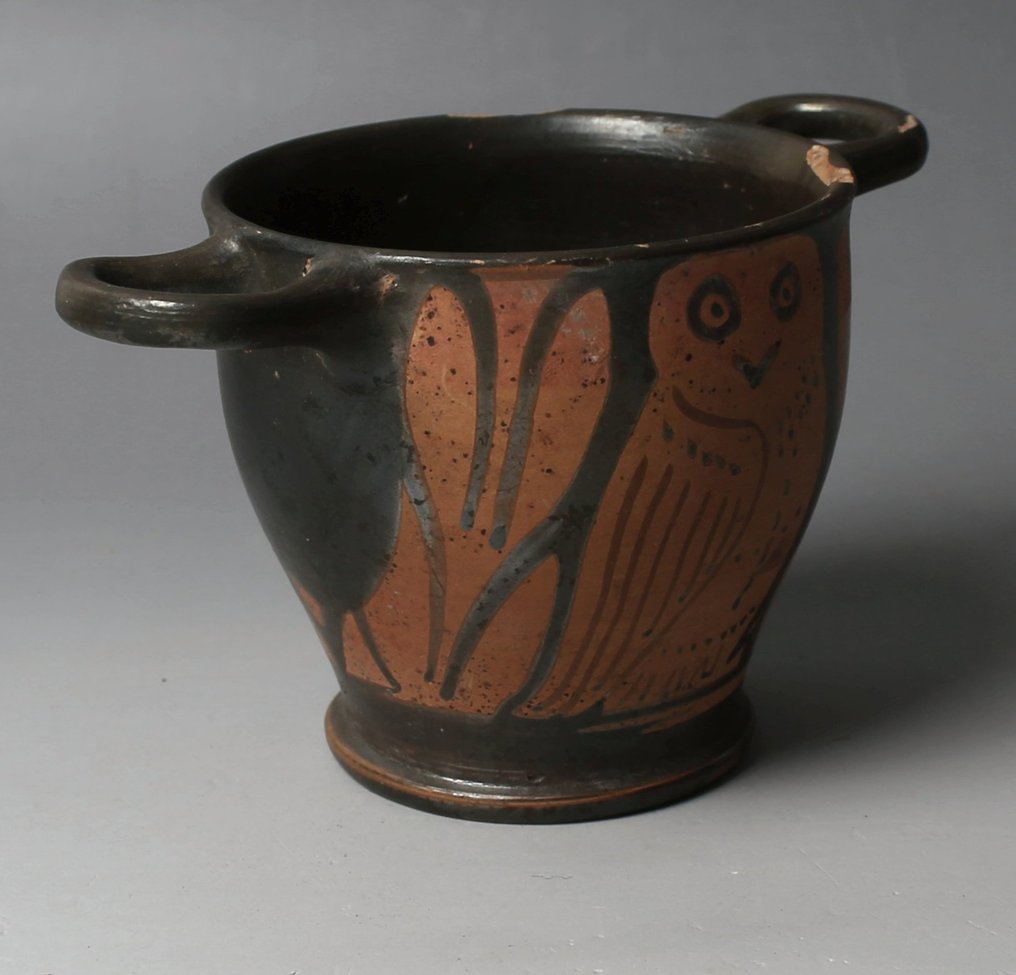
Ancient Greek Pottery Skyphos depicting an owl




08
days
16
hours
42
minutes
28
seconds
Current bid
€ 300
Reserve price not met

Expert
Selected by Ruth Garrido Vila
Directed the Ifergan Collection Museum, specialising in Phoenician and Mediterranean archaeology.
Estimate € 1,000 - € 1,300
 | €300 |
|---|
Catawiki Buyer Protection
Your payment’s safe with us until you receive your object.View details
Trustpilot 4.4 | 146353 reviews
Rated Excellent on Trustpilot.
This good-condition Ancient Greek pottery skyphos depicting an owl dates to the 4th century BC and measures 70 × 126 mm.
AI-assisted summary
Description from the seller
ITEM: Skyphos depicting an owl
MATERIAL: Pottery
CULTURE: Greek
PERIOD: 4th Century B.C
DIMENSIONS: 70 mm x 126 mm
CONDITION: Good condition
PROVENANCE: Ex Dutch private collection, acquired before 1999 from a English private collection (1986)
Comes with Certificate of Authenticity and Export license
Originating primarily in Athens during the 5th century BCE (Classical period), a Greek owl skyphos—known specifically to archaeologists as a glaux ("owl")—is an iconic Attic red-figure drinking cup celebrated for its instantly recognizable civic symbolism. Thrown on a potter's wheel from fine, iron-rich Attic clay, this deep, two-handled cup is uniquely distinguished by its asymmetrical handle arrangement: one horizontal loop handle projects outward at the rim while the opposite handle is set vertically. This clever ergonomic design allowed a drinker to slip a finger securely through the vertical ring while steadying the cup with the horizontal grip during lively banquets.
Aesthetically, the vessel pairs the lustrous jet-black glaze of Classical Athens with the reserved orange-red clay of the red-figure technique. Both sides of the cup's exterior are dominated by a large, front-facing little owl (Athene noctua)—the sacred bird and emblem of Athena, patron goddess of Athens—rendered with wide, staring eyes, neatly dotted plumage, and crisp anatomical detail. Framing the owl on either side are two upright olive sprigs with leaves and berries, evoking the sacred olive tree gifted by Athena to the Acropolis and directly echoing the imagery stamped onto contemporary Athenian silver tetradrachm coins.
Beyond its everyday function as a wine cup during the symposion, the owl skyphos carried unmistakable political, cultural, and commercial resonance across the Mediterranean world. Produced in massive quantities during the height of the Athenian Empire (Delian League), these cups functioned as portable emblems of Athenian civic pride, democratic identity, and economic prestige. Consequently, owl skyphoi were widely exported as coveted tableware to Etruria, South Italy, Sicily, and the Black Sea region, where they are frequently recovered from elite chamber tombs and domestic sanctuaries as enduring symbols of Classical Greek culture.
Seller's Story
Your Antiquarian offers ancient art and ancient coins. Our main objective is to offer the highest quality at the best price respecting and strictly complying with the laws of heritage protection and UNESCO heritage norms. Therefore, all the pieces that are published come from private collections in which the provenance can be checked or international auctions. All our antiquities and coins are accompanied by their Certificate of Authenticity. We have a no quibble 90 day return policy. At Your Antiquarian we are committed to helping disadvantaged groups and for this reason a portion of each purchase is donated to charities to help people in need.
Translated by Google TranslateITEM: Skyphos depicting an owl
MATERIAL: Pottery
CULTURE: Greek
PERIOD: 4th Century B.C
DIMENSIONS: 70 mm x 126 mm
CONDITION: Good condition
PROVENANCE: Ex Dutch private collection, acquired before 1999 from a English private collection (1986)
Comes with Certificate of Authenticity and Export license
Originating primarily in Athens during the 5th century BCE (Classical period), a Greek owl skyphos—known specifically to archaeologists as a glaux ("owl")—is an iconic Attic red-figure drinking cup celebrated for its instantly recognizable civic symbolism. Thrown on a potter's wheel from fine, iron-rich Attic clay, this deep, two-handled cup is uniquely distinguished by its asymmetrical handle arrangement: one horizontal loop handle projects outward at the rim while the opposite handle is set vertically. This clever ergonomic design allowed a drinker to slip a finger securely through the vertical ring while steadying the cup with the horizontal grip during lively banquets.
Aesthetically, the vessel pairs the lustrous jet-black glaze of Classical Athens with the reserved orange-red clay of the red-figure technique. Both sides of the cup's exterior are dominated by a large, front-facing little owl (Athene noctua)—the sacred bird and emblem of Athena, patron goddess of Athens—rendered with wide, staring eyes, neatly dotted plumage, and crisp anatomical detail. Framing the owl on either side are two upright olive sprigs with leaves and berries, evoking the sacred olive tree gifted by Athena to the Acropolis and directly echoing the imagery stamped onto contemporary Athenian silver tetradrachm coins.
Beyond its everyday function as a wine cup during the symposion, the owl skyphos carried unmistakable political, cultural, and commercial resonance across the Mediterranean world. Produced in massive quantities during the height of the Athenian Empire (Delian League), these cups functioned as portable emblems of Athenian civic pride, democratic identity, and economic prestige. Consequently, owl skyphoi were widely exported as coveted tableware to Etruria, South Italy, Sicily, and the Black Sea region, where they are frequently recovered from elite chamber tombs and domestic sanctuaries as enduring symbols of Classical Greek culture.
Seller's Story
Your Antiquarian offers ancient art and ancient coins. Our main objective is to offer the highest quality at the best price respecting and strictly complying with the laws of heritage protection and UNESCO heritage norms. Therefore, all the pieces that are published come from private collections in which the provenance can be checked or international auctions. All our antiquities and coins are accompanied by their Certificate of Authenticity. We have a no quibble 90 day return policy. At Your Antiquarian we are committed to helping disadvantaged groups and for this reason a portion of each purchase is donated to charities to help people in need.
Translated by Google TranslateDetails
Culture
Ancient Greek
Century/timeframe
4th Century B.C
Name of object
Skyphos depicting an owl
Acquired from
Private collection
Year acquired
2025
Material
Pottery
Country acquired from
Germany
Condition
Good
Previous owner acquired from
Antique market
Previous owner - year acquired
2000
Previous owner - country acquired from
Germany
I verify that I have obtained this object legally and that I am allowed to sell it
Yes
Authenticity
Original/official
Sold by
Disclaimer
The seller was informed by Catawiki about documentation requirements and guarantees the following: - the object was legally obtained, - the seller has the right to sell and/or export the object, as relevant, - the seller will provide the necessary provenance information and arrange required documentation and permits/licenses, as applicable and as per local laws, - the seller will notify the buyer of any delays in obtaining permits/licenses. By bidding, you acknowledge that import documentation may be required depending on your country of residence and that obtaining permits/licenses may cause delays in the delivery of your object.
The seller was informed by Catawiki about documentation requirements and guarantees the following: - the object was legally obtained, - the seller has the right to sell and/or export the object, as relevant, - the seller will provide the necessary provenance information and arrange required documentation and permits/licenses, as applicable and as per local laws, - the seller will notify the buyer of any delays in obtaining permits/licenses. By bidding, you acknowledge that import documentation may be required depending on your country of residence and that obtaining permits/licenses may cause delays in the delivery of your object.
