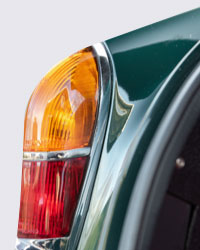
Renault - 5 L - 1973


13
days
04
hours
26
minutes
29
seconds

No bids placed
Catawiki Buyer Protection
Your payment’s safe with us until you receive your object.View details
Trustpilot 4.4 | 146353 reviews
Rated Excellent on Trustpilot.
Description from the seller
Renault 5 L 1973
• Restored in the past
• Beautiful, vibrant “Rouge” colour
• Interior in tidy condition
• Reconditioned 845 cc four-cylinder “Billancourt” engine and four-speed manual gearbox
• Exempt from road tax and MOT testing in the Netherlands
HISTORY
The now-iconic Renault 5 became world-famous as the successor to the Renault 5 and has even recently gone back into production! This speaks to the popularity of the car’s retro looks. We imported this example from Italy in 2026. This Renault 5 L was originally delivered new by the Renault dealer in Pezze di Greco, Italy, in 1973. The original dealer sticker is still on the rear window!
Production of the 5 began in 1972, so this is an early example. There are many reasons to choose a classic car, but rarely is its gear lever one of them. Yet that was exactly what the last owner from Milan was looking for: an R5 L, because, as an R4 enthusiast (he owns a 1971 TL and a 1977 Safari), he specifically wanted the version with the distinctive “umbrella” gear lever. He bought this example in 2014 and had it transported from Brindisi to Milan, where he subsequently restored it.
The restoration was difficult because of the shortage of parts: R5s have all but disappeared in Italy. The odometer read 34,800 km three years ago, and almost 10,000 km have been added since. In 2017, this example was featured in detail in an Italian classic-car magazine. As it is over 50 years old, the Renault is exempt from road tax and MOT testing in the Netherlands.
EXTERIOR
The red paintwork, colour code F733, has a beautiful shine, but also some imperfections. It is an older restoration. The more you look at the car, the more special and attractive details you notice. These include the sporty grilles beside the rear window, the door handles recessed into the doors, the air intake on the bonnet and the side indicators integrated into Renault’s diamond-shaped logo. The chrome has developed a patina, and the rubber trim is in good, renewed condition.
The 13-inch wheels are fitted with tidy chrome wheel covers. The lights and windows are also in good condition, with no cracks. The grey plastic bumpers are in good condition too. The tyres still have plenty of tread.
INTERIOR
The R5 marked a turning point in automotive history. Compared with the Fiat 127, it had an extra advantage in its first year: it was a three-door, while many competitors still did not have a tailgate. Like the R4, the early R5 also had its gear lever mounted high on the dashboard. Its single side opening is very long, making access relatively easy.
What stands out most is the exceptional comfort for such a small car: the suspension has an almost spectacularly long travel, the engine is unobtrusive, and the seats are soft. People used to speak of “French suspension”. The interior is in tidy, restored condition. The upholstery was rewoven using an original example as a reference, while the door panels were simply given a thorough clean.
The side panels are also trimmed in imitation leather. The headliner is a work of art in itself. Floor mats are fitted throughout the interior. The interior is in good condition, with normal signs of use. The side panels and dashboard are also in good condition, with no damage or worn patches. The luggage compartment is tidy.
TECHNICAL
The R5 is fitted with a small “Billancourt” 782 cc four-cylinder petrol engine, producing approximately 34 hp and driving the front wheels through a four-speed manual gearbox—quite modern for a small car at the time. This engine comes from Renault’s older engine family, named after the factory in Billancourt, near Paris, where it was developed. The engine is mounted transversely at the front, with the gearbox alongside it, keeping the car compact while still providing relatively generous interior space.
The suspension consists of independent front suspension with torsion bars and a rear axle with longitudinally mounted torsion bars, providing surprisingly comfortable handling despite the simple engineering. The brakes are drum brakes, and the steering is entirely mechanical, without power assistance, making the car light yet direct at low speeds. Thanks to its simple mechanics, low weight and robust construction, the R5 L is known for being easy to maintain and relatively straightforward to repair. This made it a popular city car in its day and, today, a much-loved classic among enthusiasts of pure, analogue engineering.
The car was used for a long drive in June 2026 without any problems, and it drives, brakes and shifts well. The engine bay looks clean and well cared for, and accommodates the spare wheel. The engine was fully reconditioned around 2015 by a specialist in R4 engines, and the radiator, exhaust, brakes, suspension and steering rack were also renewed. The clutch and gearbox are pleasant to use, with very smooth operation, while the steering is light.
GENERAL
The 1973 Renault 5 L is an early version of the first-generation Renault 5, a compact hatchback introduced in 1972 as a modern, economical alternative to Renault’s older small models. It indirectly succeeded the Renault 4 as a more contemporary city car, although the Renault 4 remained alongside the R5 for many years as a more rugged and utilitarian model.
The R5 L itself was the base version, with a small 782 cc engine, intended to provide affordable transport at a time when fuel economy was becoming increasingly important because of the oil crisis. The second-generation Renault 5, often called the “Supercinq”, arrived in 1984 as the successor to the first-generation R5. It was more modern in design, comfort and safety, and was eventually succeeded by the Renault Clio in 1990. Interestingly, the R5 also became popular thanks to its practical third or fifth door and clever use of space within a very compact exterior. Today, the basic L version is especially cherished by classic-car enthusiasts for its pure, minimalist character and lack of unnecessary luxuries.
Seller's Story
For several years we have been active in the sale of vintage, classic and modern sports cars throughout the Netherlands, Europe and the rest of the world. We offer a wonderful variety of collector and driver cars that you can enjoy for years to come. You can find this online at Carrosso. com or by visiting our showroom in Oldemarkt, an hour's drive from Amsterdam.
We have a wide variety of classic sports cars, if you are interested in the specific details of a particular car, feel free to give us a call. We are open to negotiating transactions, we can store cars, and we have an effective and reliable way to sell your cars through our purchase or consignment sales program. So, if you have a (classic) sports car for sale, contact us and we can give you the price your car deserves!
Details
Brand
Renault
Model type
5 L
Year
1973
Located in
Netherlands
Mileage reading
44535 km
Registration papers
with Italian registration
Transmission
Manual
Fuel
Petrol
Colour
Red
Horse power
37
Cubic capacity
845
Matching numbers
Unknown
Matching colours
Unknown
Service book/history
No
Valid MOT
No
CoC (Certificate of Conformity) present
No
Condition (Exterior)
Good: may require conventional body and paintwork. May require replacement of parts
Condition (Interior)
Very Good: clean, showing minimal wear. May require replacement of minor missing or broken parts
Condition (Frame and Underbody)
Good: frame/structure shows minor signs of surface rust, signs of usage/wear, may require some attention
Condition (Mechanical)
Very Good: mechanically sound, may require minor service
Condition (Overall)
Good condition: visible signs of wear and general ageing
Vehicle registration
We can help buyers register their vehicle through our trusted external partner. The process is straightforward and can be completed after purchase. Vehicle registration remains the buyer's responsibility.
Sold by
Disclaimer
Catawiki always aims to offer you the best possible buying experience. Our experts virtually review and select every vehicle in line with our submission guidelines and we require our sellers to provide the most accurate description of the vehicle. However, providing a fully detailed analysis of the vehicle is extremely difficult, and close to impossible. To guide you, we ask our sellers to provide information about the vehicle’s condition. Please consider that most vehicles for sale are classic vehicles and they often already have a whole life behind them, meaning that even a condition 1 or 2 vehicle might need maintenance to be ready for the road. It is advised to carefully read our submission guidelines that further describe details about the condition grades and types to manage your expectations. Cars are sold “as is”, meaning as described and in the condition they are in at the time of the sale and without any representation, warranty or assumption of liability of any kind as to the condition by Catawiki or by the seller. The condition of this item is the opinion of the seller and may differ from yours, your local garage, or the dealer’s opinion. This does not automatically mean the car does not conform to its description. Before bidding, please check your local legislation regarding vehicle registration. Neither the seller nor Catawiki is responsible for the registration of the vehicle in your country and will not accept a cancellation for your failure to register the vehicle. We also recommend that, if possible, you arrange a viewing with the seller before placing a bid.
Catawiki always aims to offer you the best possible buying experience. Our experts virtually review and select every vehicle in line with our submission guidelines and we require our sellers to provide the most accurate description of the vehicle. However, providing a fully detailed analysis of the vehicle is extremely difficult, and close to impossible. To guide you, we ask our sellers to provide information about the vehicle’s condition. Please consider that most vehicles for sale are classic vehicles and they often already have a whole life behind them, meaning that even a condition 1 or 2 vehicle might need maintenance to be ready for the road. It is advised to carefully read our submission guidelines that further describe details about the condition grades and types to manage your expectations. Cars are sold “as is”, meaning as described and in the condition they are in at the time of the sale and without any representation, warranty or assumption of liability of any kind as to the condition by Catawiki or by the seller. The condition of this item is the opinion of the seller and may differ from yours, your local garage, or the dealer’s opinion. This does not automatically mean the car does not conform to its description. Before bidding, please check your local legislation regarding vehicle registration. Neither the seller nor Catawiki is responsible for the registration of the vehicle in your country and will not accept a cancellation for your failure to register the vehicle. We also recommend that, if possible, you arrange a viewing with the seller before placing a bid.