Blaise Pascal - Les Provinciales ou les lettres escrites par Louis de Montalte à un Provincial de se amis & aux RR. - 1657
01
day
12
hours
01
minute
17
seconds
Current bid
€ 70
Reserve price not met

Expert
Selected by Volker Riepenhausen
Specialist in travel literature and pre-1600 rare prints with 28 years experience.
Estimate € 1,700 - € 4,500
26 other people are watching this object
 Bidder 1491 Bidder 1491 | €70 | |
|---|---|---|
 Bidder 9586 Bidder 9586 | €60 | |
 Bidder 5584 Bidder 5584 | €55 | |
Catawiki Buyer Protection
Your payment’s safe with us until you receive your object.View details
Trustpilot 4.4 | 122553 reviews
Rated Excellent on Trustpilot.
Author/Illustrator: Blaise Pascal; Book title: Les Provinciales ou les lettres escrites par Louis de Montalte à un Provincial de ses amis & aux RR.
AI-assisted summary
Description from the seller
Pascal, Blaise
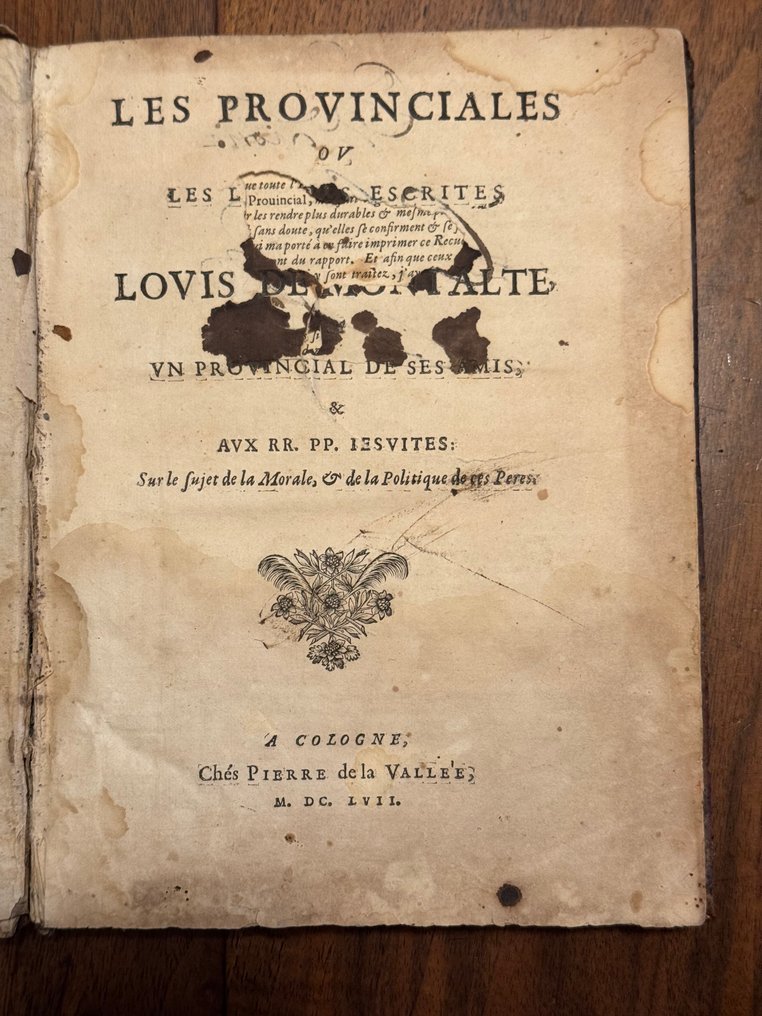
The Provincial Letters or the letters written by Louis de Montalte to a Provincial of his friends & to the Jesuit Fathers: on the subject of Morality and the Politics of these Fathers.
Cologne, Pierre Vallée, 1657
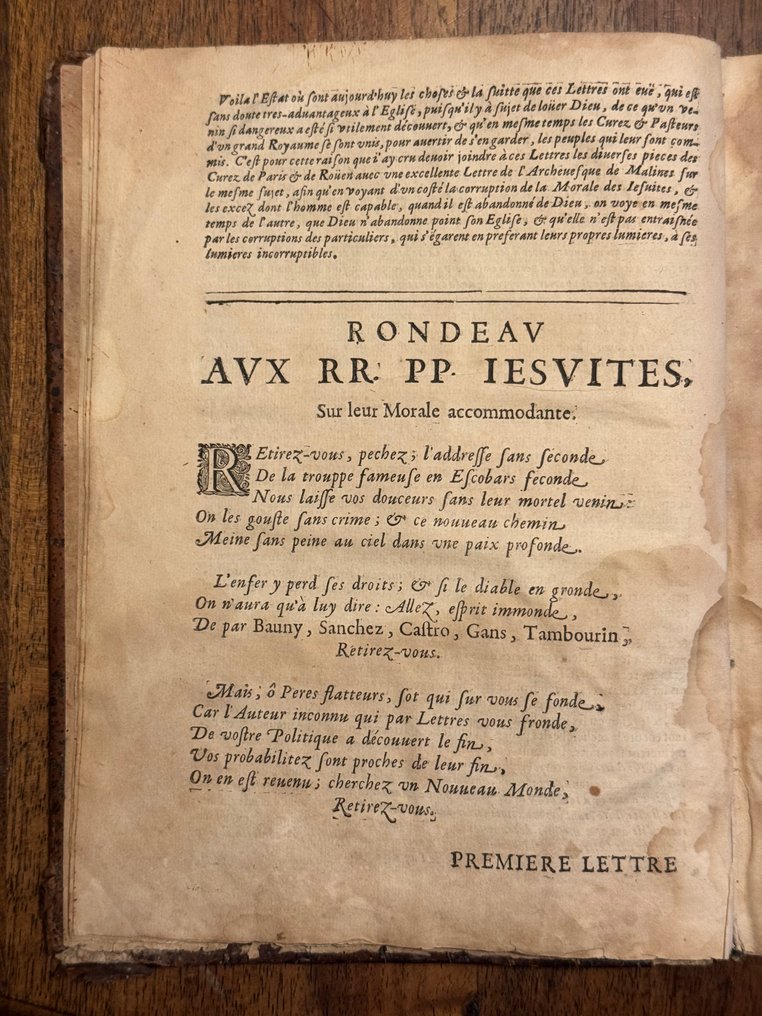
Original edition of the Provinciales with Pascal's letter to R. P. Annat, also in original, and ten other pieces of the great controversy between Jansenists and Jesuits.
A bound copy from the period in moucheté calf, worn binding, with losses to the headbands, dull corners.
Original edition, first state
In-4 (242 x 180mm). Fleuron engraved and printed on the title page, initials engraved on wood.
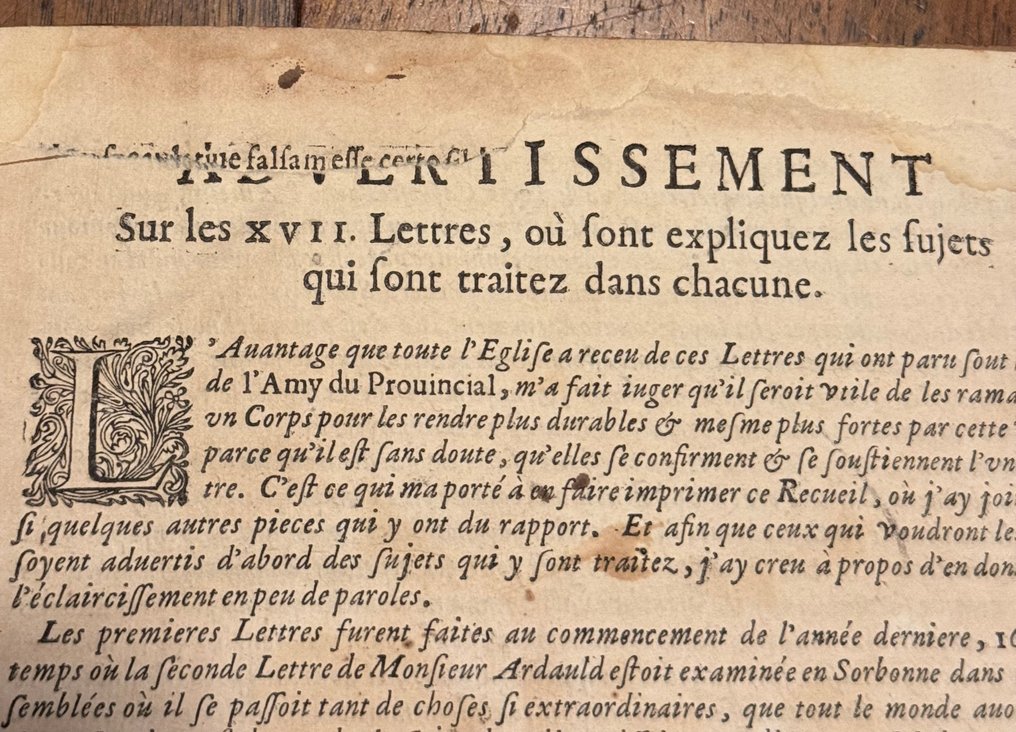
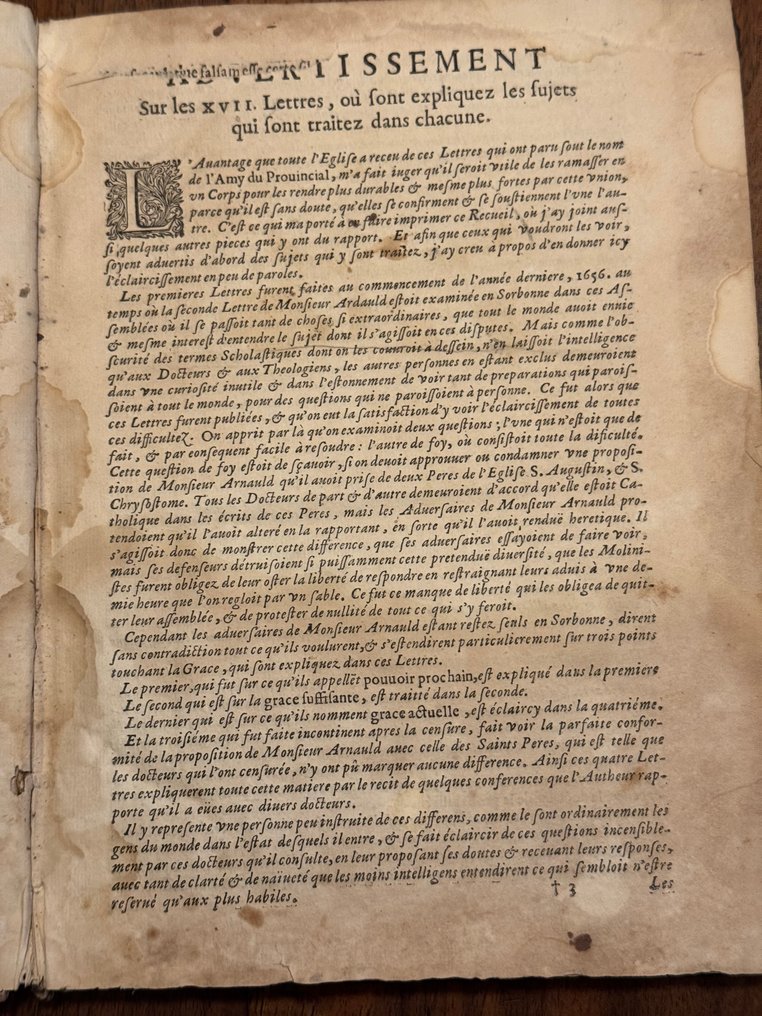
First state: Advertisement written as such and not Avertissement, with mention of 'XVII. lettres' only and not XVIII, along with the Refutation of the response to the twelfth letter (linked after the Twelfth letter), with the seventeenth letter in 8 pages and not 12, which corresponds to the 'most sought-after' state (see Tchemerzine-Scheler et al.)
Collation and content: 1 title page, 3 unnumbered pages for the Advertisement and the Rondeau to the RR. PP. Jesuits, [First Letter:] January 23, 1656, A4: 8 pages; Second letter… February 29, 1656: 8 pages; Response from the provincial to the first two letters and on the verso Third Letter… February 9, 1656, 8 pages; Fourth Letter… February 25, 1656: 8 pages; Fifth letter… March 20, 1656: 8 pages; Sixth letter… April 10, 1656: 8 pages; Seventh letter… April 25, 1656: 8 pages; Eighth letter… May 28, 1656: 8 pages; Ninth letter… July 3, 1656: 8 pages; Tenth letter… August 2, 1656; Eleventh letter… August 18, 1656: 8 pages; Twelfth letter… September 9, 1656: 8 pages; Refutation of the response to the twelfth letter: 8 pages; Thirteenth letter… September 30, 1656: 8 pages; Fourteenth letter… October 23, 1656: 8 pages; Fifteenth letter… November 25, 1656: 8 pages; Sixteenth letter… December 4, 1656: 12 pages; Seventeenth letter… January 23, 1657: 8 pages in first state; Eighteenth letter… March 24, 1657.
Attachments:
1. Blaise Pascal, Letter to R. P. Annat concerning his writing titled, The good faith of the Jansenists, no date [1657]. Original edition. 8 pages;
2. Antoine Arnauld and Pierre Nicole. Advice from the priests of Paris to the priests of other dioceses of France on the bad maxims of some new casuists. Paris, 1656. 8pp
3. Table of propositions contained in the Extract of the most dangerous propositions of the Morality of several new Casuists, faithfully taken from their works. SLND. 2 unnumbered pages.
4. Extract of some of the most dangerous propositions of Morality from several new Casuists, faithfully taken from their works. SLND.20 pp.
5. Jean Rousse and Antoine Dupuy. Continuation of the extract of several poor propositions by the new casuists collected by Messieurs the Curés of Paris and presented to Our Lords of the General Assembly of the Clergy of France on November 14, 1656. Paris, 1656. 1 f. n. ch. 8 pp.
6. [Juan de Caramuel y Lobkowicz]. Principles and consequences of probability explained by Caramuel, one of the most famous among the new Casuists, in a book printed in 1652, titled Theologia fundamentalis. Brussels, M. de Bossuyt, 1655. 18 pages.
7. [Antoine Escobar y Mendoza]. Extract from several dangerous propositions taken… from the first volume… of Escobar’s 'New Moral Theology'… [s. l., 1652-1656?]. 14 pages. 1 leaf. unnumbered errata sheet
8. Jean Rousse. Summary of the sermon of the Priests of Paris delivered by Mr. Rousse, priest of Saint Roch... on their advice sent to the priests of other dioceses against the pernicious morality of some new casuists. Paris, 1656. Original edition. 1 leaf, unnumbered pages, 6 pages.
9. Jacob Boonen. Letter of the Most Illustrious D. D. Jacob Boonen addressed to the Eminent Cardinals of the Roman Inquisition, interpellated by the Jesuits against the same. 1 f. n. ch. 6 pp.
10. Charles Dufour. Letter from a clergyman of Rouen to one of his friends about what happened at the trial of Mr. Dufour, Abbot of Aulney, formerly curate of Saint Maclou in Rouen, and Father Brisacier, Jesuit. [Rouen, March 10, 1657]. 4 pages.
11. Charles DUFOUR. Letter from a priest of Rouen to a rural priest about the method used by the Priests of the said city against the doctrine of some casuists… Against P. Brisacier, Berard, & de La Brière. Paris, 1656. 1 f. n. ch, 15 pp.
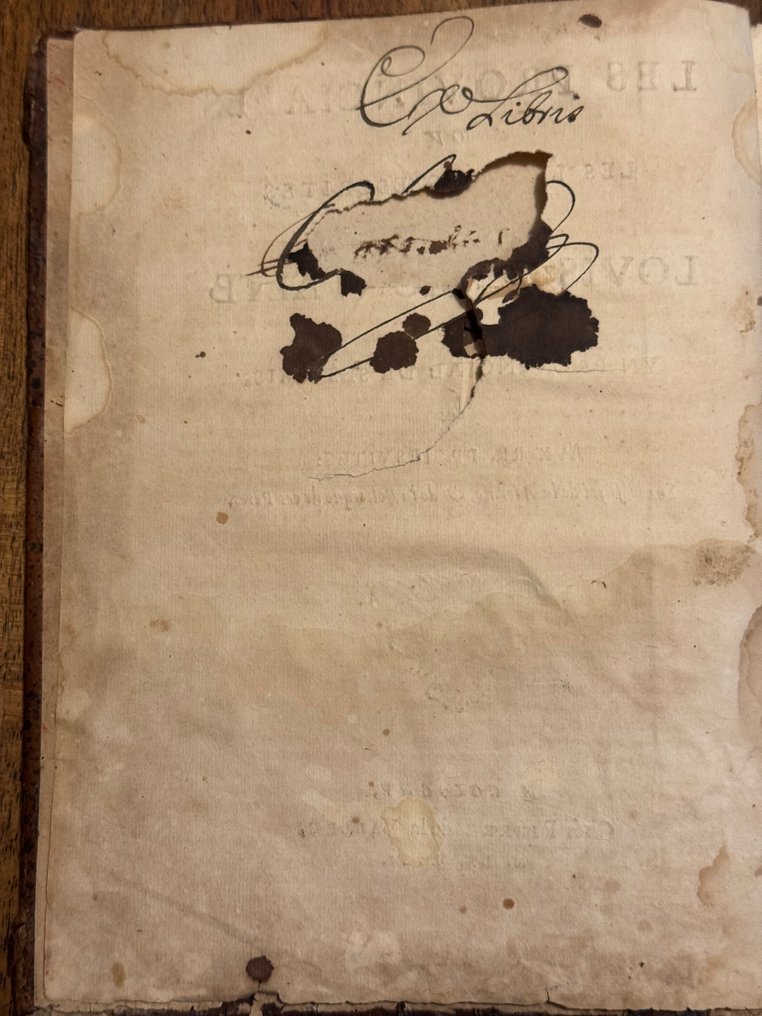
Defects: Titled mutilated and stained with ink (a handwritten ex libris on the back has disintegrated the paper); first leaf of the Avertissement mutilated with loss of the top of the letters (the bottom of the D can still be seen); paper of the first Lettre browned; marginal dampness throughout; paper of the Fifth Lettre browned; ink strokes on the first leaf of the Eighth Lettre; paper of the Tenth Lettre browned; paper of the Réfutation browned; ink strokes on leaf 5/6 of the Fourteenth Lettre; small stain on the first leaves of the seventeenth Lettre; ink stains on leaves 7/8 of the Advis of Messieurs les Curez de Paris and on the first leaf of the table; on leaves 7/8, on leaves 7/8 of the continuation of the extract of several poor propositions of the new casuists; leaves 1/2 and 3/4 heavily stained with ink, as well as pages 9 to 16.
This work, which expresses the controversy of its time, did not meet the same fate as the pamphlets of that era. Probably because Pascal, with his genius, addressed the essential issues and elevated the debate to a level that interests mankind across all ages. It is especially because the Provinciales are one of the purest masterpieces of the French language. Voltaire, in The Age of Louis XIV, called them the first book of genius seen in prose, adding that the opening letters are worth the best comedies of Molière. Madame de Sévigné herself wrote to Gilles Ménage on September 12, 1656: “I read with pleasure the eleventh letter of the Jansenists. It seems to me very beautiful (…) It is extremely entertaining everywhere, but especially in the countryside.” This first classical masterpiece had the perfect appearance of objectivity, the author disappearing behind his subject by presenting a pure object of thought.
As an introduction to the controversial time of the Provinciales, one should read in this copy the fifth attachment to this collection. It consists of excerpts from Antoine Escobar y Mendoza, the famous Spanish Jesuit, Father Escobar, whom Pascal cites more than sixty times in the Provinciales. In the excerpt from several dangerous propositions drawn from the first volume of Escobar's 'New Moral Theology', you will find the targeted transformation of the notorious Jesuit laxism. This reversal by the Jansenists of Jesuit propositions is the origin of the ridicules that Molière, Boileau, and La Fontaine would find: 'That it is permitted to become a eunuch to preserve one's voice'... , 'In how many ways can servants serve their masters' debaucheries'... , 'That it is permitted to rent one's house to fallen women, knowing it should be a place of debauchery'... , 'That a man reputed to be very debauched does not commit mortal sin by soliciting a woman without the intention of executing what he proposes' etc. Today, the best account of this controversial moment in France's intellectual history can be found in the pages of the catalog for the exhibition Blaise Pascal. The heart and reason held at the BnF in 2016-2017.
The capital text of the Provinciales, which the contemporaries of the great thinker called The Little Letters, consists of eighteen pieces, the first ten of which bear, as a heading, Letter written by a provincial to one of his friends. The work is followed by another authentic letter from Pascal, the Letter to R. P. Annat, concerning his writing titled La bonne foy des jansenistes.
These anonymous letters, printed as they were composed, were published between January 23, 1656, and May 24, 1657, then compiled into a collection probably by Nicole's efforts. In this form, they received an overall title and the name of an imaginary author, Louis de Montalte, a famous pseudonym that is an anagram of Pascal, which he would reuse in various ways, including A. Dettonville. Within a few years, complete editions of the Provinciales were published, along with Latin and English translations.
In 1655, the Duke of Liancourt, known for his great piety, was refused confession by the priest of Saint-Sulpice because of his ties to Port Royal. Antoine Arnaud was tasked with drafting a public letter, which appeared in February 1655, to stigmatize the conduct of the priest and where he opposed the reasons given by the enemies of Port Royal to try to exclude this movement from the Church.
Arnaud's protest was met with insulting pamphlets, and a quarrel ensued around the Augustinus of Jansenius, who was condemned in Rome in 1653. Arnaud, brought before the Faculty of Theology at the Sorbonne, was condemned both on the factual and legal grounds, having been censured by a properly constituted assembly of over forty mendicant friars, instead of the eight who had the right to attend. From then on, the Messieurs of Port Royal were considered heretics. Arnaud composed a response that did not seem satisfactory, and he then turned to the young Pascal, who knew better than he did how to reach the public.
It was indeed after the famous night of November 23, 1654, which Pascal recorded in the Memorial, that the writer, who entered Port Royal in January 1655, brought his secular culture, nourished by great readings, and all his genius to the 'solitaires,' as evidenced by the 'Conversation with M. de Sacy.' His sharp mind allowed Pascal to address the 'world,' to move and convince it, and to present to a broad audience issues that, by their nature, seemed to be solely the concern of theologians. This revelation through language would be entirely for the benefit of the Messieurs of Port Royal. The pious community was in great need of a defender who could speak to the world and make it judge its cause.
The letter written by a provincial to a friend about the current disputes at the Sorbonne was a tremendous success. Pascal mocked the Sorbonne, and the letter was censored. To cause trouble for Port Royal, all pretexts were good. On January 29, Pascal, seated opposite the College of Clermont, with all the documentary sources provided by Arnaud, was finishing his second Provincial. Pascal ceased the controversy after the eighteenth letter. The fight lasted two years, and the Provinciales, finally condemned by the Parliament of Provence, were placed on the index. In 1660, a report from an ecclesiastical commission to the Council of State led to the burning of the Latin translation of the book made by Nicole, fearing that it contained a note from the translator that insulted the memory of Louis XIII. But the Jansenists triumphed over their Jesuit opponents. They revealed the motives of their politics and exposed their 'quibbling' before a vast audience; that was what mattered, and that was the personal work of Pascal.
Thus, the battle that the Provincials would quickly lose on the terrain of ideas they aimed to defend would, on the other hand, be a triumph on the realm of taste: the failure of the pamphlets should be overshadowed by the reality of the literary work? The champion of effective grace would be redeemed by the grace of the world.
Pascal, Blaise
The Provincial Letters or the letters written by Louis de Montalte to a Provincial of his friends & to the Jesuit Fathers: on the subject of Morality and the Politics of these Fathers.
Cologne, Pierre Vallée, 1657
Original edition of the Provinciales with Pascal's letter to R. P. Annat, also in original, and ten other pieces of the great controversy between Jansenists and Jesuits.
A bound copy from the period in moucheté calf, worn binding, with losses to the headbands, dull corners.
Original edition, first state
In-4 (242 x 180mm). Fleuron engraved and printed on the title page, initials engraved on wood.
First state: Advertisement written as such and not Avertissement, with mention of 'XVII. lettres' only and not XVIII, along with the Refutation of the response to the twelfth letter (linked after the Twelfth letter), with the seventeenth letter in 8 pages and not 12, which corresponds to the 'most sought-after' state (see Tchemerzine-Scheler et al.)
Collation and content: 1 title page, 3 unnumbered pages for the Advertisement and the Rondeau to the RR. PP. Jesuits, [First Letter:] January 23, 1656, A4: 8 pages; Second letter… February 29, 1656: 8 pages; Response from the provincial to the first two letters and on the verso Third Letter… February 9, 1656, 8 pages; Fourth Letter… February 25, 1656: 8 pages; Fifth letter… March 20, 1656: 8 pages; Sixth letter… April 10, 1656: 8 pages; Seventh letter… April 25, 1656: 8 pages; Eighth letter… May 28, 1656: 8 pages; Ninth letter… July 3, 1656: 8 pages; Tenth letter… August 2, 1656; Eleventh letter… August 18, 1656: 8 pages; Twelfth letter… September 9, 1656: 8 pages; Refutation of the response to the twelfth letter: 8 pages; Thirteenth letter… September 30, 1656: 8 pages; Fourteenth letter… October 23, 1656: 8 pages; Fifteenth letter… November 25, 1656: 8 pages; Sixteenth letter… December 4, 1656: 12 pages; Seventeenth letter… January 23, 1657: 8 pages in first state; Eighteenth letter… March 24, 1657.
Attachments:
1. Blaise Pascal, Letter to R. P. Annat concerning his writing titled, The good faith of the Jansenists, no date [1657]. Original edition. 8 pages;
2. Antoine Arnauld and Pierre Nicole. Advice from the priests of Paris to the priests of other dioceses of France on the bad maxims of some new casuists. Paris, 1656. 8pp
3. Table of propositions contained in the Extract of the most dangerous propositions of the Morality of several new Casuists, faithfully taken from their works. SLND. 2 unnumbered pages.
4. Extract of some of the most dangerous propositions of Morality from several new Casuists, faithfully taken from their works. SLND.20 pp.
5. Jean Rousse and Antoine Dupuy. Continuation of the extract of several poor propositions by the new casuists collected by Messieurs the Curés of Paris and presented to Our Lords of the General Assembly of the Clergy of France on November 14, 1656. Paris, 1656. 1 f. n. ch. 8 pp.
6. [Juan de Caramuel y Lobkowicz]. Principles and consequences of probability explained by Caramuel, one of the most famous among the new Casuists, in a book printed in 1652, titled Theologia fundamentalis. Brussels, M. de Bossuyt, 1655. 18 pages.
7. [Antoine Escobar y Mendoza]. Extract from several dangerous propositions taken… from the first volume… of Escobar’s 'New Moral Theology'… [s. l., 1652-1656?]. 14 pages. 1 leaf. unnumbered errata sheet
8. Jean Rousse. Summary of the sermon of the Priests of Paris delivered by Mr. Rousse, priest of Saint Roch... on their advice sent to the priests of other dioceses against the pernicious morality of some new casuists. Paris, 1656. Original edition. 1 leaf, unnumbered pages, 6 pages.
9. Jacob Boonen. Letter of the Most Illustrious D. D. Jacob Boonen addressed to the Eminent Cardinals of the Roman Inquisition, interpellated by the Jesuits against the same. 1 f. n. ch. 6 pp.
10. Charles Dufour. Letter from a clergyman of Rouen to one of his friends about what happened at the trial of Mr. Dufour, Abbot of Aulney, formerly curate of Saint Maclou in Rouen, and Father Brisacier, Jesuit. [Rouen, March 10, 1657]. 4 pages.
11. Charles DUFOUR. Letter from a priest of Rouen to a rural priest about the method used by the Priests of the said city against the doctrine of some casuists… Against P. Brisacier, Berard, & de La Brière. Paris, 1656. 1 f. n. ch, 15 pp.
Defects: Titled mutilated and stained with ink (a handwritten ex libris on the back has disintegrated the paper); first leaf of the Avertissement mutilated with loss of the top of the letters (the bottom of the D can still be seen); paper of the first Lettre browned; marginal dampness throughout; paper of the Fifth Lettre browned; ink strokes on the first leaf of the Eighth Lettre; paper of the Tenth Lettre browned; paper of the Réfutation browned; ink strokes on leaf 5/6 of the Fourteenth Lettre; small stain on the first leaves of the seventeenth Lettre; ink stains on leaves 7/8 of the Advis of Messieurs les Curez de Paris and on the first leaf of the table; on leaves 7/8, on leaves 7/8 of the continuation of the extract of several poor propositions of the new casuists; leaves 1/2 and 3/4 heavily stained with ink, as well as pages 9 to 16.
This work, which expresses the controversy of its time, did not meet the same fate as the pamphlets of that era. Probably because Pascal, with his genius, addressed the essential issues and elevated the debate to a level that interests mankind across all ages. It is especially because the Provinciales are one of the purest masterpieces of the French language. Voltaire, in The Age of Louis XIV, called them the first book of genius seen in prose, adding that the opening letters are worth the best comedies of Molière. Madame de Sévigné herself wrote to Gilles Ménage on September 12, 1656: “I read with pleasure the eleventh letter of the Jansenists. It seems to me very beautiful (…) It is extremely entertaining everywhere, but especially in the countryside.” This first classical masterpiece had the perfect appearance of objectivity, the author disappearing behind his subject by presenting a pure object of thought.
As an introduction to the controversial time of the Provinciales, one should read in this copy the fifth attachment to this collection. It consists of excerpts from Antoine Escobar y Mendoza, the famous Spanish Jesuit, Father Escobar, whom Pascal cites more than sixty times in the Provinciales. In the excerpt from several dangerous propositions drawn from the first volume of Escobar's 'New Moral Theology', you will find the targeted transformation of the notorious Jesuit laxism. This reversal by the Jansenists of Jesuit propositions is the origin of the ridicules that Molière, Boileau, and La Fontaine would find: 'That it is permitted to become a eunuch to preserve one's voice'... , 'In how many ways can servants serve their masters' debaucheries'... , 'That it is permitted to rent one's house to fallen women, knowing it should be a place of debauchery'... , 'That a man reputed to be very debauched does not commit mortal sin by soliciting a woman without the intention of executing what he proposes' etc. Today, the best account of this controversial moment in France's intellectual history can be found in the pages of the catalog for the exhibition Blaise Pascal. The heart and reason held at the BnF in 2016-2017.
The capital text of the Provinciales, which the contemporaries of the great thinker called The Little Letters, consists of eighteen pieces, the first ten of which bear, as a heading, Letter written by a provincial to one of his friends. The work is followed by another authentic letter from Pascal, the Letter to R. P. Annat, concerning his writing titled La bonne foy des jansenistes.
These anonymous letters, printed as they were composed, were published between January 23, 1656, and May 24, 1657, then compiled into a collection probably by Nicole's efforts. In this form, they received an overall title and the name of an imaginary author, Louis de Montalte, a famous pseudonym that is an anagram of Pascal, which he would reuse in various ways, including A. Dettonville. Within a few years, complete editions of the Provinciales were published, along with Latin and English translations.
In 1655, the Duke of Liancourt, known for his great piety, was refused confession by the priest of Saint-Sulpice because of his ties to Port Royal. Antoine Arnaud was tasked with drafting a public letter, which appeared in February 1655, to stigmatize the conduct of the priest and where he opposed the reasons given by the enemies of Port Royal to try to exclude this movement from the Church.
Arnaud's protest was met with insulting pamphlets, and a quarrel ensued around the Augustinus of Jansenius, who was condemned in Rome in 1653. Arnaud, brought before the Faculty of Theology at the Sorbonne, was condemned both on the factual and legal grounds, having been censured by a properly constituted assembly of over forty mendicant friars, instead of the eight who had the right to attend. From then on, the Messieurs of Port Royal were considered heretics. Arnaud composed a response that did not seem satisfactory, and he then turned to the young Pascal, who knew better than he did how to reach the public.
It was indeed after the famous night of November 23, 1654, which Pascal recorded in the Memorial, that the writer, who entered Port Royal in January 1655, brought his secular culture, nourished by great readings, and all his genius to the 'solitaires,' as evidenced by the 'Conversation with M. de Sacy.' His sharp mind allowed Pascal to address the 'world,' to move and convince it, and to present to a broad audience issues that, by their nature, seemed to be solely the concern of theologians. This revelation through language would be entirely for the benefit of the Messieurs of Port Royal. The pious community was in great need of a defender who could speak to the world and make it judge its cause.
The letter written by a provincial to a friend about the current disputes at the Sorbonne was a tremendous success. Pascal mocked the Sorbonne, and the letter was censored. To cause trouble for Port Royal, all pretexts were good. On January 29, Pascal, seated opposite the College of Clermont, with all the documentary sources provided by Arnaud, was finishing his second Provincial. Pascal ceased the controversy after the eighteenth letter. The fight lasted two years, and the Provinciales, finally condemned by the Parliament of Provence, were placed on the index. In 1660, a report from an ecclesiastical commission to the Council of State led to the burning of the Latin translation of the book made by Nicole, fearing that it contained a note from the translator that insulted the memory of Louis XIII. But the Jansenists triumphed over their Jesuit opponents. They revealed the motives of their politics and exposed their 'quibbling' before a vast audience; that was what mattered, and that was the personal work of Pascal.
Thus, the battle that the Provincials would quickly lose on the terrain of ideas they aimed to defend would, on the other hand, be a triumph on the realm of taste: the failure of the pamphlets should be overshadowed by the reality of the literary work? The champion of effective grace would be redeemed by the grace of the world.
Details
Number of Books
12
Subject
Philosophy
Book Title
Les Provinciales ou les lettres escrites par Louis de Montalte à un Provincial de se amis & aux RR.
Author/ Illustrator
Blaise Pascal
Condition
Fair
Publication year oldest item
1657
Height
242 mm
Edition
1st Edition
Width
180 mm
Language
French
Original language
Yes
Publisher
Pierre Vallée
Binding/ Material
Leather
Number of pages
300
