Bodoni / Esiodo - ΗΣΙΟΔΟΥ ΤΟΥ ΑΣΚΡΑΙΟΥ ΤΑ ΕΥΡΙΣΚΟΜΕΝΑ - 1797


08
days
21
hours
21
minutes
27
seconds
Current bid
€ 1
Reserve price not met

Expert
Selected by Ilaria Colombo
Specialist in old books, specialising in theological disputes since 1999.
Estimate € 900 - € 1,500
10 other people are watching this object
 Bidder 9529 Bidder 9529 | €1 |
|---|
Catawiki Buyer Protection
Your payment’s safe with us until you receive your object.View details
Trustpilot 4.4 | 122473 reviews
Rated Excellent on Trustpilot.
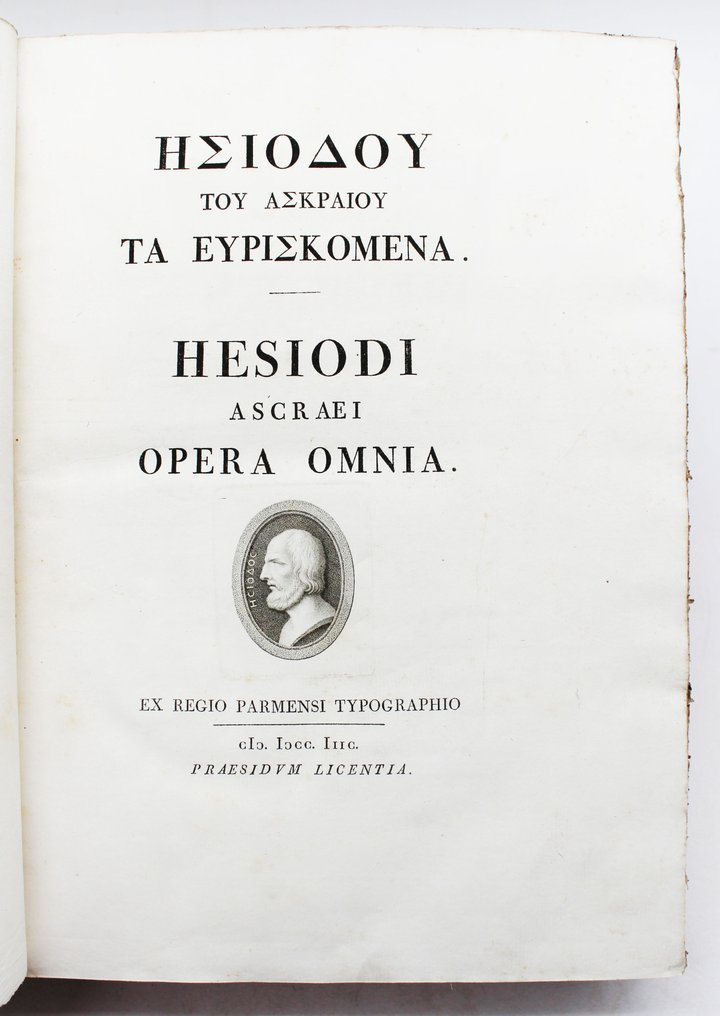
Author/Illustrator: Bodoni / Esiodo; Title: Hesiodou tou Askraiou ta Euriskomena.
AI-assisted summary
Description from the seller
Between myth and reason: The Greek Neoclassicism of Giambattista Bodoni
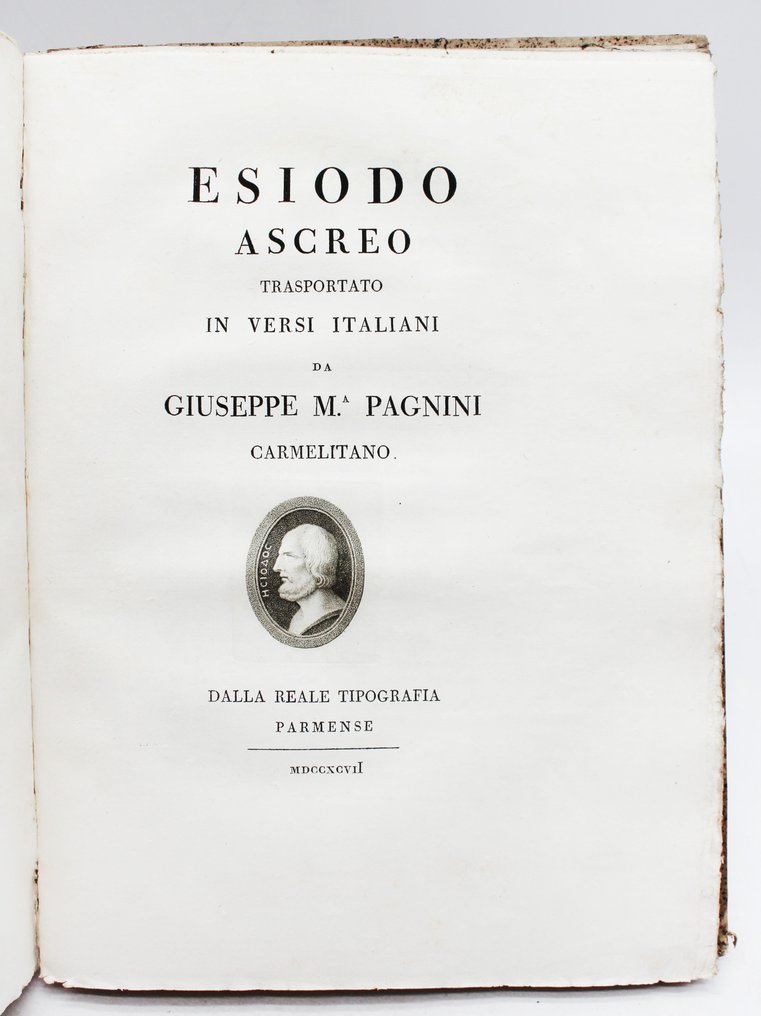
Splendid Parmese edition of the complete works of Hesiod, printed by Giambattista Bodoni in 1797, with Greek text, Latin translation by Bernardo Zamagna, and Italian version by Giuseppe Maria Pagnini. A complete copy of the three parts, with leaves closed and with margins, a refined testimony of typographic neoclassicism and the modern fortune of the archaic poet. The publication marks one of the peaks of Bodoni's late-century production and, together with his editions of Virgil and Horace, stands as a manifesto of balance between formal purity and humanistic idealism. In the clarity of the Greek character and in the triple linguistic mediation—Greek, Latin, and Italian—there is an ambition to bring Hesiod back to the center of European culture, as a figure of a lost harmony between man, nature, and divinity. Today, the work is offered as an object of study and contemplation, a perfect synthesis of typography, philology, and neoclassical aesthetics.
Market value
Complete copies in similar condition (closed pages, with original bindings and contemporary endpapers, even if defective) generally fall within a price range of 1,500 to 3,000 euros, with higher prices for restored copies, those with original bindings in good condition, or with prestigious provenance. Some particularly valuable copies, in Bodoniana bindings or with historic ex libris, have reached values between 4,000 and 5,000 euros at international auctions. The material features – endpapers, uncut sheets, and the perfect condition of the Greek text – are now the most appreciated elements by collectors and scholars of mature Bodoni.
Physical description and condition
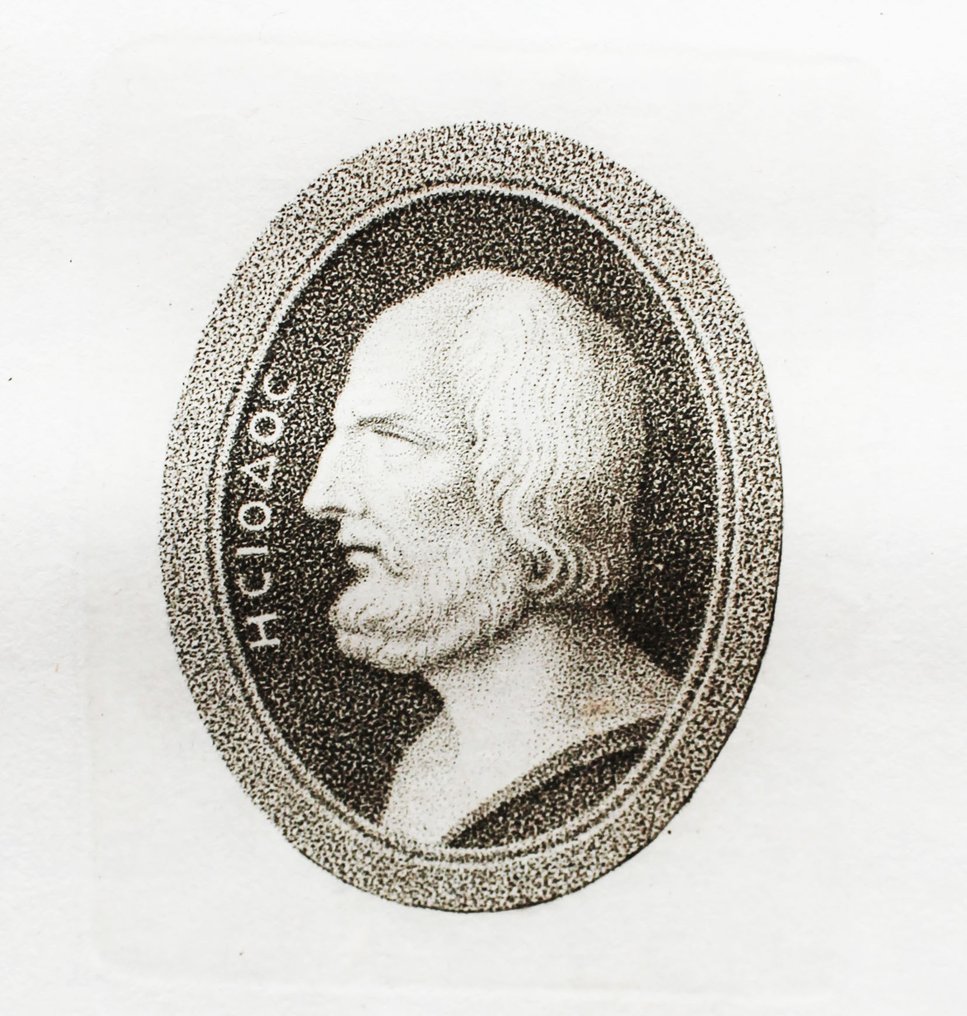
Three parts in a quarto volume. Contemporary hardcover binding in splash cardboard, with a rebacked leather spine, structurally solid. Portrait of Hesiod within a medallion at the frontispiece, with elegant Bodoni typographic borders. Woodworm holes along the inner margin of about 30 pages in the central part of the volume, without loss of text. Copy with closed and uncut pages, with deckle edges, rare in this condition of freshness. Collation: [2], 16, 1-45, [5], 49-110; [4], 279, [1]; 104 pages. Paper of excellent quality, light ivory tone, typical of editions intended for the educated market and ducal gifts.
Full title and author
Hesiod of Askra's discoveries
Parma, Giambattista Bodoni, 1797.
Giambattista Bodoni / Hesiod
Context and Significance
This Bodoni edition brings together for the first time in its entirety the works of Hesiod in three distinct yet harmonious sections: the original Greek text, Bernardo Zamagna's metrical Latin translation, and Giuseppe Maria Pagnini's Italian prose version. The editorial project, born within the learned environment of the Bourbon court of Parma, reflects the Enlightenment ideal of knowledge accessible and organized according to criteria of rationality and beauty. Bodoni, the duke's printer and a refined interpreter of European neoclassicism, creates a balance of forms and spaces that transforms the text into a work of art. The sober layout, elegant Greek characters, clarity of the page, and absence of unnecessary ornamentation visually translate Hesiod's conception of cosmic order. It is a book that, like few others, celebrates the return of the ancient under the light of modern reason: a typographic Hesiod, reformulated as a symbol of the continuity between myth and modernity.
Biography of the Author
Hesiod (8th century BC), a Greek poet from Ascra in Boeotia, was partly a contemporary and partly an antagonist of Homer. His main works—Theogony, Works and Days, The Shield of Heracles—outline a universe ordered by divine and moral laws, in which man is called to labor, justice, and piety. Unlike Homer, Hesiod introduces an autobiographical and didactic dimension, claiming for the first time the poet's personal voice. His figure is central in Greek moral and cosmogonic tradition, and his influence, mediated through the Roman world, spans the Middle Ages and the Renaissance, eventually becoming in the eighteenth century a model of balance and archaic sobriety.
Printing history and circulation
This edition was printed in Parma in 1797 at Giambattista Bodoni's personal typography, which had then reached full artistic and technical maturity. It is cited by Brooks as number 689 among his 'beautiful editions.' Bodoni, already renowned throughout Europe for the purity of his typefaces and for his controlled use of white space, had elevated printing to an aesthetic discipline. His Greek editions, such as this one, were intended for collectors, scholars, and members of the enlightened aristocracy. The print run was limited, and the preservation of copies in closed folio is now a rare event. The work is among the most emblematic productions of the Bodonian workshop at the end of the century, where technique merged with an almost sacred ideal of beauty and measure.
BIBLIOGRAPHY AND REFERENCES
Brooks, Giambattista Bodoni: A Bibliography, no. 689
Dibdin, An Introduction to the Knowledge of Rare and Valuable Editions of the Greek and Latin Classics
Sandys, A History of Classical Scholarship, vol. 2
Brunet II, 1058
Graesse II, 511
De Lama, Life of the Knight Giambattista Bodoni, Parma, 1816
Updike, Printing Types: Their History, Forms and Use, Cambridge, 1922
Seller's Story
Luxury Books: Your Go-To Guide for Nabbing Literary Treasures!
Embarking on the thrilling journey of collecting rare and timeless printed works? Here's your snappy rundown, "The Collector's Cheat Sheet," to ensure you're not just flipping pages but stacking up the value:
1. Edition and Rarity: Rarity is the name of the game. First editions, limited printings, and books flaunting unique features like eye-catching illustrations or mind-blowing bindings? Consider them the VIPs of the collector's world.
2. Condition & Dimension: Picture this – a book in mint condition, untouched by the woes of wear and tear. Now, flip the script: wear, foxing, discoloration – they're the villains here. And don't forget to size up the dimensions, because a book's size matters in the collector's universe.
3. Authenticity: In a world of replicas and forgeries, verifying a book's authenticity is your superhero move. Expert examination and authentication – your trusty sidekicks in this quest.
4. Provenance: Who owned it before you? If the book has hobnobbed with famous figures or danced through historical events, its value skyrockets. Every book has a story, but some have blockbuster tales.
5. Demand and Market Trends: Think of book values as the stock market of the literary world. Stay savvy on collector trends and market shifts to ride the waves of value.
6. Subject Matter: Some topics are like fine wine – they get better with time. Dive into subjects with a timeless appeal or ride the wave of emerging cultural and historical relevance.
7. Binding and Design: Beauty is more than skin deep. Intricate bindings, stunning covers, and illustrations – these are the accessories that make a book runway-ready in the collector's eyes.
8. Association Copies: Books with a personal touch – whether it's a connection to the author or a famous personality – elevate the historical vibes. A book with a backstory? Count us in.
9. Investment Potential: Passion is the engine, but some collectors eye future returns. Keep in mind, though, that the book market can be as unpredictable as a plot twist.
10. Expert Advice: New to the game? Don't play solo. Seek wisdom from the book gurus, hit up book fairs, and join collector communities. We at Luxury Books are the Yodas of the rare book galaxy, helping you build collections that scream sophistication and cultural clout.
Because collecting rare books isn't just about dollar signs – it's a journey of preserving heritage and embracing literary treasures. Happy collecting!
Translated by Google TranslateBetween myth and reason: The Greek Neoclassicism of Giambattista Bodoni
Splendid Parmese edition of the complete works of Hesiod, printed by Giambattista Bodoni in 1797, with Greek text, Latin translation by Bernardo Zamagna, and Italian version by Giuseppe Maria Pagnini. A complete copy of the three parts, with leaves closed and with margins, a refined testimony of typographic neoclassicism and the modern fortune of the archaic poet. The publication marks one of the peaks of Bodoni's late-century production and, together with his editions of Virgil and Horace, stands as a manifesto of balance between formal purity and humanistic idealism. In the clarity of the Greek character and in the triple linguistic mediation—Greek, Latin, and Italian—there is an ambition to bring Hesiod back to the center of European culture, as a figure of a lost harmony between man, nature, and divinity. Today, the work is offered as an object of study and contemplation, a perfect synthesis of typography, philology, and neoclassical aesthetics.
Market value
Complete copies in similar condition (closed pages, with original bindings and contemporary endpapers, even if defective) generally fall within a price range of 1,500 to 3,000 euros, with higher prices for restored copies, those with original bindings in good condition, or with prestigious provenance. Some particularly valuable copies, in Bodoniana bindings or with historic ex libris, have reached values between 4,000 and 5,000 euros at international auctions. The material features – endpapers, uncut sheets, and the perfect condition of the Greek text – are now the most appreciated elements by collectors and scholars of mature Bodoni.
Physical description and condition
Three parts in a quarto volume. Contemporary hardcover binding in splash cardboard, with a rebacked leather spine, structurally solid. Portrait of Hesiod within a medallion at the frontispiece, with elegant Bodoni typographic borders. Woodworm holes along the inner margin of about 30 pages in the central part of the volume, without loss of text. Copy with closed and uncut pages, with deckle edges, rare in this condition of freshness. Collation: [2], 16, 1-45, [5], 49-110; [4], 279, [1]; 104 pages. Paper of excellent quality, light ivory tone, typical of editions intended for the educated market and ducal gifts.
Full title and author
Hesiod of Askra's discoveries
Parma, Giambattista Bodoni, 1797.
Giambattista Bodoni / Hesiod
Context and Significance
This Bodoni edition brings together for the first time in its entirety the works of Hesiod in three distinct yet harmonious sections: the original Greek text, Bernardo Zamagna's metrical Latin translation, and Giuseppe Maria Pagnini's Italian prose version. The editorial project, born within the learned environment of the Bourbon court of Parma, reflects the Enlightenment ideal of knowledge accessible and organized according to criteria of rationality and beauty. Bodoni, the duke's printer and a refined interpreter of European neoclassicism, creates a balance of forms and spaces that transforms the text into a work of art. The sober layout, elegant Greek characters, clarity of the page, and absence of unnecessary ornamentation visually translate Hesiod's conception of cosmic order. It is a book that, like few others, celebrates the return of the ancient under the light of modern reason: a typographic Hesiod, reformulated as a symbol of the continuity between myth and modernity.
Biography of the Author
Hesiod (8th century BC), a Greek poet from Ascra in Boeotia, was partly a contemporary and partly an antagonist of Homer. His main works—Theogony, Works and Days, The Shield of Heracles—outline a universe ordered by divine and moral laws, in which man is called to labor, justice, and piety. Unlike Homer, Hesiod introduces an autobiographical and didactic dimension, claiming for the first time the poet's personal voice. His figure is central in Greek moral and cosmogonic tradition, and his influence, mediated through the Roman world, spans the Middle Ages and the Renaissance, eventually becoming in the eighteenth century a model of balance and archaic sobriety.
Printing history and circulation
This edition was printed in Parma in 1797 at Giambattista Bodoni's personal typography, which had then reached full artistic and technical maturity. It is cited by Brooks as number 689 among his 'beautiful editions.' Bodoni, already renowned throughout Europe for the purity of his typefaces and for his controlled use of white space, had elevated printing to an aesthetic discipline. His Greek editions, such as this one, were intended for collectors, scholars, and members of the enlightened aristocracy. The print run was limited, and the preservation of copies in closed folio is now a rare event. The work is among the most emblematic productions of the Bodonian workshop at the end of the century, where technique merged with an almost sacred ideal of beauty and measure.
BIBLIOGRAPHY AND REFERENCES
Brooks, Giambattista Bodoni: A Bibliography, no. 689
Dibdin, An Introduction to the Knowledge of Rare and Valuable Editions of the Greek and Latin Classics
Sandys, A History of Classical Scholarship, vol. 2
Brunet II, 1058
Graesse II, 511
De Lama, Life of the Knight Giambattista Bodoni, Parma, 1816
Updike, Printing Types: Their History, Forms and Use, Cambridge, 1922
Seller's Story
Luxury Books: Your Go-To Guide for Nabbing Literary Treasures!
Embarking on the thrilling journey of collecting rare and timeless printed works? Here's your snappy rundown, "The Collector's Cheat Sheet," to ensure you're not just flipping pages but stacking up the value:
1. Edition and Rarity: Rarity is the name of the game. First editions, limited printings, and books flaunting unique features like eye-catching illustrations or mind-blowing bindings? Consider them the VIPs of the collector's world.
2. Condition & Dimension: Picture this – a book in mint condition, untouched by the woes of wear and tear. Now, flip the script: wear, foxing, discoloration – they're the villains here. And don't forget to size up the dimensions, because a book's size matters in the collector's universe.
3. Authenticity: In a world of replicas and forgeries, verifying a book's authenticity is your superhero move. Expert examination and authentication – your trusty sidekicks in this quest.
4. Provenance: Who owned it before you? If the book has hobnobbed with famous figures or danced through historical events, its value skyrockets. Every book has a story, but some have blockbuster tales.
5. Demand and Market Trends: Think of book values as the stock market of the literary world. Stay savvy on collector trends and market shifts to ride the waves of value.
6. Subject Matter: Some topics are like fine wine – they get better with time. Dive into subjects with a timeless appeal or ride the wave of emerging cultural and historical relevance.
7. Binding and Design: Beauty is more than skin deep. Intricate bindings, stunning covers, and illustrations – these are the accessories that make a book runway-ready in the collector's eyes.
8. Association Copies: Books with a personal touch – whether it's a connection to the author or a famous personality – elevate the historical vibes. A book with a backstory? Count us in.
9. Investment Potential: Passion is the engine, but some collectors eye future returns. Keep in mind, though, that the book market can be as unpredictable as a plot twist.
10. Expert Advice: New to the game? Don't play solo. Seek wisdom from the book gurus, hit up book fairs, and join collector communities. We at Luxury Books are the Yodas of the rare book galaxy, helping you build collections that scream sophistication and cultural clout.
Because collecting rare books isn't just about dollar signs – it's a journey of preserving heritage and embracing literary treasures. Happy collecting!
Translated by Google TranslateDetails
Number of Books
1
Subject
History
Book Title
ΗΣΙΟΔΟΥ ΤΟΥ ΑΣΚΡΑΙΟΥ ΤΑ ΕΥΡΙΣΚΟΜΕΝΑ
Author/ Illustrator
Bodoni / Esiodo
Condition
Good
Publication year oldest item
1797
Height
311 mm
Edition
1st Edition Thus
Width
227 mm
Language
Greek, Italian, Latin
Original language
Yes
Publisher
Parma, Giambattista Bodoni, 1797
Binding/ Material
Hardback
Number of pages
517
Sold by
