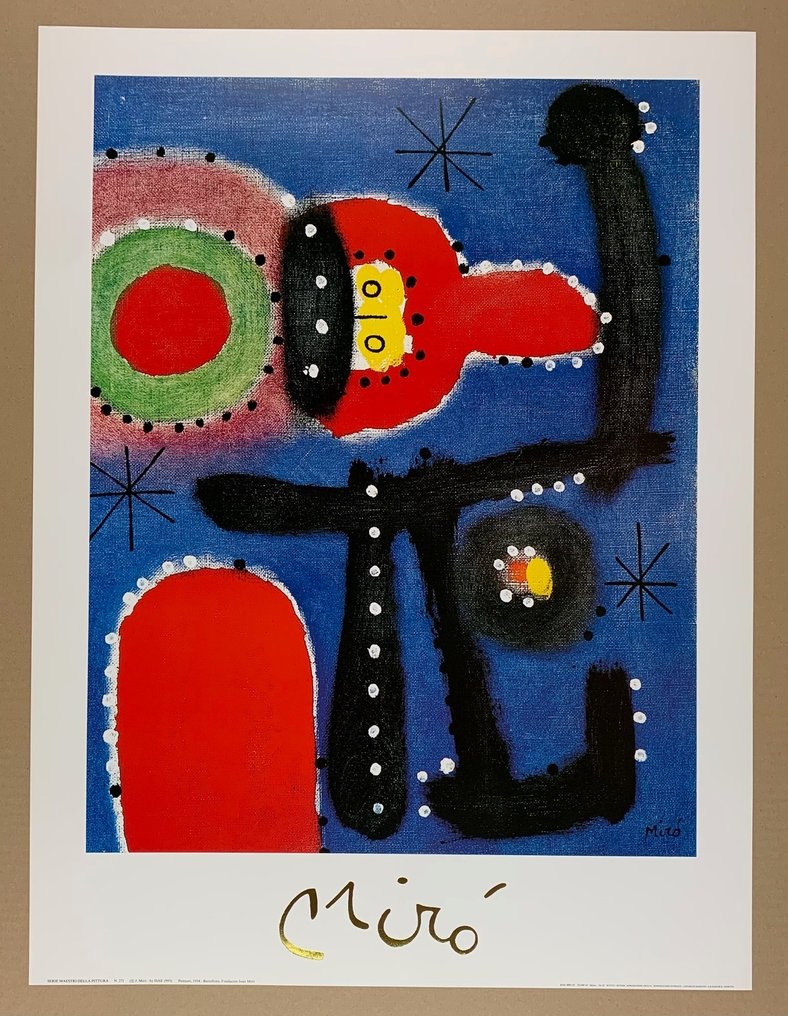
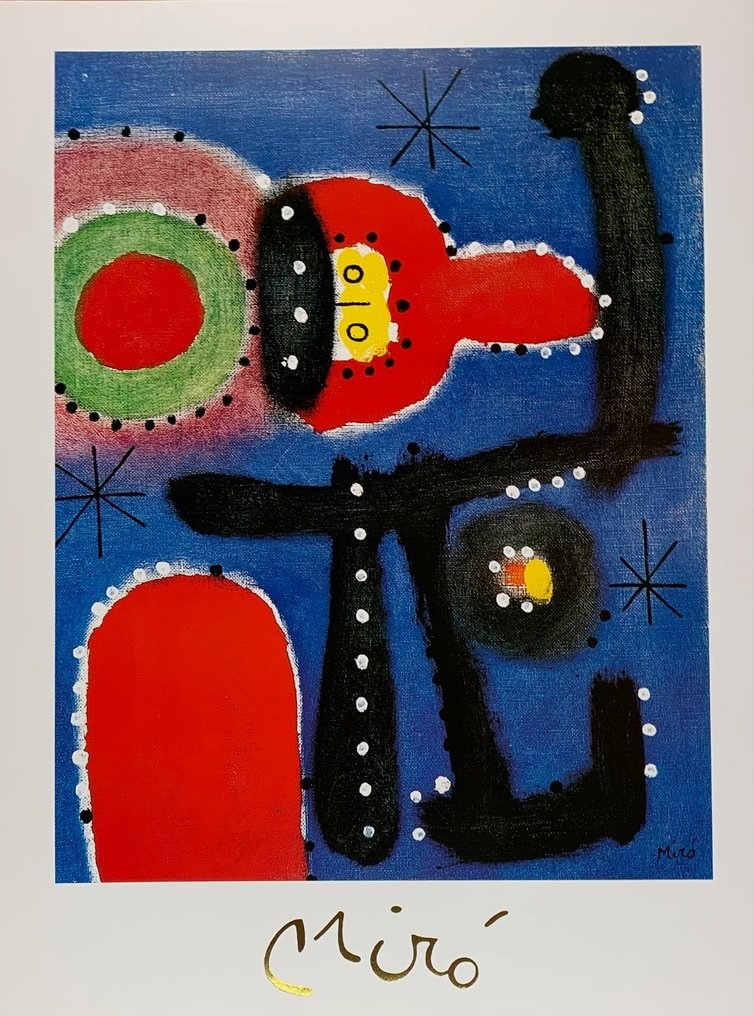
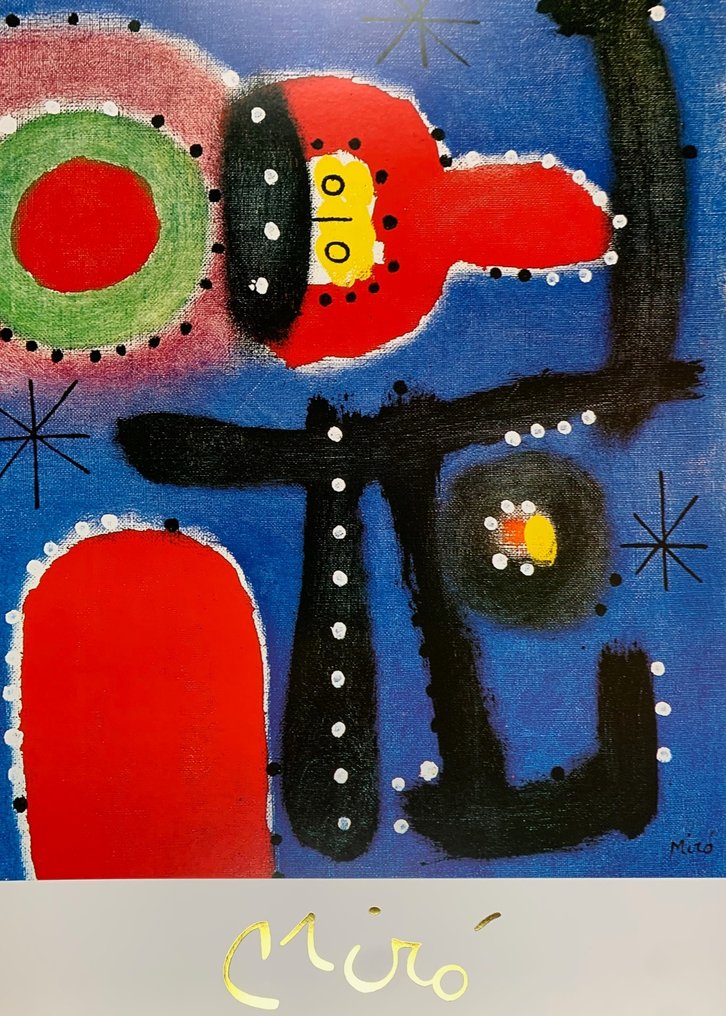
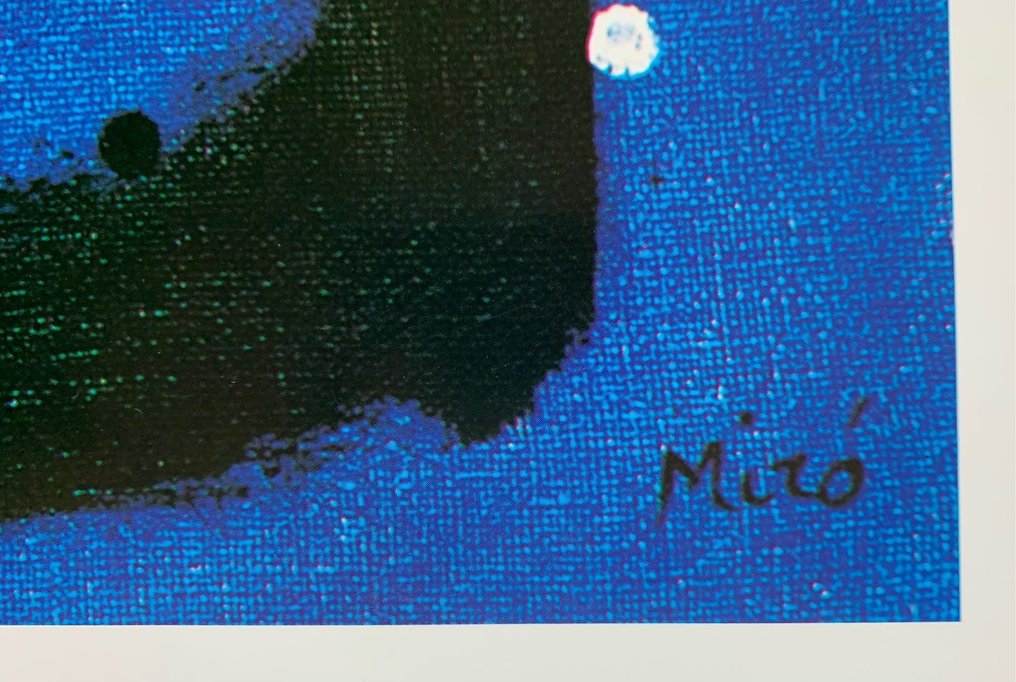
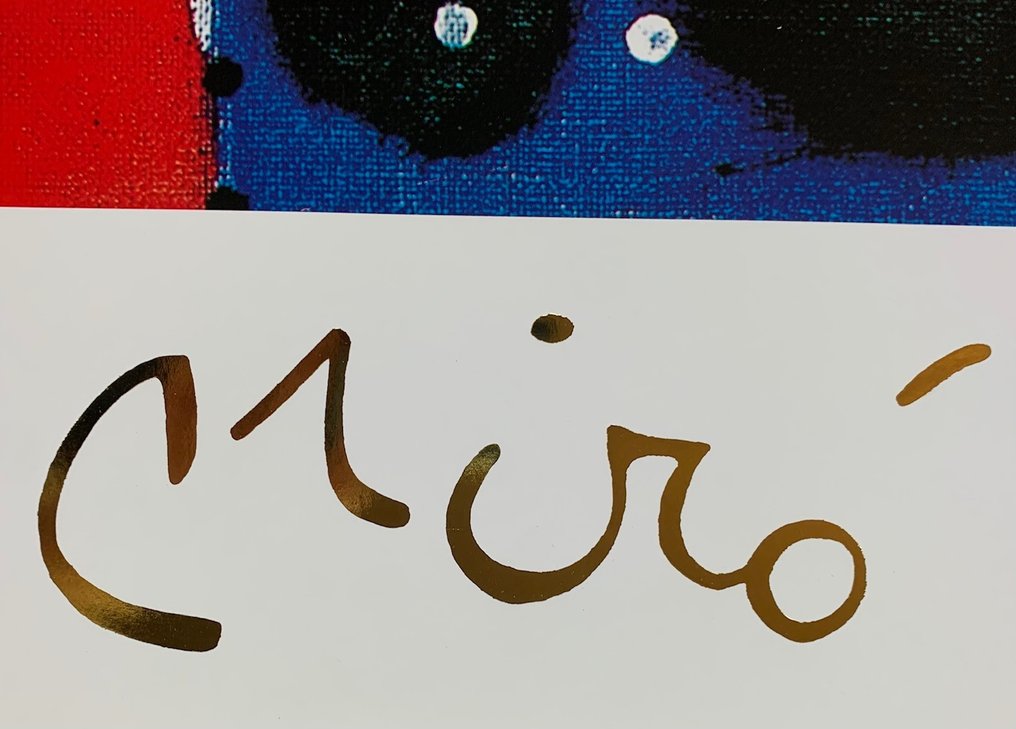
Joan Miro (1893-1983) - Peinture, 1954 - Artprint - 80 x 60 cm
01
day
16
hours
19
minutes
05
seconds
Current bid
€ 25
No reserve price

Expert
Selected by Juan Antonio Rodríguez
Eight years experience valuing posters, previously valuer at Balclis, Barcelona.
Estimate € 150 - € 200
11 other people are watching this object
 Bidder 0028 Bidder 0028 | €25 | |
|---|---|---|
 Bidder 7134 Bidder 7134 | €20 | |
| Bidder 0028 | €15 | |
Catawiki Buyer Protection
Your payment’s safe with us until you receive your object.View details
Trustpilot 4.4 | 121798 reviews
Rated Excellent on Trustpilot.
Description from the seller
Beautiful, expressive art print by Joan Miró in the size of 80 x 60 cm titled Peinture. The work is a high-quality offset print on sturdy, smooth paper and is in very good condition.
Artist: Joan Miró
Painting
Art: Art print
Technology: Offset printing on firm, smooth paper
Originality: Reproduction
Sheet size: 80 x 60 cm
Condition: New
Origin: Art Publishing
Era: Modern Art
Nationality: Spanish Art
Joan Miró:
Joan Miró, born on April 20, 1893, in Barcelona, Spain, is one of the most important artists of the 20th century. Known for his vibrant, often playful works that represent a mixture of Surrealism, abstraction, and Dadaist influences, Miró has had a lasting impact on modern art. His unique, biomorphic shapes and intense use of color created an unmistakable visual language that inspired numerous artists.
Miró's artistic training began in Barcelona, where he enrolled at the Escola de la Llotja and later at the Escola d'Art, Galí. His early influences included Catalan folk art as well as the works of Vincent van Gogh and Paul Cézanne. These influences shaped his early works, which were still strongly realistic and characterized by an intense use of color.
In the early 1920s, Miró moved to Paris, where he came into contact with leading artists of the avant-garde movement. There, he befriended Pablo Picasso, whose innovative approaches and Cubist works had a strong influence on Miró's development. The encounter with the Paris art scene led to a radical change in his style, shifting towards an increasingly abstract and surrealist visual language.
Surrealism, led by artists such as André Breton, Salvador Dalí, and Max Ernst, profoundly influenced Miró. Breton, the founder of Surrealism, described Miró as 'the most surrealist of all of us.' Miró's works from this period are characterized by their dreamlike, almost childlike depictions and their use of symbols and signs. He developed his own form of surrealist automatism, a technique in which the unconscious plays a central role and which turns painting into a spontaneous expression of the inner self.
Miró's biomorphic forms and his preference for vivid colors also inspired artists of abstract art. Wassily Kandinsky, a pioneer of abstraction, and his work on color symbolism and form have left a clear mark on Miró's work. Similarly, Miró influenced artists like Alexander Calder, whose kinetic sculptures exhibit a similar playful quality and freedom in dealing with form and space.
In the 1930s, during the Spanish Civil War and the subsequent Franco dictatorship, Miró increasingly addressed political themes. His renowned work 'El Segador' (The Reaper), which was exhibited at the 1937 World Exhibition in Paris, is an example of his political art, expressing his deep connection to Catalonia and his resistance against oppression.
After World War II, Miró returned to a freer, more experimental style. His works from this period, such as the 'Constellations' series, demonstrate a refined balance between structure and spontaneity and were admired by artists of the New York School, including Jackson Pollock and Mark Rothko. Pollock's Action Paintings and Rothko's color fields are influenced by Miró's free approach to material and form.
Miró's influence also extended to the Pop Art movement, particularly on artists like Robert Rauschenberg and Roy Lichtenstein. Rauschenberg's collages and assemblages, as well as Lichtenstein's comic-like representations, demonstrate a similar playful approach and the integration of everyday objects and images into art.
In contemporary art, artists like Yayoi Kusama and Takashi Murakami have advanced Miró's work. Kusama's obsessively repeated patterns and Murakami's 'Superflat' style, which combines traditional Japanese art with pop culture, reflect Miró's influence on the modern art landscape.
The street art movement has also benefited from Miró's legacy. Artists like Banksy and Shepard Fairey use public space as a canvas to spread social and political messages, similar to Miró with 'El Segador'. Their works are direct, accessible, and often provocative, placing them in the tradition of Miró's socially engaged art.
Miró's work also extended to sculpture and ceramics. His three-dimensional pieces, often created in collaboration with ceramist Josep Llorens Artigas, demonstrate an equally playful and experimental approach as his paintings. These works have influenced sculptors like Henry Moore and Jean Arp, who also experimented with organic shapes and abstracted figures.
In summary, Joan Miró remains a central figure in art history, whose influence extends across numerous movements and generations of artists. His constant search for new forms of expression and his ability to blend different styles and techniques make him an inexhaustible source of inspiration for artists worldwide. From the Surrealists to the Abstracts and contemporary icons of the art world, Miró has continually redefined the boundaries of possibility and remains a vibrant legacy in 21st-century art.
Related artists to Miro:
Salvador Dalí, Pablo Picasso, André Breton, René Magritte, Max Ernst, Jean Arp, Yves Tanguy, Hans Arp, Marcel Duchamp, Paul Éluard, Georges Braque, Henri Matisse, Alexander Calder, Fernand Léger, Joan Prats, Antoni Tàpies, Jean Cocteau, Tristan Tzara, Robert Desnos, Luis Buñuel, Man Ray, Pierre Reverdy, Georges Bataille, Kurt Schwitters, Francis Picabia, Alberto Giacometti, André Masson, Hans Bellmer, Dora Maar
Information about shipping:
We roll prints onto solid cardboard cores, wrap them with corrugated cardboard, and ship them in specially designed, very sturdy boxes. The shipment is sent with a tracking number for parcel tracking.
About us:
We have been active in the art dealing industry for over 20 years and possess extensive experience in the professional handling and shipping of artworks.
No shipping to the Canary Islands
Seller's Story
We have been operating several online shops in the art trade for over 20 years. On the one hand, we specialize in rare art prints, exhibition posters and collectible reproductions, and on the other hand, we trade in art editions and originals by well-known contemporary artists.
The works we offer all come from the respective publishers, art galleries and institutions such as museums that published them in close cooperation with the artists. The works you find with us are often several decades old, in perfect or good condition and without a previous private owner.
We place particular emphasis on professional packaging. Nothing is more annoying than purchasing a rare print that arrives damaged due to poor or inadequate packaging.
If you have any questions about the works on offer, we are always happy to help you!
Translated by Google TranslateBeautiful, expressive art print by Joan Miró in the size of 80 x 60 cm titled Peinture. The work is a high-quality offset print on sturdy, smooth paper and is in very good condition.
Artist: Joan Miró
Painting
Art: Art print
Technology: Offset printing on firm, smooth paper
Originality: Reproduction
Sheet size: 80 x 60 cm
Condition: New
Origin: Art Publishing
Era: Modern Art
Nationality: Spanish Art
Joan Miró:
Joan Miró, born on April 20, 1893, in Barcelona, Spain, is one of the most important artists of the 20th century. Known for his vibrant, often playful works that represent a mixture of Surrealism, abstraction, and Dadaist influences, Miró has had a lasting impact on modern art. His unique, biomorphic shapes and intense use of color created an unmistakable visual language that inspired numerous artists.
Miró's artistic training began in Barcelona, where he enrolled at the Escola de la Llotja and later at the Escola d'Art, Galí. His early influences included Catalan folk art as well as the works of Vincent van Gogh and Paul Cézanne. These influences shaped his early works, which were still strongly realistic and characterized by an intense use of color.
In the early 1920s, Miró moved to Paris, where he came into contact with leading artists of the avant-garde movement. There, he befriended Pablo Picasso, whose innovative approaches and Cubist works had a strong influence on Miró's development. The encounter with the Paris art scene led to a radical change in his style, shifting towards an increasingly abstract and surrealist visual language.
Surrealism, led by artists such as André Breton, Salvador Dalí, and Max Ernst, profoundly influenced Miró. Breton, the founder of Surrealism, described Miró as 'the most surrealist of all of us.' Miró's works from this period are characterized by their dreamlike, almost childlike depictions and their use of symbols and signs. He developed his own form of surrealist automatism, a technique in which the unconscious plays a central role and which turns painting into a spontaneous expression of the inner self.
Miró's biomorphic forms and his preference for vivid colors also inspired artists of abstract art. Wassily Kandinsky, a pioneer of abstraction, and his work on color symbolism and form have left a clear mark on Miró's work. Similarly, Miró influenced artists like Alexander Calder, whose kinetic sculptures exhibit a similar playful quality and freedom in dealing with form and space.
In the 1930s, during the Spanish Civil War and the subsequent Franco dictatorship, Miró increasingly addressed political themes. His renowned work 'El Segador' (The Reaper), which was exhibited at the 1937 World Exhibition in Paris, is an example of his political art, expressing his deep connection to Catalonia and his resistance against oppression.
After World War II, Miró returned to a freer, more experimental style. His works from this period, such as the 'Constellations' series, demonstrate a refined balance between structure and spontaneity and were admired by artists of the New York School, including Jackson Pollock and Mark Rothko. Pollock's Action Paintings and Rothko's color fields are influenced by Miró's free approach to material and form.
Miró's influence also extended to the Pop Art movement, particularly on artists like Robert Rauschenberg and Roy Lichtenstein. Rauschenberg's collages and assemblages, as well as Lichtenstein's comic-like representations, demonstrate a similar playful approach and the integration of everyday objects and images into art.
In contemporary art, artists like Yayoi Kusama and Takashi Murakami have advanced Miró's work. Kusama's obsessively repeated patterns and Murakami's 'Superflat' style, which combines traditional Japanese art with pop culture, reflect Miró's influence on the modern art landscape.
The street art movement has also benefited from Miró's legacy. Artists like Banksy and Shepard Fairey use public space as a canvas to spread social and political messages, similar to Miró with 'El Segador'. Their works are direct, accessible, and often provocative, placing them in the tradition of Miró's socially engaged art.
Miró's work also extended to sculpture and ceramics. His three-dimensional pieces, often created in collaboration with ceramist Josep Llorens Artigas, demonstrate an equally playful and experimental approach as his paintings. These works have influenced sculptors like Henry Moore and Jean Arp, who also experimented with organic shapes and abstracted figures.
In summary, Joan Miró remains a central figure in art history, whose influence extends across numerous movements and generations of artists. His constant search for new forms of expression and his ability to blend different styles and techniques make him an inexhaustible source of inspiration for artists worldwide. From the Surrealists to the Abstracts and contemporary icons of the art world, Miró has continually redefined the boundaries of possibility and remains a vibrant legacy in 21st-century art.
Related artists to Miro:
Salvador Dalí, Pablo Picasso, André Breton, René Magritte, Max Ernst, Jean Arp, Yves Tanguy, Hans Arp, Marcel Duchamp, Paul Éluard, Georges Braque, Henri Matisse, Alexander Calder, Fernand Léger, Joan Prats, Antoni Tàpies, Jean Cocteau, Tristan Tzara, Robert Desnos, Luis Buñuel, Man Ray, Pierre Reverdy, Georges Bataille, Kurt Schwitters, Francis Picabia, Alberto Giacometti, André Masson, Hans Bellmer, Dora Maar
Information about shipping:
We roll prints onto solid cardboard cores, wrap them with corrugated cardboard, and ship them in specially designed, very sturdy boxes. The shipment is sent with a tracking number for parcel tracking.
About us:
We have been active in the art dealing industry for over 20 years and possess extensive experience in the professional handling and shipping of artworks.
No shipping to the Canary Islands
Seller's Story
We have been operating several online shops in the art trade for over 20 years. On the one hand, we specialize in rare art prints, exhibition posters and collectible reproductions, and on the other hand, we trade in art editions and originals by well-known contemporary artists.
The works we offer all come from the respective publishers, art galleries and institutions such as museums that published them in close cooperation with the artists. The works you find with us are often several decades old, in perfect or good condition and without a previous private owner.
We place particular emphasis on professional packaging. Nothing is more annoying than purchasing a rare print that arrives damaged due to poor or inadequate packaging.
If you have any questions about the works on offer, we are always happy to help you!
Translated by Google TranslateDetails
Artist
Joan Miro (1893-1983)
Sold by
Owner or reseller
Title of artwork
Peinture, 1954 - Artprint - 80 x 60 cm
Technique
Offset print
Signature
Plate signed
Country of Origin
Germany
Year
1954
Condition
Excellent condition
Height
80 cm
Width
60 cm
Style
Modern
Period
1950-1960
Sold with frame
No