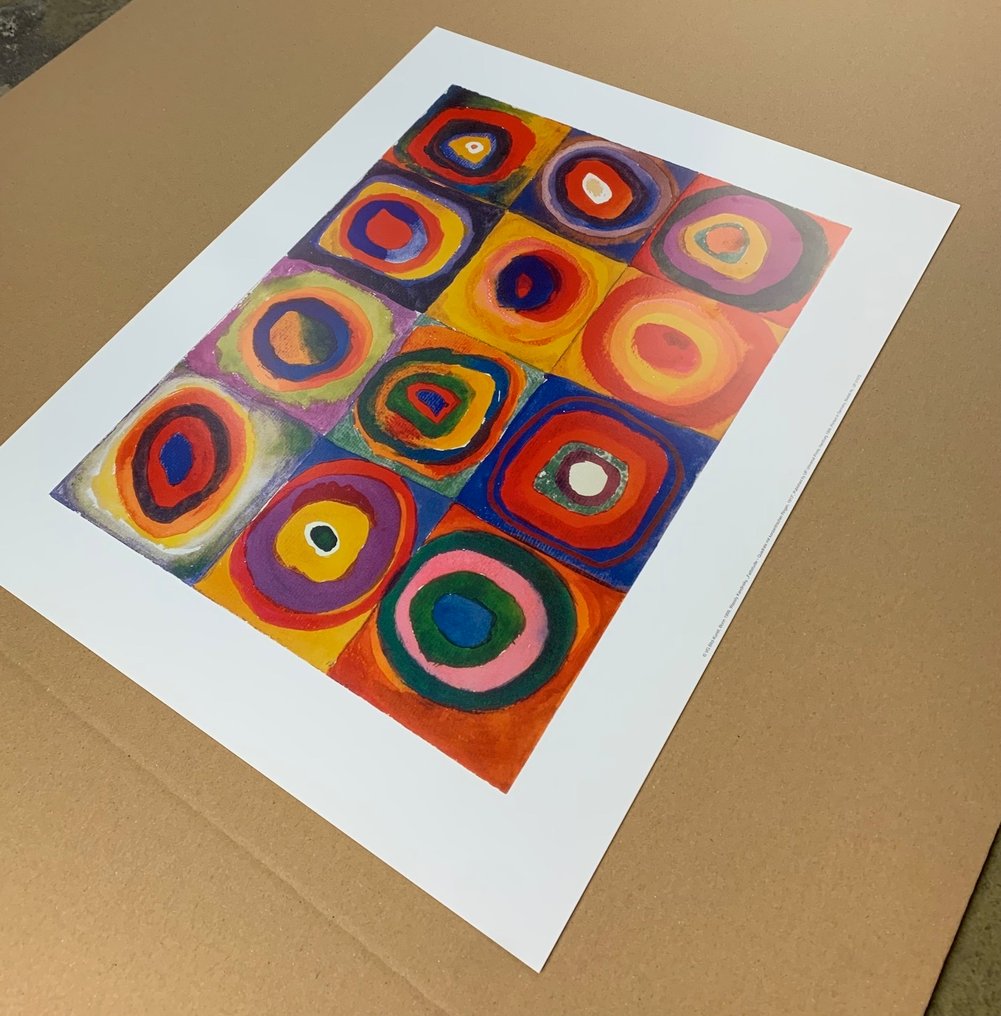
Wassily Kandinsky (1866-1944) - Color Study - Squares with Concentric Rings, 1913 - Artprint - 40 x 50 cm


06
days
19
hours
08
minutes
35
seconds
Starting bid
€ 1
No reserve price

Expert
Selected by Juan Antonio Rodríguez
Eight years experience valuing posters, previously valuer at Balclis, Barcelona.
Estimate € 150 - € 200
No bids placed
Catawiki Buyer Protection
Your payment’s safe with us until you receive your object.View details
Trustpilot 4.4 | 122473 reviews
Rated Excellent on Trustpilot.
Description from the seller
Beautiful, expressive art print by Wassily Kandinsky in 40 x 50 cm format titled 'Square Circles'. The piece is a high-quality print on sturdy paper and is in very good condition.
Artist: Wassily Kandinsky
Square Circles
Art: Art print
Technique: Printing on stiff paper
Originality: Reproduction
Sheet dimensions: 40 x 50 cm
Condition: New
Origin: Art Publishing
Era: Expressionism
Nationality: Russian Art
Wassily Kandinsky
Wassily Kandinsky, born in 1866 in Moscow and died in 1944 in Neuilly-sur-Seine, France, is considered one of the most important artists of the 20th century and a pioneer of abstract art. He was not only a painter but also an art theorist, whose writings on color and form had a lasting influence on the art world. Kandinsky believed in the spiritual power of art and saw abstract painting as a way to express emotional and spiritual truths beyond the visible world.
Kandinsky began his career relatively late. After initially studying law, he dedicated himself to painting only from the age of 30. After studying in Munich and an initial artistic phase influenced by Art Nouveau and Russian folk art, Kandinsky turned to abstract art. His early works still show representational elements, but in them, he already begins to detach from realistic depiction and instead uses colors and shapes as autonomous means of expression.
In 1911, Kandinsky, together with Franz Marc, founded the artist group 'Der Blaue Reiter,' a loose association of expressionist artists that also included Paul Klee, August Macke, and Gabriele Münter. The group emphasized the spiritual and emotional power of art and regarded color as a central means of depicting inner, mental states. Kandinsky's paintings from this period, such as 'Composition V' (1911) and 'Impression III (Concert)' (1911), are characterized by intense colors and a growing departure from figurative representation. These works mark Kandinsky's path toward complete abstraction.
One of Kandinsky's most famous works is 'Composition VII' (1913), a large-scale, complex painting that displays a dense network of shapes, lines, and colors. In this work, his effort to connect music and painting is evident. Kandinsky believed that art, much like music, does not rely on depicting the external world to convey emotional and spiritual content. In this context, he coined the term 'inner sound,' which describes the idea that abstract forms and colors can evoke emotional and spiritual resonances in the viewer.
During World War I, Kandinsky returned to Russia, where he worked as a cultural official. However, the revolutionary art policy in the early Soviet Union did not align with his ideas, and he left the country in 1921. He moved to Germany and began teaching at the Bauhaus in 1922, one of the most important art and design schools of the modern era. At the Bauhaus, Kandinsky collaborated with artists such as Paul Klee, Lyonel Feininger, and László Moholy-Nagy, further developing his theories on geometry and color. During this phase, his works became increasingly geometric, as seen in 'Yellow-Red-Blue' (1925), where he arranged simple geometric shapes like circles, triangles, and lines into a harmonious, colorful composition.
After the closure of the Bauhaus by the National Socialists in 1933, Kandinsky moved to France, where he lived until his death. In his later works, such as 'Composition X' (1939), he returned to freer, organic forms, but combined them with the clear geometric structures he had developed at the Bauhaus.
Kandinsky's influence on modern art is hardly overstated. As a pioneer of abstraction and an important theorist, he shaped generations of artists, including abstract expressionists like Jackson Pollock and Mark Rothko, as well as representatives of color field painting and geometric abstraction. His writings, especially 'Concerning the Spiritual in Art' (1911) and 'Point and Line to Surface' (1926), remain fundamental to understanding modern art and the significance of color and form as means of expression.
In summary, Wassily Kandinsky remains a key figure in 20th-century art, whose works and theories revolutionized the concept of abstraction in painting. His conviction that art does not have to depict the visible world but can express inner, spiritual realities remains one of the central legacies of modern art.
Related artists:
Paul Klee, Franz Marc, August Macke, Gabriele Münter, Alexej von Jawlensky, Lyonel Feininger, Johannes Itten, Oskar Schlemmer, László Moholy-Nagy, Piet Mondrian, Kazimir Malevich
Information about shipping:
We roll prints onto solid cardboard cores, wrap them with corrugated cardboard, and ship them in sturdy boxes with tracking numbers.
About us:
We have been active in the art dealing industry for over 20 years and possess extensive experience in the professional handling and shipping of artworks.
No shipping Canary Islands, Taiwan
Seller's Story
We have been operating several online shops in the art trade for over 20 years. On the one hand, we specialize in rare art prints, exhibition posters and collectible reproductions, and on the other hand, we trade in art editions and originals by well-known contemporary artists.
The works we offer all come from the respective publishers, art galleries and institutions such as museums that published them in close cooperation with the artists. The works you find with us are often several decades old, in perfect or good condition and without a previous private owner.
We place particular emphasis on professional packaging. Nothing is more annoying than purchasing a rare print that arrives damaged due to poor or inadequate packaging.
If you have any questions about the works on offer, we are always happy to help you!
Translated by Google TranslateBeautiful, expressive art print by Wassily Kandinsky in 40 x 50 cm format titled 'Square Circles'. The piece is a high-quality print on sturdy paper and is in very good condition.
Artist: Wassily Kandinsky
Square Circles
Art: Art print
Technique: Printing on stiff paper
Originality: Reproduction
Sheet dimensions: 40 x 50 cm
Condition: New
Origin: Art Publishing
Era: Expressionism
Nationality: Russian Art
Wassily Kandinsky
Wassily Kandinsky, born in 1866 in Moscow and died in 1944 in Neuilly-sur-Seine, France, is considered one of the most important artists of the 20th century and a pioneer of abstract art. He was not only a painter but also an art theorist, whose writings on color and form had a lasting influence on the art world. Kandinsky believed in the spiritual power of art and saw abstract painting as a way to express emotional and spiritual truths beyond the visible world.
Kandinsky began his career relatively late. After initially studying law, he dedicated himself to painting only from the age of 30. After studying in Munich and an initial artistic phase influenced by Art Nouveau and Russian folk art, Kandinsky turned to abstract art. His early works still show representational elements, but in them, he already begins to detach from realistic depiction and instead uses colors and shapes as autonomous means of expression.
In 1911, Kandinsky, together with Franz Marc, founded the artist group 'Der Blaue Reiter,' a loose association of expressionist artists that also included Paul Klee, August Macke, and Gabriele Münter. The group emphasized the spiritual and emotional power of art and regarded color as a central means of depicting inner, mental states. Kandinsky's paintings from this period, such as 'Composition V' (1911) and 'Impression III (Concert)' (1911), are characterized by intense colors and a growing departure from figurative representation. These works mark Kandinsky's path toward complete abstraction.
One of Kandinsky's most famous works is 'Composition VII' (1913), a large-scale, complex painting that displays a dense network of shapes, lines, and colors. In this work, his effort to connect music and painting is evident. Kandinsky believed that art, much like music, does not rely on depicting the external world to convey emotional and spiritual content. In this context, he coined the term 'inner sound,' which describes the idea that abstract forms and colors can evoke emotional and spiritual resonances in the viewer.
During World War I, Kandinsky returned to Russia, where he worked as a cultural official. However, the revolutionary art policy in the early Soviet Union did not align with his ideas, and he left the country in 1921. He moved to Germany and began teaching at the Bauhaus in 1922, one of the most important art and design schools of the modern era. At the Bauhaus, Kandinsky collaborated with artists such as Paul Klee, Lyonel Feininger, and László Moholy-Nagy, further developing his theories on geometry and color. During this phase, his works became increasingly geometric, as seen in 'Yellow-Red-Blue' (1925), where he arranged simple geometric shapes like circles, triangles, and lines into a harmonious, colorful composition.
After the closure of the Bauhaus by the National Socialists in 1933, Kandinsky moved to France, where he lived until his death. In his later works, such as 'Composition X' (1939), he returned to freer, organic forms, but combined them with the clear geometric structures he had developed at the Bauhaus.
Kandinsky's influence on modern art is hardly overstated. As a pioneer of abstraction and an important theorist, he shaped generations of artists, including abstract expressionists like Jackson Pollock and Mark Rothko, as well as representatives of color field painting and geometric abstraction. His writings, especially 'Concerning the Spiritual in Art' (1911) and 'Point and Line to Surface' (1926), remain fundamental to understanding modern art and the significance of color and form as means of expression.
In summary, Wassily Kandinsky remains a key figure in 20th-century art, whose works and theories revolutionized the concept of abstraction in painting. His conviction that art does not have to depict the visible world but can express inner, spiritual realities remains one of the central legacies of modern art.
Related artists:
Paul Klee, Franz Marc, August Macke, Gabriele Münter, Alexej von Jawlensky, Lyonel Feininger, Johannes Itten, Oskar Schlemmer, László Moholy-Nagy, Piet Mondrian, Kazimir Malevich
Information about shipping:
We roll prints onto solid cardboard cores, wrap them with corrugated cardboard, and ship them in sturdy boxes with tracking numbers.
About us:
We have been active in the art dealing industry for over 20 years and possess extensive experience in the professional handling and shipping of artworks.
No shipping Canary Islands, Taiwan
Seller's Story
We have been operating several online shops in the art trade for over 20 years. On the one hand, we specialize in rare art prints, exhibition posters and collectible reproductions, and on the other hand, we trade in art editions and originals by well-known contemporary artists.
The works we offer all come from the respective publishers, art galleries and institutions such as museums that published them in close cooperation with the artists. The works you find with us are often several decades old, in perfect or good condition and without a previous private owner.
We place particular emphasis on professional packaging. Nothing is more annoying than purchasing a rare print that arrives damaged due to poor or inadequate packaging.
If you have any questions about the works on offer, we are always happy to help you!
Translated by Google TranslateDetails
Artist
Wassily Kandinsky (1866-1944)
Sold by
Owner or reseller
Title of artwork
Color Study - Squares with Concentric Rings, 1913 - Artprint - 40 x 50 cm
Technique
Offset print
Signature
Not signed
Country of Origin
Germany
Year
1913
Condition
Excellent condition
Height
40 cm
Width
50 cm
Style
Expressionism
Period
1910-1920
Sold with frame
No