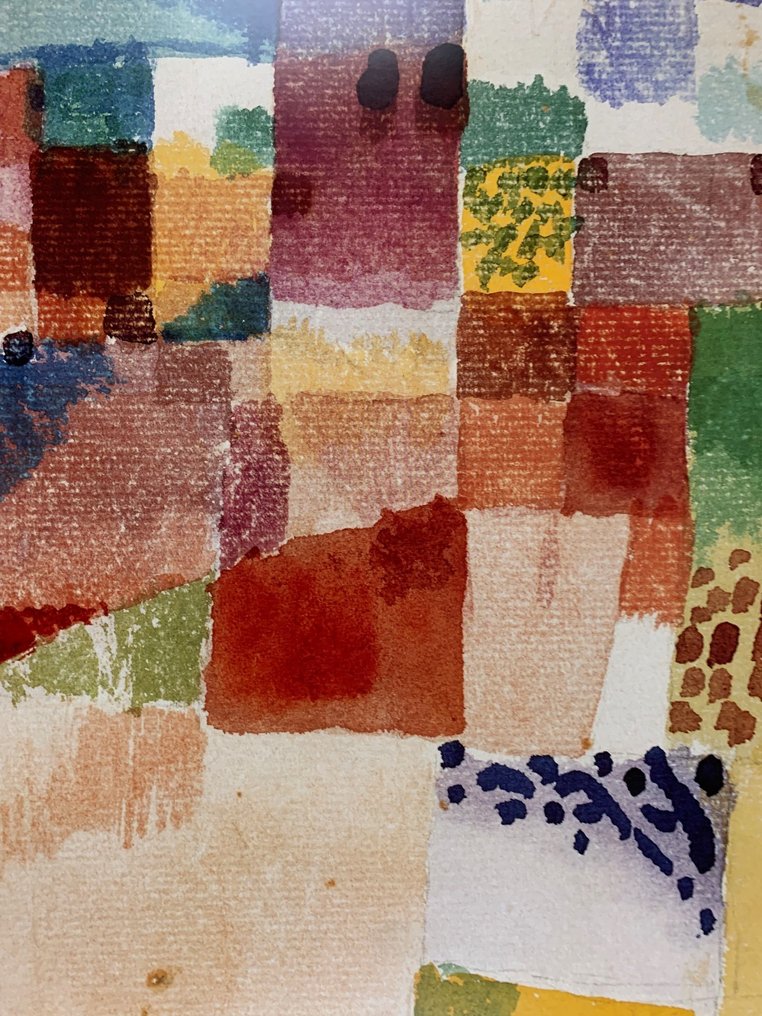
Paul Klee - Motiv aus Hammamet, 1914 - Artprint - 73 x 60 cm


02
days
00
hours
02
minutes
28
seconds
Starting bid
€ 1
Reserve price not met

Expert
Selected by Juan Antonio Rodríguez
Eight years experience valuing posters, previously valuer at Balclis, Barcelona.
Estimate € 150 - € 200
No bids placed
Catawiki Buyer Protection
Your payment’s safe with us until you receive your object.View details
Trustpilot 4.4 | 122190 reviews
Rated Excellent on Trustpilot.
Description from the seller
Beautiful, expressive art print by Paul Klee in the format 73 x 60 cm titled "Motif from Hammamet, 1914." The work is a high-quality offset print on firm paper and is in very good condition.
Artist: Paul Klee
Motif from Hammamet, 1914
Art: Art print
Technology: Offset printing
Originality: Reproduction
Sheet dimensions: 73 x 60 cm
Condition: New
Origin: Art Publisher
Era: Classical Modernism
Nationality: German art
Paul Klee:
Paul Klee, born on December 18, 1879, in Münchenbuchsee, Switzerland, and died on June 29, 1940, in Muralto, Switzerland, is considered one of the most important artists of modern art. Known for his diverse styles and techniques, Klee had a lasting influence on 20th-century art. His works, often inspired by music, poetry, and childish imagination, combine abstract forms with figurative elements and create a unique visual language that influenced many artists after him.
Klee's artistic training began at the Academy of Fine Arts in Munich, where he was taught among others by Franz von Stuck. In his early years, Klee was heavily influenced by Symbolism and the graphic art of Art Nouveau. Artists like Gustav Klimt and Aubrey Beardsley, whose decorative and linear style elements echo in Klee's works, shaped his development. The line work and ornamentation in Klee's early works are strongly reminiscent of the works of Klimt and Beardsley.
A pivotal turning point in Klee's career was his encounter with the avant-garde movement "Der Blaue Reiter" in Munich, which he joined in 1911. Under the influence of artists like Wassily Kandinsky and Franz Marc, who advocated for a new spiritual art, Klee began to focus increasingly on abstraction. Kandinsky's considerations on color symbolism and abstract composition, as well as Marc's animal depictions characterized by a vibrant color palette and symbolic meaning, had a profound influence on Klee's work.
Another significant influence on Klee's art was the Cubist movement, led by Pablo Picasso and Georges Braque. Cubism, which broke down objects into geometric shapes, inspired Klee to explore complex spatial structures in his works. Klee's ability to integrate different artistic currents is evident in his preference for playing with perspective and form. Fernand Léger and Juan Gris, other important Cubists, also contributed to the development of Klee's abstract visual language.
Klee's journey to Tunisia in 1914 marked another important moment in his artistic development. The intense colors and clear light of North Africa inspired Klee to create a series of watercolors and paintings that are among the highlights of his work. These works, often referred to as "Tunisia Watercolors," display a luminous use of color and a particular clarity that greatly influenced his later work. This explosion of color is reminiscent of the works of Henri Matisse, whose vibrant colors and expressive shapes radiate a similar vitality.
During his time at the Bauhaus in Weimar and Dessau from 1921 to 1931, where he worked as a teacher, Klee further developed his theories about color and form. At the Bauhaus, he worked alongside artists such as László Moholy-Nagy and Lyonel Feininger, whose experimental approaches and interdisciplinary methods enriched his own techniques. Moholy-Nagy's experiments with light and photography and Feininger's Cubist cityscapes demonstrated similar pursuits of a new, modern artistic language. Other Bauhaus artists like Josef Albers, Anni Albers, and Johannes Itten influenced and were influenced by Klee's work. Klee's impact on color theory and composition techniques is clearly evident in their works. Josef Albers' series "Homage to the Square" shows a systematic exploration of color interaction, which can be traced back to Klee's teaching at the Bauhaus.
The Surrealists, including artists like Joan Miró and Max Ernst, were also inspired by Klee's fantastic and dreamlike images. Miró's biomorphic forms and Ernst's experimental techniques demonstrate how strongly Klee's works influenced the Surrealist movement. Both artists shared with Klee an interest in exploring the unconscious and coincidence. Salvador Dalí and René Magritte, other prominent surrealists, displayed similar approaches in their works for exploring the dream world and the unconscious.
Even the Abstract Expressionists, particularly artists like Jackson Pollock and Mark Rothko, drew inspiration from Klee's work. Pollock's Action Paintings and Rothko's color field compositions reflect Klee's intuitive approach to art and his ability to generate deep emotional resonance. Pollock's dynamic lines and Rothko's meditative color fields are in an artistic dialogue with Klee's abstract and often spiritual compositions. Willem de Kooning and Barnett Newman, two other key figures of Abstract Expressionism, also demonstrated the influence of Klee's work in their art.
In contemporary art, artists like Gerhard Richter and Sigmar Polke have continued Klee's experimental spirit. Richter's versatility and his exploration of various styles and techniques reflect Klee's own artistic journey. Polke's playful and often ironic works display a similar sense of freedom and experimentation. Other contemporary artists such as Anselm Kiefer and Georg Baselitz have incorporated Klee's influence into their complex and often monumental works.
Klee's influence extends also to sculpture and installation art. Artists such as Alexander Calder and Jean Tinguely, who created kinetic sculptures, were inspired by Klee's playful and often humorous approach to form and movement. Calder's mobiles and Tinguely's mechanical installations embody Klee's idea of the dynamic and constantly changing artwork. Louise Bourgeois and Richard Serra, known for their emotional depth and structural complexity, also show traces of Klee's influence.
In the field of abstract art, artists like Bridget Riley and Ellsworth Kelly have further developed Klee's principles of color and form. Riley's Op Art paintings, which create visual illusions, and Kelly's clear, geometric fields of color demonstrate how Klee's theories on perception and abstraction continue to live on in modern art. Agnes Martin and Frank Stella, whose works are often seen as meditative and structural explorations, also reflect the principles that Klee pursued in his art.
Klee's influence is also evident in digital art. Artists like Casey Reas and Joshua Davis use algorithms and programming to create generative artworks that recall Klee's experimental and systematic approach to art. These contemporary artists continue Klee's legacy by utilizing new technologies and media to bring his ideas into the present.
Paul Klee remains a central figure in art history, whose influence extends across numerous movements and generations of artists. His constant search for new forms of expression and his ability to blend different styles and techniques make him an inexhaustible source of inspiration for artists worldwide. From the Expressionists to the Surrealists and up to contemporary icons of the art world, Klee has continually redefined the boundaries of possibility and remains a vibrant legacy in 21st-century art.
Shipping information:
We roll prints onto solid cardboard tubes, wrap them in corrugated cardboard, and ship them in special, very sturdy boxes. Shipping is done with a tracking number for package tracking.
About us:
We have been active in the art trade for over 20 years and have extensive experience in the professional handling and shipping of works of art.
No shipping Canary Islands, Taiwan
Seller's Story
We have been operating several online shops in the art trade for over 20 years. On the one hand, we specialize in rare art prints, exhibition posters and collectible reproductions, and on the other hand, we trade in art editions and originals by well-known contemporary artists.
The works we offer all come from the respective publishers, art galleries and institutions such as museums that published them in close cooperation with the artists. The works you find with us are often several decades old, in perfect or good condition and without a previous private owner.
We place particular emphasis on professional packaging. Nothing is more annoying than purchasing a rare print that arrives damaged due to poor or inadequate packaging.
If you have any questions about the works on offer, we are always happy to help you!
Translated by Google TranslateBeautiful, expressive art print by Paul Klee in the format 73 x 60 cm titled "Motif from Hammamet, 1914." The work is a high-quality offset print on firm paper and is in very good condition.
Artist: Paul Klee
Motif from Hammamet, 1914
Art: Art print
Technology: Offset printing
Originality: Reproduction
Sheet dimensions: 73 x 60 cm
Condition: New
Origin: Art Publisher
Era: Classical Modernism
Nationality: German art
Paul Klee:
Paul Klee, born on December 18, 1879, in Münchenbuchsee, Switzerland, and died on June 29, 1940, in Muralto, Switzerland, is considered one of the most important artists of modern art. Known for his diverse styles and techniques, Klee had a lasting influence on 20th-century art. His works, often inspired by music, poetry, and childish imagination, combine abstract forms with figurative elements and create a unique visual language that influenced many artists after him.
Klee's artistic training began at the Academy of Fine Arts in Munich, where he was taught among others by Franz von Stuck. In his early years, Klee was heavily influenced by Symbolism and the graphic art of Art Nouveau. Artists like Gustav Klimt and Aubrey Beardsley, whose decorative and linear style elements echo in Klee's works, shaped his development. The line work and ornamentation in Klee's early works are strongly reminiscent of the works of Klimt and Beardsley.
A pivotal turning point in Klee's career was his encounter with the avant-garde movement "Der Blaue Reiter" in Munich, which he joined in 1911. Under the influence of artists like Wassily Kandinsky and Franz Marc, who advocated for a new spiritual art, Klee began to focus increasingly on abstraction. Kandinsky's considerations on color symbolism and abstract composition, as well as Marc's animal depictions characterized by a vibrant color palette and symbolic meaning, had a profound influence on Klee's work.
Another significant influence on Klee's art was the Cubist movement, led by Pablo Picasso and Georges Braque. Cubism, which broke down objects into geometric shapes, inspired Klee to explore complex spatial structures in his works. Klee's ability to integrate different artistic currents is evident in his preference for playing with perspective and form. Fernand Léger and Juan Gris, other important Cubists, also contributed to the development of Klee's abstract visual language.
Klee's journey to Tunisia in 1914 marked another important moment in his artistic development. The intense colors and clear light of North Africa inspired Klee to create a series of watercolors and paintings that are among the highlights of his work. These works, often referred to as "Tunisia Watercolors," display a luminous use of color and a particular clarity that greatly influenced his later work. This explosion of color is reminiscent of the works of Henri Matisse, whose vibrant colors and expressive shapes radiate a similar vitality.
During his time at the Bauhaus in Weimar and Dessau from 1921 to 1931, where he worked as a teacher, Klee further developed his theories about color and form. At the Bauhaus, he worked alongside artists such as László Moholy-Nagy and Lyonel Feininger, whose experimental approaches and interdisciplinary methods enriched his own techniques. Moholy-Nagy's experiments with light and photography and Feininger's Cubist cityscapes demonstrated similar pursuits of a new, modern artistic language. Other Bauhaus artists like Josef Albers, Anni Albers, and Johannes Itten influenced and were influenced by Klee's work. Klee's impact on color theory and composition techniques is clearly evident in their works. Josef Albers' series "Homage to the Square" shows a systematic exploration of color interaction, which can be traced back to Klee's teaching at the Bauhaus.
The Surrealists, including artists like Joan Miró and Max Ernst, were also inspired by Klee's fantastic and dreamlike images. Miró's biomorphic forms and Ernst's experimental techniques demonstrate how strongly Klee's works influenced the Surrealist movement. Both artists shared with Klee an interest in exploring the unconscious and coincidence. Salvador Dalí and René Magritte, other prominent surrealists, displayed similar approaches in their works for exploring the dream world and the unconscious.
Even the Abstract Expressionists, particularly artists like Jackson Pollock and Mark Rothko, drew inspiration from Klee's work. Pollock's Action Paintings and Rothko's color field compositions reflect Klee's intuitive approach to art and his ability to generate deep emotional resonance. Pollock's dynamic lines and Rothko's meditative color fields are in an artistic dialogue with Klee's abstract and often spiritual compositions. Willem de Kooning and Barnett Newman, two other key figures of Abstract Expressionism, also demonstrated the influence of Klee's work in their art.
In contemporary art, artists like Gerhard Richter and Sigmar Polke have continued Klee's experimental spirit. Richter's versatility and his exploration of various styles and techniques reflect Klee's own artistic journey. Polke's playful and often ironic works display a similar sense of freedom and experimentation. Other contemporary artists such as Anselm Kiefer and Georg Baselitz have incorporated Klee's influence into their complex and often monumental works.
Klee's influence extends also to sculpture and installation art. Artists such as Alexander Calder and Jean Tinguely, who created kinetic sculptures, were inspired by Klee's playful and often humorous approach to form and movement. Calder's mobiles and Tinguely's mechanical installations embody Klee's idea of the dynamic and constantly changing artwork. Louise Bourgeois and Richard Serra, known for their emotional depth and structural complexity, also show traces of Klee's influence.
In the field of abstract art, artists like Bridget Riley and Ellsworth Kelly have further developed Klee's principles of color and form. Riley's Op Art paintings, which create visual illusions, and Kelly's clear, geometric fields of color demonstrate how Klee's theories on perception and abstraction continue to live on in modern art. Agnes Martin and Frank Stella, whose works are often seen as meditative and structural explorations, also reflect the principles that Klee pursued in his art.
Klee's influence is also evident in digital art. Artists like Casey Reas and Joshua Davis use algorithms and programming to create generative artworks that recall Klee's experimental and systematic approach to art. These contemporary artists continue Klee's legacy by utilizing new technologies and media to bring his ideas into the present.
Paul Klee remains a central figure in art history, whose influence extends across numerous movements and generations of artists. His constant search for new forms of expression and his ability to blend different styles and techniques make him an inexhaustible source of inspiration for artists worldwide. From the Expressionists to the Surrealists and up to contemporary icons of the art world, Klee has continually redefined the boundaries of possibility and remains a vibrant legacy in 21st-century art.
Shipping information:
We roll prints onto solid cardboard tubes, wrap them in corrugated cardboard, and ship them in special, very sturdy boxes. Shipping is done with a tracking number for package tracking.
About us:
We have been active in the art trade for over 20 years and have extensive experience in the professional handling and shipping of works of art.
No shipping Canary Islands, Taiwan
Seller's Story
We have been operating several online shops in the art trade for over 20 years. On the one hand, we specialize in rare art prints, exhibition posters and collectible reproductions, and on the other hand, we trade in art editions and originals by well-known contemporary artists.
The works we offer all come from the respective publishers, art galleries and institutions such as museums that published them in close cooperation with the artists. The works you find with us are often several decades old, in perfect or good condition and without a previous private owner.
We place particular emphasis on professional packaging. Nothing is more annoying than purchasing a rare print that arrives damaged due to poor or inadequate packaging.
If you have any questions about the works on offer, we are always happy to help you!
Translated by Google TranslateDetails
Artist
Paul Klee
Sold by
Owner or reseller
Title of artwork
Motiv aus Hammamet, 1914 - Artprint - 73 x 60 cm
Technique
Offset print
Signature
Not signed
Country of Origin
Germany
Year
1914
Condition
Excellent condition
Height
73 cm
Width
60 cm
Style
Modern
Period
1910-1920
Sold with frame
No