Geffrey Chaucer - The Woorkes - Canterbury Tales - 1538



04
days
05
hours
15
minutes
38
seconds
Current bid
€ 4,300
Reserve price met

Expert
Selected by Ilaria Colombo
Specialist in old books, specialising in theological disputes since 1999.
Estimate € 5,500 - € 9,000
34 other people are watching this object
 Bidder 7139 Bidder 7139 | €4,300 | |
|---|---|---|
 Bidder 9435 Bidder 9435 | €3,700 | |
 Bidder 6151 Bidder 6151 | €3,300 | |
Catawiki Buyer Protection
Your payment’s safe with us until you receive your object.View details
Trustpilot 4.4 | 122813 reviews
Rated Excellent on Trustpilot.
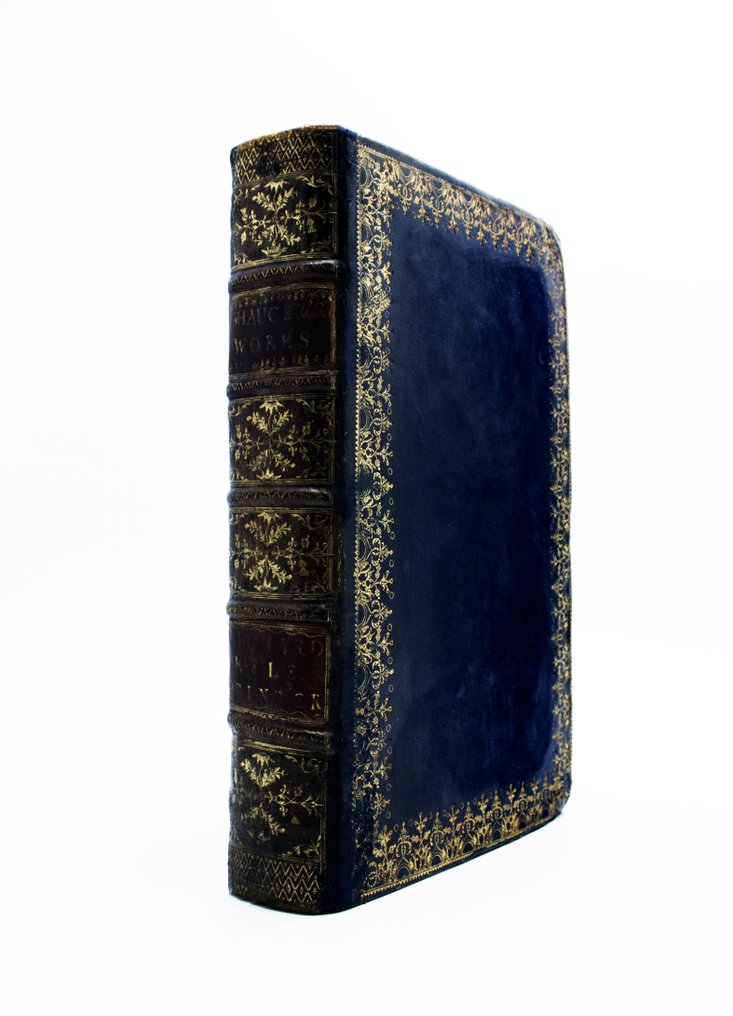
The Woorkes of Geffrey Chaucer, London, Richard Kele, 1538, first edition in this format, in English with the original language, bound in black morocco leather, 732 pages, measuring 206 by 312 mm, in good condition.
AI-assisted summary
Description from the seller
Chaucer, the father of English literature (and Shakespeare): the birth of a myth
Edition worthy of a king - sold at auction in 2024 - USD 11,970
This edition, descended from William Thynne's princeps (London, 1532), represents the first true consecration of Chaucer as England's national author.
The edition of Chaucer's works probably used by Shakespeare as a source for Troilus and Cressida. Chaucer, described by Caxton as 'the venerable father and first founder and embellisher of the ornate eloquence in our English language,' played an important role in the dissemination of vernacular English as a literary language and, together with Shakespeare, is considered one of the greatest authors of that language.
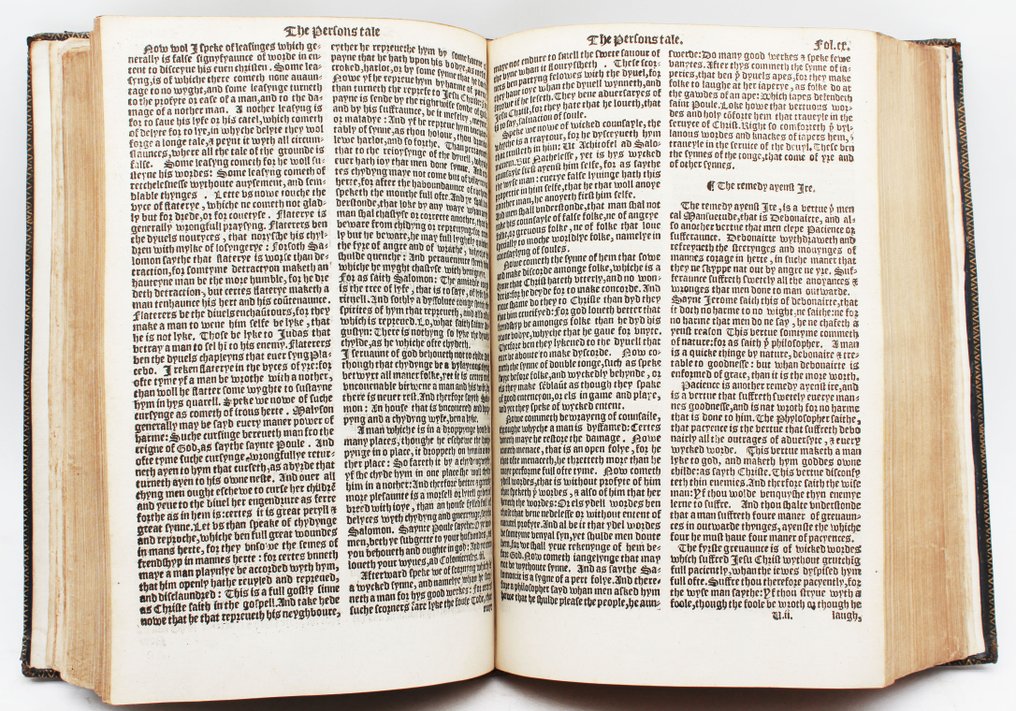
Magnificent specimen of one of the earliest anthologies of Geoffrey Chaucer's works, the greatest English poet of the Middle Ages, printed during the Elizabethan era. The volume consolidates in a single corpus the Canterbury Tales, Troilus and Criseyde, Parliament of Fowls, and other minor poems, in dense and evocative Gothic typeface, with large woodcut initials and an heraldic frontispiece. The binding, in finely gold-tooled black Moroccan leather from the eighteenth century, testifies to the antiquarian and collecting regard that already in the Georgian age surrounded Chaucer's work, then recognized as the 'Father of English Poetry.'
Market value
The Elizabethan editions of Chaucer's Works are extremely rare on the market. Complete and well-preserved copies of this series (Kele–Kingston–Islip) now fetch between 20,000 and 35,000 euros, depending on the presence of an intact title page, the quality of the paper, and the binding. Examples with distinguished provenance or in Georgian art bindings, like this one, can exceed 40,000 euros at international auctions (Sotheby’s, Christie’s, Bonhams).
Physical description and condition
Text in Gothic type on two columns. Title page with large woodcut coat of arms within an ornamental frame, woodcut initials and drop caps, original title page attached to an ancient support sheet and inserted in the correct position. Eighteenth-century English binding in full blue Morocco leather, covers decorated with a wide gilded floral border, spine with five raised bands with richly decorated compartments and red Morocco leather panels with gilded titles. Copy in excellent overall condition, pages slightly browned but strong and intact, with marginal signs of use. Pages (2); (18); 710; (2).
Full title and author
The Works of Geoffrey Chaucer.
London, Richard Kele, [1538].
Geffrey Chaucer.
Context and Significance
The edition, descending from William Thynne's princeps (London, 1532), represents the first true consecration of Chaucer as England's national author. Gathering his major works and integrating them with related texts by John Lydgate and Thomas Hoccleve, it defined the medieval English literary canon and made it accessible to the educated public of the Elizabethan age. The Gothic character and Middle English language retain the archaic aura of an identity heritage, while the printing, produced in London workshops that also served the Tudor court, manifests the cultural pride of a kingdom that was defining its own language and literary mythology.
Biography of the Author
Geoffrey Chaucer was born in London around 1343 and died in 1400. He was a diplomat, royal official, and court poet. Considered the father of English literature, he blended the French and Italian heritage (Dante, Petrarch, Boccaccio) with the native tradition, shaping a national poetic language. The Canterbury Tales are his masterpiece, an ironic and lively fresco of 14th-century England, intertwining moral, comic, and allegorical registers. He is buried in the Poet's Corner at Westminster Abbey.
Printing history and circulation
The first edition of Chaucer's Works was published by William Thynne in 1532, followed by an expanded edition in 1542. Subsequently, various versions were reprinted between 1561 and 1602, edited by figures such as John Kyngston, Adam Islip, and Richard Kele, who introduced corrections and added Lydgate's Siege of Thebes. These editions were widely circulated in university libraries and among Elizabethan collectors, becoming the main witnesses of Chaucerian textual transmission before the 18th-century revision by John Urry (1721).
BIBLIOGRAPHY AND REFERENCES
STC 5068–5071 (British Library); Pforzheimer 179; Grolier, Langland to Wither, 33; De Ricci, English Collectors of Books & Manuscripts, p. 47; Speght, Chaucer’s Works, 1598; Printing and the Mind of Man 38 (per la tradizione tipografica elisabettiana).
Seller's Story
Luxury Books: Your Go-To Guide for Nabbing Literary Treasures!
Embarking on the thrilling journey of collecting rare and timeless printed works? Here's your snappy rundown, "The Collector's Cheat Sheet," to ensure you're not just flipping pages but stacking up the value:
1. Edition and Rarity: Rarity is the name of the game. First editions, limited printings, and books flaunting unique features like eye-catching illustrations or mind-blowing bindings? Consider them the VIPs of the collector's world.
2. Condition & Dimension: Picture this – a book in mint condition, untouched by the woes of wear and tear. Now, flip the script: wear, foxing, discoloration – they're the villains here. And don't forget to size up the dimensions, because a book's size matters in the collector's universe.
3. Authenticity: In a world of replicas and forgeries, verifying a book's authenticity is your superhero move. Expert examination and authentication – your trusty sidekicks in this quest.
4. Provenance: Who owned it before you? If the book has hobnobbed with famous figures or danced through historical events, its value skyrockets. Every book has a story, but some have blockbuster tales.
5. Demand and Market Trends: Think of book values as the stock market of the literary world. Stay savvy on collector trends and market shifts to ride the waves of value.
6. Subject Matter: Some topics are like fine wine – they get better with time. Dive into subjects with a timeless appeal or ride the wave of emerging cultural and historical relevance.
7. Binding and Design: Beauty is more than skin deep. Intricate bindings, stunning covers, and illustrations – these are the accessories that make a book runway-ready in the collector's eyes.
8. Association Copies: Books with a personal touch – whether it's a connection to the author or a famous personality – elevate the historical vibes. A book with a backstory? Count us in.
9. Investment Potential: Passion is the engine, but some collectors eye future returns. Keep in mind, though, that the book market can be as unpredictable as a plot twist.
10. Expert Advice: New to the game? Don't play solo. Seek wisdom from the book gurus, hit up book fairs, and join collector communities. We at Luxury Books are the Yodas of the rare book galaxy, helping you build collections that scream sophistication and cultural clout.
Because collecting rare books isn't just about dollar signs – it's a journey of preserving heritage and embracing literary treasures. Happy collecting!
Translated by Google TranslateChaucer, the father of English literature (and Shakespeare): the birth of a myth
Edition worthy of a king - sold at auction in 2024 - USD 11,970
This edition, descended from William Thynne's princeps (London, 1532), represents the first true consecration of Chaucer as England's national author.
The edition of Chaucer's works probably used by Shakespeare as a source for Troilus and Cressida. Chaucer, described by Caxton as 'the venerable father and first founder and embellisher of the ornate eloquence in our English language,' played an important role in the dissemination of vernacular English as a literary language and, together with Shakespeare, is considered one of the greatest authors of that language.
Magnificent specimen of one of the earliest anthologies of Geoffrey Chaucer's works, the greatest English poet of the Middle Ages, printed during the Elizabethan era. The volume consolidates in a single corpus the Canterbury Tales, Troilus and Criseyde, Parliament of Fowls, and other minor poems, in dense and evocative Gothic typeface, with large woodcut initials and an heraldic frontispiece. The binding, in finely gold-tooled black Moroccan leather from the eighteenth century, testifies to the antiquarian and collecting regard that already in the Georgian age surrounded Chaucer's work, then recognized as the 'Father of English Poetry.'
Market value
The Elizabethan editions of Chaucer's Works are extremely rare on the market. Complete and well-preserved copies of this series (Kele–Kingston–Islip) now fetch between 20,000 and 35,000 euros, depending on the presence of an intact title page, the quality of the paper, and the binding. Examples with distinguished provenance or in Georgian art bindings, like this one, can exceed 40,000 euros at international auctions (Sotheby’s, Christie’s, Bonhams).
Physical description and condition
Text in Gothic type on two columns. Title page with large woodcut coat of arms within an ornamental frame, woodcut initials and drop caps, original title page attached to an ancient support sheet and inserted in the correct position. Eighteenth-century English binding in full blue Morocco leather, covers decorated with a wide gilded floral border, spine with five raised bands with richly decorated compartments and red Morocco leather panels with gilded titles. Copy in excellent overall condition, pages slightly browned but strong and intact, with marginal signs of use. Pages (2); (18); 710; (2).
Full title and author
The Works of Geoffrey Chaucer.
London, Richard Kele, [1538].
Geffrey Chaucer.
Context and Significance
The edition, descending from William Thynne's princeps (London, 1532), represents the first true consecration of Chaucer as England's national author. Gathering his major works and integrating them with related texts by John Lydgate and Thomas Hoccleve, it defined the medieval English literary canon and made it accessible to the educated public of the Elizabethan age. The Gothic character and Middle English language retain the archaic aura of an identity heritage, while the printing, produced in London workshops that also served the Tudor court, manifests the cultural pride of a kingdom that was defining its own language and literary mythology.
Biography of the Author
Geoffrey Chaucer was born in London around 1343 and died in 1400. He was a diplomat, royal official, and court poet. Considered the father of English literature, he blended the French and Italian heritage (Dante, Petrarch, Boccaccio) with the native tradition, shaping a national poetic language. The Canterbury Tales are his masterpiece, an ironic and lively fresco of 14th-century England, intertwining moral, comic, and allegorical registers. He is buried in the Poet's Corner at Westminster Abbey.
Printing history and circulation
The first edition of Chaucer's Works was published by William Thynne in 1532, followed by an expanded edition in 1542. Subsequently, various versions were reprinted between 1561 and 1602, edited by figures such as John Kyngston, Adam Islip, and Richard Kele, who introduced corrections and added Lydgate's Siege of Thebes. These editions were widely circulated in university libraries and among Elizabethan collectors, becoming the main witnesses of Chaucerian textual transmission before the 18th-century revision by John Urry (1721).
BIBLIOGRAPHY AND REFERENCES
STC 5068–5071 (British Library); Pforzheimer 179; Grolier, Langland to Wither, 33; De Ricci, English Collectors of Books & Manuscripts, p. 47; Speght, Chaucer’s Works, 1598; Printing and the Mind of Man 38 (per la tradizione tipografica elisabettiana).
Seller's Story
Luxury Books: Your Go-To Guide for Nabbing Literary Treasures!
Embarking on the thrilling journey of collecting rare and timeless printed works? Here's your snappy rundown, "The Collector's Cheat Sheet," to ensure you're not just flipping pages but stacking up the value:
1. Edition and Rarity: Rarity is the name of the game. First editions, limited printings, and books flaunting unique features like eye-catching illustrations or mind-blowing bindings? Consider them the VIPs of the collector's world.
2. Condition & Dimension: Picture this – a book in mint condition, untouched by the woes of wear and tear. Now, flip the script: wear, foxing, discoloration – they're the villains here. And don't forget to size up the dimensions, because a book's size matters in the collector's universe.
3. Authenticity: In a world of replicas and forgeries, verifying a book's authenticity is your superhero move. Expert examination and authentication – your trusty sidekicks in this quest.
4. Provenance: Who owned it before you? If the book has hobnobbed with famous figures or danced through historical events, its value skyrockets. Every book has a story, but some have blockbuster tales.
5. Demand and Market Trends: Think of book values as the stock market of the literary world. Stay savvy on collector trends and market shifts to ride the waves of value.
6. Subject Matter: Some topics are like fine wine – they get better with time. Dive into subjects with a timeless appeal or ride the wave of emerging cultural and historical relevance.
7. Binding and Design: Beauty is more than skin deep. Intricate bindings, stunning covers, and illustrations – these are the accessories that make a book runway-ready in the collector's eyes.
8. Association Copies: Books with a personal touch – whether it's a connection to the author or a famous personality – elevate the historical vibes. A book with a backstory? Count us in.
9. Investment Potential: Passion is the engine, but some collectors eye future returns. Keep in mind, though, that the book market can be as unpredictable as a plot twist.
10. Expert Advice: New to the game? Don't play solo. Seek wisdom from the book gurus, hit up book fairs, and join collector communities. We at Luxury Books are the Yodas of the rare book galaxy, helping you build collections that scream sophistication and cultural clout.
Because collecting rare books isn't just about dollar signs – it's a journey of preserving heritage and embracing literary treasures. Happy collecting!
Translated by Google TranslateDetails
Number of Books
1
Subject
Literature
Book Title
The Woorkes - Canterbury Tales
Author/ Illustrator
Geffrey Chaucer
Condition
Good
Publication year oldest item
1538
Height
312 mm
Edition
1st Edition Thus
Width
206 mm
Language
English
Original language
Yes
Publisher
London, Richard Kele, [1538]
Binding/ Material
Leather
Number of pages
732
Sold by
