Charles François Daubigny (1817-1878) - Roseaux sur l'Oise au crépuscule - NO RESERVE
16
days
03
hours
04
minutes
45
seconds
Current bid
€ 600
No reserve price

Expert
Selected by Caterina Maffeis
Master in early Renaissance Italian painting with internship at Sotheby’s and 15 years' experience.
Estimate € 5,000 - € 7,000
24 other people are watching this object
 Bidder 4758 Bidder 4758 | €600 | |
|---|---|---|
 Bidder 9297 Bidder 9297 | €8 | |
 Bidder 7210 Bidder 7210 | €7 | |
Catawiki Buyer Protection
Your payment’s safe with us until you receive your object.View details
Trustpilot 4.4 | 122473 reviews
Rated Excellent on Trustpilot.
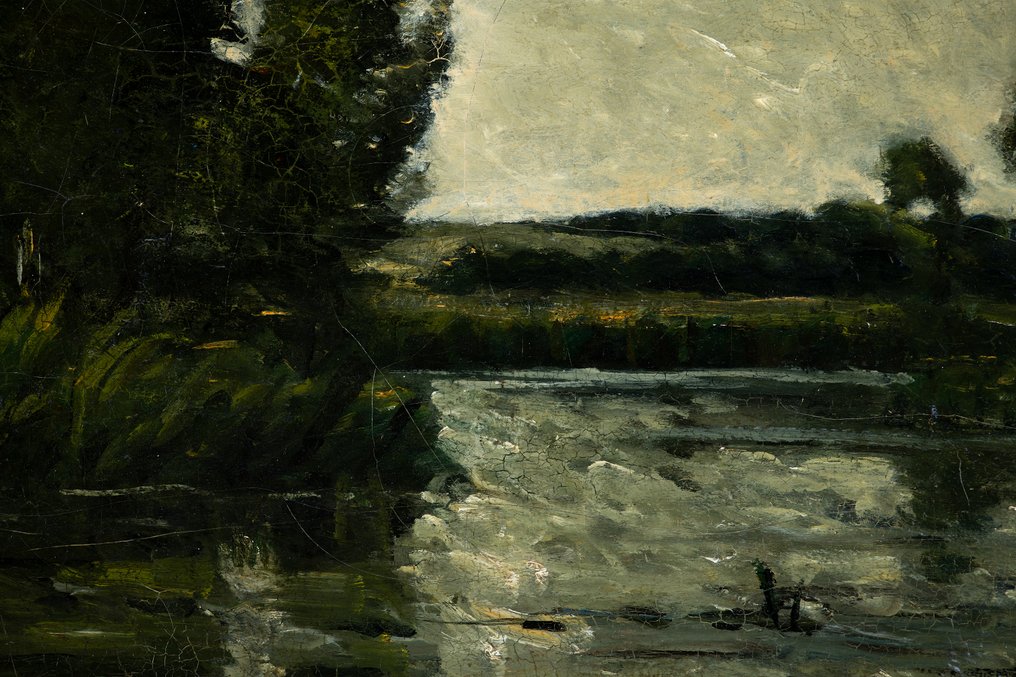
Roseaux sur l’Oise au crépuscule, a 19th-century oil painting on canvas from France by Charles François Daubigny, sold with frame.
AI-assisted summary
Description from the seller
Artist: Charles François Daubigny (1817–1878)
Reeds on the Oise at dusk
Dated: 1872
Technique: Oil paint on canvas
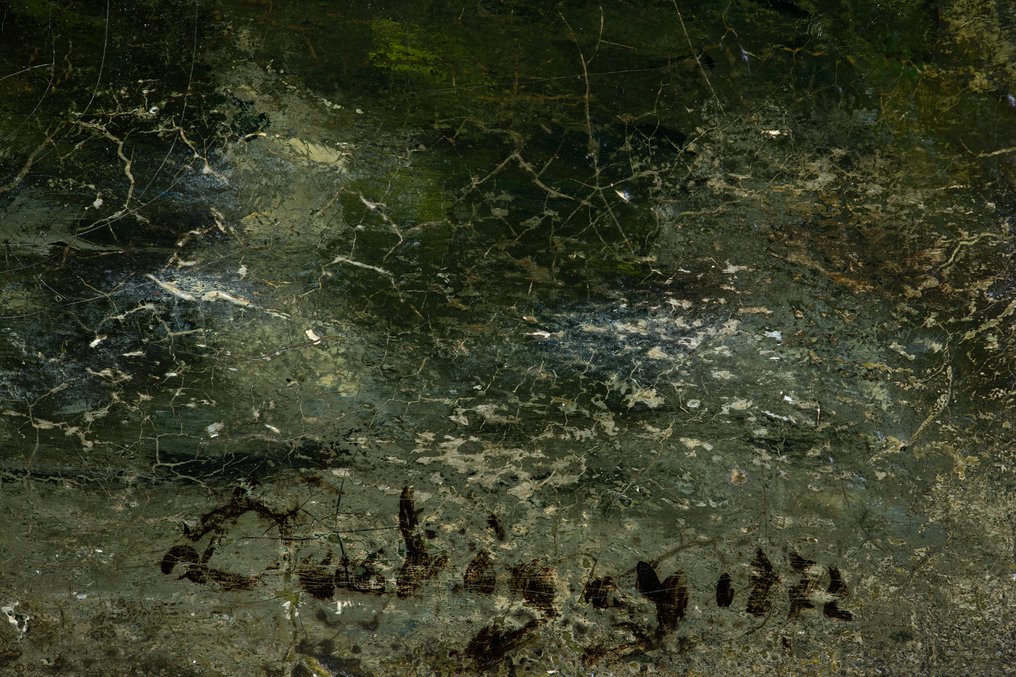
Signature: Hand-signed lower left; verso fully signed, provided with collection catalog number and year.
Style/School: Barbizon School – early-impressionist landscape
Condition: Authentic craquelure, discolored varnish and paint layer; no retouching visible under UV light; frame with small signs of aging.
Introduction
Charles François Daubigny is among the most important landscape painters of the mid-19th century. As a central figure of the Barbizon School, he played a crucial role in the transition from traditional realism to later impressionism. His sensitivity to atmosphere and light made him a pioneer who directly influenced painters like Claude Monet and Camille Pissarro. This painting, Roseaux sur l’Oise au crépuscule from 1872, dates from the final phase of his career and poetically captures the silence of dusk along the Oise River — the landscape that fascinated Daubigny throughout his life.
Description of the work
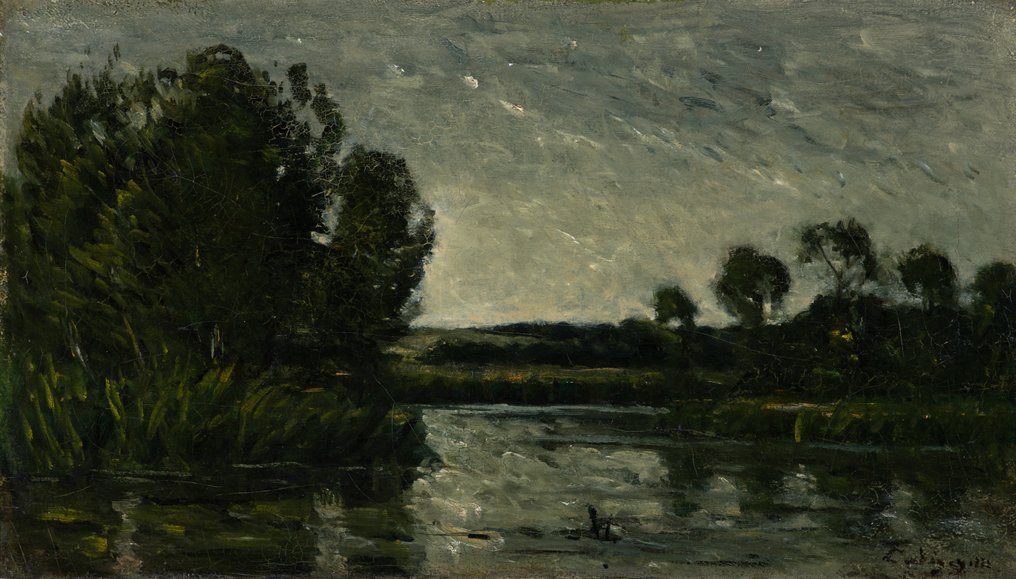
The painting depicts a tranquil river landscape at evening light, seen from the bank of the Oise. On the left, a dense cluster of reeds and willows rises up, dark and powerful in tone, while on the right, the trees are outlined in a lighter silhouette against the gray-blue sky. The water forms the core of the composition: broad horizontal brushstrokes follow the movement of the river surface and capture the last shimmering light. The reed beds mark the transition between earth and water, creating a rhythm that keeps the composition in balance. The expansive sky, painted with short, slanting brushstrokes, evokes a subtle sense of wind and approaching dusk.
The composition is typical of Daubigny’s later work: open, honest, without anecdotal figures or idealization. The artist invites the viewer to experience the tranquility and shifting light firsthand, as a snapshot of nature in motion.
Technique and color palette
Daubigny’s technique in this work demonstrates impressive mastery over tone and brushwork. He works with thin layers of oil paint in which the tones blend seamlessly, interspersed with thicker accents in the water and vegetation. The palette is subdued yet rich: earthy olive greens, dark umbers, and bluish grays predominate, while the light in the water is captured with mixtures of lead white and broken ocher. The paint is applied with smooth, direct strokes, without sharp contours — a technique that gives his paintings a spontaneous, lively texture.
It is characteristic of Daubigny's working method that he often painted directly outdoors, sometimes from his studio boat Le Botin, which he used to sail over the Oise to capture the light and atmosphere of the water on location. This approach contains the seed of Impressionist painting, which would come into full bloom a few years later.
Style and art historical context
As a key figure of the Barbizon School, Daubigny collaborated with artists such as Jean-Baptiste-Camille Corot and Théodore Rousseau. His vision diverged from the romantic idealization of the landscape; he aimed to depict the direct, simple image of nature without mythological embellishment. Roseaux sur l’Oise au crépuscule is an exemplary example of this approach: the painting focuses entirely on the interplay between water, sky, and light, and conveys an almost modern impression of space and atmosphere.
In France, Daubigny is often seen as a direct precursor to Claude Monet, who further developed his approach to light effects. In the Netherlands, similar tendencies can be found among painters such as Johan Barthold Jongkind and later the Hague School – particularly Jacob Maris and Anton Mauve – who achieved the same tonality and subdued poetry in landscape painting. Internationally, his work aligns emotionally with Camille Pissarro and John Constable.
Condition
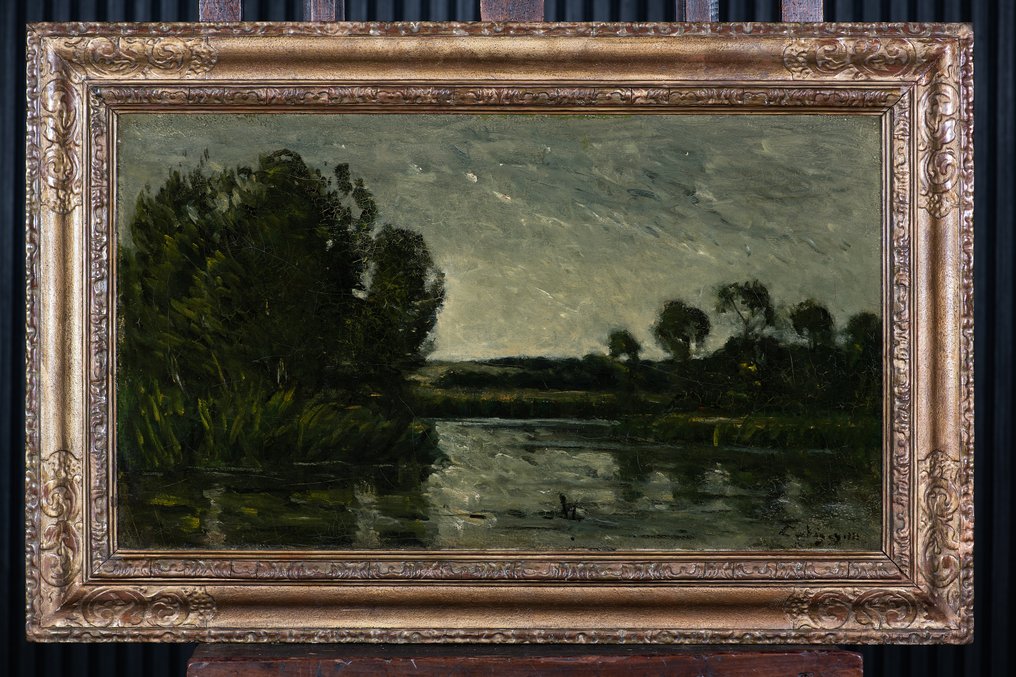
The painting is in an authentic, well-preserved condition with a natural craquelure that confirms the age of the paint layer. The varnish has darkened, slightly muting the colors, but under UV examination, no disturbing overpaintings or later interventions are visible. The brushwork and the original surface of the work are intact. The frame, a richly gilded example with floral motifs, shows only minor signs of aging, such as a few small spots of paint loss at the edges.
Conclusion
Roses on the Oise at twilight represents Daubigny at his most personal and refined moment: a poetic, intimate landscape capturing the transition from day to night with masterful sensitivity. The dating of 1872 and the double signature – both recto and verso, with the full inscription of the name – emphasize the authenticity and provenance of the work.
The painting embodies the transition from the Barbizon School to Impressionism and represents an important link in the development of the modern landscape. For collectors of 19th-century French painting, this is a particularly valuable and rare work, representative of the late period of one of the founders of Impressionism.
To be offered at a premium art auction with No Reserve.
The work 'Roses on the Oise at dusk' is in a gilded bronze-golden wooden frame with plaster ornaments.
Total dimensions: 64x99.5cm
Canvas dimensions: 46x82cm
All shipments are sent in professional packaging via FedEx, DPD, or PostNL.
For all shipments, a surcharge for packaging material applies, which is already included in the stated shipping price.
Shipping artworks always carries certain risks. While shipping is possible, we recommend collecting the artwork in person when this option is available. If shipping is chosen, this is entirely at the buyer's risk. Collection ensures that the artwork will be received undamaged and in perfect condition. After purchase, you can easily schedule an appointment to collect the artwork from our workshop and studio, where it will be safely and carefully prepared for you.
Transport quotation request via our website (Service-transport) or via Catawiki support.
The customer is responsible for any import duties and additional costs that may apply upon delivery abroad.
We aim to deliver your artwork to you safely and in optimal condition, paying careful attention to packaging and the shipping process. If you have any questions or special requests, you can always contact Catawiki customer service.
Seller's Story
Welcome to Vandenberg Fine Art BV on Catawiki. We specialize in paintings from the 15th to the 19th century, with particular attention to Dutch, Belgian, and Italian masters. Our carefully curated collection consists of high-quality artworks that stand out for their artistic quality, authenticity, and historical relevance.
Our offer includes works by prominent artists from the Dutch and Flemish schools, as well as important representatives of the Italian Renaissance and Baroque. Each artwork is selected with expertise, paying special attention to condition, provenance, and art historical significance.
At Vandenberg Fine Art, reliability and transparency are central. We provide detailed descriptions, high-quality images, and carefully conducted provenance research. Our goal is to support both experienced collectors and novice art lovers in making informed choices.
Discover our exclusive collection and experience the rich history and lasting beauty of classical painting.
Translated by Google TranslateArtist: Charles François Daubigny (1817–1878)
Reeds on the Oise at dusk
Dated: 1872
Technique: Oil paint on canvas
Signature: Hand-signed lower left; verso fully signed, provided with collection catalog number and year.
Style/School: Barbizon School – early-impressionist landscape
Condition: Authentic craquelure, discolored varnish and paint layer; no retouching visible under UV light; frame with small signs of aging.
Introduction
Charles François Daubigny is among the most important landscape painters of the mid-19th century. As a central figure of the Barbizon School, he played a crucial role in the transition from traditional realism to later impressionism. His sensitivity to atmosphere and light made him a pioneer who directly influenced painters like Claude Monet and Camille Pissarro. This painting, Roseaux sur l’Oise au crépuscule from 1872, dates from the final phase of his career and poetically captures the silence of dusk along the Oise River — the landscape that fascinated Daubigny throughout his life.
Description of the work
The painting depicts a tranquil river landscape at evening light, seen from the bank of the Oise. On the left, a dense cluster of reeds and willows rises up, dark and powerful in tone, while on the right, the trees are outlined in a lighter silhouette against the gray-blue sky. The water forms the core of the composition: broad horizontal brushstrokes follow the movement of the river surface and capture the last shimmering light. The reed beds mark the transition between earth and water, creating a rhythm that keeps the composition in balance. The expansive sky, painted with short, slanting brushstrokes, evokes a subtle sense of wind and approaching dusk.
The composition is typical of Daubigny’s later work: open, honest, without anecdotal figures or idealization. The artist invites the viewer to experience the tranquility and shifting light firsthand, as a snapshot of nature in motion.
Technique and color palette
Daubigny’s technique in this work demonstrates impressive mastery over tone and brushwork. He works with thin layers of oil paint in which the tones blend seamlessly, interspersed with thicker accents in the water and vegetation. The palette is subdued yet rich: earthy olive greens, dark umbers, and bluish grays predominate, while the light in the water is captured with mixtures of lead white and broken ocher. The paint is applied with smooth, direct strokes, without sharp contours — a technique that gives his paintings a spontaneous, lively texture.
It is characteristic of Daubigny's working method that he often painted directly outdoors, sometimes from his studio boat Le Botin, which he used to sail over the Oise to capture the light and atmosphere of the water on location. This approach contains the seed of Impressionist painting, which would come into full bloom a few years later.
Style and art historical context
As a key figure of the Barbizon School, Daubigny collaborated with artists such as Jean-Baptiste-Camille Corot and Théodore Rousseau. His vision diverged from the romantic idealization of the landscape; he aimed to depict the direct, simple image of nature without mythological embellishment. Roseaux sur l’Oise au crépuscule is an exemplary example of this approach: the painting focuses entirely on the interplay between water, sky, and light, and conveys an almost modern impression of space and atmosphere.
In France, Daubigny is often seen as a direct precursor to Claude Monet, who further developed his approach to light effects. In the Netherlands, similar tendencies can be found among painters such as Johan Barthold Jongkind and later the Hague School – particularly Jacob Maris and Anton Mauve – who achieved the same tonality and subdued poetry in landscape painting. Internationally, his work aligns emotionally with Camille Pissarro and John Constable.
Condition
The painting is in an authentic, well-preserved condition with a natural craquelure that confirms the age of the paint layer. The varnish has darkened, slightly muting the colors, but under UV examination, no disturbing overpaintings or later interventions are visible. The brushwork and the original surface of the work are intact. The frame, a richly gilded example with floral motifs, shows only minor signs of aging, such as a few small spots of paint loss at the edges.
Conclusion
Roses on the Oise at twilight represents Daubigny at his most personal and refined moment: a poetic, intimate landscape capturing the transition from day to night with masterful sensitivity. The dating of 1872 and the double signature – both recto and verso, with the full inscription of the name – emphasize the authenticity and provenance of the work.
The painting embodies the transition from the Barbizon School to Impressionism and represents an important link in the development of the modern landscape. For collectors of 19th-century French painting, this is a particularly valuable and rare work, representative of the late period of one of the founders of Impressionism.
To be offered at a premium art auction with No Reserve.
The work 'Roses on the Oise at dusk' is in a gilded bronze-golden wooden frame with plaster ornaments.
Total dimensions: 64x99.5cm
Canvas dimensions: 46x82cm
All shipments are sent in professional packaging via FedEx, DPD, or PostNL.
For all shipments, a surcharge for packaging material applies, which is already included in the stated shipping price.
Shipping artworks always carries certain risks. While shipping is possible, we recommend collecting the artwork in person when this option is available. If shipping is chosen, this is entirely at the buyer's risk. Collection ensures that the artwork will be received undamaged and in perfect condition. After purchase, you can easily schedule an appointment to collect the artwork from our workshop and studio, where it will be safely and carefully prepared for you.
Transport quotation request via our website (Service-transport) or via Catawiki support.
The customer is responsible for any import duties and additional costs that may apply upon delivery abroad.
We aim to deliver your artwork to you safely and in optimal condition, paying careful attention to packaging and the shipping process. If you have any questions or special requests, you can always contact Catawiki customer service.
Seller's Story
Welcome to Vandenberg Fine Art BV on Catawiki. We specialize in paintings from the 15th to the 19th century, with particular attention to Dutch, Belgian, and Italian masters. Our carefully curated collection consists of high-quality artworks that stand out for their artistic quality, authenticity, and historical relevance.
Our offer includes works by prominent artists from the Dutch and Flemish schools, as well as important representatives of the Italian Renaissance and Baroque. Each artwork is selected with expertise, paying special attention to condition, provenance, and art historical significance.
At Vandenberg Fine Art, reliability and transparency are central. We provide detailed descriptions, high-quality images, and carefully conducted provenance research. Our goal is to support both experienced collectors and novice art lovers in making informed choices.
Discover our exclusive collection and experience the rich history and lasting beauty of classical painting.
Translated by Google TranslateDetails
Artist
Charles François Daubigny (1817-1878)
Sold with frame
Yes
Title of artwork
Roseaux sur l'Oise au crépuscule - NO RESERVE
Technique
Oil painting
Signature
Hand signed
Country of Origin
France
Year
1872
Condition
Good condition
Height
64 cm
Width
99.5 cm
Weight
7 kg
Depiction/Theme
Landscape
Style
Barbizon school
Period
19th century
Sold by
