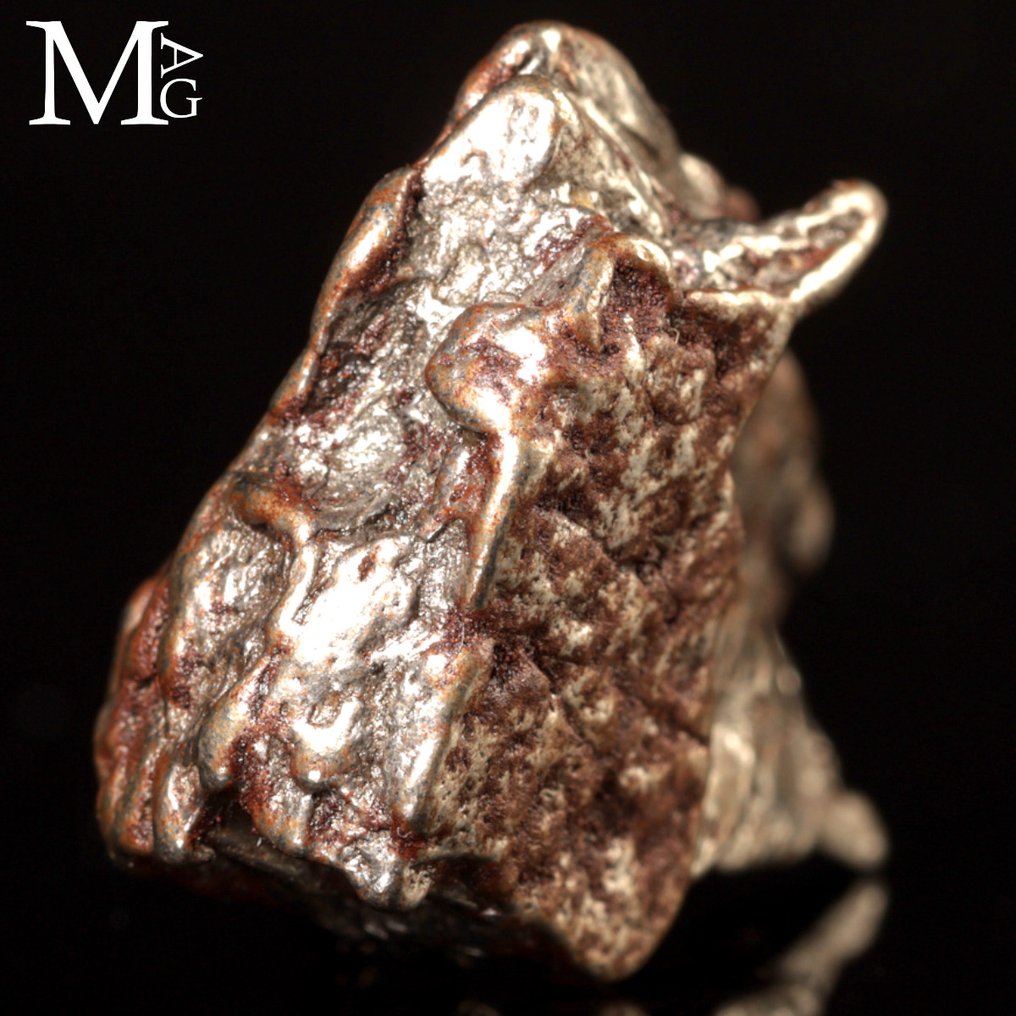
Campo del Cielo meteorite – iron-nickel with Widmanstätten structure - Height: 39 mm - Width: 25 mm - 40 g



04
days
10
hours
16
minutes
17
seconds
Current bid
€ 2
No reserve price

Expert
Selected by Francesco Moser
Over 20 years collecting meteorites; former museum curator and experienced restorer.
Estimate € 150 - € 220
11 other people are watching this object
 Bidder 7619 Bidder 7619 | €2 | |
|---|---|---|
| Bidder 8955 | €1 |
Catawiki Buyer Protection
Your payment’s safe with us until you receive your object.View details
Trustpilot 4.4 | 121798 reviews
Rated Excellent on Trustpilot.
A Campo del Cielo iron nickel meteorite from Argentina weighing 40 g with Widmanstätten structure, 39 x 25 x 15 mm, offers a tangible link to its 4.5 billion year history and a visible fusion crust for serious collectors.
AI-assisted summary
Description from the seller
The Campo del Cielo meteorite is an iron meteorite (class IAB-MG) discovered in Argentina's Chaco Province, in an area known for meteorite fragments estimated to have fallen between 4,000 and 5,000 years ago. The region is named "Campo del Cielo" (Spanish for "field of the sky") because of local legends that spoke of "fragments of the sky falling to Earth."
Iron (Fe): ~92%
Nickel (Ni): ~6-7%
Traces of cobalt (Co), phosphorus (P), gallium (Ga), germanium (Ge) and iridium (Ir)
Kamacite (low nickel iron-nickel alloy)
Taenite (high nickel iron-nickel alloy)
Troilite (iron sulfide)
Graphite and schreibersite (rare iron nickel phosphide)
The meteorite has a rough and irregular structure, typical of the fusion crust formed during its descent through the Earth's atmosphere. Some smooth sections may reveal the classic Widmanstätten structure, characteristic of iron meteorites, which consists of bands of iron-nickel alloy slowly crystallized in space over millions of years.
Cosmic age: ~4.5 billion years (formation)
Date of fall: Approximately 4,000-5,000 years ago
Isotopic analysis of the meteorite has provided insights into the formation of the solar system.
This Campo del Cielo specimen represents a fragment of the universe, a testimony to the birth of the solar system and the history of iron meteorites that traveled for millions of years before falling to Earth. Its rough, metallic appearance, combined with its internal Widmanstätten structure, makes it a fascinating piece for collectors and enthusiasts of mineralogy and astrophysics.
Seller's Story
The Mineral Art Gallery offers minerals, fossils, shells and natural elements.
Born in Italy in 2017, today she collaborates with international galleries and collectors, she is a direct importer of large minerals and naturalistic collectible elements; deals with the processing to insert them inside the living space. A section of the gallery was dedicated to the Wunderkammer, "chamber of wonders or cabinet of curiosities" in which Mirabilia elements are presented: naturalia and italiania, a union between "the present is the past".
All lots are shipped via DHL Express and Fercam couriers, with insured parcel and tracking.
Translated by Google TranslateThe Campo del Cielo meteorite is an iron meteorite (class IAB-MG) discovered in Argentina's Chaco Province, in an area known for meteorite fragments estimated to have fallen between 4,000 and 5,000 years ago. The region is named "Campo del Cielo" (Spanish for "field of the sky") because of local legends that spoke of "fragments of the sky falling to Earth."
Iron (Fe): ~92%
Nickel (Ni): ~6-7%
Traces of cobalt (Co), phosphorus (P), gallium (Ga), germanium (Ge) and iridium (Ir)
Kamacite (low nickel iron-nickel alloy)
Taenite (high nickel iron-nickel alloy)
Troilite (iron sulfide)
Graphite and schreibersite (rare iron nickel phosphide)
The meteorite has a rough and irregular structure, typical of the fusion crust formed during its descent through the Earth's atmosphere. Some smooth sections may reveal the classic Widmanstätten structure, characteristic of iron meteorites, which consists of bands of iron-nickel alloy slowly crystallized in space over millions of years.
Cosmic age: ~4.5 billion years (formation)
Date of fall: Approximately 4,000-5,000 years ago
Isotopic analysis of the meteorite has provided insights into the formation of the solar system.
This Campo del Cielo specimen represents a fragment of the universe, a testimony to the birth of the solar system and the history of iron meteorites that traveled for millions of years before falling to Earth. Its rough, metallic appearance, combined with its internal Widmanstätten structure, makes it a fascinating piece for collectors and enthusiasts of mineralogy and astrophysics.
Seller's Story
The Mineral Art Gallery offers minerals, fossils, shells and natural elements.
Born in Italy in 2017, today she collaborates with international galleries and collectors, she is a direct importer of large minerals and naturalistic collectible elements; deals with the processing to insert them inside the living space. A section of the gallery was dedicated to the Wunderkammer, "chamber of wonders or cabinet of curiosities" in which Mirabilia elements are presented: naturalia and italiania, a union between "the present is the past".
All lots are shipped via DHL Express and Fercam couriers, with insured parcel and tracking.
Translated by Google TranslateDetails
Type of meteorite
Campo del Cielo meteorite – iron-nickel with Widmanstätten structure
Weight
40 g
Country of Origin
Argentina
Height
39 mm
Width
25 mm
Depth
15 mm
Sold by