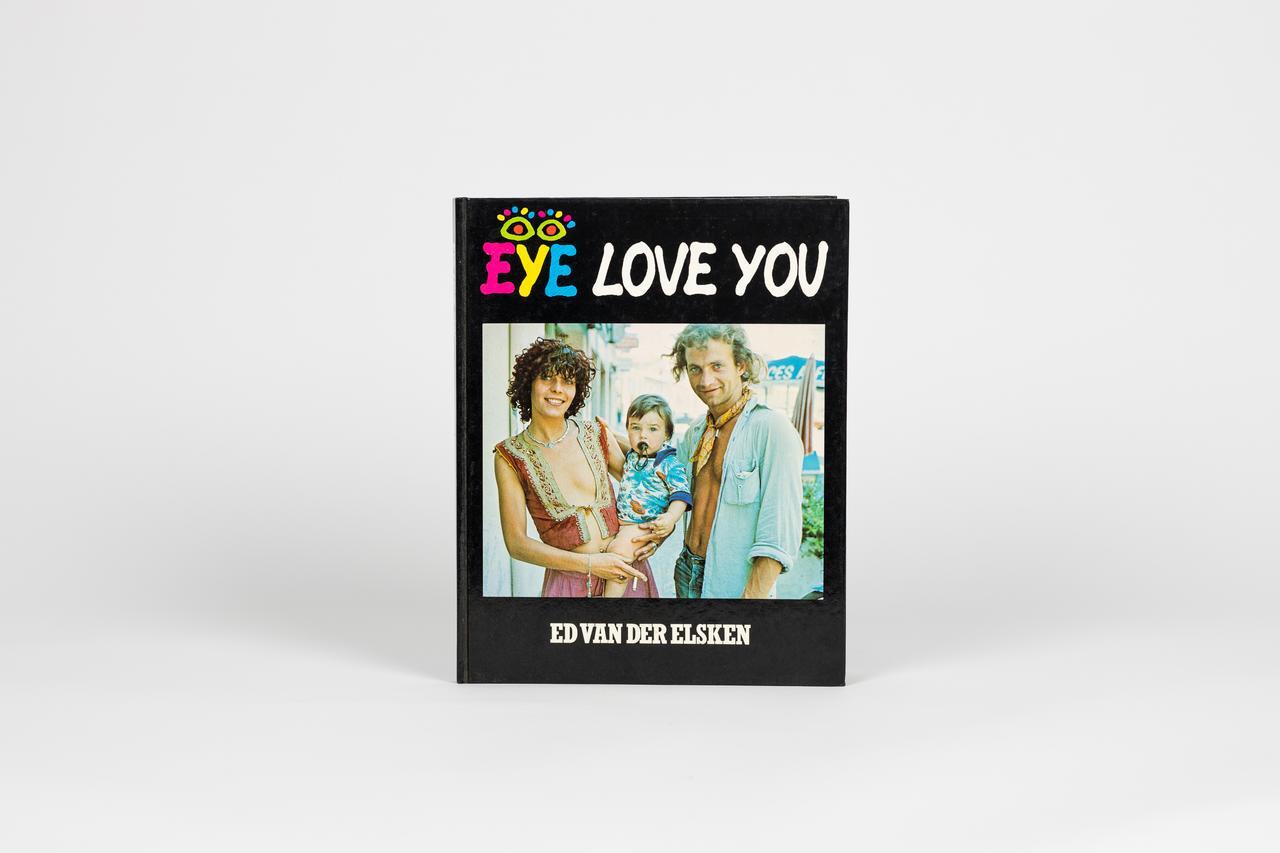
Sanne Sannes - Sex a Gogo (FRESH COPY) - 1969


13
days
10
hours
21
minutes
35
seconds
Current bid
€ 10
No reserve price

Expert
Selected by Sebastian Hau
Founded and directed two French book fairs; nearly 20 years of experience in contemporary books.
Estimate € 280 - € 350
23 other people are watching this object
 Bidder 5410 Bidder 5410 | €10 | |
|---|---|---|
| Bidder 5233 | €9 | |
| Bidder 5410 | €6 | |
Catawiki Buyer Protection
Your payment’s safe with us until you receive your object.View details
Trustpilot 4.4 | 123718 reviews
Rated Excellent on Trustpilot.
Description from the seller
SCARCE, IMPORTANT, BRILLIANT AND HIGHLY INNOVATIVE PHOTOBOOK AND ARTIST BOOK -
by Dutch photographer Sanne Sannes (1937-1967).
- Martin Parr , The Photobook, vol 1, page 227
- Frits Gierstberg, Rik Suermondt, The Dutch Photobook, page 55
- Alessandro Bertolotti , Books of Nudes, page 210
CREATIVE AND CRAZY LAYOUT -
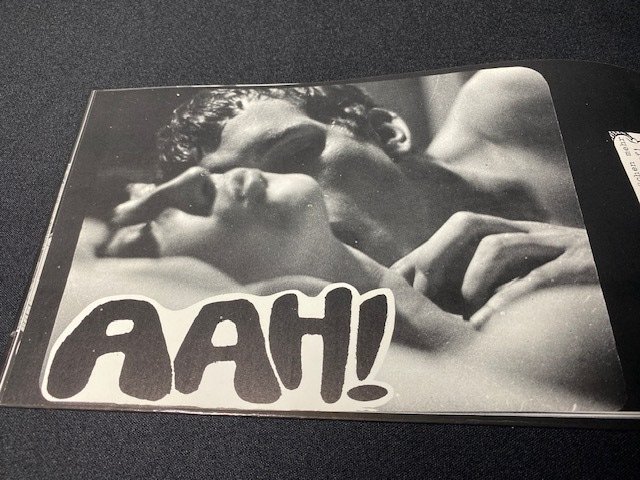
BRILLIANT MIXTURE OF PHOTOGRAPHY, COMIC ELEMENTS AND TYPOGRAPHY.
A WONDERFUL OBJECT AND ABSOLUTE MUST-HAVE FOR EVERY AMBITIOUS PHOTO AND ARTIST BOOK COLLECTION - IN FRESH CONDITION.
This is the LAST EXCLUSIVE BEST-OF-PHOTOBOOKS AUCTION by 5Uhr30.com, Cologne, Germany -
STARTING THIS YEAR.
One of only a few publications with the work by the great photographer, who died at the age of only 30 cause of a car accident and who published during his short life-time only one book: Oog om Oog' ('Eye for Eye').
Sanne Sannes experienced a brief and stormy career in photography and film. At the time of his sudden death in March 1967, he was a leading photographer in the Netherlands who was just about to make a breakthrough abroad. Sannes’ photos and his ideas concerning aesthetics and the presentation of photography were diametrically opposed to all of the existing ‘rules and norms’, for which he received substantial attention in the press.
'Face of Love', Another book by Sanne Sannes, was published in 1972, and was mentioned here:
802 photobooks of the M. + M. Auer collection, page 550.
‘I was originally a drawing artist, more than anything else I want to be a film director, and in between this I am a searching photographer.’
- Sanne Sannes, in Focus 48 (1963) 4, page 21 -
5Uhr30.com guarantees detailed and accurate descriptions, 100% transport protection, 100% transport insurance and of course combined shipping - worldwide.
Verlag der Europäischen Bücherei H.M. Hieronimi, 1969. First German edition, first printing.
'Sex à gogo. For amusement only' - was originally published in the same year, in identical size, layout and content by De Bezige Bij, Amsterdam; just the language (Dutch) was different.
Hardback (as issued). 159 x 280 mm. 190 pages. 190 photocollages. Photos: Sanne Sannes. Design by Walter Steevens. Text in German.
Condition:
Inside excellent, very fresh and flawless, clean with no marks and no foxing. Outside the highly sensitive covers quiet fresh with no bumping and in much more better than usual condition; light rubbing at the corners (and not heavy what is often the case), fragile spine lightly used, but overall well-preserved and better than usual. Binding and all pages very strong (often the binding is shaky). Overall fine, better and fresher than usual condition.
Scarce, brilliant photobook by Sanne Sannes - hard to find in any edition and in any condition.
'In the eight years that Sanne Sannes was active as a photographer, he acquired the reputation of an angry young man, chiefly based on the unorthodox nature of his photography. His autonomous work, primarily black-and-white photography, was what brought him the greatest notoriety. In its content and technical quality, Sannes’ work was an assault on the existing rules and norms governing photography at the time. Sannes reaffirmed his reputation time and time again with his outspoken ideas about photography and his views concerning the manner in which the medium functioned within the existing art world.
As the spokesman of a new generation, Sannes played in important role in the discussion centring on the question of whether photography was to be considered art and whether it belonged in the traditional institutions as such. His position in these discussions is evident, for example, in a commotion of his own doing, instigated in response to an April 1964 exhibition at the Stedelijk Museum in Amsterdam. Sannes threatened to withdraw his work because he felt the manner in which the photographers and their work were being treated during the exhibition’s preparation was misplaced. Photo enlargements were being cut down to size without consultation in advance. Furthermore, works by photographers such as Wim van der Linde and Koen Wessing, though officially invited to participate, were rejected after being examined. Sannes accused the organisation of ‘dirigisme from the top’ and refused to acknowledge Louis Kloet, the exhibition’s organiser, as an authority in the area of photography. In Sannes’ view, the idea that the museum had maintained its right to turn down a submission—whether in part or in its entirety—was equivalent to censorship and discrimination with respect to photography as an art form.
Even while studying at the Kunstacademie Minerva (‘Minerva Art Academy’) in Groningen, Sannes was already assuming standpoints that were controversial. First there were disagreements with the school’s directors regarding the classes he was required to take. Sannes wished to study photography as his main discipline, which was not possible at this time. Consequently unable to complete his studies, Sannes was forced to comply with compulsory military service. There he had a chance to develop his photography further, by being provided access to a darkroom where he was able to experiment with various printing techniques.
Sannes’ autonomous photography focused largely on the theme of women. In his photos, he tried to create atmospheric images intended to evoke human emotions. He was searching for a wide range of emotional moments, which he saw ideally reflected in the female figure. In the actualisation of this theme, he made use of certain female types, ranging from the ‘eternal’ woman (Eve, Venus) to the witch and the female vampire. The mood of these photos changed with each type, from calm and serene to erotic and ecstatic.
Like a film director, Sannes tried to win the trust of his model in order to create a field of tension. He first directed and then photographed the situations, preferably working with camera in hand and taking advantage of available light. This approach resulted in motion blur and a strong contrast effect, thus bringing suspense to Sannes’ photography. This he intensified even more by evoking the suggestion that his model had just been caught unawares at a moment of personal intimacy. It was especially this atmosphere of intimacy that was viewed as erotic at the time, consequently creating quite a stir. Sannes found this ridiculous. Eroticism for him was ‘that field of vision where all human emotion can be accommodated’. Moreover, art in his view was also eroticism: ‘you can also read eroticism as the desire to live’.
Sannes believed that the ideas governing photography were out-dated: in his view, they were partially to blame for the uniformity. Too often people were striving after pictures appealing for their technique—cliché images—in which absolutely every trace of the man behind the camera had been omitted. The notion that technical perfection supersedes artistic quality meant that every new approach was nipped in the bud. Sannes felt this uniformity in photography could only be broken by innovation derived from experimentation. He was therefore continually seeking the medium’s boundaries and possibilities by experimenting with negatives and prints.
In addition to motion blur and contrast, Sannes also turned to fragmentary enlargement, combination printing, the scratching of negatives and prints, coarse grain, photomontage, and cut negatives. He sometimes laid his photographic paper beneath a glass plate covered with drops of water. These experimental manipulations had an absolute effect on the moods and emotions he wished to emphasise in his photos.
Despite Sannes’ critique of traditional photography, his work can be seen as a continuation of developments that had become extremely popular in the 1950s. On one hand, the stylistic principles formulated by Otto Steinert under the term ‘Subjective Photography’ resonated greatly at this time; on the other hand, a personal aspect was introduced, e.g. human interest photography. Sannes’ photography, as it were, is a synthesis of both movements (he admired the photos of Pim van Os as well as Ed van der Elsken), a combination of aesthetic principles and his own vision of the subject photographed.
Sannes refused to be categorised into any one group or movement. He tried to fulfil a self-determined goal on his own. It was important for a photographer to maintain his own style and not be preoccupied with public recognition. He had to go his own way and be convinced of his own personal values and ideas: ‘the certainty that you can create something, that is one of your biggest assets’. Sannes strived for an expansion of the term ‘photography’. In this respect, he no longer recognised the term ‘photo’. It was for this reason that photography, as a medium, was too limited for him. While he continued to view photography as his hinterland, in 1965 he stated the following: ‘I don’t believe in photography. It no longer gives me enough satisfaction. If we continue in this direction, I’m going to repeat myself. The plague of photography is the endless repetition.’
Sannes was seeking a new visual idiom, a combination of photo and film: ‘fotofilm’, made up of both photo and film fragments. Based on this idea, one could only do a photo justice when using it in a book or a film. In Sannes’ view, a photo derived its quality and meaning from the series of images in which it was placed. The totality of such a series was determined by the order and experimental nature of the photos. It was through the cohesion of the images that the observer was to experience and interpret the mood. These series were narrative in structure. Their stories could be traced back to the so-called ‘ciné-romans’ (cinema-novels). This was Sannes’ designation for the scenarios he wrote for photobooks and photofilms.
The made-for-television film Dirty Girl (Santa Lucia) was the only project based on one of these scenarios that was realised, commissioned by the VPRO broadcasting company (the film is today preserved at the Film Museum in Amsterdam). The televised broadcast was planned for 28 May 1966. The VPRO dared not take responsibility for the film’s content, however, and left the decision regarding the film’s broadcasting to the Dutch film ratings board (the ‘filmkeuring’). This organisation judged the film to be too shocking and inappropriate for broadcasting on television. The board had trouble with what it viewed as the extreme erotic and sadistic nature of the film. Furthermore, the technical quality of the film was not entirely successful. Particularly problematic was the editing of the individual photos, from which the film was compiled, resulting in the loss of much of its expressiveness.
Sannes was much more successful with his contribution to the exhibition Vijf Gelderse Fotografen (‘Five Photographers from Gelderland’) at the Gemeentemuseum in Arnhem. The design of his presentation at this exhibition was a clear reflection of what he had been trying to achieve with his ciné-novels. In the museum itself, Sannes had the walls of the rotunda painted black, with a black canvas spanned across the ceiling. His photos covered two of the walls, printed in various formats. On a third wall, he took individual photos and arranged them in the form of a cross that continued down across the floor. Two projectors were used to show alternating slides on the walls. The space was lit with continually changing colours produced by a flashing traffic light, while experimental music played in the background. The spectators were completely absorbed in a play of image, light, and sound. With his presentation, Sannes showed convincingly how the boundaries of photography could be surmounted, simultaneously breaking with traditional forms of presentation.
Sannes’ oeuvre also includes commissioned photographic work. He published regularly in weeklies and newspapers and also worked for women’s magazines such as Margriet, Libelle and Rosita. Not all of the photos in this category convey an outpouring of inspiration. In many cases, the subjects—primarily fashion reportages—were minimally appealing to him. In effect, he only accepted commissions of this kind in order to finance his more artistic projects. Favourable exceptions are the photo commissions for which he was given greater freedom in the selection and actualisation of the subject to be photographed. A photo reportage that Sannes did for Libelle in 1966 in India demonstrated he was capable of high-quality documentary photography. Another example was a reportage he made in Sweden on behalf of the publishing company De Bezige Bij. These photos were not only published in numerous newspapers and weeklies, but were used by Sannes in his own projects.
Equally intriguing are the reportages that Sannes made on behalf of Panorama. The artistic freedom given by the magazine’s editors gave him an opportunity to experiment with slide and colour material. This can be seen, for instance, in two publications from 1965: Het haar van haar (‘The Hair of Hers’) and a reportage on Jenny Arean, for which Sannes also did the layout.
In the 1960s, Sannes’ work largely defined the face of photography in the Netherlands. Both in professional and amateur circles, the influence of his photography and its groundbreaking character were unmistakable. Notwithstanding, the taboos that Sannes was attempting to break—in terms of content and technique—lost their relevance quite soon after his death.
Despite the fact that historical literature on photography in the Netherlands describes Sannes as an innovator, few today are familiar with his name. Sannes’ premature death prevented him from fully meeting the high expectations existing at the time, but also from obtaining general recognition for his photography and his views concerning the medium.'
(Cécile van der Harten)
Seller's Story
welcome to 5h30.
5Uhr30 is based in ehrenfeld, the trendiest neighborhood in cologne - with a shop and with a showroom for photography.
5H30 offers very rare, very beautiful, very special photobooks - sold-out, modern-antiquarian and antiquarian. we are also offering photo invitation cards, film and photo posters, photo catalogs and original photo prints.
5Uhr30 is specialized on german photo publications,
but also has an exciting range of photo books from all over europe, japan, north and south america. travel brochures, children's books, company brochures...everything that has to do with photography in the narrower or broader sense inspires us. please visit us if you are in cologne or the surrounding area. You will not regret it! :)
5:30 am always tries to offer the best condition.
5h30 is shipping worldwide, fast and safe -
with 100% protection, with full insurance and with tracking number.
please contact us by email, if you have any questions or if you are looking for something special, cause only a part of our offers are online.
Thanks for your interest.
ecki heuser and team
Translated by Google TranslateSCARCE, IMPORTANT, BRILLIANT AND HIGHLY INNOVATIVE PHOTOBOOK AND ARTIST BOOK -
by Dutch photographer Sanne Sannes (1937-1967).
- Martin Parr , The Photobook, vol 1, page 227
- Frits Gierstberg, Rik Suermondt, The Dutch Photobook, page 55
- Alessandro Bertolotti , Books of Nudes, page 210
CREATIVE AND CRAZY LAYOUT -
BRILLIANT MIXTURE OF PHOTOGRAPHY, COMIC ELEMENTS AND TYPOGRAPHY.
A WONDERFUL OBJECT AND ABSOLUTE MUST-HAVE FOR EVERY AMBITIOUS PHOTO AND ARTIST BOOK COLLECTION - IN FRESH CONDITION.
This is the LAST EXCLUSIVE BEST-OF-PHOTOBOOKS AUCTION by 5Uhr30.com, Cologne, Germany -
STARTING THIS YEAR.
One of only a few publications with the work by the great photographer, who died at the age of only 30 cause of a car accident and who published during his short life-time only one book: Oog om Oog' ('Eye for Eye').
Sanne Sannes experienced a brief and stormy career in photography and film. At the time of his sudden death in March 1967, he was a leading photographer in the Netherlands who was just about to make a breakthrough abroad. Sannes’ photos and his ideas concerning aesthetics and the presentation of photography were diametrically opposed to all of the existing ‘rules and norms’, for which he received substantial attention in the press.
'Face of Love', Another book by Sanne Sannes, was published in 1972, and was mentioned here:
802 photobooks of the M. + M. Auer collection, page 550.
‘I was originally a drawing artist, more than anything else I want to be a film director, and in between this I am a searching photographer.’
- Sanne Sannes, in Focus 48 (1963) 4, page 21 -
5Uhr30.com guarantees detailed and accurate descriptions, 100% transport protection, 100% transport insurance and of course combined shipping - worldwide.
Verlag der Europäischen Bücherei H.M. Hieronimi, 1969. First German edition, first printing.
'Sex à gogo. For amusement only' - was originally published in the same year, in identical size, layout and content by De Bezige Bij, Amsterdam; just the language (Dutch) was different.
Hardback (as issued). 159 x 280 mm. 190 pages. 190 photocollages. Photos: Sanne Sannes. Design by Walter Steevens. Text in German.
Condition:
Inside excellent, very fresh and flawless, clean with no marks and no foxing. Outside the highly sensitive covers quiet fresh with no bumping and in much more better than usual condition; light rubbing at the corners (and not heavy what is often the case), fragile spine lightly used, but overall well-preserved and better than usual. Binding and all pages very strong (often the binding is shaky). Overall fine, better and fresher than usual condition.
Scarce, brilliant photobook by Sanne Sannes - hard to find in any edition and in any condition.
'In the eight years that Sanne Sannes was active as a photographer, he acquired the reputation of an angry young man, chiefly based on the unorthodox nature of his photography. His autonomous work, primarily black-and-white photography, was what brought him the greatest notoriety. In its content and technical quality, Sannes’ work was an assault on the existing rules and norms governing photography at the time. Sannes reaffirmed his reputation time and time again with his outspoken ideas about photography and his views concerning the manner in which the medium functioned within the existing art world.
As the spokesman of a new generation, Sannes played in important role in the discussion centring on the question of whether photography was to be considered art and whether it belonged in the traditional institutions as such. His position in these discussions is evident, for example, in a commotion of his own doing, instigated in response to an April 1964 exhibition at the Stedelijk Museum in Amsterdam. Sannes threatened to withdraw his work because he felt the manner in which the photographers and their work were being treated during the exhibition’s preparation was misplaced. Photo enlargements were being cut down to size without consultation in advance. Furthermore, works by photographers such as Wim van der Linde and Koen Wessing, though officially invited to participate, were rejected after being examined. Sannes accused the organisation of ‘dirigisme from the top’ and refused to acknowledge Louis Kloet, the exhibition’s organiser, as an authority in the area of photography. In Sannes’ view, the idea that the museum had maintained its right to turn down a submission—whether in part or in its entirety—was equivalent to censorship and discrimination with respect to photography as an art form.
Even while studying at the Kunstacademie Minerva (‘Minerva Art Academy’) in Groningen, Sannes was already assuming standpoints that were controversial. First there were disagreements with the school’s directors regarding the classes he was required to take. Sannes wished to study photography as his main discipline, which was not possible at this time. Consequently unable to complete his studies, Sannes was forced to comply with compulsory military service. There he had a chance to develop his photography further, by being provided access to a darkroom where he was able to experiment with various printing techniques.
Sannes’ autonomous photography focused largely on the theme of women. In his photos, he tried to create atmospheric images intended to evoke human emotions. He was searching for a wide range of emotional moments, which he saw ideally reflected in the female figure. In the actualisation of this theme, he made use of certain female types, ranging from the ‘eternal’ woman (Eve, Venus) to the witch and the female vampire. The mood of these photos changed with each type, from calm and serene to erotic and ecstatic.
Like a film director, Sannes tried to win the trust of his model in order to create a field of tension. He first directed and then photographed the situations, preferably working with camera in hand and taking advantage of available light. This approach resulted in motion blur and a strong contrast effect, thus bringing suspense to Sannes’ photography. This he intensified even more by evoking the suggestion that his model had just been caught unawares at a moment of personal intimacy. It was especially this atmosphere of intimacy that was viewed as erotic at the time, consequently creating quite a stir. Sannes found this ridiculous. Eroticism for him was ‘that field of vision where all human emotion can be accommodated’. Moreover, art in his view was also eroticism: ‘you can also read eroticism as the desire to live’.
Sannes believed that the ideas governing photography were out-dated: in his view, they were partially to blame for the uniformity. Too often people were striving after pictures appealing for their technique—cliché images—in which absolutely every trace of the man behind the camera had been omitted. The notion that technical perfection supersedes artistic quality meant that every new approach was nipped in the bud. Sannes felt this uniformity in photography could only be broken by innovation derived from experimentation. He was therefore continually seeking the medium’s boundaries and possibilities by experimenting with negatives and prints.
In addition to motion blur and contrast, Sannes also turned to fragmentary enlargement, combination printing, the scratching of negatives and prints, coarse grain, photomontage, and cut negatives. He sometimes laid his photographic paper beneath a glass plate covered with drops of water. These experimental manipulations had an absolute effect on the moods and emotions he wished to emphasise in his photos.
Despite Sannes’ critique of traditional photography, his work can be seen as a continuation of developments that had become extremely popular in the 1950s. On one hand, the stylistic principles formulated by Otto Steinert under the term ‘Subjective Photography’ resonated greatly at this time; on the other hand, a personal aspect was introduced, e.g. human interest photography. Sannes’ photography, as it were, is a synthesis of both movements (he admired the photos of Pim van Os as well as Ed van der Elsken), a combination of aesthetic principles and his own vision of the subject photographed.
Sannes refused to be categorised into any one group or movement. He tried to fulfil a self-determined goal on his own. It was important for a photographer to maintain his own style and not be preoccupied with public recognition. He had to go his own way and be convinced of his own personal values and ideas: ‘the certainty that you can create something, that is one of your biggest assets’. Sannes strived for an expansion of the term ‘photography’. In this respect, he no longer recognised the term ‘photo’. It was for this reason that photography, as a medium, was too limited for him. While he continued to view photography as his hinterland, in 1965 he stated the following: ‘I don’t believe in photography. It no longer gives me enough satisfaction. If we continue in this direction, I’m going to repeat myself. The plague of photography is the endless repetition.’
Sannes was seeking a new visual idiom, a combination of photo and film: ‘fotofilm’, made up of both photo and film fragments. Based on this idea, one could only do a photo justice when using it in a book or a film. In Sannes’ view, a photo derived its quality and meaning from the series of images in which it was placed. The totality of such a series was determined by the order and experimental nature of the photos. It was through the cohesion of the images that the observer was to experience and interpret the mood. These series were narrative in structure. Their stories could be traced back to the so-called ‘ciné-romans’ (cinema-novels). This was Sannes’ designation for the scenarios he wrote for photobooks and photofilms.
The made-for-television film Dirty Girl (Santa Lucia) was the only project based on one of these scenarios that was realised, commissioned by the VPRO broadcasting company (the film is today preserved at the Film Museum in Amsterdam). The televised broadcast was planned for 28 May 1966. The VPRO dared not take responsibility for the film’s content, however, and left the decision regarding the film’s broadcasting to the Dutch film ratings board (the ‘filmkeuring’). This organisation judged the film to be too shocking and inappropriate for broadcasting on television. The board had trouble with what it viewed as the extreme erotic and sadistic nature of the film. Furthermore, the technical quality of the film was not entirely successful. Particularly problematic was the editing of the individual photos, from which the film was compiled, resulting in the loss of much of its expressiveness.
Sannes was much more successful with his contribution to the exhibition Vijf Gelderse Fotografen (‘Five Photographers from Gelderland’) at the Gemeentemuseum in Arnhem. The design of his presentation at this exhibition was a clear reflection of what he had been trying to achieve with his ciné-novels. In the museum itself, Sannes had the walls of the rotunda painted black, with a black canvas spanned across the ceiling. His photos covered two of the walls, printed in various formats. On a third wall, he took individual photos and arranged them in the form of a cross that continued down across the floor. Two projectors were used to show alternating slides on the walls. The space was lit with continually changing colours produced by a flashing traffic light, while experimental music played in the background. The spectators were completely absorbed in a play of image, light, and sound. With his presentation, Sannes showed convincingly how the boundaries of photography could be surmounted, simultaneously breaking with traditional forms of presentation.
Sannes’ oeuvre also includes commissioned photographic work. He published regularly in weeklies and newspapers and also worked for women’s magazines such as Margriet, Libelle and Rosita. Not all of the photos in this category convey an outpouring of inspiration. In many cases, the subjects—primarily fashion reportages—were minimally appealing to him. In effect, he only accepted commissions of this kind in order to finance his more artistic projects. Favourable exceptions are the photo commissions for which he was given greater freedom in the selection and actualisation of the subject to be photographed. A photo reportage that Sannes did for Libelle in 1966 in India demonstrated he was capable of high-quality documentary photography. Another example was a reportage he made in Sweden on behalf of the publishing company De Bezige Bij. These photos were not only published in numerous newspapers and weeklies, but were used by Sannes in his own projects.
Equally intriguing are the reportages that Sannes made on behalf of Panorama. The artistic freedom given by the magazine’s editors gave him an opportunity to experiment with slide and colour material. This can be seen, for instance, in two publications from 1965: Het haar van haar (‘The Hair of Hers’) and a reportage on Jenny Arean, for which Sannes also did the layout.
In the 1960s, Sannes’ work largely defined the face of photography in the Netherlands. Both in professional and amateur circles, the influence of his photography and its groundbreaking character were unmistakable. Notwithstanding, the taboos that Sannes was attempting to break—in terms of content and technique—lost their relevance quite soon after his death.
Despite the fact that historical literature on photography in the Netherlands describes Sannes as an innovator, few today are familiar with his name. Sannes’ premature death prevented him from fully meeting the high expectations existing at the time, but also from obtaining general recognition for his photography and his views concerning the medium.'
(Cécile van der Harten)
Seller's Story
welcome to 5h30.
5Uhr30 is based in ehrenfeld, the trendiest neighborhood in cologne - with a shop and with a showroom for photography.
5H30 offers very rare, very beautiful, very special photobooks - sold-out, modern-antiquarian and antiquarian. we are also offering photo invitation cards, film and photo posters, photo catalogs and original photo prints.
5Uhr30 is specialized on german photo publications,
but also has an exciting range of photo books from all over europe, japan, north and south america. travel brochures, children's books, company brochures...everything that has to do with photography in the narrower or broader sense inspires us. please visit us if you are in cologne or the surrounding area. You will not regret it! :)
5:30 am always tries to offer the best condition.
5h30 is shipping worldwide, fast and safe -
with 100% protection, with full insurance and with tracking number.
please contact us by email, if you have any questions or if you are looking for something special, cause only a part of our offers are online.
Thanks for your interest.
ecki heuser and team
Translated by Google TranslateDetails
Number of Books
1
Subject
Art, Photography
Book Title
Sex a Gogo (FRESH COPY)
Author/ Illustrator
Sanne Sannes
Condition
Very good
Publication year oldest item
1969
Height
280 mm
Edition
1st Edition
Width
159 mm
Language
German
Original language
No
Publisher
Verlag der Europäischen Bücherei H.M. Hieronimi
Binding/ Material
Hardback
Number of pages
190
Sold by
GermanyVerified
protop
Rechtliche Informationen des Verkäufers
- Unternehmen:
- 5Uhr30.com
- Repräsentant:
- Ecki Heuser
- Adresse:
- 5Uhr30.com
Thebäerstr. 34
50823 Köln
GERMANY - Telefonnummer:
- +491728184000
- Email:
- photobooks@5Uhr30.com
- USt-IdNr.:
- DE154811593
AGB
AGB des Verkäufers. Mit einem Gebot auf dieses Los akzeptieren Sie ebenfalls die AGB des Verkäufers.
Widerrufsbelehrung
- Frist: 14 Tage sowie gemäß den hier angegebenen Bedingungen
- Rücksendkosten: Käufer trägt die unmittelbaren Kosten der Rücksendung der Ware
- Vollständige Widerrufsbelehrung