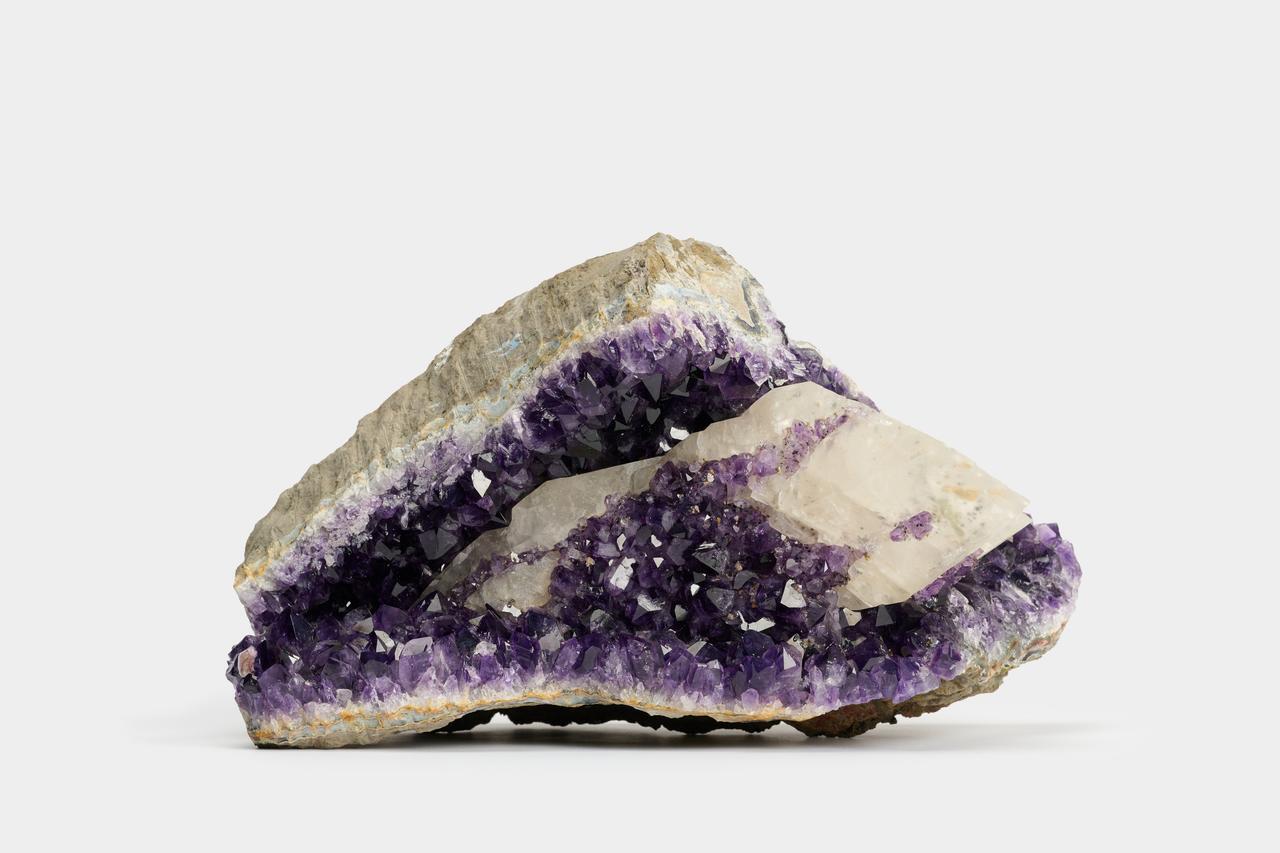
Unique Fluorescent Quartz in Dolomite Calcite matrix La Sassa Tuscany Italy LW MW SW - Height: 6.8 cm - Width: 11.5 cm- 388 g - (1)


06
days
04
hours
17
minutes
34
seconds
Starting bid
€ 1
No reserve price

Expert
Selected by Luca Esposito
Geology graduate with 10 years' professional experience and webshop founder.
Estimate € 160 - € 190
No bids placed
Catawiki Buyer Protection
Your payment’s safe with us until you receive your object.View details
Trustpilot 4.4 | 122713 reviews
Rated Excellent on Trustpilot.
This cabinet-sized specimen from La Sassa, Tuscany, Italy features yellow fluorescent quartz in a calcite-dolomite matrix, with UV glow across wavelengths.
AI-assisted summary
Description from the seller
Large specimen of yellow fluorescent quartz in a Calcite/ Dolomite matrix. Unique to La Sassa in Tuscany, yellow fluorescence is due to traces of uranyl and rare earth elements. Photos in UV SW and natural light.
Locality: La Sassa, Montecatini Val di Cecina, Pisa Province, Tuscany, Italy
Class: Massive/Crystalline
Size Range: Cabinet (10-18 cm)
Size: 11.5 x 6.8 x 5.3 cm
Weight: 388 gr
Unique and first found in the 1970's in a Calcite / Dolomite outcrop near the village of La Sassa.. Analysed by the British Museum in 1972 and confirmed to be a rare occurance of fluorescent quartz.
The quartz fluoresces under all UV wavelengths (SW-MW-LW)
According to Dallegno and coauthors, the fluorescing quartz is genetically linked to an early stage of hydrothermal metamorphism of the Larderello geothermal field, in whose peripheral zone the La Sassa vein system is located. Magmatic fluids with high concentrations of electrolytes (NaCl, KCl) and silica migrated upward to land surfaces, along extensional faults. At La Sassa, some siliceous sinter outcrops have been individualised and described. They are due to intense subaereal hot springs activity, which are spatially and genetically linked to Carlin-type gold deposits. Fluorescing quartz originates in outcrops located in the most tectonized area, with the strongest (hot spring) hydrothermal activity. In today rocks which correspond to fossil siliceous sinter deposits, some remnants of glowing quartz are found. Several different generations of quartz, both fluorescing and non-fluorescing, are known. Within the bright lemon-yellow fluorescing quartz, the authors detected the presence of electrolytes and lithic fragments of tourmaline (dravite-schorl series) as solid inclusions within the radiating fibers of quartz, and a rare artichoke quartz which is typical of an environment where conditions forced a rapid growth of the crystalline aggregate. The luminescence centres in quartz are attributed to the presence of hydrocarbons (both aliphatic and polyciclic-aromatic), (UO2)2+, REE, crystalline lattice defects as Si and O vacancy, Al3+/Metal+/2+. By ICP-MS analyses on some quartz samples, a relatively high concentration of incompatible elements (Li, Be, Ga, Rb, Cs), calcophile elements (Sb, As, Te, Ag), as well as a high content of Al and Ti, has been measured.
Most of the La Sassa quartz shows bright photoluminescence under UV light (SW, MW, and LW). The most typical form consists of macroscopic spheroidal aggregates of closely packed needle-like crystalline fibres (star quartz), probably resulting from crystallisation of previous deposited silica gel in hot springs system, in carbonate matrix. Bright yellow/yellow-green fluorescence is observed in honey-yellow fibrous-radiating aggregates, yellow-green-bluish fluoresence in colourless to white fibrous-radiating aggregates. Other luminescent quartz forms include massive aggregates with saccharoidal texture, white to pale grey colour and yellow-orange fluorescence, and aggregates of euhedral crystals (also in the form of "artichoke quartz") with bright yellow-green fluorescence. These quartz forms occur in a mature silica-carbonate sinter and/or within a system of surficial veins, sometimes also included in a metasomatized and/or silicized ophiolite protolith (listvinite-birbirite). Star quartz in listvinite-birbirite shows a white-blue-greeinsh fluoresence and the host rock (in which are present Fe carbonates, non-fluorecent quartz, Cr-bearing mica and chromite relics) a red-brown emission due to the presence of Fe3+ and Cr3+ luminescence centres. Also some carbonate levels (calcite-aragonite levels in banded thermogenic sediments) exhibit spectacular photoluminescence colours due to the presence of traces of organic substances, REE, etc.
Large specimen of yellow fluorescent quartz in a Calcite/ Dolomite matrix. Unique to La Sassa in Tuscany, yellow fluorescence is due to traces of uranyl and rare earth elements. Photos in UV SW and natural light.
Locality: La Sassa, Montecatini Val di Cecina, Pisa Province, Tuscany, Italy
Class: Massive/Crystalline
Size Range: Cabinet (10-18 cm)
Size: 11.5 x 6.8 x 5.3 cm
Weight: 388 gr
Unique and first found in the 1970's in a Calcite / Dolomite outcrop near the village of La Sassa.. Analysed by the British Museum in 1972 and confirmed to be a rare occurance of fluorescent quartz.
The quartz fluoresces under all UV wavelengths (SW-MW-LW)
According to Dallegno and coauthors, the fluorescing quartz is genetically linked to an early stage of hydrothermal metamorphism of the Larderello geothermal field, in whose peripheral zone the La Sassa vein system is located. Magmatic fluids with high concentrations of electrolytes (NaCl, KCl) and silica migrated upward to land surfaces, along extensional faults. At La Sassa, some siliceous sinter outcrops have been individualised and described. They are due to intense subaereal hot springs activity, which are spatially and genetically linked to Carlin-type gold deposits. Fluorescing quartz originates in outcrops located in the most tectonized area, with the strongest (hot spring) hydrothermal activity. In today rocks which correspond to fossil siliceous sinter deposits, some remnants of glowing quartz are found. Several different generations of quartz, both fluorescing and non-fluorescing, are known. Within the bright lemon-yellow fluorescing quartz, the authors detected the presence of electrolytes and lithic fragments of tourmaline (dravite-schorl series) as solid inclusions within the radiating fibers of quartz, and a rare artichoke quartz which is typical of an environment where conditions forced a rapid growth of the crystalline aggregate. The luminescence centres in quartz are attributed to the presence of hydrocarbons (both aliphatic and polyciclic-aromatic), (UO2)2+, REE, crystalline lattice defects as Si and O vacancy, Al3+/Metal+/2+. By ICP-MS analyses on some quartz samples, a relatively high concentration of incompatible elements (Li, Be, Ga, Rb, Cs), calcophile elements (Sb, As, Te, Ag), as well as a high content of Al and Ti, has been measured.
Most of the La Sassa quartz shows bright photoluminescence under UV light (SW, MW, and LW). The most typical form consists of macroscopic spheroidal aggregates of closely packed needle-like crystalline fibres (star quartz), probably resulting from crystallisation of previous deposited silica gel in hot springs system, in carbonate matrix. Bright yellow/yellow-green fluorescence is observed in honey-yellow fibrous-radiating aggregates, yellow-green-bluish fluoresence in colourless to white fibrous-radiating aggregates. Other luminescent quartz forms include massive aggregates with saccharoidal texture, white to pale grey colour and yellow-orange fluorescence, and aggregates of euhedral crystals (also in the form of "artichoke quartz") with bright yellow-green fluorescence. These quartz forms occur in a mature silica-carbonate sinter and/or within a system of surficial veins, sometimes also included in a metasomatized and/or silicized ophiolite protolith (listvinite-birbirite). Star quartz in listvinite-birbirite shows a white-blue-greeinsh fluoresence and the host rock (in which are present Fe carbonates, non-fluorecent quartz, Cr-bearing mica and chromite relics) a red-brown emission due to the presence of Fe3+ and Cr3+ luminescence centres. Also some carbonate levels (calcite-aragonite levels in banded thermogenic sediments) exhibit spectacular photoluminescence colours due to the presence of traces of organic substances, REE, etc.
Details
Number of items
1
Mineral Form
Unique Fluorescent Quartz in Dolomite Calcite matrix La Sassa Tuscany Italy LW MW SW
Weight
388 g
Origin (Region/ City)
La Sassa Tuscany
Country of Origin
Italy
Height
6.8 cm
Width
11.5 cm
Depth
5.3 cm
Sold by