Trissino - Opere - 1729



09
days
06
hours
04
minutes
46
seconds
Current bid
€ 1
No reserve price

Expert
Selected by Ilaria Colombo
Specialist in old books, specialising in theological disputes since 1999.
Estimate € 200 - € 300
10 other people are watching this object
 Bidder 1006 Bidder 1006 | €1 |
|---|
Catawiki Buyer Protection
Your payment’s safe with us until you receive your object.View details
Trustpilot 4.4 | 122473 reviews
Rated Excellent on Trustpilot.
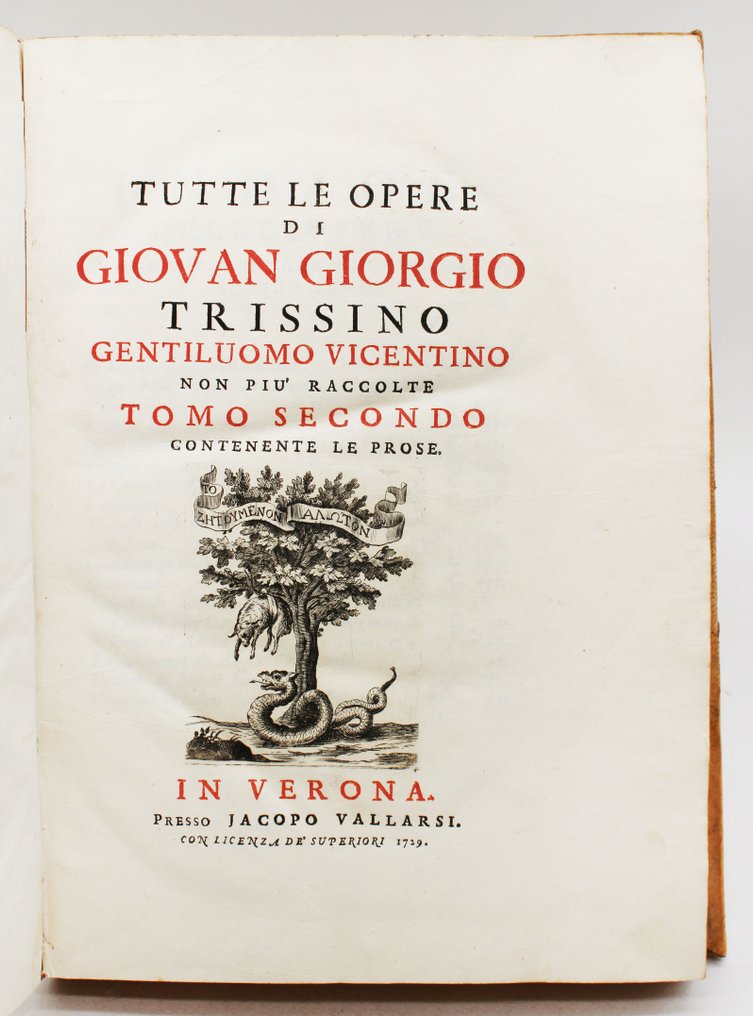
Two-volume, folio edition of Giovan Giorgio Trissino's Opere, bound in parchment, Verona 1729, in Italian.
AI-assisted summary
Description from the seller
In Folio - The scholar who reformed the language, provoked poets, and rewrote the canon.
Two volumes in folio. The Works of Giovan Giorgio Trissino, collected and published in Verona in 1729 in two volumes by Jacopo Vallarsi's workshop, represent one of the most influential and controversial syntheses of late Italian humanism, where literature, metrics, linguistic theory, oratory, and grammatical reflection intertwine in an audacious attempt to reform the vernacular language and reposition Italy within a classical model. This eighteenth-century edition, sumptuous in printing and typographic design, testifies not only to Trissino's popularity as a theorist but also to the persistence of his linguistic battles – from the new alphabet to the defense of the illustrious vernacular – which spanned the sixteenth century and sparked fierce debates. His prose, presented here in an orderly and philologically careful form, reveals an author who sought to rewrite the foundations of Italian poetry, combining treatise writing with the most rigorous metrical reflection, the dispute over the vernacular, the relationship with Dante, and the complex dialectic between imitation of the Greeks and Italian identity. The entire work thus becomes a mirror of the intellectual transformation of an era that looked to the classical past as a key to re-found modernity.
Market value
The presence of the two volumes in contemporaneous, uniform binding, the very fresh condition of the pages, and the clarity of the typography of the plates and ornamental friezes determine a value above the average of dispersed single copies. Complete copies in two volumes and in good condition are currently valued in a stable market range, around 1,500 euros, with fluctuations depending on the quality of the binding and internal cleanliness. The two complete volumes often fetch significantly higher prices compared to loose copies or those taken from conventual libraries with intensive use; the condition of your copies, visually high, is consistent with the upper range of the market for this edition.
Physical description and condition - collector's copy
Contemporary rigid parchment, with a spine patch and impressed title. Figured headpieces, ornamental woodcut initials, and finials. Pages (4); 44 unnumbered; 398; (2). (4); 8 unnumbered; 318; 2 unnumbered; 82; (4). Two folio volumes showing some signs of use on the covers, very fresh interiors, printed on well-engraved white paper. Wide margins. A collector's copy.
Full title and author
All the works of Giovan Giorgio Trissino, Gentleman of Vicenza, are no longer collected. Volume II and Volume II.
Verona, at the shop of Jacopo Vallarsi, 1729.
Giovan Giorgio Trissino
Context and Significance
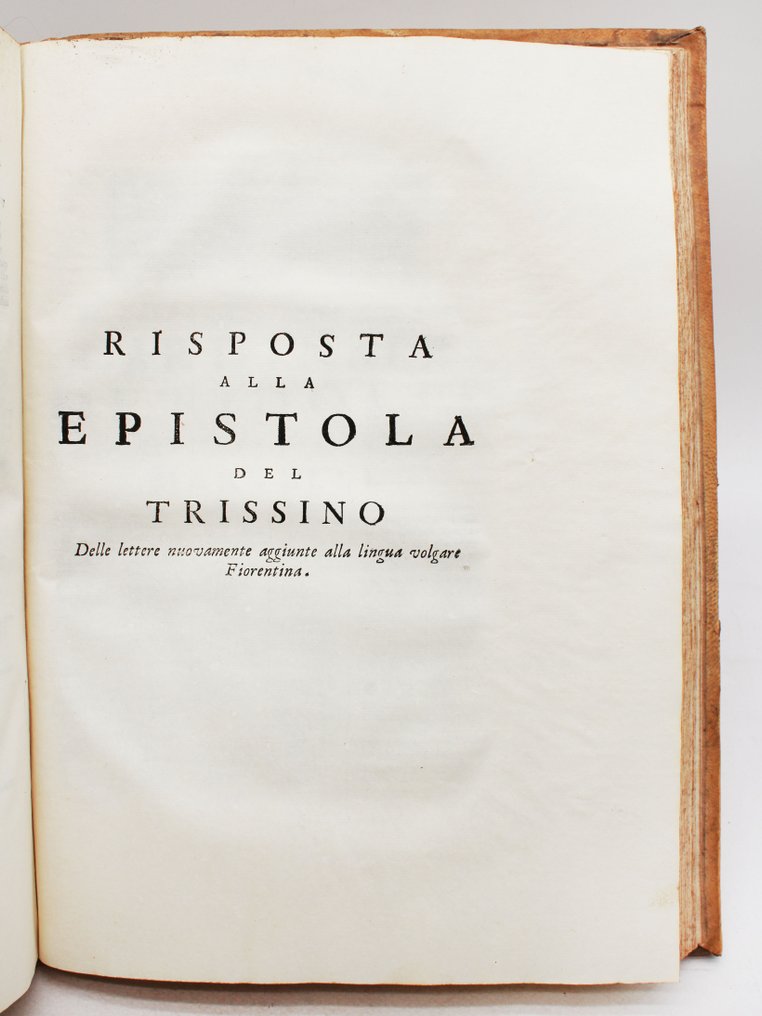
This monumental work gathers the entire theoretical and literary corpus of Giovan Giorgio Trissino, one of the key figures in 16th-century linguistic and poetic reflection. His works mark the last great attempt to impose a regulated system on the Italian vernacular based on Greek and Latin models, through a theoretical framework aimed at establishing a 'scientific' poetry. The volume includes the Six Divisions of Poetics, a crucial text that attempts to transpose Aristotelian doctrine into the Italian poetic system; the Grammatical Doubts, where Trissino addresses issues of pronunciation, accentuation, and word formation; the Epistle on Language and the famous Response to Florentine letters, which form the core of the debate on grammar and normative regulation of the vernacular; the Portraits, Life, Dialogues, and rhetorical parts that illuminate the practice of humanistic prose. Notably, it features the entire apparatus on Italian metrics, with analysis of feet, trimeters, iambs, and accentual systems—a rare Italian attempt to construct a metric regulated by Latin principles. This 18th-century edition, rich with vignettes and ornaments in late Baroque style, reflects the enduring centrality of the author in Italian linguistic debate, as well as the antiquarian interest of the early 1700s in recovering the great theorists of the previous century.
Biography of the Author
Giovan Giorgio Trissino (Vicenza, 1478 – Rome, 1550) was a poet, language theorist, playwright, diplomat, and a key figure of early sixteenth-century Italy. A student of Padovan humanism and supporter of supralocal linguistic theories, he proposed an alphabetic reform that sparked intense controversy; he actively participated in discussions on language, opposing the Florentine codification. Author of the most influential poetic treatise after that of Diomede and of the first regular Italian tragedy (La Sofonisba), he was close to imperial circles and refined humanist environments. His works marked a dividing line in linguistic debate, between normative classicism and the defense of Italian linguistic diversity.
Printing history and circulation
The 1729 Verona edition is one of the most elegant and comprehensive 18th-century collections of the Trissinian work. Printed by Jacopo Vallarsi, a prominent figure in Venetian scholarly publishing, it reflects the typical 18th-century desire to reorganize the Italian humanist canon into systematic and philologically controlled editions. It is an uncommon edition, often found in separate volumes; the presence of the two coordinated volumes is less frequent. Its circulation was mainly academic, intended for noble libraries and collections dedicated to studies of the Italian language and poetics.
BIBLIOGRAPHY AND REFERENCES
Key references include bibliographic repertoires on Venetian publishing of the early 18th century, Trissinian studies on the language issue, and catalogs of Italian humanist collections. For further insights: critical works on Trissinian Poetics, studies on the alphabet reform and Italian metrics of the 16th century, historical repertoires of Vallarsi editions, and catalogs of major Italian and French libraries with copies from the collection. Additional possible comparisons include the 16th-century editions of individual works and contemporary grammatical treatises by Bembo, Fortunio, and Tolomei.
Seller's Story
RareBooks NO-RESERVE brings the charm of antiquity into the digital age — with curated sales, exceptional deals, and stories worth collecting.
Because owning a rare book should feel like a discovery, not a luxury.
RareBooks NO-RESERVE is revolutionizing the online market for antique and rare books.
As a pioneer in e-commerce, the company transforms access to valuable and collectible editions by launching exclusive flash sales across leading platforms — offering significant discounts on books that are typically available only at premium prices.
With a sharp focus on visibility, digital innovation, and strategic pricing, RareBooks NO-RESERVE turns rarity into opportunity, building lasting customer loyalty through irresistible deals and curated value propositions.
Marina
Translated by Google TranslateIn Folio - The scholar who reformed the language, provoked poets, and rewrote the canon.
Two volumes in folio. The Works of Giovan Giorgio Trissino, collected and published in Verona in 1729 in two volumes by Jacopo Vallarsi's workshop, represent one of the most influential and controversial syntheses of late Italian humanism, where literature, metrics, linguistic theory, oratory, and grammatical reflection intertwine in an audacious attempt to reform the vernacular language and reposition Italy within a classical model. This eighteenth-century edition, sumptuous in printing and typographic design, testifies not only to Trissino's popularity as a theorist but also to the persistence of his linguistic battles – from the new alphabet to the defense of the illustrious vernacular – which spanned the sixteenth century and sparked fierce debates. His prose, presented here in an orderly and philologically careful form, reveals an author who sought to rewrite the foundations of Italian poetry, combining treatise writing with the most rigorous metrical reflection, the dispute over the vernacular, the relationship with Dante, and the complex dialectic between imitation of the Greeks and Italian identity. The entire work thus becomes a mirror of the intellectual transformation of an era that looked to the classical past as a key to re-found modernity.
Market value
The presence of the two volumes in contemporaneous, uniform binding, the very fresh condition of the pages, and the clarity of the typography of the plates and ornamental friezes determine a value above the average of dispersed single copies. Complete copies in two volumes and in good condition are currently valued in a stable market range, around 1,500 euros, with fluctuations depending on the quality of the binding and internal cleanliness. The two complete volumes often fetch significantly higher prices compared to loose copies or those taken from conventual libraries with intensive use; the condition of your copies, visually high, is consistent with the upper range of the market for this edition.
Physical description and condition - collector's copy
Contemporary rigid parchment, with a spine patch and impressed title. Figured headpieces, ornamental woodcut initials, and finials. Pages (4); 44 unnumbered; 398; (2). (4); 8 unnumbered; 318; 2 unnumbered; 82; (4). Two folio volumes showing some signs of use on the covers, very fresh interiors, printed on well-engraved white paper. Wide margins. A collector's copy.
Full title and author
All the works of Giovan Giorgio Trissino, Gentleman of Vicenza, are no longer collected. Volume II and Volume II.
Verona, at the shop of Jacopo Vallarsi, 1729.
Giovan Giorgio Trissino
Context and Significance
This monumental work gathers the entire theoretical and literary corpus of Giovan Giorgio Trissino, one of the key figures in 16th-century linguistic and poetic reflection. His works mark the last great attempt to impose a regulated system on the Italian vernacular based on Greek and Latin models, through a theoretical framework aimed at establishing a 'scientific' poetry. The volume includes the Six Divisions of Poetics, a crucial text that attempts to transpose Aristotelian doctrine into the Italian poetic system; the Grammatical Doubts, where Trissino addresses issues of pronunciation, accentuation, and word formation; the Epistle on Language and the famous Response to Florentine letters, which form the core of the debate on grammar and normative regulation of the vernacular; the Portraits, Life, Dialogues, and rhetorical parts that illuminate the practice of humanistic prose. Notably, it features the entire apparatus on Italian metrics, with analysis of feet, trimeters, iambs, and accentual systems—a rare Italian attempt to construct a metric regulated by Latin principles. This 18th-century edition, rich with vignettes and ornaments in late Baroque style, reflects the enduring centrality of the author in Italian linguistic debate, as well as the antiquarian interest of the early 1700s in recovering the great theorists of the previous century.
Biography of the Author
Giovan Giorgio Trissino (Vicenza, 1478 – Rome, 1550) was a poet, language theorist, playwright, diplomat, and a key figure of early sixteenth-century Italy. A student of Padovan humanism and supporter of supralocal linguistic theories, he proposed an alphabetic reform that sparked intense controversy; he actively participated in discussions on language, opposing the Florentine codification. Author of the most influential poetic treatise after that of Diomede and of the first regular Italian tragedy (La Sofonisba), he was close to imperial circles and refined humanist environments. His works marked a dividing line in linguistic debate, between normative classicism and the defense of Italian linguistic diversity.
Printing history and circulation
The 1729 Verona edition is one of the most elegant and comprehensive 18th-century collections of the Trissinian work. Printed by Jacopo Vallarsi, a prominent figure in Venetian scholarly publishing, it reflects the typical 18th-century desire to reorganize the Italian humanist canon into systematic and philologically controlled editions. It is an uncommon edition, often found in separate volumes; the presence of the two coordinated volumes is less frequent. Its circulation was mainly academic, intended for noble libraries and collections dedicated to studies of the Italian language and poetics.
BIBLIOGRAPHY AND REFERENCES
Key references include bibliographic repertoires on Venetian publishing of the early 18th century, Trissinian studies on the language issue, and catalogs of Italian humanist collections. For further insights: critical works on Trissinian Poetics, studies on the alphabet reform and Italian metrics of the 16th century, historical repertoires of Vallarsi editions, and catalogs of major Italian and French libraries with copies from the collection. Additional possible comparisons include the 16th-century editions of individual works and contemporary grammatical treatises by Bembo, Fortunio, and Tolomei.
Seller's Story
RareBooks NO-RESERVE brings the charm of antiquity into the digital age — with curated sales, exceptional deals, and stories worth collecting.
Because owning a rare book should feel like a discovery, not a luxury.
RareBooks NO-RESERVE is revolutionizing the online market for antique and rare books.
As a pioneer in e-commerce, the company transforms access to valuable and collectible editions by launching exclusive flash sales across leading platforms — offering significant discounts on books that are typically available only at premium prices.
With a sharp focus on visibility, digital innovation, and strategic pricing, RareBooks NO-RESERVE turns rarity into opportunity, building lasting customer loyalty through irresistible deals and curated value propositions.
Marina
Translated by Google TranslateDetails
Number of Books
2
Subject
Poetry
Book Title
Opere
Author/ Illustrator
Trissino
Condition
Good
Publication year oldest item
1729
Height
332 mm
Edition
1st Edition Thus
Width
234 mm
Language
Italian
Original language
Yes
Publisher
Verona, Presso Jacopo Vallarsi, 1729
Binding/ Material
Vellum
Number of pages
866
Sold by
