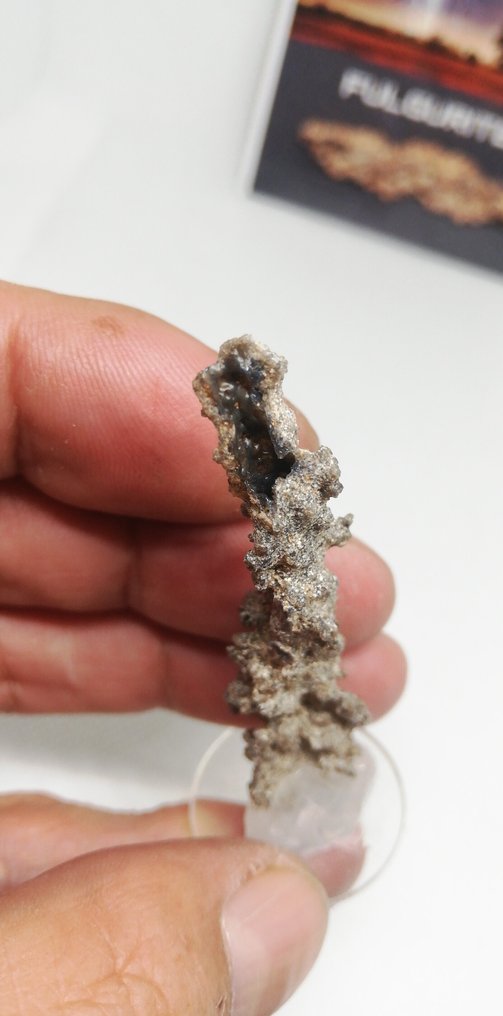
9 Fulgurites (Lightning Impact). Léchateliérite. (No reserve price) - 35 g



04
days
03
hours
37
minutes
55
seconds
Current bid
€ 25
No reserve price

Expert
Selected by Francesco Moser
Over 20 years collecting meteorites; former museum curator and experienced restorer.
Estimate € 120 - € 180
10 other people are watching this object
 Bidder 2913 Bidder 2913 | €25 | |
|---|---|---|
 Bidder 9977 Bidder 9977 | €20 | |
| Bidder 2913 | €15 | |
Catawiki Buyer Protection
Your payment’s safe with us until you receive your object.View details
Trustpilot 4.4 | 122713 reviews
Rated Excellent on Trustpilot.
A 35 g fulgurite specimen from Sahara, Maroc, formed as 9 FULGURITES (Impact de Foudre) Léchateliérite with a striking interior hole and glassy tube shape, a compelling piece for meteorite enthusiasts.
AI-assisted summary
Description from the seller
Fulgurite (from Latin fulgur, 'ray') is a metamorphic rock in the shape of a tube composed of lechatelierite (vitrified silica) that is found in sands or sandstones. Its formation is due to the fall of atmospheric lightning.
The impact of lightning on sandy terrain causes the fusion of silica grains, as its temperature can reach up to 30,000 degrees, which is higher than the surface temperature of the sun, and extends to a depth of more than a meter, but within a very narrow zone. The silica is thus vitrified into lightning tubes, sometimes twisted or branched. These fulgurites can be found in desert sands and coastal dunes.
The formation of fulgurites is a rare phenomenon, and extracting a whole one is complicated due to the mineral's fragility, which makes it easily breakable.
The fulgurite from this lot has a good size, a perfectly visible interior hole, and a very aesthetic shape, making it one of the most beautiful specimens you can find. A true specimen worthy of a great collection.
1 g of weight was removed from each piece. Pieces are glued onto a glass base.
Seller's Story
As a collector and meteorite enthusiast and member of the IMCA.
(International Association of Meteorite Collectors),
I guarantee the authenticity of all my meteorites, selected with care, to offer you the best service.
IMCA # 6758
DC meteorites
Translated by Google TranslateFulgurite (from Latin fulgur, 'ray') is a metamorphic rock in the shape of a tube composed of lechatelierite (vitrified silica) that is found in sands or sandstones. Its formation is due to the fall of atmospheric lightning.
The impact of lightning on sandy terrain causes the fusion of silica grains, as its temperature can reach up to 30,000 degrees, which is higher than the surface temperature of the sun, and extends to a depth of more than a meter, but within a very narrow zone. The silica is thus vitrified into lightning tubes, sometimes twisted or branched. These fulgurites can be found in desert sands and coastal dunes.
The formation of fulgurites is a rare phenomenon, and extracting a whole one is complicated due to the mineral's fragility, which makes it easily breakable.
The fulgurite from this lot has a good size, a perfectly visible interior hole, and a very aesthetic shape, making it one of the most beautiful specimens you can find. A true specimen worthy of a great collection.
1 g of weight was removed from each piece. Pieces are glued onto a glass base.
Seller's Story
As a collector and meteorite enthusiast and member of the IMCA.
(International Association of Meteorite Collectors),
I guarantee the authenticity of all my meteorites, selected with care, to offer you the best service.
IMCA # 6758
DC meteorites
Translated by Google TranslateDetails
Type of meteorite
9 Fulgurites (Lightning Impact). Léchateliérite. (No reserve price)
Weight
35 g
Origin (Region/ City)
Desert
Country of Origin
Morocco
Sold by