Cicerone - (POST INCUNABLE) M. Tullii Ciceronis - 1538




00
days
14
hours
29
minutes
30
seconds
Current bid
€ 350
No reserve price

Expert
Selected by Volker Riepenhausen
Specialist in travel literature and pre-1600 rare prints with 28 years experience.
Estimate € 1,500 - € 2,000
60 other people are watching this object
 Bidder 0966 Bidder 0966 | €350 | |
|---|---|---|
 Bidder 0772 Bidder 0772 | €330 | |
| Bidder 0966 | €310 | |
Catawiki Buyer Protection
Your payment’s safe with us until you receive your object.View details
Trustpilot 4.4 | 121798 reviews
Rated Excellent on Trustpilot.
This post incunabula volume pairs three Cicero orations with scholarly Italian and Latinate notes, making it a distinguished philological collectible for serious bibliophiles.
AI-assisted summary
Description from the seller
Elegitur exclusively presents three works by Cicero, each in a limited edition and extremely rare, with a colossal collector's value.
Author:
Marcus Tullius Cicero (106–43 BC)
Roman philosopher, orator, and statesman, the greatest exponent of Latin eloquence, whose rhetorical and philosophical work left an indelible mark on humanist and Renaissance culture. His orations were the subject of countless editions and commentaries in the 16th century, considered essential tools for the formation of the cultured man and the perfect orator.
The input is a dash character, which does not require translation.
Full title and contents of the volume:
1. M. T. Ciceronis in L. Pisonem oratio, Q. Asconii Paediani commentariis illustrata.
Parisiis, apud Michaëlem Vascosanum, in aedibus Ascensianis, via ad D. Iacobum, sub signo Fontis. M.D.XXXVIII (1538).
• Illustrated frontispiece with a woodcut representation of Renaissance typography, bearing the motto “PRELVM ASCENSIANVM”.
• Edition accompanied by the commentary of Quintus Asconius Pedianus, the famous Roman grammarian of the Augustan age, author of exegetical glosses on various Ciceronian orations.
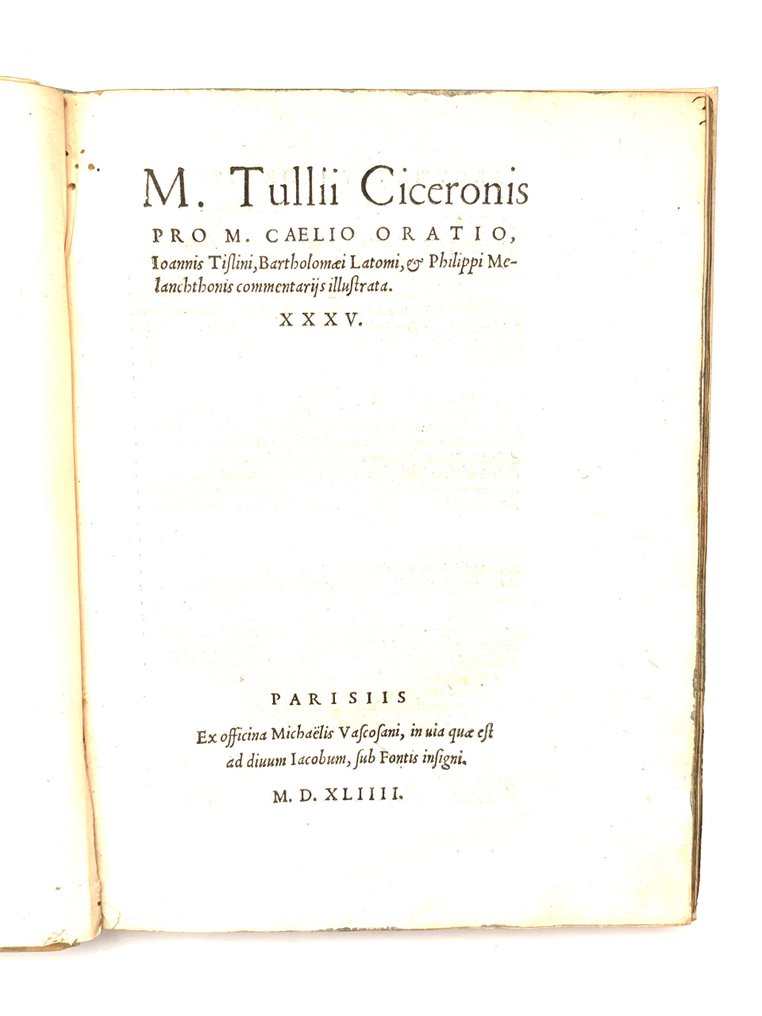
2. M. Tullii Ciceronis pro M. Caelio oratio, Ioannis Tisleni, Bartholomaei Latomi, & Philippi Melanchthonis commentariis illustrata.
Parisiis, former Michaëlis Vascosani workshop, in via quae est ad divum Iacobum, sub Fontis insigne. M.D.XLIIII (1544).
• Edition enriched by the comments of three prominent humanists: Ioannes Tislenus, Bartholomaeus Latomus and Philippus Melanchthon, the latter being the greatest exponent of Lutheran Humanism and Luther's main collaborator.
• The text is a paradigmatic example of judicial oratory, in which Cicero defends Marcus Caelius Rufus, the orator's pupil and protégé.
3. M. T. Ciceronis pro T. Annio Milone oratio, Q. Asconii Paediani et Francisci Sylvii commentariis, Bartholomaei Latomi scholiis, & Philippi Melanchthonis dispositione illustrata.
Parisiis, former Michaëlis Vascosani workshop, in via quae est ad divum Iacobum, sub Fontis insigne. M.D.XLV (1545).
• Commentaries by Asconius Pedianus, Franciscus Sylvius, Latomus and Melanchthon, which offer a comparison between the classical exegetical tradition and the humanistic-philological one of the 16th century.
• The oration, one of Cicero's most famous, defends Milo accused of the killing of Clodius, an episode of the highest political importance in the late Roman Republic.
The input is a dash character, which does not require translation.
Printer and typographic context:
Michel de Vascosan (Michael Vascosanus)—active in Paris between 1530 and 1570—was one of the most eminent humanist printers of the 16th century. Son-in-law of Henri Estienne (Henricus Stephanus), he belonged to the French typographic school that fused formal elegance and philological rigor. His editions are distinguished by:
• the clarity of the Roman character, derived from the Estienne workshop;
• the philological care of classical texts, often edited by humanists linked to the Sorbonne and the Reformed movement;
• the presence of beautiful woodcuts on the frontispiece, including the famous printing scene with the printing press and the inscription “PRELVM ASCENSIANVM”, a symbol of continuity with the tradition of Jodocus Badius Ascensius, Vascosan's master and predecessor.
The input is a dash character, which does not require translation.
Historical and cultural context:
The period 1538–1545 represents the apogee of Parisian typographical humanism. During these years, the printing presses of Estienne, Colinaeus, and Vascosan disseminated the fundamental texts of classical antiquity, contributing to the philological revival and educational reform.
Cicero's orations, in particular, were considered model texts for rhetoric, moral philosophy, and civic education, and were accompanied by commentaries by the most illustrious humanist philologists—Catholic and Reformed—reflecting the fervent intellectual dialogue between the two worlds.
The input is a dash character, which does not require translation.
Material description:
• Format: quarto (4º)
• Binding: contemporary or slightly later, presumably in hard parchment or old cardboard.
• Pagination: works bound together, each with its own independent title page and typographic register.
• Typeface: elegant roman of clear Estienian derivation, with titles in capital letters and an airy layout.
• State of preservation: excellent for the period, laid paper of excellent quality, clean title pages, only slight marginal redness and rare contemporary pen annotations (“Ciceronis”, “opera”) in a humanist hand.
• Typographic brand: woodcut with the scene of the press (for the first work) and the sign of the Font (sub signo Fontis) for the subsequent ones, symbol of the Vascosaniana workshop.
The input is a dash character, which does not require translation.
Bibliographic and collecting importance:
This collection is a perfect example of a sixteenth-century humanistic compilation, uniting three fundamental orations by Cicero in successive editions by the same printer, linked by graphic and philological coherence.
The presence of the commentaries of Asconius, Latomus and Melanchthon offers a precious document of the dialogue between classical exegesis and European Reformed culture.
The Vascosanian editions of Cicero are today considered among the most elegant and philologically authoritative of the pre-Stephanian period, and the collection of several titles in a single volume gives them considerable bibliophilic value.
The input is a dash character, which does not require translation.
Bibliographic references:
• Renouard, Annales de l'imprimerie des Estienne, passim.
• Brunet, Manuel du Libraire, II, 16.
• Adams, Catalog of Books Printed in the 16th Century, C-1581, C-1594, C-1602.
• Mortimer, Harvard College Library, French Sixteenth-Century Books, n. 160–163.
The input is a dash character, which does not require translation.
Overall rating:
A work of rare integrity and great historical and typographical value, it testifies to the excellence of Parisian humanist publishing and Cicero's influence at the heart of the European Renaissance.
Collation: tom I (28pp) tom II (52pp) tom III (71pp) 3pp index
Shipping Terms and Conditions: The book will be carefully packaged to best protect it from any damage during transit. Shipping will be fast and insured, arriving within 24 business hours within the EU and within 72 business hours outside of the EU. Please note that for countries outside of the EU, any customs duties and costs will be borne by the buyer.
Elegitur exclusively presents three works by Cicero, each in a limited edition and extremely rare, with a colossal collector's value.
Author:
Marcus Tullius Cicero (106–43 BC)
Roman philosopher, orator, and statesman, the greatest exponent of Latin eloquence, whose rhetorical and philosophical work left an indelible mark on humanist and Renaissance culture. His orations were the subject of countless editions and commentaries in the 16th century, considered essential tools for the formation of the cultured man and the perfect orator.
The input is a dash character, which does not require translation.
Full title and contents of the volume:
1. M. T. Ciceronis in L. Pisonem oratio, Q. Asconii Paediani commentariis illustrata.
Parisiis, apud Michaëlem Vascosanum, in aedibus Ascensianis, via ad D. Iacobum, sub signo Fontis. M.D.XXXVIII (1538).
• Illustrated frontispiece with a woodcut representation of Renaissance typography, bearing the motto “PRELVM ASCENSIANVM”.
• Edition accompanied by the commentary of Quintus Asconius Pedianus, the famous Roman grammarian of the Augustan age, author of exegetical glosses on various Ciceronian orations.
2. M. Tullii Ciceronis pro M. Caelio oratio, Ioannis Tisleni, Bartholomaei Latomi, & Philippi Melanchthonis commentariis illustrata.
Parisiis, former Michaëlis Vascosani workshop, in via quae est ad divum Iacobum, sub Fontis insigne. M.D.XLIIII (1544).
• Edition enriched by the comments of three prominent humanists: Ioannes Tislenus, Bartholomaeus Latomus and Philippus Melanchthon, the latter being the greatest exponent of Lutheran Humanism and Luther's main collaborator.
• The text is a paradigmatic example of judicial oratory, in which Cicero defends Marcus Caelius Rufus, the orator's pupil and protégé.
3. M. T. Ciceronis pro T. Annio Milone oratio, Q. Asconii Paediani et Francisci Sylvii commentariis, Bartholomaei Latomi scholiis, & Philippi Melanchthonis dispositione illustrata.
Parisiis, former Michaëlis Vascosani workshop, in via quae est ad divum Iacobum, sub Fontis insigne. M.D.XLV (1545).
• Commentaries by Asconius Pedianus, Franciscus Sylvius, Latomus and Melanchthon, which offer a comparison between the classical exegetical tradition and the humanistic-philological one of the 16th century.
• The oration, one of Cicero's most famous, defends Milo accused of the killing of Clodius, an episode of the highest political importance in the late Roman Republic.
The input is a dash character, which does not require translation.
Printer and typographic context:
Michel de Vascosan (Michael Vascosanus)—active in Paris between 1530 and 1570—was one of the most eminent humanist printers of the 16th century. Son-in-law of Henri Estienne (Henricus Stephanus), he belonged to the French typographic school that fused formal elegance and philological rigor. His editions are distinguished by:
• the clarity of the Roman character, derived from the Estienne workshop;
• the philological care of classical texts, often edited by humanists linked to the Sorbonne and the Reformed movement;
• the presence of beautiful woodcuts on the frontispiece, including the famous printing scene with the printing press and the inscription “PRELVM ASCENSIANVM”, a symbol of continuity with the tradition of Jodocus Badius Ascensius, Vascosan's master and predecessor.
The input is a dash character, which does not require translation.
Historical and cultural context:
The period 1538–1545 represents the apogee of Parisian typographical humanism. During these years, the printing presses of Estienne, Colinaeus, and Vascosan disseminated the fundamental texts of classical antiquity, contributing to the philological revival and educational reform.
Cicero's orations, in particular, were considered model texts for rhetoric, moral philosophy, and civic education, and were accompanied by commentaries by the most illustrious humanist philologists—Catholic and Reformed—reflecting the fervent intellectual dialogue between the two worlds.
The input is a dash character, which does not require translation.
Material description:
• Format: quarto (4º)
• Binding: contemporary or slightly later, presumably in hard parchment or old cardboard.
• Pagination: works bound together, each with its own independent title page and typographic register.
• Typeface: elegant roman of clear Estienian derivation, with titles in capital letters and an airy layout.
• State of preservation: excellent for the period, laid paper of excellent quality, clean title pages, only slight marginal redness and rare contemporary pen annotations (“Ciceronis”, “opera”) in a humanist hand.
• Typographic brand: woodcut with the scene of the press (for the first work) and the sign of the Font (sub signo Fontis) for the subsequent ones, symbol of the Vascosaniana workshop.
The input is a dash character, which does not require translation.
Bibliographic and collecting importance:
This collection is a perfect example of a sixteenth-century humanistic compilation, uniting three fundamental orations by Cicero in successive editions by the same printer, linked by graphic and philological coherence.
The presence of the commentaries of Asconius, Latomus and Melanchthon offers a precious document of the dialogue between classical exegesis and European Reformed culture.
The Vascosanian editions of Cicero are today considered among the most elegant and philologically authoritative of the pre-Stephanian period, and the collection of several titles in a single volume gives them considerable bibliophilic value.
The input is a dash character, which does not require translation.
Bibliographic references:
• Renouard, Annales de l'imprimerie des Estienne, passim.
• Brunet, Manuel du Libraire, II, 16.
• Adams, Catalog of Books Printed in the 16th Century, C-1581, C-1594, C-1602.
• Mortimer, Harvard College Library, French Sixteenth-Century Books, n. 160–163.
The input is a dash character, which does not require translation.
Overall rating:
A work of rare integrity and great historical and typographical value, it testifies to the excellence of Parisian humanist publishing and Cicero's influence at the heart of the European Renaissance.
Collation: tom I (28pp) tom II (52pp) tom III (71pp) 3pp index
Shipping Terms and Conditions: The book will be carefully packaged to best protect it from any damage during transit. Shipping will be fast and insured, arriving within 24 business hours within the EU and within 72 business hours outside of the EU. Please note that for countries outside of the EU, any customs duties and costs will be borne by the buyer.
Details
Number of Books
1
Subject
History, Incunabula & early printing, Literature, Philosophy
Book Title
(POST INCUNABLE) M. Tullii Ciceronis
Author/ Illustrator
Cicerone
Condition
Fine
Publication year oldest item
1538
Edition
1st Edition
Language
Latin
Original language
Yes
Publisher
Michael Vascosanus
Binding/ Material
Vellum
Number of pages
154
