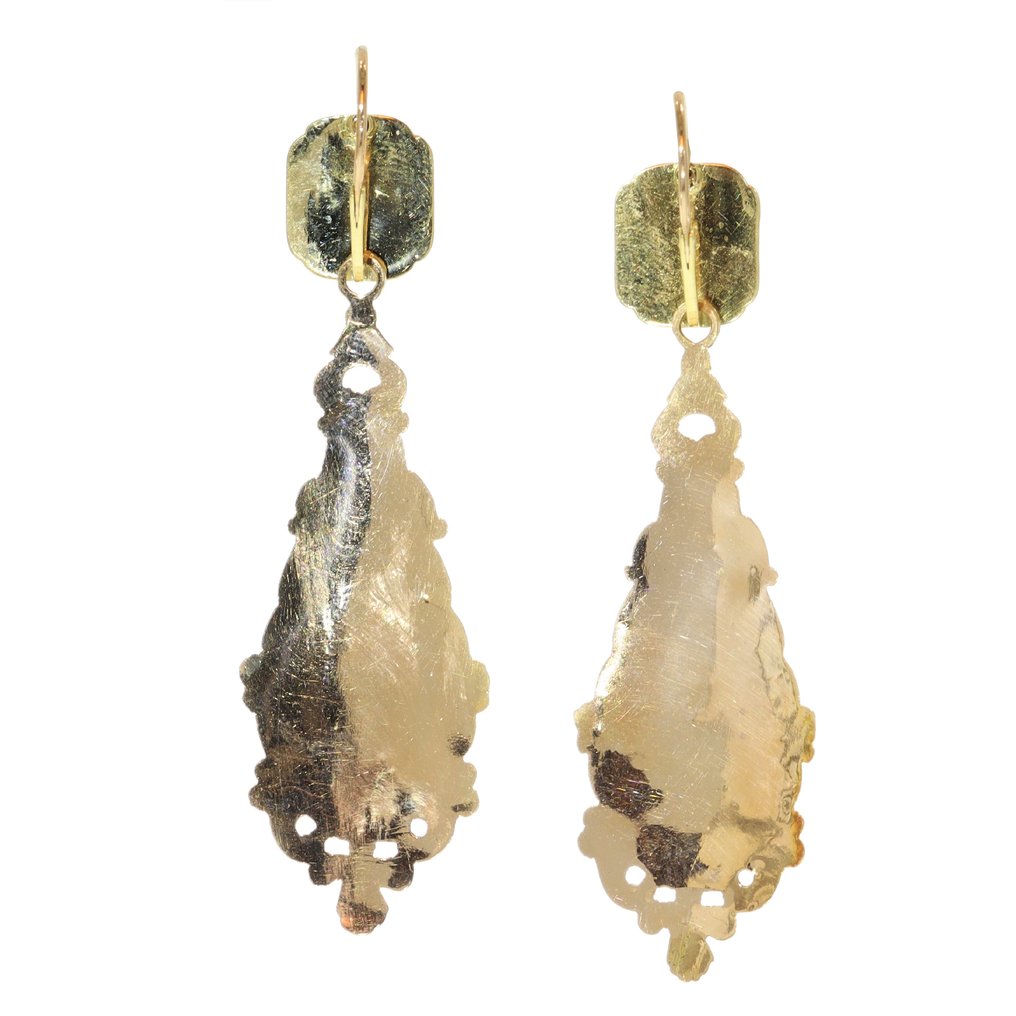
Earrings - 18 kt. Yellow gold - Cameo, Victorian 1830


01
day
15
hours
48
minutes
53
seconds

37 other people are watching this object
 Bidder 9837 Bidder 9837 | €150 | |
|---|---|---|
 Bidder 9829 Bidder 9829 | €140 | |
| Bidder 9829 | €130 | |
Catawiki Buyer Protection
Your payment’s safe with us until you receive your object.View details
Trustpilot 4.4 | 121798 reviews
Rated Excellent on Trustpilot.
Victorian era cameo earrings from 1830 in 18 karat yellow gold, weighing 9.9 grams with black enamel and crescent moons, a refined example of 19th century craftsmanship.
AI-assisted summary
Description from the seller
Laura Inghirami and Donna Jewel act as guest curators for this auction. Laura Inghirami and Donna Jewel are not the seller and have not screened or otherwise reviewed the objects and cannot be held responsible nor liable for the objects in this auction nor any statements made by the sellers
These extraordinary Victorian earrings, crafted around 1830, tell a story of refined elegance and symbolism. Finely carved cameos, encased in rich 18K yellow gold and highlighted with black enamel, depict timeless profiles adorned with crescent moons and botanical motifs. These design elements suggest ties to mythology and nature, reflecting the Victorian fascination with storytelling through jewellery. A striking testament to 19th-century craftsmanship, these earrings are not just adornments but artefacts that connect us to an era steeped in beauty and meaning.
Antique jewelry object group
earrings long hanging
Condition
in very good condition, though there are slight imperfections on the surface of the black enamel.
Country of origin
Although it does not carry any legible control marks we believe this to be of French or Belgian origin.
Style
Victorian - Victorian decorative arts refers to the style of decorative arts during the Victorian era. The Victorian era is known for its eclectic revival and interpretation of historic styles and the introduction of cross-cultural influences from the middle east and Asia in furniture, fittings, and Interior decoration. Victorian design is widely viewed as having indulged in a regrettable excess of ornament. The Arts and Crafts movement, the aesthetic movement, Anglo-Japanese style, and Art Nouveau style have their beginnings in the late Victorian era.
See also: Victorian
Period
ca. 1830
Source of inspiration
Mythology (?)
Theme
Mythology and femininity, reflected in crescent moons and botanical motifs, symbolising harmony and natural beauty.
Material 18K
yellow gold (touchstone tested)
Techniques
Enamelling is an old and widely-adopted technology. The ancient Egyptians applied enamels to pottery and stone objects. The ancient Greeks, Celts, Russians, and Chinese also used enameling processes on metal objects. Enamel is the colorful result of fusing powdered glass to a substrate by firing, usually between 750 and 850 degrees Celsius. The powder melts and flows and hardens to a smooth, durable vitreous coating on metal, glass or ceramic. According to some sources, the word enamel comes from the High German word smelzan (to smelt) via the Old French esmail. Used as a noun, "an enamel" is a usually small decorative object, coated with enamel coating, such as a champlevé or a cloisonné (different techniques).
Cameo is a method of carving, or an item of jewellery or vessel made in this manner. It features a raised (positive) relief image. There are three main materials for Cameo carving; Shells or Agate (called a Hardstone cameo), and glass. Cameos can be produced by setting a carved relief, such as a portrait, onto a background of a contrasting colour. This is called an assembled cameo. Alternately, a cameo can be carved directly out of a material with integral layers or banding, such as (banded) agate or layered glass, where different layers have different colours. Sometimes dyes are used to enhance these colours. Cameos are often worn as jewellery. Stone cameos of great artistry were made in Greece dating back as far as the 6th century BC. They were very popular in Ancient Rome, and one of the most famous stone cameos from this period is the Gemma Claudia made for the Emperor Claudius. The technique has since enjoyed periodic revivals, notably in the early Renaissance, and again in the 17th, 18th and 19th centuries.
Hallmarks
Illegible remains.
Dimensions
height 7,60 cm (2,99 inch)
Weight
9,90 gram (6,37 dwt)
Adin Reference Nº
24278-0417
- All jewels are delivered in an Adin jewellery box. Jewellery boxes shown in photos are for display purposes only and are not included with the jewel, unless stated otherwise.
- Accompanied by a professional report of authenticity for your peace of mind.
- Shipped insured and registered for your security, though you're most welcome to collect in person.
- For shipments outside the EU, import duties and other charges may apply. We advise checking this in advance.
- We invite you to browse through our customer feedback to discover the level of satisfaction we consistently provide.
- See more of our products, visit: https://auction.catawiki.com/lotsfrom/Adin
- Antique and vintage jewellery often undergoes thoughtful refurbishment, remodelling, or repairs to enhance its longevity and wearability. Such pieces frequently bear marks of this tender care. Furthermore, we present our antique and vintage jewellery in its authentic state, refraining from removing scratches or applying rhodium plating to white gold items. Our priority is to preserve the genuine allure and history of each piece. However, as the new owner, you have the option to take it to a local goldsmith for a cosmetic refresh, should you choose.
Seller's Story
Adin shares with their collection of vintage and antique jewellery over 4 decades of expertise. On our provider page, you get the experience of exploring our boutique, located in the world diamond center Antwerp. Elkan Wijnberg, Adin’s founder and CEO, is a member of the Belgian Chamber of Experts to the Courts of Justice and of both the British and American Society of Jewellery Historians.
Laura Inghirami and Donna Jewel act as guest curators for this auction. Laura Inghirami and Donna Jewel are not the seller and have not screened or otherwise reviewed the objects and cannot be held responsible nor liable for the objects in this auction nor any statements made by the sellers
These extraordinary Victorian earrings, crafted around 1830, tell a story of refined elegance and symbolism. Finely carved cameos, encased in rich 18K yellow gold and highlighted with black enamel, depict timeless profiles adorned with crescent moons and botanical motifs. These design elements suggest ties to mythology and nature, reflecting the Victorian fascination with storytelling through jewellery. A striking testament to 19th-century craftsmanship, these earrings are not just adornments but artefacts that connect us to an era steeped in beauty and meaning.
Antique jewelry object group
earrings long hanging
Condition
in very good condition, though there are slight imperfections on the surface of the black enamel.
Country of origin
Although it does not carry any legible control marks we believe this to be of French or Belgian origin.
Style
Victorian - Victorian decorative arts refers to the style of decorative arts during the Victorian era. The Victorian era is known for its eclectic revival and interpretation of historic styles and the introduction of cross-cultural influences from the middle east and Asia in furniture, fittings, and Interior decoration. Victorian design is widely viewed as having indulged in a regrettable excess of ornament. The Arts and Crafts movement, the aesthetic movement, Anglo-Japanese style, and Art Nouveau style have their beginnings in the late Victorian era.
See also: Victorian
Period
ca. 1830
Source of inspiration
Mythology (?)
Theme
Mythology and femininity, reflected in crescent moons and botanical motifs, symbolising harmony and natural beauty.
Material 18K
yellow gold (touchstone tested)
Techniques
Enamelling is an old and widely-adopted technology. The ancient Egyptians applied enamels to pottery and stone objects. The ancient Greeks, Celts, Russians, and Chinese also used enameling processes on metal objects. Enamel is the colorful result of fusing powdered glass to a substrate by firing, usually between 750 and 850 degrees Celsius. The powder melts and flows and hardens to a smooth, durable vitreous coating on metal, glass or ceramic. According to some sources, the word enamel comes from the High German word smelzan (to smelt) via the Old French esmail. Used as a noun, "an enamel" is a usually small decorative object, coated with enamel coating, such as a champlevé or a cloisonné (different techniques).
Cameo is a method of carving, or an item of jewellery or vessel made in this manner. It features a raised (positive) relief image. There are three main materials for Cameo carving; Shells or Agate (called a Hardstone cameo), and glass. Cameos can be produced by setting a carved relief, such as a portrait, onto a background of a contrasting colour. This is called an assembled cameo. Alternately, a cameo can be carved directly out of a material with integral layers or banding, such as (banded) agate or layered glass, where different layers have different colours. Sometimes dyes are used to enhance these colours. Cameos are often worn as jewellery. Stone cameos of great artistry were made in Greece dating back as far as the 6th century BC. They were very popular in Ancient Rome, and one of the most famous stone cameos from this period is the Gemma Claudia made for the Emperor Claudius. The technique has since enjoyed periodic revivals, notably in the early Renaissance, and again in the 17th, 18th and 19th centuries.
Hallmarks
Illegible remains.
Dimensions
height 7,60 cm (2,99 inch)
Weight
9,90 gram (6,37 dwt)
Adin Reference Nº
24278-0417
- All jewels are delivered in an Adin jewellery box. Jewellery boxes shown in photos are for display purposes only and are not included with the jewel, unless stated otherwise.
- Accompanied by a professional report of authenticity for your peace of mind.
- Shipped insured and registered for your security, though you're most welcome to collect in person.
- For shipments outside the EU, import duties and other charges may apply. We advise checking this in advance.
- We invite you to browse through our customer feedback to discover the level of satisfaction we consistently provide.
- See more of our products, visit: https://auction.catawiki.com/lotsfrom/Adin
- Antique and vintage jewellery often undergoes thoughtful refurbishment, remodelling, or repairs to enhance its longevity and wearability. Such pieces frequently bear marks of this tender care. Furthermore, we present our antique and vintage jewellery in its authentic state, refraining from removing scratches or applying rhodium plating to white gold items. Our priority is to preserve the genuine allure and history of each piece. However, as the new owner, you have the option to take it to a local goldsmith for a cosmetic refresh, should you choose.
Seller's Story
Adin shares with their collection of vintage and antique jewellery over 4 decades of expertise. On our provider page, you get the experience of exploring our boutique, located in the world diamond center Antwerp. Elkan Wijnberg, Adin’s founder and CEO, is a member of the Belgian Chamber of Experts to the Courts of Justice and of both the British and American Society of Jewellery Historians.
Details
Era
1400-1900
Laboratory Report
No laboratory report
Estimated period
1800-1850
Metal
Yellow gold
Brand jewellery
No
Fineness
18 kt.
Total weight
9.9 g
Condition
Good condition - used with some signs of wear
Gender
Unisex
Title additional information
Cameo, Victorian 1830
Disclaimer
Catawiki always aims to offer you the best possible buying experience. Our experts virtually review and select every object in line with our submission guidelines. While we strive to provide a detailed description and photographs of each jewellery object, discrepancies or inaccuracies may occur. It is your responsibility to review all of the information provided about an object, including the condition and description, before placing an order. Sellers are responsible for the information, pictures and description provided, including the quality, quantity and nature of the jewelry supplied. A small imperfection that cannot be seen in the photo but is included in the description is not a non-conformity. A Lab Report is not a guarantee, valuation or appraisal regarding the articles described therein. A Lab Report contains only the characteristics of an article described after it has been graded, tested, examined, and analyzed using the techniques and equipment used at the time of the examination from that specific Lab. The results of any other examination performed on the article may differ depending when, how, by whom and with which grading standard the article is examined. In addition, any changes and improvements in techniques and equipment that may have occurred which may enable the examiner to detect, among other things, the use of processes for altering the characteristics of an article which use was previously undetectable, does not automatically mean the object does not conform to its description.
Catawiki always aims to offer you the best possible buying experience. Our experts virtually review and select every object in line with our submission guidelines. While we strive to provide a detailed description and photographs of each jewellery object, discrepancies or inaccuracies may occur. It is your responsibility to review all of the information provided about an object, including the condition and description, before placing an order. Sellers are responsible for the information, pictures and description provided, including the quality, quantity and nature of the jewelry supplied. A small imperfection that cannot be seen in the photo but is included in the description is not a non-conformity. A Lab Report is not a guarantee, valuation or appraisal regarding the articles described therein. A Lab Report contains only the characteristics of an article described after it has been graded, tested, examined, and analyzed using the techniques and equipment used at the time of the examination from that specific Lab. The results of any other examination performed on the article may differ depending when, how, by whom and with which grading standard the article is examined. In addition, any changes and improvements in techniques and equipment that may have occurred which may enable the examiner to detect, among other things, the use of processes for altering the characteristics of an article which use was previously undetectable, does not automatically mean the object does not conform to its description.