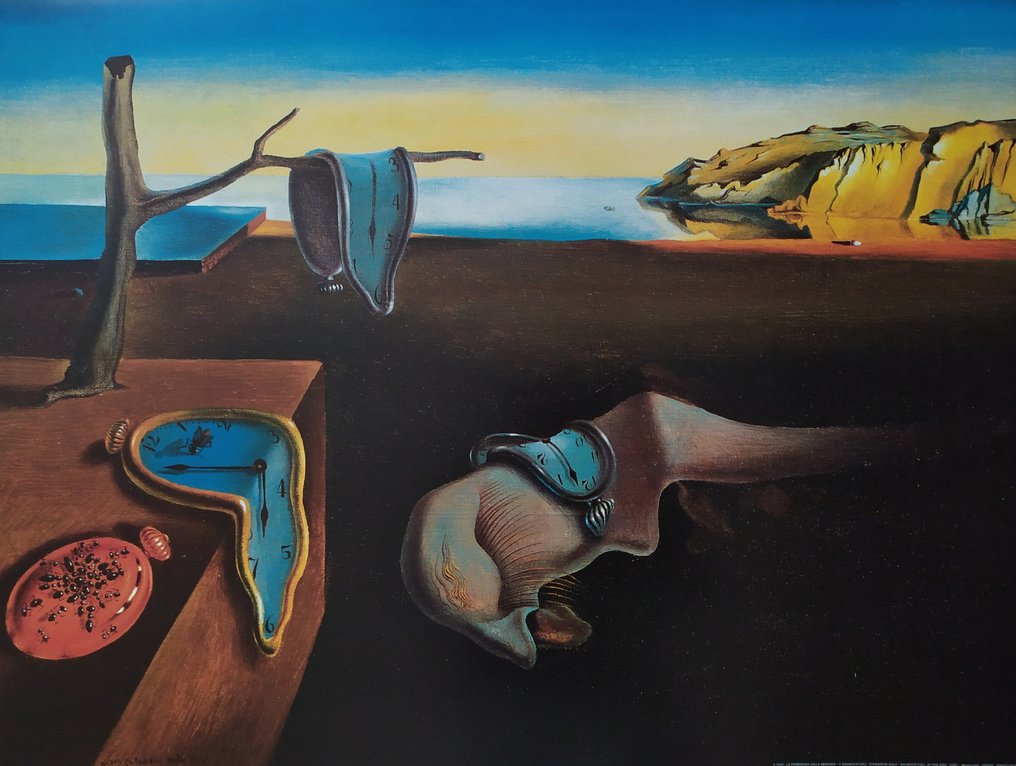
Salvador Dalí (1904-1989) (after) - "The Persistence of Memory, 1931 " - (60x80cm)


00
days
22
hours
26
minutes
22
seconds
Current bid
€ 16
No reserve price

Expert
Selected by Juan Antonio Rodríguez
Eight years experience valuing posters, previously valuer at Balclis, Barcelona.
Estimate € 150 - € 200
17 other people are watching this object
 Bidder 2144 Bidder 2144 | €16 | |
|---|---|---|
 Bidder 8760 Bidder 8760 | €10 | |
 Bidder 6503 Bidder 6503 | €1 |
Catawiki Buyer Protection
Your payment’s safe with us until you receive your object.View details
Trustpilot 4.4 | 122290 reviews
Rated Excellent on Trustpilot.
Description from the seller
- Salvador Dalí (after). Authorized offset on heavyweight smooth satin paper (300gsm approx).
Size: 60 x 80 cm.
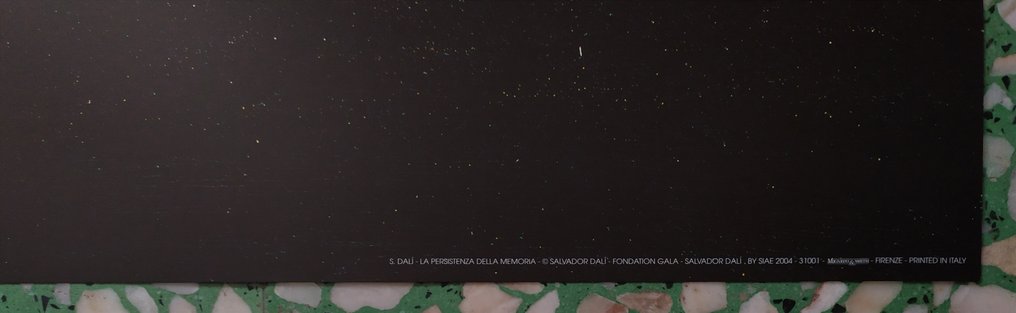
- Copyright Gala - Salvador Dalí Foundation by SIAE.
- Condition: excellent. Never framed, never exposed.
- Salvador Dalí, born on May 11, 1904, in Figueras, Spain, was a Spanish Surrealist painter and printmaker, known for his explorations of subconscious imagery. He studied art in Madrid and Barcelona, displaying unusual technical skill as a painter. His mature artistic style developed in the late 1920s after discovering Sigmund Freud’s writings on the erotic significance of subconscious imagery and affiliating with the Paris Surrealists.
Dalí’s painting style matured rapidly from 1929 to 1937, producing paintings that made him the world’s best-known Surrealist artist.
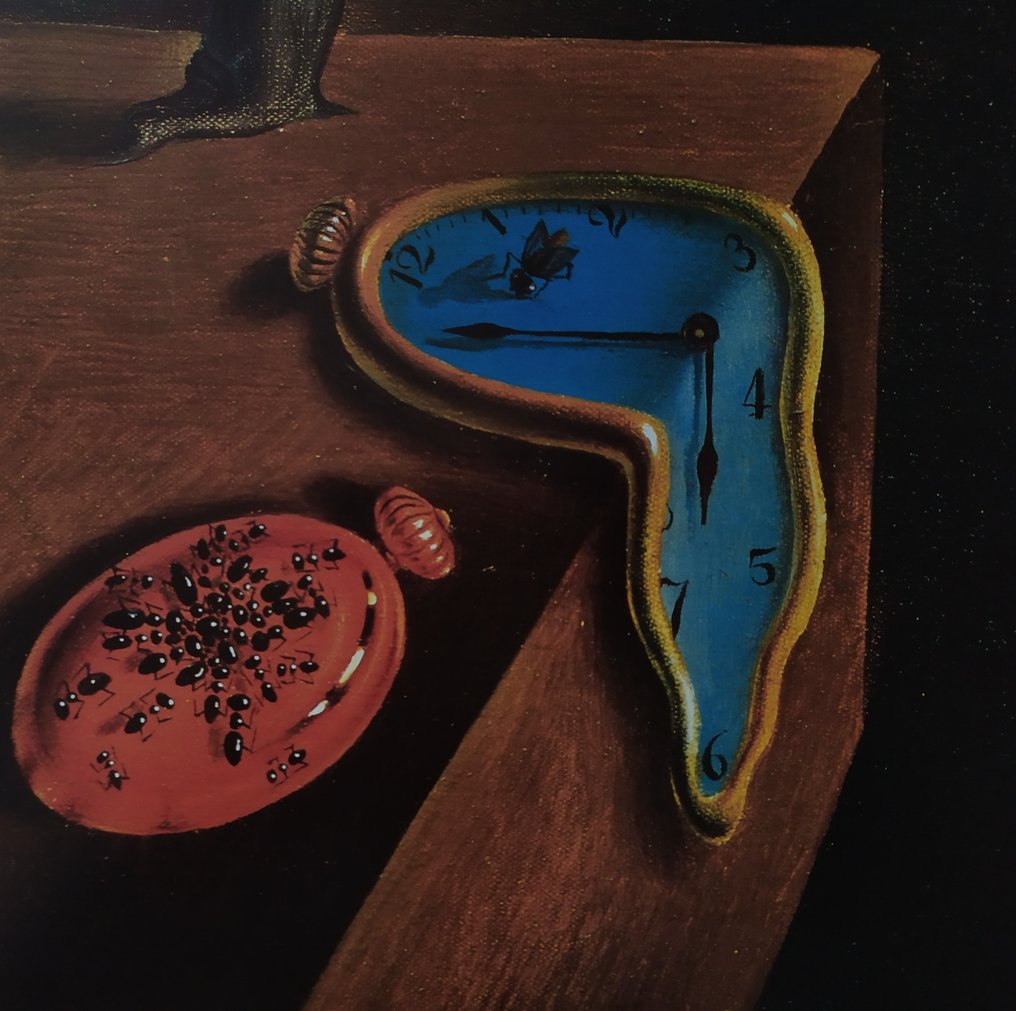
Dalí's most famous work, 'The Persistence of Memory' (1931), is one of the most recognizable works of Surrealism. This work introduced the image of the soft melting pocket watch, epitomizing Dalí's theory of 'softness' and 'hardness'. The painting depicts a dreamlike world where ordinary objects are juxtaposed, deformed, or otherwise transformed in a bizarre and irrational manner. The limp melting watches rest in an eerily calm landscape, often referred to as 'Melting Clocks', 'The Soft Watches', or 'The Melting Watches'.
The piece is a subjective vision of time and its implications, both in the artwork itself and in memories. It’s also a tribute to the inner time of the unconscious, which has its own way of telling time and escapes superficial rationality. The well-known surrealist piece is seen as an unconscious symbol of the relativity of space and time, a Surrealist meditation on the collapse of our notions of a fixed cosmic order. However, Dalí stated that the soft watches were not inspired by the theory of relativity, but by the surrealist perception of a Camembert melting in the sun.
In the middle of the composition, it’s possible to recognize a human figure, a strange “monster” that Dalí used in several contemporary pieces to represent himself. The creature seems to be based on a figure from the Paradise section of Hieronymus Bosch’s “The Garden of Earthly Delights,” which Dalí had studied. The iconography may refer to a dream that Dalí himself had experienced, and the clocks may symbolize the passing of time as one experiences it in sleep or the persistence of time in the eyes of the dreamer.
In terms of the value of his works, Dalí’s paintings continue to perform well at auction. According to Mei Moses of the famous auction house, the average compound annual return for Salvador Dalí resold at auction between 2003 and 2017 was 7.3%. A remarkable 88.2% of 153 such works increased in value.
Some artists of similar importance, Basquiat, Picasso, Hockney, Lichtenstein, Miró, Banksy, Brainwash, Delaunay, Nara, Soulages, Lagasse, Ramos, Rothko, Lautrec, Klimt, Matisse, Hirst, Chagall, Hockney, Haring, Indiana, Mondrian, Groening, Coa, Warhol, Richter, Monroe, Kusama, Murakami, Testa, Villemot, Oldenburg, Hopper, Ripollès, Wesselmann, Magritte, Jenk, Orlinski, Wille, Rizzi, among others.
Seller's Story
Seller on Catawiki for over seven years.
I invite you to visit my profile, where you'll find a complete list of the different lots currently being auctioned. Click on "Yuke."
Good luck at the auctions!
Translated by Google Translate- Salvador Dalí (after). Authorized offset on heavyweight smooth satin paper (300gsm approx).
Size: 60 x 80 cm.
- Copyright Gala - Salvador Dalí Foundation by SIAE.
- Condition: excellent. Never framed, never exposed.
- Salvador Dalí, born on May 11, 1904, in Figueras, Spain, was a Spanish Surrealist painter and printmaker, known for his explorations of subconscious imagery. He studied art in Madrid and Barcelona, displaying unusual technical skill as a painter. His mature artistic style developed in the late 1920s after discovering Sigmund Freud’s writings on the erotic significance of subconscious imagery and affiliating with the Paris Surrealists.
Dalí’s painting style matured rapidly from 1929 to 1937, producing paintings that made him the world’s best-known Surrealist artist.
Dalí's most famous work, 'The Persistence of Memory' (1931), is one of the most recognizable works of Surrealism. This work introduced the image of the soft melting pocket watch, epitomizing Dalí's theory of 'softness' and 'hardness'. The painting depicts a dreamlike world where ordinary objects are juxtaposed, deformed, or otherwise transformed in a bizarre and irrational manner. The limp melting watches rest in an eerily calm landscape, often referred to as 'Melting Clocks', 'The Soft Watches', or 'The Melting Watches'.
The piece is a subjective vision of time and its implications, both in the artwork itself and in memories. It’s also a tribute to the inner time of the unconscious, which has its own way of telling time and escapes superficial rationality. The well-known surrealist piece is seen as an unconscious symbol of the relativity of space and time, a Surrealist meditation on the collapse of our notions of a fixed cosmic order. However, Dalí stated that the soft watches were not inspired by the theory of relativity, but by the surrealist perception of a Camembert melting in the sun.
In the middle of the composition, it’s possible to recognize a human figure, a strange “monster” that Dalí used in several contemporary pieces to represent himself. The creature seems to be based on a figure from the Paradise section of Hieronymus Bosch’s “The Garden of Earthly Delights,” which Dalí had studied. The iconography may refer to a dream that Dalí himself had experienced, and the clocks may symbolize the passing of time as one experiences it in sleep or the persistence of time in the eyes of the dreamer.
In terms of the value of his works, Dalí’s paintings continue to perform well at auction. According to Mei Moses of the famous auction house, the average compound annual return for Salvador Dalí resold at auction between 2003 and 2017 was 7.3%. A remarkable 88.2% of 153 such works increased in value.
Some artists of similar importance, Basquiat, Picasso, Hockney, Lichtenstein, Miró, Banksy, Brainwash, Delaunay, Nara, Soulages, Lagasse, Ramos, Rothko, Lautrec, Klimt, Matisse, Hirst, Chagall, Hockney, Haring, Indiana, Mondrian, Groening, Coa, Warhol, Richter, Monroe, Kusama, Murakami, Testa, Villemot, Oldenburg, Hopper, Ripollès, Wesselmann, Magritte, Jenk, Orlinski, Wille, Rizzi, among others.
Seller's Story
Seller on Catawiki for over seven years.
I invite you to visit my profile, where you'll find a complete list of the different lots currently being auctioned. Click on "Yuke."
Good luck at the auctions!
Translated by Google TranslateDetails
Artist
Salvador Dalí (1904-1989) (after)
Sold by
Owner or reseller
Edition
Original
Title of artwork
"The Persistence of Memory, 1931 " - (60x80cm)
Technique
Offset print
Signature
Not signed
Country of Origin
Italy
Year
2004
Condition
Excellent condition
Height
60 cm
Width
80 cm
Style
Surrealism
Period
2000-2010
Sold with frame
No