Giannettasio - Halieutica - 1690



09
days
06
hours
44
minutes
35
seconds
Starting bid
€ 1
No reserve price

Expert
Selected by Ilaria Colombo
Specialist in old books, specialising in theological disputes since 1999.
Estimate € 400 - € 800
No bids placed
Catawiki Buyer Protection
Your payment’s safe with us until you receive your object.View details
Trustpilot 4.4 | 122473 reviews
Rated Excellent on Trustpilot.
Halieutica by Nicolò Partenio Giannettasio, an illustrated 1690 Latin edition (1st in this format) published in Naples by Ex Officina Jacobi Raillard, bound in parchment with 12 copper-engraved plates and an illustrated frontispiece, totaling 252 pages.
AI-assisted summary
Description from the seller
HALIEUTICA OR ARS PISCATORIA - The Art of the Fisherman That Becomes a Luminous Sea
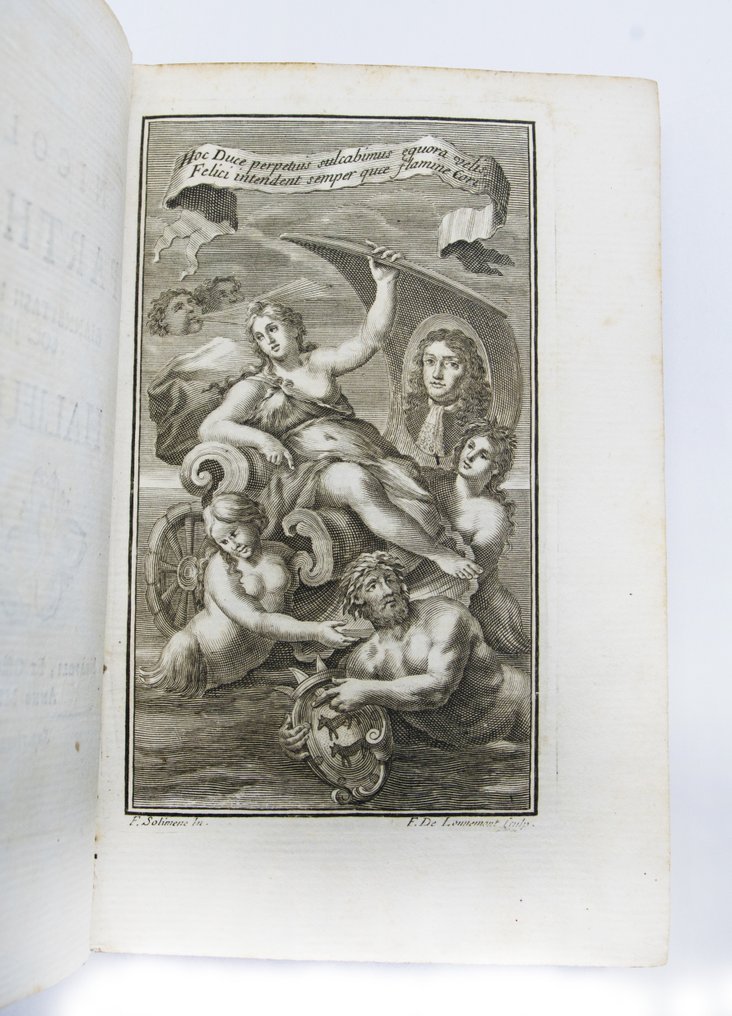
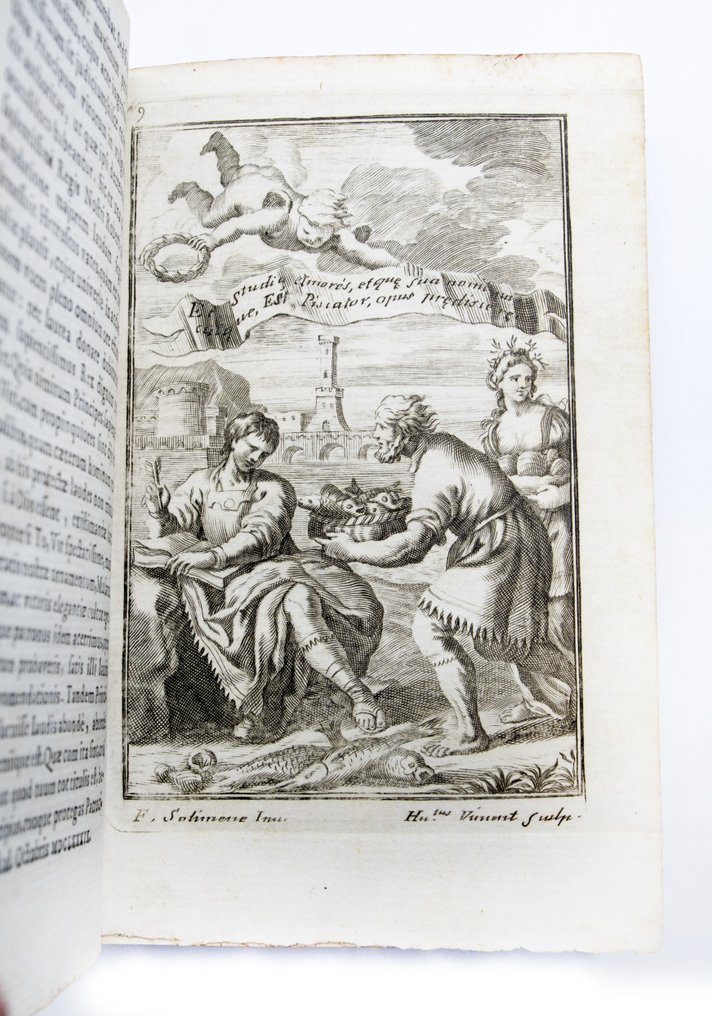
Frontispiece depicting Apollo and the Muses, another allegorical plate with a portrait of the author, 10 splendid full-page plates drawn by Francesco Solimena and engraved in copper by François de Louvemont and Uberto Vincent.
Beautiful edition and first printing of the engravings. A poem in ten cantos celebrating sea fishing with the line, the trap, the net, and other methods.
The 'Halieutica' by Nicolò Partenio Giannettasio, a Neapolitan Jesuit, is one of the most fascinating texts of Baroque scientific poetry: a poem in Latin hexameters that celebrates the marine world by intertwining science, myth, fishing, celestial astrology, and natural theology. Composed of ten books (or sections) and published by Giacomo Raillard's Neapolitan workshop, the work features a splendid allegorical frontispiece, engraved by Francesco Solimena and F. de Marimonis, accompanied by a cycle of 12 copperplate engravings that enrich and expand the meaning of the text. The front engraving visually represents the entire poetic program: Apollo as a guiding light, the arts, waters, stars, fertility, and the order of nature.
The volume is not merely a didactic poem but a baroque synthesis of science, myth, and devotion, intended for higher Jesuit education. In an esoteric sense, the maritime poem becomes an allegory of depths and ascents: water as a hidden principle, fishing as an act of knowledge, Apollo as light drawn from shadow. The described specimen, elegant and well-preserved, also bears handwritten notes, indicating active reading, and features a rear binding in half parchment with decorated paper, red splashes at the edges, and high-quality materials, giving it the additional charm of objects that are preserved and studied.
Market value
The sixteenth-century editions of Haleutica, especially those complete with the 12 copper plates and the frontispiece by Solimena, are sought after and not easy to find in good condition. Complete copies, with high-quality bindings and solid preservation, generally range from 1,600 to 2,000 euros, with peaks of 2,500 euros for particularly fresh copies or those with significant provenance. The presence of ancient handwritten notes and full iconography further increases their collectible appeal.
Physical description and condition
Half parchment binding with points, decorated paper-covered boards; smooth spine. Edges sprinkled with red. Phytomorphic engraved decoration on the frontispiece. Ornamental headbands and cartouches. Incised frontispiece and 12 copper plates, clear and well-inked. Presence of marginal handwritten notes. Some foxing. Pp. (4); 246; 2nn; (4).
Full title and author
Halieutica.
Neapoli, from the workshop of Jacobi Raillard, 1690.
Nicolai Parthenii Giannettasii.
Context and Significance
L’Haleutica belongs to the baroque tradition of scientific poetry, a genre in which Giannettasio excelled alongside his famous Astronomicon and Hydraulica. The work explores the world of fish, fishing, tides, winds, stars, and seasons, composing a poetic encyclopedia of the sea. The presence of the 12 incised tables, together with the Solimene frontispiece, gives the volume a highly prestigious iconographic character.
Solimena's engraving, a master of Neapolitan Baroque, introduces a luminous interpretation of the work: Apollo, figure of knowledge, orders the chaos of waters and illuminates the natural world. The poem thus becomes, in a symbolic-esoteric key, a journey that leads from the dark depths of the sea to the clarity of the mind: water as origin, fish as secret, fishing as revelation.
The success of the work is confirmed by subsequent reprints and its use as a reference text in the Jesuit colleges of Southern Italy.
Biography of the Author
Nicolò Partenio Giannettasio was born in Naples in 1648 and died in 1715. Jesuit, poet, mathematician, cosmographer, and Hebrew professor at the College of the Jesuits in Naples, he was one of the most authoritative voices of Latin Baroque poetry. His work combines academic rigor, naturalistic sensitivity, and narrative skill. His works, read throughout Europe, are high examples of modern didactic poetry.
Printing history and circulation
First edition of the Haleutica, printed in Naples by Giacomo Raillard between 1689 and 1690 (with various frontispieces that may have irregular dating).
Work in ten books, enriched with 12 engraved plates plus a frontispiece.
Originally circulating mainly in Jesuit colleges, high schools, among mathematicians, cosmographers, theologians, and Latin poets.
The presence of the panels by Solimena and Marimonis constitutes the main valuable iconographic element.
No significant variants of the princeps are known.
BIBLIOGRAPHY AND REFERENCES
Jesuit catalogs of the 17th century.
Repertories of Latin Baroque poetry.
Bibliography on Giannettasio.
Inventory of Neapolitan workshops of the late Seventeenth century.
Studies on Solimena and Neapolitan engraving.
WorldCat, ICCU, KVK.
Literature on baroque scientific poetry and didactic poems.
Seller's Story
Luxury Books: Your Go-To Guide for Nabbing Literary Treasures!
Embarking on the thrilling journey of collecting rare and timeless printed works? Here's your snappy rundown, "The Collector's Cheat Sheet," to ensure you're not just flipping pages but stacking up the value:
1. Edition and Rarity: Rarity is the name of the game. First editions, limited printings, and books flaunting unique features like eye-catching illustrations or mind-blowing bindings? Consider them the VIPs of the collector's world.
2. Condition & Dimension: Picture this – a book in mint condition, untouched by the woes of wear and tear. Now, flip the script: wear, foxing, discoloration – they're the villains here. And don't forget to size up the dimensions, because a book's size matters in the collector's universe.
3. Authenticity: In a world of replicas and forgeries, verifying a book's authenticity is your superhero move. Expert examination and authentication – your trusty sidekicks in this quest.
4. Provenance: Who owned it before you? If the book has hobnobbed with famous figures or danced through historical events, its value skyrockets. Every book has a story, but some have blockbuster tales.
5. Demand and Market Trends: Think of book values as the stock market of the literary world. Stay savvy on collector trends and market shifts to ride the waves of value.
6. Subject Matter: Some topics are like fine wine – they get better with time. Dive into subjects with a timeless appeal or ride the wave of emerging cultural and historical relevance.
7. Binding and Design: Beauty is more than skin deep. Intricate bindings, stunning covers, and illustrations – these are the accessories that make a book runway-ready in the collector's eyes.
8. Association Copies: Books with a personal touch – whether it's a connection to the author or a famous personality – elevate the historical vibes. A book with a backstory? Count us in.
9. Investment Potential: Passion is the engine, but some collectors eye future returns. Keep in mind, though, that the book market can be as unpredictable as a plot twist.
10. Expert Advice: New to the game? Don't play solo. Seek wisdom from the book gurus, hit up book fairs, and join collector communities. We at Luxury Books are the Yodas of the rare book galaxy, helping you build collections that scream sophistication and cultural clout.
Because collecting rare books isn't just about dollar signs – it's a journey of preserving heritage and embracing literary treasures. Happy collecting!
Translated by Google TranslateHALIEUTICA OR ARS PISCATORIA - The Art of the Fisherman That Becomes a Luminous Sea
Frontispiece depicting Apollo and the Muses, another allegorical plate with a portrait of the author, 10 splendid full-page plates drawn by Francesco Solimena and engraved in copper by François de Louvemont and Uberto Vincent.
Beautiful edition and first printing of the engravings. A poem in ten cantos celebrating sea fishing with the line, the trap, the net, and other methods.
The 'Halieutica' by Nicolò Partenio Giannettasio, a Neapolitan Jesuit, is one of the most fascinating texts of Baroque scientific poetry: a poem in Latin hexameters that celebrates the marine world by intertwining science, myth, fishing, celestial astrology, and natural theology. Composed of ten books (or sections) and published by Giacomo Raillard's Neapolitan workshop, the work features a splendid allegorical frontispiece, engraved by Francesco Solimena and F. de Marimonis, accompanied by a cycle of 12 copperplate engravings that enrich and expand the meaning of the text. The front engraving visually represents the entire poetic program: Apollo as a guiding light, the arts, waters, stars, fertility, and the order of nature.
The volume is not merely a didactic poem but a baroque synthesis of science, myth, and devotion, intended for higher Jesuit education. In an esoteric sense, the maritime poem becomes an allegory of depths and ascents: water as a hidden principle, fishing as an act of knowledge, Apollo as light drawn from shadow. The described specimen, elegant and well-preserved, also bears handwritten notes, indicating active reading, and features a rear binding in half parchment with decorated paper, red splashes at the edges, and high-quality materials, giving it the additional charm of objects that are preserved and studied.
Market value
The sixteenth-century editions of Haleutica, especially those complete with the 12 copper plates and the frontispiece by Solimena, are sought after and not easy to find in good condition. Complete copies, with high-quality bindings and solid preservation, generally range from 1,600 to 2,000 euros, with peaks of 2,500 euros for particularly fresh copies or those with significant provenance. The presence of ancient handwritten notes and full iconography further increases their collectible appeal.
Physical description and condition
Half parchment binding with points, decorated paper-covered boards; smooth spine. Edges sprinkled with red. Phytomorphic engraved decoration on the frontispiece. Ornamental headbands and cartouches. Incised frontispiece and 12 copper plates, clear and well-inked. Presence of marginal handwritten notes. Some foxing. Pp. (4); 246; 2nn; (4).
Full title and author
Halieutica.
Neapoli, from the workshop of Jacobi Raillard, 1690.
Nicolai Parthenii Giannettasii.
Context and Significance
L’Haleutica belongs to the baroque tradition of scientific poetry, a genre in which Giannettasio excelled alongside his famous Astronomicon and Hydraulica. The work explores the world of fish, fishing, tides, winds, stars, and seasons, composing a poetic encyclopedia of the sea. The presence of the 12 incised tables, together with the Solimene frontispiece, gives the volume a highly prestigious iconographic character.
Solimena's engraving, a master of Neapolitan Baroque, introduces a luminous interpretation of the work: Apollo, figure of knowledge, orders the chaos of waters and illuminates the natural world. The poem thus becomes, in a symbolic-esoteric key, a journey that leads from the dark depths of the sea to the clarity of the mind: water as origin, fish as secret, fishing as revelation.
The success of the work is confirmed by subsequent reprints and its use as a reference text in the Jesuit colleges of Southern Italy.
Biography of the Author
Nicolò Partenio Giannettasio was born in Naples in 1648 and died in 1715. Jesuit, poet, mathematician, cosmographer, and Hebrew professor at the College of the Jesuits in Naples, he was one of the most authoritative voices of Latin Baroque poetry. His work combines academic rigor, naturalistic sensitivity, and narrative skill. His works, read throughout Europe, are high examples of modern didactic poetry.
Printing history and circulation
First edition of the Haleutica, printed in Naples by Giacomo Raillard between 1689 and 1690 (with various frontispieces that may have irregular dating).
Work in ten books, enriched with 12 engraved plates plus a frontispiece.
Originally circulating mainly in Jesuit colleges, high schools, among mathematicians, cosmographers, theologians, and Latin poets.
The presence of the panels by Solimena and Marimonis constitutes the main valuable iconographic element.
No significant variants of the princeps are known.
BIBLIOGRAPHY AND REFERENCES
Jesuit catalogs of the 17th century.
Repertories of Latin Baroque poetry.
Bibliography on Giannettasio.
Inventory of Neapolitan workshops of the late Seventeenth century.
Studies on Solimena and Neapolitan engraving.
WorldCat, ICCU, KVK.
Literature on baroque scientific poetry and didactic poems.
Seller's Story
Luxury Books: Your Go-To Guide for Nabbing Literary Treasures!
Embarking on the thrilling journey of collecting rare and timeless printed works? Here's your snappy rundown, "The Collector's Cheat Sheet," to ensure you're not just flipping pages but stacking up the value:
1. Edition and Rarity: Rarity is the name of the game. First editions, limited printings, and books flaunting unique features like eye-catching illustrations or mind-blowing bindings? Consider them the VIPs of the collector's world.
2. Condition & Dimension: Picture this – a book in mint condition, untouched by the woes of wear and tear. Now, flip the script: wear, foxing, discoloration – they're the villains here. And don't forget to size up the dimensions, because a book's size matters in the collector's universe.
3. Authenticity: In a world of replicas and forgeries, verifying a book's authenticity is your superhero move. Expert examination and authentication – your trusty sidekicks in this quest.
4. Provenance: Who owned it before you? If the book has hobnobbed with famous figures or danced through historical events, its value skyrockets. Every book has a story, but some have blockbuster tales.
5. Demand and Market Trends: Think of book values as the stock market of the literary world. Stay savvy on collector trends and market shifts to ride the waves of value.
6. Subject Matter: Some topics are like fine wine – they get better with time. Dive into subjects with a timeless appeal or ride the wave of emerging cultural and historical relevance.
7. Binding and Design: Beauty is more than skin deep. Intricate bindings, stunning covers, and illustrations – these are the accessories that make a book runway-ready in the collector's eyes.
8. Association Copies: Books with a personal touch – whether it's a connection to the author or a famous personality – elevate the historical vibes. A book with a backstory? Count us in.
9. Investment Potential: Passion is the engine, but some collectors eye future returns. Keep in mind, though, that the book market can be as unpredictable as a plot twist.
10. Expert Advice: New to the game? Don't play solo. Seek wisdom from the book gurus, hit up book fairs, and join collector communities. We at Luxury Books are the Yodas of the rare book galaxy, helping you build collections that scream sophistication and cultural clout.
Because collecting rare books isn't just about dollar signs – it's a journey of preserving heritage and embracing literary treasures. Happy collecting!
Translated by Google TranslateDetails
Number of Books
1
Subject
Esotericism
Book Title
Halieutica
Author/ Illustrator
Giannettasio
Condition
Good
Publication year oldest item
1690
Height
156 mm
Edition
1st Edition Thus, Illustrated Edition
Width
13 mm
Language
Latin
Original language
Yes
Publisher
Neapoli, Ex Officina Jacobi Raillard, 1690
Binding/ Material
Vellum
Extras
Tipped in plates
Number of pages
252
Sold by
