Manuscript Of Magic, Witchcraft And Palmistry - 1600



00
days
15
hours
47
minutes
15
seconds
Current bid
€ 430
No reserve price

Expert
Selected by Volker Riepenhausen
Specialist in travel literature and pre-1600 rare prints with 28 years experience.
Estimate € 3,000 - € 5,000
91 other people are watching this object
 Bidder 5232 Bidder 5232 | €430 | |
|---|---|---|
 Bidder 2516 Bidder 2516 | €410 | |
| Bidder 5232 | €390 | |
Catawiki Buyer Protection
Your payment’s safe with us until you receive your object.View details
Trustpilot 4.4 | 121798 reviews
Rated Excellent on Trustpilot.
A seventeenth century illustrated manuscript on magic and palmistry bound in parchment, Italian with Latin sections, offering a historical window into chiromancy in Manuscript Of Magic, Witchcraft And Palmistry.
AI-assisted summary
Description from the seller
Elegitur presents worldwide exclusively: 17th-century illustrated manuscript of magic and chiromancy.
A 17th-century manuscript in-8°, 192x134 mm, bound in full soft parchment, pages (1), 36, (1 b.). Handwritten 19th-century Italian inscription on the eyelet: 'It is a physiological treatise of the hand and magic... The script is from the 17th century. In that century, various small works of this physiological genre were published. It is paginated up to 36.' The text then begins with a three-page explanation in Italian of techniques related to chiromancy. Following this, there is Latin text starting from page 3 and ending on page 36, with the verso bearing the inscription: 'Carmina diaboli. Signa ti signa temere me tangis, et angus roma tibi subito motibus ibit amor' (Songs of the devil. You touch me at random with your signs, and love will go to Rome with sudden movements for you).
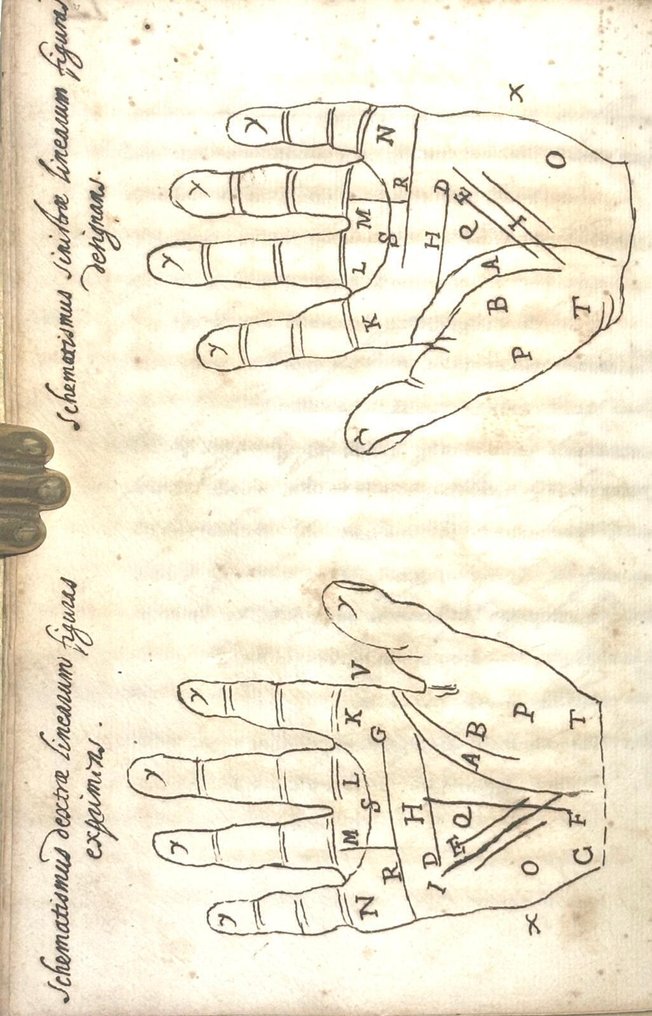
The text begins with the title 'F.F.G.V. Chyroscopia' and, in paragraphs, provides explanations on what chiromancy is and how it developed throughout history. Pages 9, 10, and 11 contain diagrams of the hand, with lines and their respective names, and in particular, on the back of card 10, there is a hand diagram of an adulterer, dated March 1592. The most interesting part starts on the back of card 13, with two diagrams of the right and left hand of a noble, dated May 11, 1603. Following this, as can be read at the beginning of card 14, the author of the text reports the study of the two hands of a German nobleman (Arnold Jost of Bentheim-Bentheim), to understand his character and life expectations in anticipation of his marriage to a Countess, commissioned by his father, Wolfgang Ernst I, Count of Isenburg-Büdingen (1560-1633), a German count of Isenburg-Birstein from 1596 to 1633; he married four times and had several children, including Countess Anna Amalie of Isenburg-Büdingen-Birstein (1591-1667), who married Arnold Jost of Bentheim-Bentheim (1580-1643) in 1608, son of Arnold III, Count of Bentheim-Steinfurt-Limburg.
So the text continues with a detailed examination of the various lines, each divided into multiple paragraphs; in particular, the text reports: De linea vitalis, De media, nali et capitis, De minsali, seu linea chori, De linea epatica, De rascetta seu restricta, De Saturnina seu prosperitatis linea, De triangulo et quadrangulo, De monte manus, seu loco lunae, De monte pollicis, De monte medy, De monte anulari, De monte auriculari, some notable appendices on the vital line, De accurata linea vitalis committens, Schema [ortinden] vitalis comminsurationim (followed by a schematic drawing of the right hand), with some XVIII additions (finally followed by two plates on page 35 and its verso, depicting the face with the related lines). A decidedly interesting text, to study. Condition: Very slight traces of use on the binding, fairly clean cut edges with some foxing and small ink spots. Overall in excellent condition.
Shipping Terms and Conditions
Insured express shipping will allow you to receive the book within 24 working hours in EU countries; for non-EU countries, it will take only 72 working hours. Please note that any customs duties and taxes will be borne by the buyer.
Elegitur presents worldwide exclusively: 17th-century illustrated manuscript of magic and chiromancy.
A 17th-century manuscript in-8°, 192x134 mm, bound in full soft parchment, pages (1), 36, (1 b.). Handwritten 19th-century Italian inscription on the eyelet: 'It is a physiological treatise of the hand and magic... The script is from the 17th century. In that century, various small works of this physiological genre were published. It is paginated up to 36.' The text then begins with a three-page explanation in Italian of techniques related to chiromancy. Following this, there is Latin text starting from page 3 and ending on page 36, with the verso bearing the inscription: 'Carmina diaboli. Signa ti signa temere me tangis, et angus roma tibi subito motibus ibit amor' (Songs of the devil. You touch me at random with your signs, and love will go to Rome with sudden movements for you).
The text begins with the title 'F.F.G.V. Chyroscopia' and, in paragraphs, provides explanations on what chiromancy is and how it developed throughout history. Pages 9, 10, and 11 contain diagrams of the hand, with lines and their respective names, and in particular, on the back of card 10, there is a hand diagram of an adulterer, dated March 1592. The most interesting part starts on the back of card 13, with two diagrams of the right and left hand of a noble, dated May 11, 1603. Following this, as can be read at the beginning of card 14, the author of the text reports the study of the two hands of a German nobleman (Arnold Jost of Bentheim-Bentheim), to understand his character and life expectations in anticipation of his marriage to a Countess, commissioned by his father, Wolfgang Ernst I, Count of Isenburg-Büdingen (1560-1633), a German count of Isenburg-Birstein from 1596 to 1633; he married four times and had several children, including Countess Anna Amalie of Isenburg-Büdingen-Birstein (1591-1667), who married Arnold Jost of Bentheim-Bentheim (1580-1643) in 1608, son of Arnold III, Count of Bentheim-Steinfurt-Limburg.
So the text continues with a detailed examination of the various lines, each divided into multiple paragraphs; in particular, the text reports: De linea vitalis, De media, nali et capitis, De minsali, seu linea chori, De linea epatica, De rascetta seu restricta, De Saturnina seu prosperitatis linea, De triangulo et quadrangulo, De monte manus, seu loco lunae, De monte pollicis, De monte medy, De monte anulari, De monte auriculari, some notable appendices on the vital line, De accurata linea vitalis committens, Schema [ortinden] vitalis comminsurationim (followed by a schematic drawing of the right hand), with some XVIII additions (finally followed by two plates on page 35 and its verso, depicting the face with the related lines). A decidedly interesting text, to study. Condition: Very slight traces of use on the binding, fairly clean cut edges with some foxing and small ink spots. Overall in excellent condition.
Shipping Terms and Conditions
Insured express shipping will allow you to receive the book within 24 working hours in EU countries; for non-EU countries, it will take only 72 working hours. Please note that any customs duties and taxes will be borne by the buyer.
Details
Number of Books
1
Subject
Esotericism, Illustrated, Incunabula & early printing
Book Title
Manuscript Of Magic, Witchcraft And Palmistry
Condition
Fine
Publication year oldest item
1600
Edition
1st Edition, Illustrated Edition, Limited edition, Special edition, Special printing
Language
Italian, Latin
Original language
Yes
Binding/ Material
Vellum
Number of pages
36
