various witches - (DEMONS AND WITCHCRAFT) Magical Manuscript for the Evocation of Demons and Spirits - 1699


00
days
14
hours
31
minutes
13
seconds
Current bid
€ 260
No reserve price

Expert
Selected by Volker Riepenhausen
Specialist in travel literature and pre-1600 rare prints with 28 years experience.
Estimate € 800 - € 1,000
88 other people are watching this object
 Bidder 8034 Bidder 8034 | €260 | |
|---|---|---|
 Bidder 3427 Bidder 3427 | €240 | |
| Bidder 8034 | €220 | |
Catawiki Buyer Protection
Your payment’s safe with us until you receive your object.View details
Trustpilot 4.4 | 121798 reviews
Rated Excellent on Trustpilot.
Author/Illustrator: various witches; Book title: "(DEMONS AND WITCHCRAFT) Magical Manuscript for the Evocation of Demons and Spirits" in Birmano/Pali, 72 pages, parchment binding, oldest item from 1699.
AI-assisted summary
Description from the seller
Elegitur presents exclusively: Manuscript of Magic and Witchcraft for the evocation of Demons and Spirits
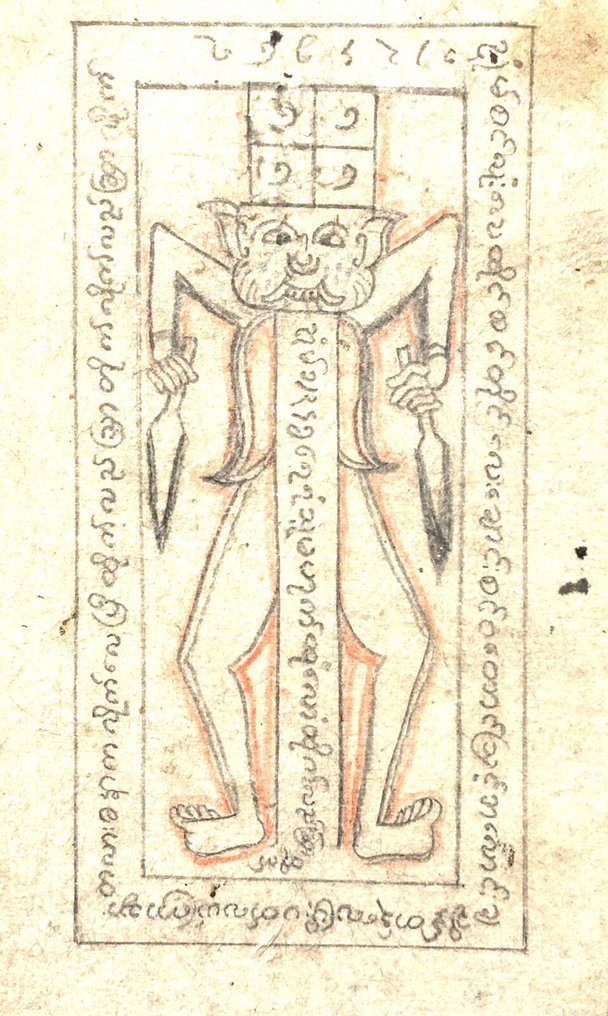
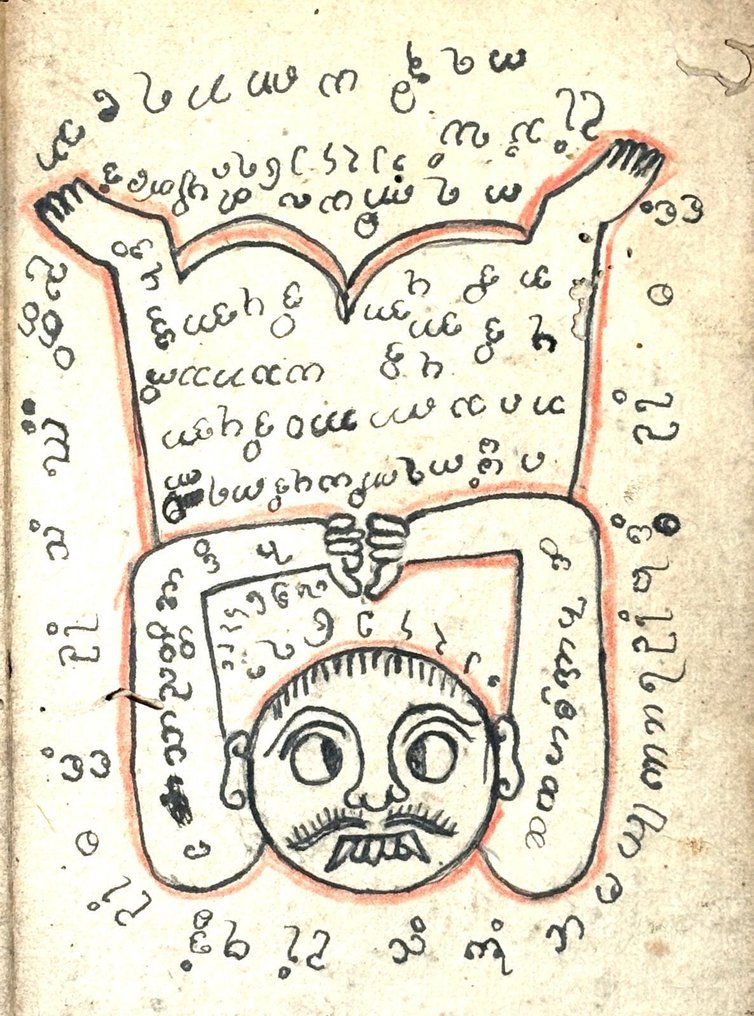
This is a rare manuscript made on mulberry paper in an accordion format (parabaik), typical of the Burmese-monastic tradition. The accordion paper support allows a sequence of illustrated panels and sacred texts, alternated according to a visual and ritual arrangement. The text is written in Burmese characters (Mon-Burmese script) and accompanies rich iconography: astrological diagrams, yantra or protective squares, magical symbols, anthropomorphic figures, animals (including elephants), and supernatural beings, often labeled with syllables and numbers that serve talismanic or divinatory functions.
The manuscript is illustrated and decorated with natural pigments and ink, a testament to refined craftsmanship and a specialized ritual function. The figures and diagrams not only illustrate the text but also 'embody' it, making the object not just a written document but also an esoteric, operational artifact.
Cultural context and ritual function
Known examples of Burmese parabaik ('folding book manuscripts') show how this format was used not only for chronicles but also for cosmologies, astrological treatises, and rituals. According to the catalog of the U Pho Thi Library, which collects parabaik and palm leaf manuscripts, the Burmese-monastic tradition also includes specialized texts on divination and protection.
In this case, the combination of elements—text in Burmese, astrological and protective diagrams, illustrations with animals and magical beings—suggests that the object was intended for use by monks, astrologers, or ritual specialists in Myanmar. The use of figures and elephants, along with numerical and syllabic diagrams, refers to a tradition—still known today in the Burmese regions—of ritual protection, astrological calculation, and 'protective' magic.
In particular, the accordion format allowed for ritual consultation: opening the manuscript reveals illustrated panels that visually 'open' the ritual pathway, alternating with the text that comments on or guides it. This makes the object not only a document but also an operational tool.
Elegitur presents exclusively: Manuscript of Magic and Witchcraft for the evocation of Demons and Spirits
This is a rare manuscript made on mulberry paper in an accordion format (parabaik), typical of the Burmese-monastic tradition. The accordion paper support allows a sequence of illustrated panels and sacred texts, alternated according to a visual and ritual arrangement. The text is written in Burmese characters (Mon-Burmese script) and accompanies rich iconography: astrological diagrams, yantra or protective squares, magical symbols, anthropomorphic figures, animals (including elephants), and supernatural beings, often labeled with syllables and numbers that serve talismanic or divinatory functions.
The manuscript is illustrated and decorated with natural pigments and ink, a testament to refined craftsmanship and a specialized ritual function. The figures and diagrams not only illustrate the text but also 'embody' it, making the object not just a written document but also an esoteric, operational artifact.
Cultural context and ritual function
Known examples of Burmese parabaik ('folding book manuscripts') show how this format was used not only for chronicles but also for cosmologies, astrological treatises, and rituals. According to the catalog of the U Pho Thi Library, which collects parabaik and palm leaf manuscripts, the Burmese-monastic tradition also includes specialized texts on divination and protection.
In this case, the combination of elements—text in Burmese, astrological and protective diagrams, illustrations with animals and magical beings—suggests that the object was intended for use by monks, astrologers, or ritual specialists in Myanmar. The use of figures and elephants, along with numerical and syllabic diagrams, refers to a tradition—still known today in the Burmese regions—of ritual protection, astrological calculation, and 'protective' magic.
In particular, the accordion format allowed for ritual consultation: opening the manuscript reveals illustrated panels that visually 'open' the ritual pathway, alternating with the text that comments on or guides it. This makes the object not only a document but also an operational tool.
Details
Number of Books
1
Subject
Esotericism, Illustrated, Incunabula & early printing
Book Title
(DEMONS AND WITCHCRAFT) Magical Manuscript for the Evocation of Demons and Spirits
Author/ Illustrator
various witches
Condition
Fair
Publication year oldest item
1699
Edition
Illustrated Edition, Special printing
Language
Burmese/Pali
Original language
Yes
Binding/ Material
Vellum
Number of pages
72
