A. Bozza - (MANUSCRIPT OF ASTRONOMY AND MAGIC) De Coelo et Mundo - 1681



00
days
15
hours
47
minutes
43
seconds
Current bid
€ 306
No reserve price

Expert
Selected by Volker Riepenhausen
Specialist in travel literature and pre-1600 rare prints with 28 years experience.
Estimate € 1,200 - € 2,000
96 other people are watching this object
 Bidder 8138 Bidder 8138 | €306 | |
|---|---|---|
 Bidder 8747 Bidder 8747 | €286 | |
 Bidder 1494 Bidder 1494 | €266 | |
Catawiki Buyer Protection
Your payment’s safe with us until you receive your object.View details
Trustpilot 4.4 | 121798 reviews
Rated Excellent on Trustpilot.
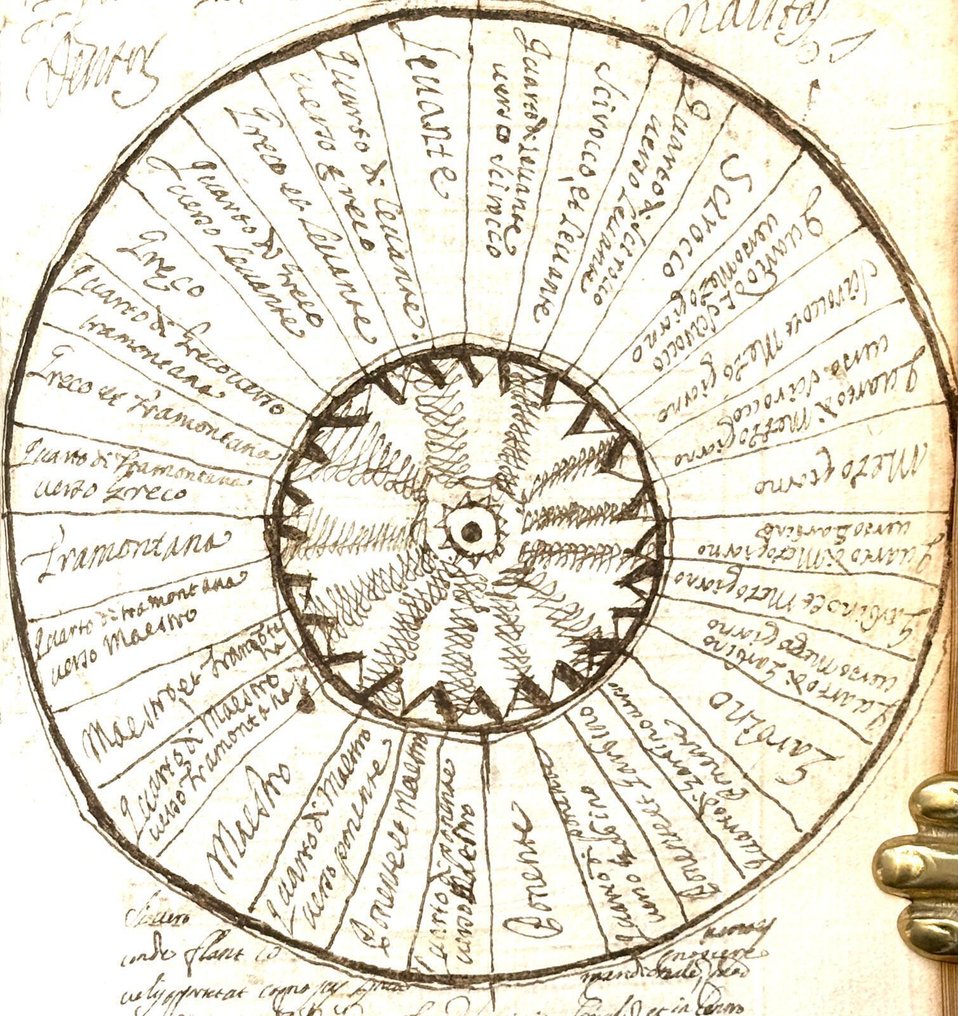
A. Bozza—author/illustrator of the manuscript titled De Coelo et Mundo, a two-volume 1681 Latin parchment-bound work on Astronomy and Magic with 206 pages and an illustrated edition.
AI-assisted summary
Description from the seller
Elegitur presents an exclusive worldwide debut of a sixteenth-century manuscript on Astrology and Magic by Brother A. Bozza, featuring drawings and illustrations, with two angels in the frontispieces to protect the knowledge contained in the work from the hands of the evil one.
Bozza Alessandro
De Generatione – De Coelo et Mundo – De Physico
Manuscript, Southern Italy, circa 1681
Two volumes, octavo, with two engraved frontispieces.
The input is a dash character, which does not require translation.
General introduction
The work presented here is a rare and valuable late 17th-century philosophical manuscript, composed of two volumes and written in 1681, during a time of profound transformation in European scientific culture. It consists of a collection of Aristotelian Quaestiones, diligently transcribed with youthful care by the Capuchin friar Alessandro Bozza di Santomenna, who was then just seventeen years old.
These volumes, originally created as study tools, now hold a top documentary value: they allow us to closely observe how Aristotelian natural philosophy, at the heart of religious education, was taught, interpreted, and internalized in a small convent in southern Italy during the second half of the seventeenth century.
The input is a dash character, which does not require translation.
Material and bibliophilic description
The two volumes, in an elegant in-8° format (approximately 18 cm), are bound in full contemporary parchment, with manuscript titles on the spines according to the austere style of monastic environments. The physical unity is compact and harmonious, demonstrating careful attention to the internal preservation of the course materials.
The cards are entirely handwritten and feature numbering in pen, sometimes irregular (a characteristic of notebooks assembled progressively and then bound), but always legible and consistent in handwriting.
A highly valuable bibliophile element are the two copper-engraved frontispieces, placed to introduce each volume.
The first with a maritime view.
The second with a hilly landscape.
These images, with their clear lines and airy composition, almost certainly originate from reused sections, appropriately inserted during binding. The choice is not accidental: the two landscapes symbolically allude to the dual dimension of the Aristotelian cosmos, the sublunary world of earthly changes and the celestial expanse home to perfect motions.
The input is a dash character, which does not require translation.
III. The author: the young Cappuccino Alessandro Bozza
Alessandro Bozza is not a figure known in the history of philosophy, and he probably published nothing during his lifetime. But precisely because of this, his manuscript is valuable: it opens a window into ordinary intellectual formation, far from the great names and close to the rhythms of monastic life.
In 1681, at the age of seventeen, Bozza followed the typical curriculum imposed by the Capuchins, in which the study of Aristotelian-scholastic natural philosophy formed the backbone of preparation for preaching and theology. His Quaestiones demonstrate a surprising level of rigor, indicative of a well-organized internal school and a competent masterful guidance.
His notes, although not intended for publication, possess an expository regularity and a formal care that reveal the pride of a young scholar immersed in the great tradition of Peripatetic thought.
The input is a dash character, which does not require translation.
IV. Content of the work
The two volumes collect notes on three major Aristotelian treatises.
On Generation and Corruption
Analysis of the fundamental processes of nature: generation, corruption, alteration, mixing of elements, theory of matter and form. The draft faithfully follows the scholastic structure of the quaestio, with arguments for and against, subtle distinctions, and orderly conclusions, according to Thomist methodology.
On the Heavens and the World with Meteorological Sections
Exposition of the Aristotelian universe: the structure of the celestial spheres, the incorruptibility of celestial bodies, circular motion, and the relationships between the sublunary and superlunary worlds. The Meteorologica provide the interpretive framework for phenomena such as vapors, winds, rains, and especially comets, which are considered products of terrestrial exhalation.
On the Physicist (Physics)
The quintessential physical treatise: nature, causes, motion, time, place, the status of infinity, the possibility of the void. Here, Bozza engages with the conceptual foundations of natural philosophy: those who study these pages literally see a philosopher 'forming' according to the canonical tradition of the ecclesiastical Studium.
The input is a dash character, which does not require translation.
V. Historical and cultural significance.
The work arises at a crucial moment: the years around 1680 are characterized by a dramatic tension between the old and the new in European science.
The Aristotelian tradition still dominates in religious orders, seminaries, and Catholic university colleges.
At the same time, the skies observed by Newton, Flamsteed, Kirch, and other astronomers are revealing a universe that refutes many Aristotelian theses, especially after the spectacular appearance of the great comet of 1680.
Cartesian mechanism and English experimentalism are opening new paths; but in religious schools, the Aristotelian-Thomist doctrine remains normative, out of fidelity to tradition and doctrinal caution.
The Bozza manuscript thus represents a perfect document for understanding how the peripheral Seicento received (or deliberately ignored) the ongoing scientific revolution. It is the voice of a culture that resists, not out of stubbornness, but out of fidelity to a millennial educational system, which remained fully functional within its scope.
The input is a dash character, which does not require translation.
VI. The incised antiportes: attribution and symbolism
The two bronze doors, certainly older or contemporary to the manuscript but not produced specifically for it, depict vast and serene landscapes. The maritime view evokes the fluid and unstable element, the dynamism of generation and corruption; the hilly scene refers to the stability of the earthly world, to the domain of sensory experience.
The style, characterized by a bright line and an airy perspective, shows affinities with Italian Baroque calcography, probably from a Venetian or Neapolitan environment, although the author remains anonymous. The inclusion of such images in a handwritten work indicates a desire to confer upon them a bookish dignity almost typographic, which is rare in study manuscripts.
The input is a dash character, which does not require translation.
VII. Impact and Role in Society of the Era
Although this manuscript was not intended for publication, its cultural impact was nonetheless tangible.
Served as an educational instrument for a young person destined for preaching and theological study.
It represents the actual level of philosophy taught in Capuchin convents, which is often more conservative than urban academies.
testimonies that the scholastic methodology (quaestiones, theses, articles, disputations) was still very much alive and functional in teaching;
It constitutes a fragment of the 'middle culture' of the late 17th century, the connective tissue that ensured the intellectual continuity between the Middle Ages and the Enlightenment.
Today, in a landscape dominated by the press, a manuscript like this has a special charm: it is unique, non-replicable, carrying the direct voice of a student, with their hesitations, their enthusiasm, their handwriting, and their world.
The input is a dash character, which does not require translation.
VIII. Conclusion
Alessandro Bozza's manuscript is not just a study notebook: it is a living testimony of how Aristotelian culture shaped generations of religious figures, precisely at the moment when modern science was imposing new visions of the cosmos.
The sum of:
school rigor
material elegance
Precious engraved ports
Vibrant historical context
manuscript authenticity
It makes it an extremely interesting specimen for the bibliophile, the historian of philosophy, the paleographer, and anyone wishing to understand how knowledge was transmitted before the definitive emergence of modern science.
A small book, then, but capable of telling an entire world: that of a young southern friar who, in 1681, studies Aristotle while, far from him, Europe discovers a new sky.
The input is a dash character, which does not require translation.
Collation and state of preservation
Two volumes in-8° (cm. 18), contemporaneous full parchment binding with handwritten titles on the spines; pages 48 [66] 43-77, [4] 169 [i.e., 170] 174-206 [2b], numbered by hand in excellent condition; with 2 beautiful copper-engraved plates at the frontispieces.
Shipping Terms and Conditions
The item will be shipped in a safe and secure packaging, with fast and insured shipping that will allow you to receive the book within just 24 working hours in EU countries, while for non-EU countries, only 72 working hours will be needed. Please note that any customs duties for non-EU countries will be borne by the buyer.
Elegitur presents an exclusive worldwide debut of a sixteenth-century manuscript on Astrology and Magic by Brother A. Bozza, featuring drawings and illustrations, with two angels in the frontispieces to protect the knowledge contained in the work from the hands of the evil one.
Bozza Alessandro
De Generatione – De Coelo et Mundo – De Physico
Manuscript, Southern Italy, circa 1681
Two volumes, octavo, with two engraved frontispieces.
The input is a dash character, which does not require translation.
General introduction
The work presented here is a rare and valuable late 17th-century philosophical manuscript, composed of two volumes and written in 1681, during a time of profound transformation in European scientific culture. It consists of a collection of Aristotelian Quaestiones, diligently transcribed with youthful care by the Capuchin friar Alessandro Bozza di Santomenna, who was then just seventeen years old.
These volumes, originally created as study tools, now hold a top documentary value: they allow us to closely observe how Aristotelian natural philosophy, at the heart of religious education, was taught, interpreted, and internalized in a small convent in southern Italy during the second half of the seventeenth century.
The input is a dash character, which does not require translation.
Material and bibliophilic description
The two volumes, in an elegant in-8° format (approximately 18 cm), are bound in full contemporary parchment, with manuscript titles on the spines according to the austere style of monastic environments. The physical unity is compact and harmonious, demonstrating careful attention to the internal preservation of the course materials.
The cards are entirely handwritten and feature numbering in pen, sometimes irregular (a characteristic of notebooks assembled progressively and then bound), but always legible and consistent in handwriting.
A highly valuable bibliophile element are the two copper-engraved frontispieces, placed to introduce each volume.
The first with a maritime view.
The second with a hilly landscape.
These images, with their clear lines and airy composition, almost certainly originate from reused sections, appropriately inserted during binding. The choice is not accidental: the two landscapes symbolically allude to the dual dimension of the Aristotelian cosmos, the sublunary world of earthly changes and the celestial expanse home to perfect motions.
The input is a dash character, which does not require translation.
III. The author: the young Cappuccino Alessandro Bozza
Alessandro Bozza is not a figure known in the history of philosophy, and he probably published nothing during his lifetime. But precisely because of this, his manuscript is valuable: it opens a window into ordinary intellectual formation, far from the great names and close to the rhythms of monastic life.
In 1681, at the age of seventeen, Bozza followed the typical curriculum imposed by the Capuchins, in which the study of Aristotelian-scholastic natural philosophy formed the backbone of preparation for preaching and theology. His Quaestiones demonstrate a surprising level of rigor, indicative of a well-organized internal school and a competent masterful guidance.
His notes, although not intended for publication, possess an expository regularity and a formal care that reveal the pride of a young scholar immersed in the great tradition of Peripatetic thought.
The input is a dash character, which does not require translation.
IV. Content of the work
The two volumes collect notes on three major Aristotelian treatises.
On Generation and Corruption
Analysis of the fundamental processes of nature: generation, corruption, alteration, mixing of elements, theory of matter and form. The draft faithfully follows the scholastic structure of the quaestio, with arguments for and against, subtle distinctions, and orderly conclusions, according to Thomist methodology.
On the Heavens and the World with Meteorological Sections
Exposition of the Aristotelian universe: the structure of the celestial spheres, the incorruptibility of celestial bodies, circular motion, and the relationships between the sublunary and superlunary worlds. The Meteorologica provide the interpretive framework for phenomena such as vapors, winds, rains, and especially comets, which are considered products of terrestrial exhalation.
On the Physicist (Physics)
The quintessential physical treatise: nature, causes, motion, time, place, the status of infinity, the possibility of the void. Here, Bozza engages with the conceptual foundations of natural philosophy: those who study these pages literally see a philosopher 'forming' according to the canonical tradition of the ecclesiastical Studium.
The input is a dash character, which does not require translation.
V. Historical and cultural significance.
The work arises at a crucial moment: the years around 1680 are characterized by a dramatic tension between the old and the new in European science.
The Aristotelian tradition still dominates in religious orders, seminaries, and Catholic university colleges.
At the same time, the skies observed by Newton, Flamsteed, Kirch, and other astronomers are revealing a universe that refutes many Aristotelian theses, especially after the spectacular appearance of the great comet of 1680.
Cartesian mechanism and English experimentalism are opening new paths; but in religious schools, the Aristotelian-Thomist doctrine remains normative, out of fidelity to tradition and doctrinal caution.
The Bozza manuscript thus represents a perfect document for understanding how the peripheral Seicento received (or deliberately ignored) the ongoing scientific revolution. It is the voice of a culture that resists, not out of stubbornness, but out of fidelity to a millennial educational system, which remained fully functional within its scope.
The input is a dash character, which does not require translation.
VI. The incised antiportes: attribution and symbolism
The two bronze doors, certainly older or contemporary to the manuscript but not produced specifically for it, depict vast and serene landscapes. The maritime view evokes the fluid and unstable element, the dynamism of generation and corruption; the hilly scene refers to the stability of the earthly world, to the domain of sensory experience.
The style, characterized by a bright line and an airy perspective, shows affinities with Italian Baroque calcography, probably from a Venetian or Neapolitan environment, although the author remains anonymous. The inclusion of such images in a handwritten work indicates a desire to confer upon them a bookish dignity almost typographic, which is rare in study manuscripts.
The input is a dash character, which does not require translation.
VII. Impact and Role in Society of the Era
Although this manuscript was not intended for publication, its cultural impact was nonetheless tangible.
Served as an educational instrument for a young person destined for preaching and theological study.
It represents the actual level of philosophy taught in Capuchin convents, which is often more conservative than urban academies.
testimonies that the scholastic methodology (quaestiones, theses, articles, disputations) was still very much alive and functional in teaching;
It constitutes a fragment of the 'middle culture' of the late 17th century, the connective tissue that ensured the intellectual continuity between the Middle Ages and the Enlightenment.
Today, in a landscape dominated by the press, a manuscript like this has a special charm: it is unique, non-replicable, carrying the direct voice of a student, with their hesitations, their enthusiasm, their handwriting, and their world.
The input is a dash character, which does not require translation.
VIII. Conclusion
Alessandro Bozza's manuscript is not just a study notebook: it is a living testimony of how Aristotelian culture shaped generations of religious figures, precisely at the moment when modern science was imposing new visions of the cosmos.
The sum of:
school rigor
material elegance
Precious engraved ports
Vibrant historical context
manuscript authenticity
It makes it an extremely interesting specimen for the bibliophile, the historian of philosophy, the paleographer, and anyone wishing to understand how knowledge was transmitted before the definitive emergence of modern science.
A small book, then, but capable of telling an entire world: that of a young southern friar who, in 1681, studies Aristotle while, far from him, Europe discovers a new sky.
The input is a dash character, which does not require translation.
Collation and state of preservation
Two volumes in-8° (cm. 18), contemporaneous full parchment binding with handwritten titles on the spines; pages 48 [66] 43-77, [4] 169 [i.e., 170] 174-206 [2b], numbered by hand in excellent condition; with 2 beautiful copper-engraved plates at the frontispieces.
Shipping Terms and Conditions
The item will be shipped in a safe and secure packaging, with fast and insured shipping that will allow you to receive the book within just 24 working hours in EU countries, while for non-EU countries, only 72 working hours will be needed. Please note that any customs duties for non-EU countries will be borne by the buyer.
Details
Number of Books
1
Subject
Astronomy, Esotericism, Illustrated, Incunabula & early printing
Book Title
(MANUSCRIPT OF ASTRONOMY AND MAGIC) De Coelo et Mundo
Author/ Illustrator
A. Bozza
Condition
Fine
Publication year oldest item
1681
Edition
Illustrated Edition, Special printing
Language
Italian, Latin
Original language
Yes
Binding/ Material
Vellum
Number of pages
206
