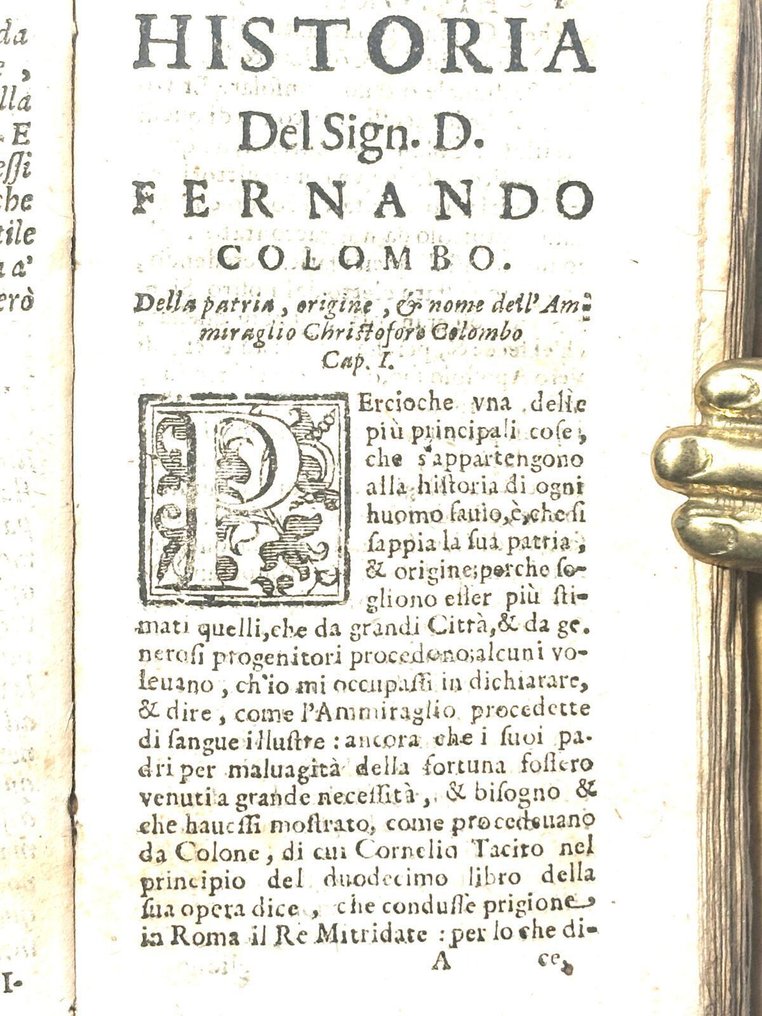
Fernando Colombo; tradotto da Alfonso Vlloa - (EXPLORATIONS and TRAVELS IN THE NEW WORLD) Historia del Sign. D. Fernando Colombo - 1685


00
days
11
hours
53
minutes
16
seconds
Current bid
€ 225
No reserve price

Expert
Selected by Volker Riepenhausen
Specialist in travel literature and pre-1600 rare prints with 28 years experience.
Estimate € 200 - € 300
18 other people are watching this object
 Bidder 4213 Bidder 4213 | €225 | |
|---|---|---|
 Bidder 9336 Bidder 9336 | €90 | |
| Bidder 4213 | €85 | |
Catawiki Buyer Protection
Your payment’s safe with us until you receive your object.View details
Trustpilot 4.4 | 121798 reviews
Rated Excellent on Trustpilot.
Author/Illustrator: Fernando Colombo; translated by Alfonso Ulloa. Book title: (EXPLORATIONS and TRAVELS IN THE NEW WORLD) Historia del Sign. D. Fernando Colombo.
AI-assisted summary
Description from the seller
Elegitur presents
History of Mr. D. Fernando Colombo
In Venetia, after Giuseppe Tramontin, 1685
Translated from Spanish to Italian by Alfonso Ulloa.
The input is a dash character, which does not require translation.
I. The work and its nature.
The volume presented here is one of the most fascinating testimonies of the early historiography of the New World, particularly of the figure of Christopher Columbus, narrated by his son Fernando (or Hernando) Columbus, who developed a biography and a collection of memories that constitute one of the most valuable primary sources on Columbus's enterprise.
The histories of Fernando Colombo are a fundamental piece in building the myth of the Admiral and in understanding the culture of discoveries between the 16th and 17th centuries. This Venetian edition from 1685, in a compact format and aimed at an educated audience, offers an updated Italian version of the Spanish text, translated by the refined cultural intermediary Alfonso Ulloa.
The input is a dash character, which does not require translation.
II. The author: Fernando (Hernando) Colombo
Fernando Colombo (1488–1539), the illegitimate son of the Admiral, was a highly refined humanist, cosmographer, bibliophile, and intellectual with Iberian-Italian training. His 'Vita dell’Ammiraglio' (published posthumously) combines:
family documentation
Personal observations.
Memories of conversations with the father.
nautical charts
Memories collected in the environments of Spanish courts.
The work, although written in the 16th century, experienced a long editorial success throughout Europe, becoming one of the canonical texts of Baroque Colombianism.
The input is a dash character, which does not require translation.
III. The translator: Alfonso Ulloa
Alfonso Ulloa, a literary figure, historian, and translator active in 17th-century Venice, was one of the most authoritative figures in making modern Spanish historiography accessible to the Italian public.
He was a specialist in translating political and historical works of the Spanish monarchy, and his version of the Histories stands out for:
clarity of the dictation
faithfulness to the original
narrative fluidity
Attention to nautical and geographical terminology.
Ulloa is considered, fully, one of the great 'cultural mediators' between overseas Spain and republican Italy.
The input is a dash character, which does not require translation.
IV. The printer: Giuseppe Tramontin (Venice)
The work was printed by Giuseppe Tramontin, active in the second half of the 17th century, known for elegant and well-composed editions, often protected by licenses from superiors and privileges, as in the present case.
Tramontin's typographic style is recognized for:
sharp characters
regular layout
Framed frontispieces with a border.
Careful small-format printing intended for a refined and portable audience.
The book belongs to the tradition of Venetian editions of travel and history of discoveries, highly sought after in the private libraries of the patriciate.
The input is a dash character, which does not require translation.
The dedicatees: Quintiliano Rezzonico and Maria Elisabetta Rezzonico
The volume is dedicated to Quintiliano Rezzonico, noble baron of the Holy Roman Empire, a member of an important Venetian family that in the following century would produce a pope: Clemente XIII (Carlo Rezzonico).
The association of the work with a dedicatee of such high rank testifies:
the prestige of the edition
its destination for patrician elites
The aristocratic interest in discovery narratives.
Next to the name of Quintilian, the name of his sister Maria Elisabetta also appears, reflecting a baroque taste for shared dedication, aimed at integrating the work into the family's cultural network.
The input is a dash character, which does not require translation.
VI. Content of the work
The work narrates:
The biography of Cristoforo Colombo.
his geographical ideas
the project of the West Indies
Preparations for the first trip.
the four transatlantic voyages
Relations with the Castilian court.
Political rivalry and administrative difficulties.
the representation of indigenous people
• The description of the discovered territories (islands, seas, routes, natural phenomena).
The narration alternates elements.
historic
geographical
nautical
cosmographic
and anecdotal, sometimes with moments of intense emotion, such as the description of the return from the first journey and the recounting of storms.
This Venetian edition emphasizes its divulgative and journalistic character, aimed at readers eager to learn about the formation of the 'New World'.
The input is a dash character, which does not require translation.
VII. Historical and Cultural Context
Published in 1685, this work arises in a context in which Europe lives:
the golden age of colonial historiography
the renewed curiosity about the origins of the discovery of America
the growth of book collecting
the competition among maritime powers (Spain, France, England, Netherlands)
The early stages of modern critical scholarship.
Venice, a city of commerce and intense political relations with Spain and the Mediterranean, was particularly appreciative of works on discoveries, both as tools for study and as objects of cultural prestige.
The input is a dash character, which does not require translation.
VIII. Impact of the work
Fernando Colombo's stories played a fundamental role in:
To consolidate the memory of the Colombian enterprise.
Legitimize the figure of the Admiral, who is sometimes controversial in contemporary sources.
Sharing a complete and personal narrative of discoveries with European readers.
To stimulate geographical and political curiosity about the New World.
engaging with the historical narratives of the Baroque and Enlightenment periods.
This Venetian edition helped make the work more accessible to northern Italy, strengthening the dissemination of Colombian storytelling among the cultured audience.
The input is a dash character, which does not require translation.
IX. Conclusion
This volume, elegant and refined, represents a milestone in the literature on geographical discoveries, one of the most intimate narratives of Christopher Columbus's life, and a jewel of Venetian typography from the late Seventeenth century.
It is a book that unites:
Go narrative
primary historic value
fascinating documentary
editorial elegance
and cultural nobility
For the modern bibliophile, it constitutes a precious testimony of the family memory of the Colombian epic, filtered through the humanistic sensibility of his son Fernando and the typographic expertise of Baroque Venice.
The input is a dash character, which does not require translation.
Collation and state of preservation
Excellent state of preservation, the collection is as follows: 15 unnumbered pages, 494 numbered pages.
Terms and Conditions of Shipping and Sale
The book will be carefully packed to ensure maximum protection, with express shipping that will allow you to receive the book within 24 working hours throughout Europe, while for non-EU countries, it will take only 72 working hours. Please note that any customs duties will be the responsibility of the buyer.
Elegitur presents
History of Mr. D. Fernando Colombo
In Venetia, after Giuseppe Tramontin, 1685
Translated from Spanish to Italian by Alfonso Ulloa.
The input is a dash character, which does not require translation.
I. The work and its nature.
The volume presented here is one of the most fascinating testimonies of the early historiography of the New World, particularly of the figure of Christopher Columbus, narrated by his son Fernando (or Hernando) Columbus, who developed a biography and a collection of memories that constitute one of the most valuable primary sources on Columbus's enterprise.
The histories of Fernando Colombo are a fundamental piece in building the myth of the Admiral and in understanding the culture of discoveries between the 16th and 17th centuries. This Venetian edition from 1685, in a compact format and aimed at an educated audience, offers an updated Italian version of the Spanish text, translated by the refined cultural intermediary Alfonso Ulloa.
The input is a dash character, which does not require translation.
II. The author: Fernando (Hernando) Colombo
Fernando Colombo (1488–1539), the illegitimate son of the Admiral, was a highly refined humanist, cosmographer, bibliophile, and intellectual with Iberian-Italian training. His 'Vita dell’Ammiraglio' (published posthumously) combines:
family documentation
Personal observations.
Memories of conversations with the father.
nautical charts
Memories collected in the environments of Spanish courts.
The work, although written in the 16th century, experienced a long editorial success throughout Europe, becoming one of the canonical texts of Baroque Colombianism.
The input is a dash character, which does not require translation.
III. The translator: Alfonso Ulloa
Alfonso Ulloa, a literary figure, historian, and translator active in 17th-century Venice, was one of the most authoritative figures in making modern Spanish historiography accessible to the Italian public.
He was a specialist in translating political and historical works of the Spanish monarchy, and his version of the Histories stands out for:
clarity of the dictation
faithfulness to the original
narrative fluidity
Attention to nautical and geographical terminology.
Ulloa is considered, fully, one of the great 'cultural mediators' between overseas Spain and republican Italy.
The input is a dash character, which does not require translation.
IV. The printer: Giuseppe Tramontin (Venice)
The work was printed by Giuseppe Tramontin, active in the second half of the 17th century, known for elegant and well-composed editions, often protected by licenses from superiors and privileges, as in the present case.
Tramontin's typographic style is recognized for:
sharp characters
regular layout
Framed frontispieces with a border.
Careful small-format printing intended for a refined and portable audience.
The book belongs to the tradition of Venetian editions of travel and history of discoveries, highly sought after in the private libraries of the patriciate.
The input is a dash character, which does not require translation.
The dedicatees: Quintiliano Rezzonico and Maria Elisabetta Rezzonico
The volume is dedicated to Quintiliano Rezzonico, noble baron of the Holy Roman Empire, a member of an important Venetian family that in the following century would produce a pope: Clemente XIII (Carlo Rezzonico).
The association of the work with a dedicatee of such high rank testifies:
the prestige of the edition
its destination for patrician elites
The aristocratic interest in discovery narratives.
Next to the name of Quintilian, the name of his sister Maria Elisabetta also appears, reflecting a baroque taste for shared dedication, aimed at integrating the work into the family's cultural network.
The input is a dash character, which does not require translation.
VI. Content of the work
The work narrates:
The biography of Cristoforo Colombo.
his geographical ideas
the project of the West Indies
Preparations for the first trip.
the four transatlantic voyages
Relations with the Castilian court.
Political rivalry and administrative difficulties.
the representation of indigenous people
• The description of the discovered territories (islands, seas, routes, natural phenomena).
The narration alternates elements.
historic
geographical
nautical
cosmographic
and anecdotal, sometimes with moments of intense emotion, such as the description of the return from the first journey and the recounting of storms.
This Venetian edition emphasizes its divulgative and journalistic character, aimed at readers eager to learn about the formation of the 'New World'.
The input is a dash character, which does not require translation.
VII. Historical and Cultural Context
Published in 1685, this work arises in a context in which Europe lives:
the golden age of colonial historiography
the renewed curiosity about the origins of the discovery of America
the growth of book collecting
the competition among maritime powers (Spain, France, England, Netherlands)
The early stages of modern critical scholarship.
Venice, a city of commerce and intense political relations with Spain and the Mediterranean, was particularly appreciative of works on discoveries, both as tools for study and as objects of cultural prestige.
The input is a dash character, which does not require translation.
VIII. Impact of the work
Fernando Colombo's stories played a fundamental role in:
To consolidate the memory of the Colombian enterprise.
Legitimize the figure of the Admiral, who is sometimes controversial in contemporary sources.
Sharing a complete and personal narrative of discoveries with European readers.
To stimulate geographical and political curiosity about the New World.
engaging with the historical narratives of the Baroque and Enlightenment periods.
This Venetian edition helped make the work more accessible to northern Italy, strengthening the dissemination of Colombian storytelling among the cultured audience.
The input is a dash character, which does not require translation.
IX. Conclusion
This volume, elegant and refined, represents a milestone in the literature on geographical discoveries, one of the most intimate narratives of Christopher Columbus's life, and a jewel of Venetian typography from the late Seventeenth century.
It is a book that unites:
Go narrative
primary historic value
fascinating documentary
editorial elegance
and cultural nobility
For the modern bibliophile, it constitutes a precious testimony of the family memory of the Colombian epic, filtered through the humanistic sensibility of his son Fernando and the typographic expertise of Baroque Venice.
The input is a dash character, which does not require translation.
Collation and state of preservation
Excellent state of preservation, the collection is as follows: 15 unnumbered pages, 494 numbered pages.
Terms and Conditions of Shipping and Sale
The book will be carefully packed to ensure maximum protection, with express shipping that will allow you to receive the book within 24 working hours throughout Europe, while for non-EU countries, it will take only 72 working hours. Please note that any customs duties will be the responsibility of the buyer.
Details
Number of Books
1
Subject
History, Travels
Book Title
(EXPLORATIONS and TRAVELS IN THE NEW WORLD) Historia del Sign. D. Fernando Colombo
Author/ Illustrator
Fernando Colombo; tradotto da Alfonso Vlloa
Condition
Good
Publication year oldest item
1685
Edition
1st Edition
Language
Italian
Original language
No
Publisher
Giuseppe Tramontin
Binding/ Material
Vellum
Number of pages
494
