Iamblichus; Nicolaus Scutellio - (MAGIC AND WITCHCRAFT) Iamblichus De Mysteriis Aegyptiorum bound with Pytagorae vita ex Iamblicho - 1556



00
days
14
hours
35
minutes
57
seconds
Current bid
€ 425
No reserve price

Expert
Selected by Volker Riepenhausen
Specialist in travel literature and pre-1600 rare prints with 28 years experience.
Estimate € 800 - € 1,000
45 other people are watching this object
 Bidder 8704 Bidder 8704 | €425 | |
|---|---|---|
 Bidder 9848 Bidder 9848 | €405 | |
| Bidder 8704 | €401 | |
Catawiki Buyer Protection
Your payment’s safe with us until you receive your object.View details
Trustpilot 4.4 | 121798 reviews
Rated Excellent on Trustpilot.
A Renaissance Latin edition by Nicolao Scutellio of Iamblichus De Mysteriis Aegyptiorum with Pythagorae vita ex Iamblichio, 1556 in Rome, bound in parchment, a key source for esoterica and late antique teurgia.
AI-assisted summary
Description from the seller
Elegitur presents exclusively.
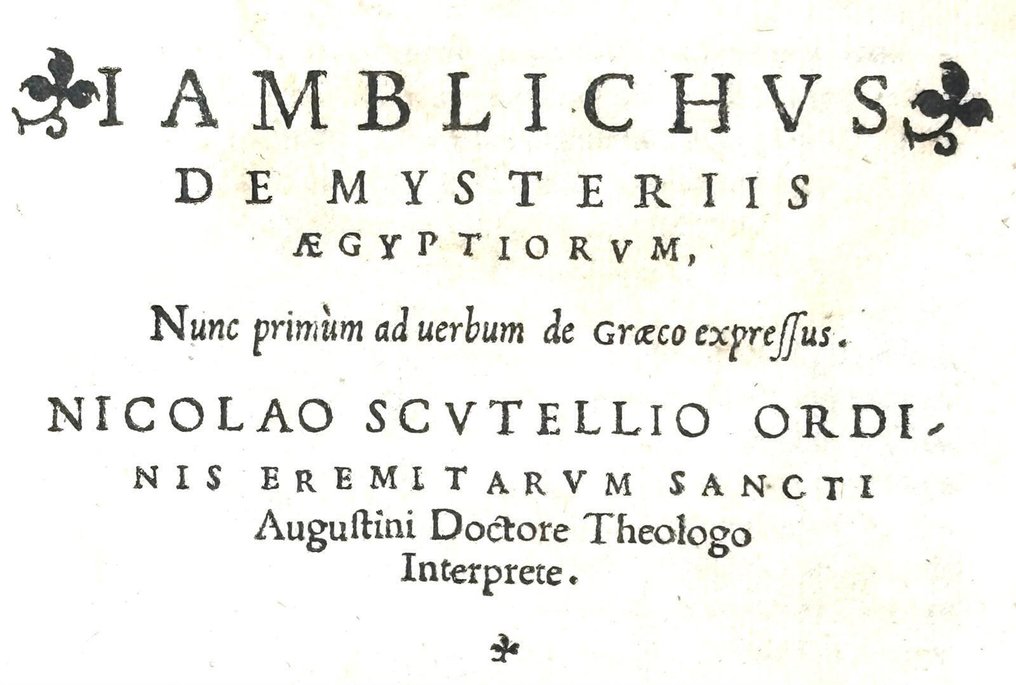
Iamblichus
On the Mysteries of the Egyptians
Latin translation of Nicolao Scutellio (Niccolò Scutelli, OESA)
In Rome, at Antonius Bladus, the Supreme Pontiff's Exchequer, 1556 (MDLVI)
Published by Vincentius Luchrinus with the privilege of the Supreme Pontiff
The input is a dash character, which does not require translation.
I. The work and its philosophical aura
The De Mysteriis Aegyptiorum is one of the most enigmatic and influential texts of late Neoplatonism, attributed to Iamblichus of Chalcis (3rd–4th centuries AD). A key work for understanding theurgy, mystery religion, late antique Hermetism, and the relationship between philosophy and ritual, the text presents itself as a defense of Egyptian sacred practices against the more rigid Neoplatonic rationalism.
It is the masterpiece in which Giamblico presents:
the doctrine of the intermediary demons
the hierarchical structure of the universe
the ritual value of symbols
the function of the Egyptian gods
The concept of the soul's 'return' to the divine.
Throughout the Renaissance, De Mysteriis was regarded as an essential key to understanding the ancient Egyptian wisdom and the occult roots of Platonic philosophy. Its influence is immense and involves humanists, theologians, magicians, philologists, and hermetists.
The input is a dash character, which does not require translation.
II. The Roman edition of 1556: a monument of the philosophical Renaissance
This edition, printed in Rome by Antonio Blado, official printer of the Pontiff, represents one of the most authoritative and sought-after Latin translations of the 16th century, endowed with papal privilege and financed by the bookseller Vincentius Luchrinus.
By importance
It is one of the earliest 'ad verbum de Graeco' translations, as proclaimed on the title page, and aimed to render the text with extraordinary fidelity to the Greek.
It is the first Roman edition and one of the most beautifully designed typographically.
It is a cornerstone of Renaissance esoteric philosophy and the relations between Christianity and Neoplatonism.
The input is a dash character, which does not require translation.
III. The translator: Nicolao Scutellio, O.E.S.A.
Niccolò Scutelli (Scutellius), belonging to the Order of the Hermits of Saint Augustine and Doctor Theologus, was an educated figure sensitive to the hermetic and philosophical currents of the time.
His work is distinguished by:
philological rigor
adherence to the Greek text
exegetical clarity
doctrinal punctuality
He also adds a section dedicated to the life and the sect of Pythagoras to the volume, compiled directly from Iamblichus, which enriches the work with an additional piece of the ancient tradition.
This addition makes the book doubly valuable for scholars of Renaissance Platonism.
The input is a dash character, which does not require translation.
IV. The printer: Antonio Blado, the Pope's printer
Antonio Blado (Bladus) was the illustrious papal typographer active between 1530 and 1567, celebrated for:
the elegance of the types
the cleaning of the editorial layout
The skillful use of sober and solemn frontispieces.
the quality of the paper and ink
the highest reputation with the Roman Curia.
Blado fu, also, a printer of official Vatican documents and the most daring humanistic works of post-Tridentine Rome.
The frontispiece is embellished with two engraved coats of arms (most probably related to the patrons or protectors of the edition) and an elegant central typographic motif.
The input is a dash character, which does not require translation.
V. Content of the work
The edition includes:
On the Mysteries of the Egyptians
The fundamental text in which Iamblichus
defends the theurgy
Justify the use of symbols and rites.
Explain the communication with the intermediary gods.
Develop the metaphysics of light.
Delineates the relationship between the soul and the universe.
Interprets Egyptian religion as a path to the divine.
2. Adjectives of life & the sect of Pythagoras…
A valuable addition on the life and the Pythagorean school, added by Scutelli, based on Giamblichus' materials.
Doctrinal framework
Brief notes and additions by the publisher, with attention to the harmony between ancient doctrine and Christian orthodoxy, a crucial theme in Rome of the 16th century.
The input is a dash character, which does not require translation.
VI. Historical-cultural significance.
The 1556 edition is set in the heart of the Roman Renaissance, when philosophers, cardinals, and humanists – from Ficino to Pico, from Patrizi to Steuco – sought to recover the foundations of 'prisca theologia'.
De Mysteriis was then considered:
a revealing text of ancient Egyptian theology
A point of contact between pagan philosophy and Christian revelation.
a primary source of natural magic
A guide to religious symbolism.
The climate of the time, between hermeticism, Platonism, and the Counter-Reformation, makes this work a document of extraordinary spiritual complexity.
The input is a dash character, which does not require translation.
VII. Recipients and influences
This edition influenced.
Augustinian theology
Aristotelian-Platonic philosophy
scholars of ancient Egyptian history
esoterists
Astronomers and 'magical naturalists'.
Librarians and collectors of rare texts.
Although published with papal privilege, the nature of the text—imbued with ancient cults and theurgy—made it a subject of interest even among more reserved intellectual circles.
The volume appears in inventories of noble and conventual libraries from the 16th and 17th centuries, and is often cited by authors such as Francesco Patrizi, Athanasius Kircher, and Giordano Bruno (who uses several concepts from it in his magico-ritual cosmology).
The input is a dash character, which does not require translation.
VIII. Conclusion
This 1556 edition of De Mysteriis Aegyptiorum by Giamblico, printed in Rome by Antonio Blado and translated by the learned Augustinian Scutelli, is a masterpiece of humanistic publishing and a monument of esoteric philosophy of the Renaissance.
A work of rare typographic elegance, rich in intellectual authority and imbued with an aura of mystery that spans the centuries, it represents an essential piece for:
the bibliophile
the history of philosophy
the interpreter of Neoplatonism
and the scholar of late antique initiatory traditions.
A book that, even today, retains its ability to evoke distant worlds where wisdom, myth, and ritual intertwine within the highest tradition of ancient and Renaissance thought.
The input is a separator line with dashes, which does not require translation.
Pythagoras' Life Collected from Iamblichus.
Edited by Nicolao Scutellio, O.E.S.A.
In Rome, Vincentius Luchrinus printed, 1556.
This rare fifteenth-century edition offers the life of Pythagoras according to the Neoplatonic tradition, collected by Niccolò Scutelli, a Trentino Augustinian scholar, who drew it directly from the writings of Iamblichus, one of the most influential late antique philosophers.
Printed in 1556 in Rome by the bookseller-publisher Vincentius Luchrinus, the work belongs to the same publishing enterprise as the famous De Mysteriis Aegyptiorum by the same Scutelli, and it constitutes a sort of ideal complement: a privileged window into ancient wisdom, Pythagorean ethos, the doctrine of numbers, inner discipline, and Hellenistic cosmism.
The frontispiece, adorned with an elegant woodcut typographic mark, is an expression of the high quality of Roman humanistic publishing in the early 1500s, suspended between philological rigor and esoteric charm.
A work of great interest to historians of philosophy, neoplatonism scholars, and Renaissance text collectors, the Vita Pythagorae is a valuable testimony to the revival of Pythagorean doctrines within the humanistic environment and their transmission in the context of post-Tridentine Catholic culture.
The input is a dash character, which does not require translation.
Collation and state of preservation
Opera 'Iamblichus De Mysteriis Aegyptiorum', 148 pages numbered, 8 pages unnumbered.
opera 'Pythagoras' life from Iamblichus' 68 pages numbered, 10 pages unnumbered
Excellent preservation state, beautiful contemporary binding from the 1500s.
Shipping terms and conditions
Shipping Terms and Conditions: The book will be carefully packaged to best protect it from any damage during transit. Shipping will be fast and insured, arriving within 24 business hours within the EU and within 72 business hours outside of the EU. Please note that for countries outside of the EU, any customs duties and costs will be borne by the buyer.
Elegitur presents exclusively.
Iamblichus
On the Mysteries of the Egyptians
Latin translation of Nicolao Scutellio (Niccolò Scutelli, OESA)
In Rome, at Antonius Bladus, the Supreme Pontiff's Exchequer, 1556 (MDLVI)
Published by Vincentius Luchrinus with the privilege of the Supreme Pontiff
The input is a dash character, which does not require translation.
I. The work and its philosophical aura
The De Mysteriis Aegyptiorum is one of the most enigmatic and influential texts of late Neoplatonism, attributed to Iamblichus of Chalcis (3rd–4th centuries AD). A key work for understanding theurgy, mystery religion, late antique Hermetism, and the relationship between philosophy and ritual, the text presents itself as a defense of Egyptian sacred practices against the more rigid Neoplatonic rationalism.
It is the masterpiece in which Giamblico presents:
the doctrine of the intermediary demons
the hierarchical structure of the universe
the ritual value of symbols
the function of the Egyptian gods
The concept of the soul's 'return' to the divine.
Throughout the Renaissance, De Mysteriis was regarded as an essential key to understanding the ancient Egyptian wisdom and the occult roots of Platonic philosophy. Its influence is immense and involves humanists, theologians, magicians, philologists, and hermetists.
The input is a dash character, which does not require translation.
II. The Roman edition of 1556: a monument of the philosophical Renaissance
This edition, printed in Rome by Antonio Blado, official printer of the Pontiff, represents one of the most authoritative and sought-after Latin translations of the 16th century, endowed with papal privilege and financed by the bookseller Vincentius Luchrinus.
By importance
It is one of the earliest 'ad verbum de Graeco' translations, as proclaimed on the title page, and aimed to render the text with extraordinary fidelity to the Greek.
It is the first Roman edition and one of the most beautifully designed typographically.
It is a cornerstone of Renaissance esoteric philosophy and the relations between Christianity and Neoplatonism.
The input is a dash character, which does not require translation.
III. The translator: Nicolao Scutellio, O.E.S.A.
Niccolò Scutelli (Scutellius), belonging to the Order of the Hermits of Saint Augustine and Doctor Theologus, was an educated figure sensitive to the hermetic and philosophical currents of the time.
His work is distinguished by:
philological rigor
adherence to the Greek text
exegetical clarity
doctrinal punctuality
He also adds a section dedicated to the life and the sect of Pythagoras to the volume, compiled directly from Iamblichus, which enriches the work with an additional piece of the ancient tradition.
This addition makes the book doubly valuable for scholars of Renaissance Platonism.
The input is a dash character, which does not require translation.
IV. The printer: Antonio Blado, the Pope's printer
Antonio Blado (Bladus) was the illustrious papal typographer active between 1530 and 1567, celebrated for:
the elegance of the types
the cleaning of the editorial layout
The skillful use of sober and solemn frontispieces.
the quality of the paper and ink
the highest reputation with the Roman Curia.
Blado fu, also, a printer of official Vatican documents and the most daring humanistic works of post-Tridentine Rome.
The frontispiece is embellished with two engraved coats of arms (most probably related to the patrons or protectors of the edition) and an elegant central typographic motif.
The input is a dash character, which does not require translation.
V. Content of the work
The edition includes:
On the Mysteries of the Egyptians
The fundamental text in which Iamblichus
defends the theurgy
Justify the use of symbols and rites.
Explain the communication with the intermediary gods.
Develop the metaphysics of light.
Delineates the relationship between the soul and the universe.
Interprets Egyptian religion as a path to the divine.
2. Adjectives of life & the sect of Pythagoras…
A valuable addition on the life and the Pythagorean school, added by Scutelli, based on Giamblichus' materials.
Doctrinal framework
Brief notes and additions by the publisher, with attention to the harmony between ancient doctrine and Christian orthodoxy, a crucial theme in Rome of the 16th century.
The input is a dash character, which does not require translation.
VI. Historical-cultural significance.
The 1556 edition is set in the heart of the Roman Renaissance, when philosophers, cardinals, and humanists – from Ficino to Pico, from Patrizi to Steuco – sought to recover the foundations of 'prisca theologia'.
De Mysteriis was then considered:
a revealing text of ancient Egyptian theology
A point of contact between pagan philosophy and Christian revelation.
a primary source of natural magic
A guide to religious symbolism.
The climate of the time, between hermeticism, Platonism, and the Counter-Reformation, makes this work a document of extraordinary spiritual complexity.
The input is a dash character, which does not require translation.
VII. Recipients and influences
This edition influenced.
Augustinian theology
Aristotelian-Platonic philosophy
scholars of ancient Egyptian history
esoterists
Astronomers and 'magical naturalists'.
Librarians and collectors of rare texts.
Although published with papal privilege, the nature of the text—imbued with ancient cults and theurgy—made it a subject of interest even among more reserved intellectual circles.
The volume appears in inventories of noble and conventual libraries from the 16th and 17th centuries, and is often cited by authors such as Francesco Patrizi, Athanasius Kircher, and Giordano Bruno (who uses several concepts from it in his magico-ritual cosmology).
The input is a dash character, which does not require translation.
VIII. Conclusion
This 1556 edition of De Mysteriis Aegyptiorum by Giamblico, printed in Rome by Antonio Blado and translated by the learned Augustinian Scutelli, is a masterpiece of humanistic publishing and a monument of esoteric philosophy of the Renaissance.
A work of rare typographic elegance, rich in intellectual authority and imbued with an aura of mystery that spans the centuries, it represents an essential piece for:
the bibliophile
the history of philosophy
the interpreter of Neoplatonism
and the scholar of late antique initiatory traditions.
A book that, even today, retains its ability to evoke distant worlds where wisdom, myth, and ritual intertwine within the highest tradition of ancient and Renaissance thought.
The input is a separator line with dashes, which does not require translation.
Pythagoras' Life Collected from Iamblichus.
Edited by Nicolao Scutellio, O.E.S.A.
In Rome, Vincentius Luchrinus printed, 1556.
This rare fifteenth-century edition offers the life of Pythagoras according to the Neoplatonic tradition, collected by Niccolò Scutelli, a Trentino Augustinian scholar, who drew it directly from the writings of Iamblichus, one of the most influential late antique philosophers.
Printed in 1556 in Rome by the bookseller-publisher Vincentius Luchrinus, the work belongs to the same publishing enterprise as the famous De Mysteriis Aegyptiorum by the same Scutelli, and it constitutes a sort of ideal complement: a privileged window into ancient wisdom, Pythagorean ethos, the doctrine of numbers, inner discipline, and Hellenistic cosmism.
The frontispiece, adorned with an elegant woodcut typographic mark, is an expression of the high quality of Roman humanistic publishing in the early 1500s, suspended between philological rigor and esoteric charm.
A work of great interest to historians of philosophy, neoplatonism scholars, and Renaissance text collectors, the Vita Pythagorae is a valuable testimony to the revival of Pythagorean doctrines within the humanistic environment and their transmission in the context of post-Tridentine Catholic culture.
The input is a dash character, which does not require translation.
Collation and state of preservation
Opera 'Iamblichus De Mysteriis Aegyptiorum', 148 pages numbered, 8 pages unnumbered.
opera 'Pythagoras' life from Iamblichus' 68 pages numbered, 10 pages unnumbered
Excellent preservation state, beautiful contemporary binding from the 1500s.
Shipping terms and conditions
Shipping Terms and Conditions: The book will be carefully packaged to best protect it from any damage during transit. Shipping will be fast and insured, arriving within 24 business hours within the EU and within 72 business hours outside of the EU. Please note that for countries outside of the EU, any customs duties and costs will be borne by the buyer.
Details
Number of Books
1
Subject
Esotericism, Incunabula & early printing
Book Title
(MAGIC AND WITCHCRAFT) Iamblichus De Mysteriis Aegyptiorum bound with Pytagorae vita ex Iamblicho
Author/ Illustrator
Iamblichus; Nicolaus Scutellio
Condition
Fine
Publication year oldest item
1556
Edition
1st Edition Thus
Language
Latin
Original language
No
Publisher
Antonius Bladus; Vincentij Luchrini
Binding/ Material
Vellum
Number of pages
160
