Frederick Lewis Norden - Travels in Egypt and Nubia - 1757




02
days
13
hours
26
minutes
39
seconds
Current bid
€ 270
Reserve price not met

Expert
Selected by Zena Chiara Masud
Holds a master’s degree in bibliography, with seven years of experience specialising in incunabula and Arabic manuscripts.
Estimate € 1,700 - € 2,000
21 other people are watching this object
 Bidder 7983 Bidder 7983 | €270 | |
|---|---|---|
 Bidder 9796 Bidder 9796 | €250 | |
| Bidder 5104 | €50 | |
Catawiki Buyer Protection
Your payment’s safe with us until you receive your object.View details
Trustpilot 4.4 | 121798 reviews
Rated Excellent on Trustpilot.
Travels in Egypt and Nubia by Frederick Lewis Norden, 1st edition in English, bound in leather, published in 1757.
AI-assisted summary
Description from the seller
The book is considered a milestone in the early scientific explorations of the area.
Frederick Lewis Norden
Travels in Egypt and Nubia
By
Frederick Lewis Norden, F.R.S.,
Captain of the Danish Navy
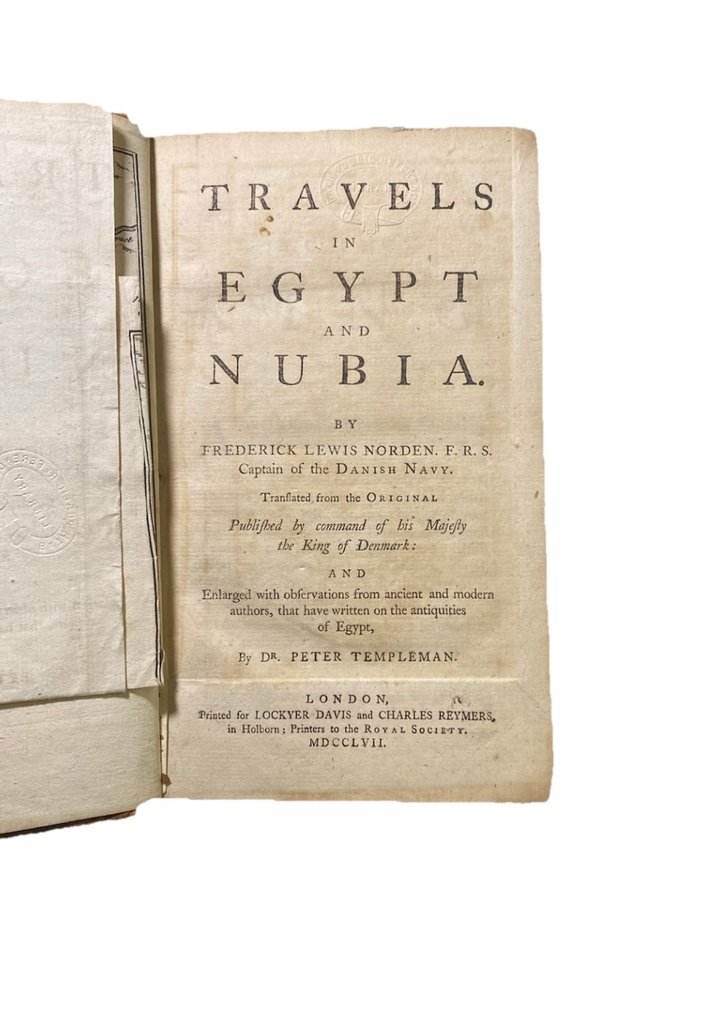
Translated from the original published by command of His Majesty the King of Denmark; and enlarged with observations from ancient and modern authors who have written on the antiquities of Egypt.
By Dr. Peter Templeman
London, printed for Lockyer Davis and Charles Reymers, in Holborn; printers to the Royal Society. 1757
Pp. XL, 154; 232, (6).
7 full-page plates outside the text, complete and collated.
Travels in Egypt and Nubia is one of the most important works dedicated to the exploration of Egypt in the 18th century. Published in London in 1757 by the printers Lockyer Davis and Charles Reymers, this volume presents the English translation of the original Danish work composed by Frederick Lewis Norden, a Danish navy captain, artist, and talented cartographer.
Norden was sent to Egypt by order of the King of Denmark with the goal of documenting monuments, populations, landscapes, and river routes. The result was a monumental work, one of the first to offer an accurate and systematic description of ancient Egypt when modern Egyptology did not yet exist. His plates, maps, and illustrations are considered fundamental for reconstructing the state of the monuments before the great 19th-century expeditions.
The edition is enriched by additions from Dr. Peter Templeman, who expands the text with observations drawn from ancient and modern sources, integrating Norden's information with historical, archaeological, and geographical comparisons, comments, and contrasts with ancient and modern sources, making the work one of the most comprehensive testimonies of 18th-century Egypt. The work includes detailed descriptions of cities, temples, villages along the Nile, local customs and traditions, as well as architectural surveys of the main sites of Pharaonic and Nubian Egypt.
The volume is also distinguished by the quality of the paper, printing, and the presence of the blind stamp visible on the title page, indicating that the copy belonged to a prominent public or institutional library. The title page is typical of 18th-century scientific editions: elegant, minimalist, and dominated by large, clean characters.
Considered a milestone of the early European explorations in Egypt, Travels in Egypt and Nubia is today a highly sought-after book among collectors and scholars. The combination of historical value, iconographic enrichment, and direct testimony of the monuments before modern alterations makes it one of the most important texts in eighteenth-century travel literature dedicated to the Orient and ancient Egypt.
The book is considered a milestone in the early scientific explorations of the area and remains highly sought after by scholars and collectors.
The book is considered a milestone in the early scientific explorations of the area.
Frederick Lewis Norden
Travels in Egypt and Nubia
By
Frederick Lewis Norden, F.R.S.,
Captain of the Danish Navy
Translated from the original published by command of His Majesty the King of Denmark; and enlarged with observations from ancient and modern authors who have written on the antiquities of Egypt.
By Dr. Peter Templeman
London, printed for Lockyer Davis and Charles Reymers, in Holborn; printers to the Royal Society. 1757
Pp. XL, 154; 232, (6).
7 full-page plates outside the text, complete and collated.
Travels in Egypt and Nubia is one of the most important works dedicated to the exploration of Egypt in the 18th century. Published in London in 1757 by the printers Lockyer Davis and Charles Reymers, this volume presents the English translation of the original Danish work composed by Frederick Lewis Norden, a Danish navy captain, artist, and talented cartographer.
Norden was sent to Egypt by order of the King of Denmark with the goal of documenting monuments, populations, landscapes, and river routes. The result was a monumental work, one of the first to offer an accurate and systematic description of ancient Egypt when modern Egyptology did not yet exist. His plates, maps, and illustrations are considered fundamental for reconstructing the state of the monuments before the great 19th-century expeditions.
The edition is enriched by additions from Dr. Peter Templeman, who expands the text with observations drawn from ancient and modern sources, integrating Norden's information with historical, archaeological, and geographical comparisons, comments, and contrasts with ancient and modern sources, making the work one of the most comprehensive testimonies of 18th-century Egypt. The work includes detailed descriptions of cities, temples, villages along the Nile, local customs and traditions, as well as architectural surveys of the main sites of Pharaonic and Nubian Egypt.
The volume is also distinguished by the quality of the paper, printing, and the presence of the blind stamp visible on the title page, indicating that the copy belonged to a prominent public or institutional library. The title page is typical of 18th-century scientific editions: elegant, minimalist, and dominated by large, clean characters.
Considered a milestone of the early European explorations in Egypt, Travels in Egypt and Nubia is today a highly sought-after book among collectors and scholars. The combination of historical value, iconographic enrichment, and direct testimony of the monuments before modern alterations makes it one of the most important texts in eighteenth-century travel literature dedicated to the Orient and ancient Egypt.
The book is considered a milestone in the early scientific explorations of the area and remains highly sought after by scholars and collectors.
Details
Number of Books
1
Culture
Ancient Egyptian
Subject
Archaeology, History, Reference, Travels
Book Title
Travels in Egypt and Nubia
Author/ Illustrator
Frederick Lewis Norden
Condition
Very good
Publication year oldest item
1757
Height
20.6 cm
Edition
1st Edition
Width
13.1 cm
Language
English
Original language
Yes
Publisher
Lockyer Davis and Charles Reymers
Binding/ Material
Leather
Extras
Fold out maps or plates, Tipped in plates
Number of pages
380
Sold by
